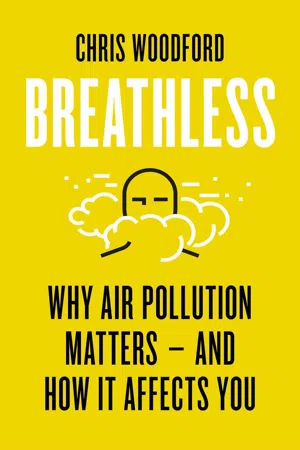
An accessible and hard-hitting look at the facts behind air pollution in everyday life.
Take a deep breath. You'll do it 20,000 times a day. You assume all this air is clean; it's the very breath of life.
But in Delhi, the toxic smog is as bad for you as smoking 50 cigarettes a day. Even a few days in Paris, London or Rome is equivalent to two or three cigarettes. Air pollution is implicated in six of the top ten causes of death worldwide, including lung cancer, heart disease, stroke, and dementia. Breathless gives us clear facts about air pollution in our everyday lives, showing how it affects our bodies, how much of it occurs in unexpected places (indoors, inside your car), and how you can minimise the risks.
Rooted in the latest science, including real-time air-quality experiments in city streets and ordinary homes, it will allow you to make up your own mind about the risks and trade-offs of modern living - wherever in the world you are.
- 368 pages
- English
- ePUB (mobile friendly)
- Available on iOS & Android
eBook - ePub
About this book
Trusted by 375,005 students
Access to over 1.5 million titles for a fair monthly price.
Study more efficiently using our study tools.
Information
CHAPTER 1
What’s your poison?
A closer look at the air you’re breathing
The world’s most poisonous substance, botulinum toxin, is so deadly that a mere ten-millionth of a gram would be enough to kill you. Is it hyperbole, then, to call air pollution a poison? It certainly sounds mischievous, even misleading, to talk about dirty air the way we’d refer to cloudy brown bottles, branded with a red skull and crossbones, locked in the back room of a Dickensian apothecary’s store. But it isn’t misleading at all. Poison is a substance that kills or harms you when enough of it enters your body; air pollution has the same effect, albeit more slowly, more cruelly and less obviously. Poisoned by pollution, your death won’t take seconds or minutes, but years or even decades; chances are, you won’t even notice you’re being poisoned. But millions of people will die early this way, this year and every year for the foreseeable future thanks to the long-term effects of breathing poisoned, polluted air.[1]
Seven to ten million early deaths might not sound many in a world of nearly eight billion. It’s about one person in a thousand, which sounds even less impressive. But poison doesn’t simply kill. For every person who eventually dies from the chronic effects of dirty air, many more suffer pained and stunted lives. Living or dead, many are victims of seemingly unconnected medical problems like heart disease, stroke, dementia, diabetes and mental illnesses that are, in fact, increasingly correlated with pollution. According to the World Health Organization, air pollution causes a quarter of all deaths from heart disease, a quarter of those from stroke, over 40 per cent of those from chronic obstructive pulmonary disease (COPD1) and almost a third of those from lung cancer. Some 90 per cent of us – 6.9 billion people – breathe polluted air, indoors or out, and will have anything from a few months to a few years shaved off our lives as a result. If you’re 23 at the moment, whether you’re going to live to the age of 85 or 87 might seem remote and academic; if you’ve reached 75 already, and the damage of living in a choking city is already done, it might give you more pause for thought. Back in 1752 in Britain, so the famous story goes, people rioted over the eleven notional days of life they thought they were going to lose when the calendar switched from Julian to Gregorian. A quarter of a millennium later, no one’s protesting that much about the months and years of life that pollution really does steal away.[2]
Even knowing all of this, it can be hard to accept dirty air as a poison. The case against air pollution feels tenuous and circumstantial: it’s almost impossible to point to certain victims – or, as scientists enjoy noting, no one’s death certificate quotes ‘air pollution’ as the cause. Perhaps that’s because ‘air pollution’ itself feels like an oxymoron; instinctively, we harbour the notion that, in a more ideal world, we might all be breathing naturally clean air. As we’ll see in later chapters, that idea is wrong-headed in three quite different ways. First, even ‘natural’ air can fall foul of a simple definition of pollution. From billowing volcanic plumes to aromatic pine trees and wild (bush) fires sparked by lightning strikes, there are plenty of examples of natural air pollution that have nothing to do with humans. Second, it’s hard to conceive of a world with completely unpolluted air and there’s little prospect of achieving it any time soon. Virtually every step forward in human civilisation to date, from the use of fire to (as we’ll see later) the silent sweep of electric cars, has involved making copious amounts of pollution. Humans are essentially – not accidentally – polluters, and perhaps they always will be. Third, we often pollute in well-meaning ways: whether you like it or not, you’ll make air pollution building a school, driving an ambulance, putting out a fire or baking birthday cakes for your daughter. It’s hard to see innocuous things like this as ‘poisoning people’.
According to one authoritative definition, ‘poisons can be swallowed, absorbed through the skin, injected, inhaled or splashed into the eyes’; just like a poison, air pollution can be absorbed through the skin and harm your eyes, as well as being breathed in.2 In other respects, pollution has a different modus operandi from poison. Poisons startle us because they’re so dramatic and rare; air pollution, by contrast, seems humdrum and ubiquitous. While it’s tempting to focus on its worst victims (those multi-million deaths a year), it’s important to remember that they’re just the tip of the iceberg. Out of sight are $225 billion worth of lost work days, endless gasps from the asthma inhaler, countless trips to hospital or visits to the doctor and many more subtle problems that medics refer to as ‘subclinical effects’ (irritating health niggles not worth bothering the doctor about). But while the effects of air pollution are spread through all humanity, they affect some much more than others. Poor people, ethnic minorities, the elderly, children in schools near busy roads, people living in developing countries, those with chronic medical conditions, even the unborn – all these are among the hardest hit. (We’ll explore the medical aspects of air pollution in detail in Chapter 8.)[4]
Why does air even matter?
If you live a busy modern urban life, stressed by the school run or the hurtling charge of the commute, you might have explored things like meditation and mindfulness as a calming form of escape. One of the fascinatingly counter-intuitive things about meditation is the way it forces you to focus on something you normally ignore: your breathing. In one common technique, you visualise the air flowing in and out of your nose until your mind slips its chains and you float away on a magic carpet of altered consciousness. Air, in that moment of transition, in the short-haul flight from stress to calm, is all that matters. But why, in the bigger scheme of things, does air matter? Why is there even air on our planet at all?
Everything on Earth is pulled in by its gravity – even the blanket of gas we call the atmosphere – and it’s hard for us to visualise and understand the implications of this. Earth’s entire atmosphere is about 600 kilometres or 370 miles thick (about 1,500 times taller than the Empire State Building). But the bit that really interests us – the troposphere – is the 18 kilometres (11 miles) or so closest to the ground (50 times the height of that skyscraper). This is the home of weather, what we generally regard as ‘air’, and therefore air pollution. If you swim, snorkel or scuba dive, even if you merely duck down in your local pool, you’ll be well aware of water pressure: the deeper you go, the more water there is above you and the harder it pushes down on you. Exactly the same logic applies to the gas that surrounds Earth. But, although we’re tacitly familiar with the abstract idea of air pressure from weather forecasts, the practical reality of living in a compressed molecular soup, under 600 kilometres of air – like fish in the ocean, but forced to clump around on the seabed – somehow eludes us.
Air is something we can neither see nor feel (unless it whips past us quickly), but the gases it contains drive almost all life, all the same. Plants powered by sunlight photosynthesise, mopping up carbon dioxide and ‘breathing’ out oxygen; animals, nibbling on those plants and on one another, do (broadly) the reverse in a process biologists call respiration. If you’re any kind of scientist, or merely curious, this prompts some fascinating questions. If, as we learn at school, air is about 80 per cent nitrogen and 20 per cent oxygen, why is it the oxygen our bodies use and not the nitrogen? Are there credible creatures that exist, anywhere on Earth, that don’t breathe oxygen? And if pollution is such a problem, and has existed for at least a million years, why haven’t our bodies evolved to dodge around it?
The answers are fascinating, too. Oxygen is the most useful chemical in the atmosphere – more generally reactive than nitrogen and better for liberating energy – and evolution has tapped into this. Our bodies can easily make energy from food with chemical reactions involving oxygen, whereas using nitrogen (or another gas, like hydrogen) is trickier and sometimes even energy-intensive. (Think of plants, which depend on lightning strikes to convert tightly bonded nitrogen in the air into a ‘food’ they can take up from the soil.) Even so, a few creatures do rely on oxygen less than we do, including snakelike giant tube worms, some 2.4 metres (almost 8 feet) long, that thrive in the bubbling jacuzzi of hydrothermal vents in the ocean floor, breathing hydrogen sulphide (the chemical smell we know as rotten eggs). And there are microscopic blobs called loriciferans that live at the bottom of the Mediterranean Sea, which can survive without any oxygen at all. It’s no coincidence that creatures like this dwell on the seabed; landlubbers, given the choice, will pick oxygen every time. As to why we haven’t adapted to survive pollution, we simply haven’t had time. Human evolutionary changes take millions of years, while the real problem caused by fire – dangerously concentrated urban pollution – dates back only a couple of thousand years. As we’ll see during this book, pollution itself is also constantly evolving: the often-invisible, 21st-century kind is very different from the in-your-face filth that people breathed in centuries gone by.[5]
Perfect air in a perfect world
If we could subtract humans from the picture altogether, what would theoretically perfect, unpolluted air actually look like?
Just as we learn at school, dry air is almost entirely made of two gases, nitrogen (78 per cent) and oxygen (21 per cent). Most of the rest is argon (one of those mysterious ‘noble’ gases that doesn’t do much at all) and there’s a dash of carbon dioxide. There are also tiny (trace) amounts of gases such as helium in Earth’s atmosphere (60 times less than carbon dioxide) and flammable hydrogen (10 times less again).
Suppose you took a volume of air the size of a modest bedroom (about 25 cubic metres or 33 cubic yards). Nitrogen would fill all but a layer 50 centimetres (20 inches) or so thick, which would be the oxygen. Argon would line roughly the bottom 2.5 centimetres (1 inch), and the carbon dioxide would fit in five milk bottles in the corner. Now this is a slightly misleading picture, since 70 per cent of our planet is covered by water and the air isn’t, in fact, dry at all. But even adding in water vapour doesn’t change things that much. The other gases politely shift up to make room: adding about 3 per cent water vapour to the air (a typical amount) dials down the nitrogen content (to about 75 per cent), the oxygen content somewhat less (to 20 per cent) and the other gases less still.[6]
One way to appreciate the idea of a ‘perfect’ Earth atmosphere is to contemplate the atmospheres of other planets. All the speculation about aliens nipping down to Earth in flying saucers overlooks a fundamental problem with interpla...
Table of contents
- Title Page
- Contents
- Introduction
- CHAPTER 1: What’s your poison?
- CHAPTER 2: Around the world
- CHAPTER 3: Caesar’s dying breath
- CHAPTER 4: Natural born polluters?
- CHAPTER 5: Going places?
- CHAPTER 6: Made in China?
- CHAPTER 7: Safe indoors?
- CHAPTER 8: Killing us softly
- CHAPTER 9: Down to Earth
- CHAPTER 10: Scrubbing up
- CHAPTER 11: People power
- Coming clean
- Acknowledgements
- References
- Copyright
Frequently asked questions
Yes, you can cancel anytime from the Subscription tab in your account settings on the Perlego website. Your subscription will stay active until the end of your current billing period. Learn how to cancel your subscription
No, books cannot be downloaded as external files, such as PDFs, for use outside of Perlego. However, you can download books within the Perlego app for offline reading on mobile or tablet. Learn how to download books offline
We are an online textbook subscription service, where you can get access to an entire online library for less than the price of a single book per month. With over 1.5 million books across 990+ topics, we’ve got you covered! Learn about our mission
Look out for the read-aloud symbol on your next book to see if you can listen to it. The read-aloud tool reads text aloud for you, highlighting the text as it is being read. You can pause it, speed it up and slow it down. Learn more about Read Aloud
Yes! You can use the Perlego app on both iOS and Android devices to read anytime, anywhere — even offline. Perfect for commutes or when you’re on the go.
Please note we cannot support devices running on iOS 13 and Android 7 or earlier. Learn more about using the app
Please note we cannot support devices running on iOS 13 and Android 7 or earlier. Learn more about using the app
Yes, you can access Breathless by Chris Woodford in PDF and/or ePUB format, as well as other popular books in Biological Sciences & Science General. We have over 1.5 million books available in our catalogue for you to explore.