'In Clive, we have an ever-fascinating guide to Britain's heathery districts, not only marvelling at the wildlife of such wild places, but also celebrating their diverse origins, uses and cultural resonances' - Andrew Byfield
Heathlands are so much more than simply purple carpets of heather. They are ancient landscapes found throughout Britain that support a complex of inter-related species and an immense diversity of habitats. They also possess a unique human history defined by the struggle between pastoralism and the competing demands of those who seek exclusive use of the land.
In this latest addition to the British Wildlife Collection, Clive Chatters introduces us to Britain's heathlands and their anatomy. He then takes the reader on a geographical heathland tour – from the maritime sub-arctic of the Shetlands to the mild wetness of the Atlantic coast – with an in memoriam nod to those heaths that have been erased from common memory and understanding. He concludes with a review of how people have perceived and used heathland wildlife over the ages, and sets out a future vision for this iconic landscape, its unique habitats and the species that live there.
Most of our heaths are pale shadows of their former selves. However, Chatters argues, it is not inevitable that the catastrophic losses of the recent past are the destiny of our remaining heaths. Should we wish, their place in the countryside as an integral part of British culture can be secured.
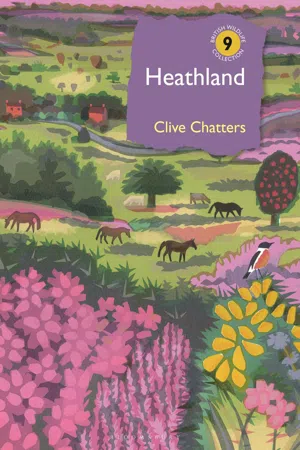
- 432 pages
- English
- ePUB (mobile friendly)
- Available on iOS & Android
eBook - ePub
Heathland
About this book
Trusted by 375,005 students
Access to over 1 million titles for a fair monthly price.
Study more efficiently using our study tools.
Information
Part One
An introduction to heathland

Coastal heath at Bryher, Isles of Scilly.
chapter one
British heathlands
Heathlands defy ready definition. The diverse places that we call heaths are cultural landscapes overlain with the language of ecology. It is unnecessary to reconcile these different perspectives, as both offer a path to understanding what makes our heathlands special.
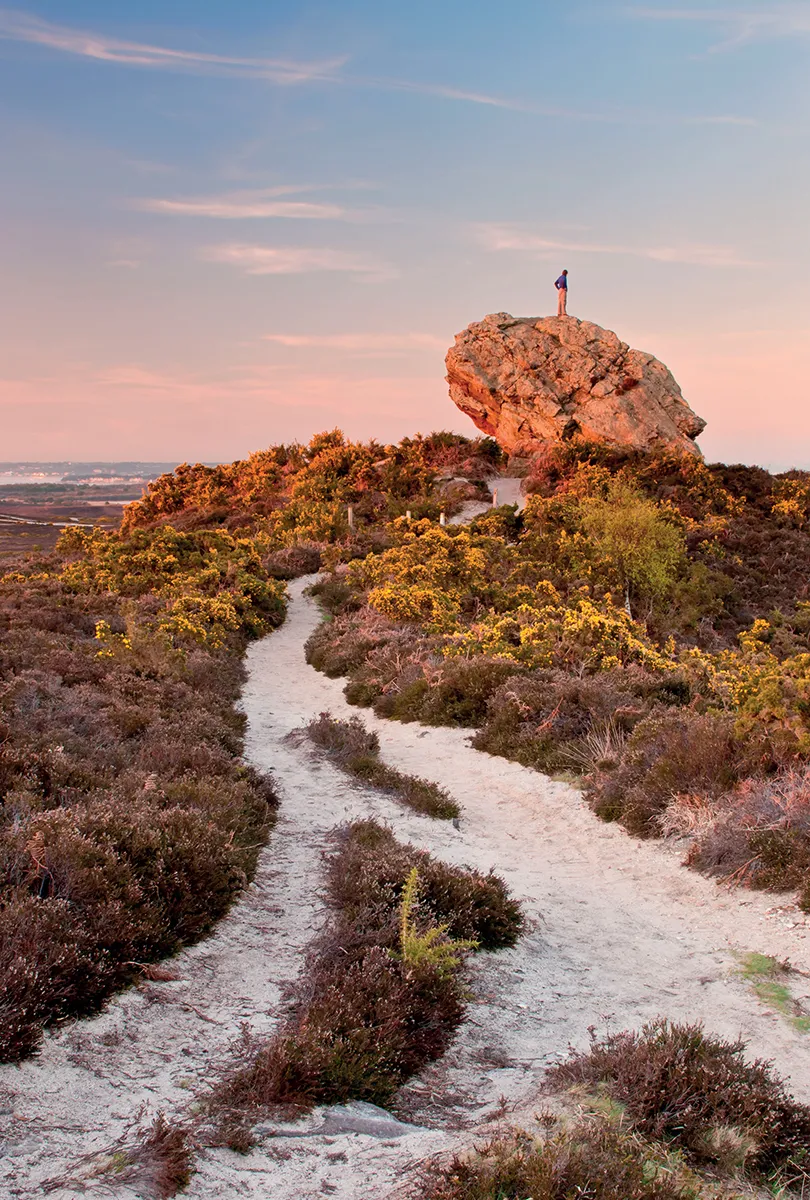
The Aglestone, Purbeck Heaths, Dorset.
Heathlands are one of a handful of British landscapes that have been recognised by English-speaking people for as long as we have had a written history. Legal documents and literary works have made frequent references to heaths for over a millennium, without needing to define what was an everyday feature of the countryside. Barely a century has passed since scientists first sought to classify what they meant by heathland; sadly, many of the places that these early ecologists were describing had already been depleted of much of their diversity and wonder. This accident of history means that any review of Britain’s heaths needs to navigate through scientific descriptions that sometimes relegate heathland habitats to being little more than accumulations of heather. This book seeks to challenge those narrow definitions and to promote an understanding of heathland that would be familiar to our forebears, as well as respecting the experience of modern people whose livelihoods are bound up with the heath.
Throughout history, the land of Britain has been divided amongst a powerful elite. Heathlands represent a residue of what was left behind as more valuable tracts of countryside were exploited to the full. There have always been people who have depended on this landscape of leftovers; and many have suffered through being deprived of their heathland heritage whilst other communities have fought to retain their rights to its resources. The human history of heathland can be read as a struggle between communities reliant on pastoralism and the competing demands of those who seek exclusive use of the land. The natural history of heathland reaches back into evolutionary time, far before the emergence of modern humans. The habitats and species of heathland landscapes are natural, whilst their current character is a manifestation of how people have modified the landscape.
What are heathlands?
Heathlands are landscapes that are associated with pastoral economies – most of Britain’s heaths are fragments of habitats derived from such places.
The habitats of heathland are associated with soils that are relatively base-poor and low in nutrients. Typical heathland vegetation has a prominent dwarf-shrub element, mostly comprising members of the heather family. These dwarf shrubs are found within matrices of bare ground and grassland, which in turn support herbaceous and annual flowering plants. Within these characteristic associations there is scope for other forms of vegetation to become dominant, including those composed of lichen, bryophytes and ferns. These shorter elements of a heath may be set within gladed thorn-scrub and forest trees, whilst elsewhere those same woody species grow as groves on an open plain. The location and relative proportion of each of these elements is not fixed in time; heathlands are naturally in a continuous state of change.
Where are heathlands found?
The nations of Scotland, Wales and England are part of an archipelago that lies off the western coast of Eurasia. The latitude of inhabited islands ranges from 60.7° in the north to 49.8° in the south. This breadth of latitude, combined with the presence of continental and oceanic influences, supports the development of habitats under highly diverse climatic conditions. Heathlands can be found throughout this range, including in the uplands – but uplands fall outside the remit of this book. The distinction of lowlands from uplands is far from clear-cut, as definitions that rely on altitude cannot be consistently applied across the whole country. In A Nature Conservation Review, Derek Ratcliffe devised an approach that drew on the practical realities of how people respond to their environment. Under Ratcliffe’s definition, a lowland landscape is a place where people live and farm throughout the year; I have followed this pragmatic approach.
Britain’s heathlands can be viewed as part of a global continuum of habitats that fall within distinct climatic zones. In the Northern Isles and in the north-east of mainland Scotland there are heathland communities that exhibit affinities with maritime subarctic and boreal conditions; these communities can be found in both the uplands and the lowlands. The presence of the Atlantic Ocean is effective in moderating the extremes of climate at these high latitudes, so winters in the north of Scotland are much warmer and wetter than those experienced at the same latitudes in the continental landmasses of Siberia and central Canada. Maritime conditions, with their associated freedom from severe frosts, prevail throughout Britain’s Atlantic seaboard and are reflected in the presence of oceanic heathlands from Shetland to the Isles of Scilly.
Oceanic influences moderate the climate of the extreme south-west of Britain to generate almost frost-free winters followed by warm but moist summers, which are conditions associated with heathland species characteristic of the Mediterranean and Lusitanian parts of southern Europe. As the influence of the ocean decreases in the south and east, so the summers become warmer and dryer. In these parts of the country the climate is still relatively humid and mostly free from harsh winters – circumstances that support the development of Atlantic and sub-Atlantic heaths. In a global context, Britain is particularly important for the scale and diversity of these oceanic and Atlantic heaths (Farrell 1989). The influence of the Atlantic is not universal, as Britain lies sufficiently close to the European mainland for elements of its continental climate to be detectable in eastern England and the English Midlands; the cold winters and parched summers of these regions share similarities with the heaths of Europe’s central plain.

Oceanic heaths in Assynt, Sutherland.
For most of Britain’s history there were heathlands to be found throughout the lowlands, with their distribution and character being determined by environmental factors such as climate, geology and soil type. Heathlands lost their natural position in our landscape following the intensification of mechanised agriculture and the easy availability of inexpensive fertilisers. Today, where heathlands survive, their character is determined by a combination of environmental factors and the history of how people have used the land.
Where do heathlands come from?
Tens of millions of years ago
The genesis of Britain’s heathlands is obscured by time and a paucity of hard evidence. There are a handful of sites were plant subfossils have survived recent glaciations, such as in the ball clays of Bovey Tracey on the southern flank of Dartmoor (Devon). Thirty million years ago, what is now Bovey Heathfield was an alluvial plain into which numerous small rivers flowed. Over aeons the neighbouring hills were weathered away, their detritus eventually washing out onto the plain by way of small deltas. The passage of time has compressed these deposits into bands of clay that are interspersed with layers of lignite – a low-grade coal composed of plant remains. In the early 1860s Oswald Heer, the Director of Zürich’s Botanical Gardens, worked these deposits and described a surprisingly familiar flora. Heer recovered remains of Creeping Willow Salix repens and Scots Pine Pinus sylvestris alongside now extinct members of the heather family, including relatives of Bog Rosemary Andromeda sp. and Bilberry Vaccinium sp. Later investigations from the same site, reported by Chandler (1957), identified more heathland species, including relatives of Bog Myrtle Myrica sp. and Royal Fern Osmunda sp. From these, and other subfossils, we know that recognisable components of heathland habitats were evolving at the same time as large herbivorous mammals were becoming dominant over much of what is now north-west Europe.

Royal Fern Osmunda regalis, exhibiting its fire-tolerant qualities. Retire Common, Cornwall.
Millions of years ago
Tens of millions of years later, more plant fragments were laid down in deposits of the Norwich Crag formation near Ludham in Norfolk. The Ludham flora grew in a cool but temperate climate, around two million years ago. Richard West’s paper of 1961 draws on these fragments to describe a partially wooded landscape with glades of oceanic heath comprising Heather Calluna vulgaris, a Crowberry Empetrum sp. and clubmosses Lycopodiaceae. The flora and habitats would be recognisable today, albeit the tree cover was a mixture of Oaks Quercus spp. and a Hazel Corylus sp. growing amongst conifers including a Spruce Picea sp. and a Hemlock Tsuga sp. To the...
Table of contents
- Cover
- Title Page
- Dedication
- Contents
- Foreword
- Part One: An introduction to heathland
- Part Two: A selection of British heaths
- Part Three: Perceptions
- eCopyright
Frequently asked questions
Yes, you can cancel anytime from the Subscription tab in your account settings on the Perlego website. Your subscription will stay active until the end of your current billing period. Learn how to cancel your subscription
No, books cannot be downloaded as external files, such as PDFs, for use outside of Perlego. However, you can download books within the Perlego app for offline reading on mobile or tablet. Learn how to download books offline
Perlego offers two plans: Essential and Complete
- Essential is ideal for learners and professionals who enjoy exploring a wide range of subjects. Access the Essential Library with 800,000+ trusted titles and best-sellers across business, personal growth, and the humanities. Includes unlimited reading time and Standard Read Aloud voice.
- Complete: Perfect for advanced learners and researchers needing full, unrestricted access. Unlock 1.4M+ books across hundreds of subjects, including academic and specialized titles. The Complete Plan also includes advanced features like Premium Read Aloud and Research Assistant.
We are an online textbook subscription service, where you can get access to an entire online library for less than the price of a single book per month. With over 1 million books across 990+ topics, we’ve got you covered! Learn about our mission
Look out for the read-aloud symbol on your next book to see if you can listen to it. The read-aloud tool reads text aloud for you, highlighting the text as it is being read. You can pause it, speed it up and slow it down. Learn more about Read Aloud
Yes! You can use the Perlego app on both iOS and Android devices to read anytime, anywhere — even offline. Perfect for commutes or when you’re on the go.
Please note we cannot support devices running on iOS 13 and Android 7 or earlier. Learn more about using the app
Please note we cannot support devices running on iOS 13 and Android 7 or earlier. Learn more about using the app
Yes, you can access Heathland by Clive Chatters in PDF and/or ePUB format, as well as other popular books in Biological Sciences & Botany. We have over one million books available in our catalogue for you to explore.