eBook - ePub
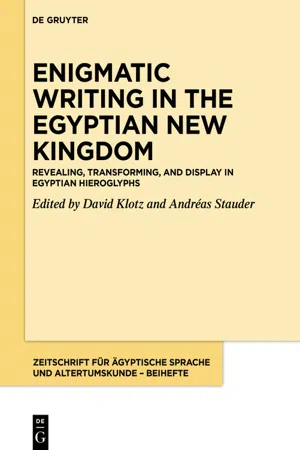
Revealing, transforming, and display in Egyptian hieroglyphs
- 272 pages
- English
- ePUB (mobile friendly)
- Available on iOS & Android
eBook - ePub
Revealing, transforming, and display in Egyptian hieroglyphs
About this book
This is the first synthesis on Egyptian enigmatic writing (also referred to as "cryptography") in the New Kingdom (c.1550–1070 BCE). Enigmatic writing is an extended practice of Egyptian hieroglyphic writing, set against immediate decoding and towards revealing additional levels of meaning. This first volume consists of studies by the main specialists in the field. The second volume is a lexicon of all attested enigmatic signs and values.
Information
Andréas Stauder
The Visual Otherness of the Enigmatic Text in Some Netherworld Books of the New Kingdom
In the following I discuss the enigmatic text for its visual dimensions and for the particular reading experience it induces. I focus on one specific tradition of enigmatic writing in one corpus among the so-called Netherworld Books, the Books of the Solar-Osirian Unity (henceforth: BSOU), inscribed on the Second Shrine of Tutankhamun, on the Ceiling of Corridor G of the Tomb of Ramses VI, and on the Enigmatic Wall in the Tomb of Ramses IX. 919 Unlike in other traditions of enigmatic writing in the New Kingdom, enigmatic writing in the Netherworld Books does not present a concentration of immediately highly iconic signs, and would therefore appear rather distinct. The setting is different too, in sealed-off funerary apartments rather than (in public spaces) in temples or displayed on private monuments and artifacts. Yet, as to be shown, the Netherworld Books, and particularly the BSOU, demonstrate some of the fundamental determinants and properties of the enigmatic text, in common to the various traditions and practices of enigmatic writing in the New Kingdom.
I first describe how writing is de-familiarized in the BSOU, commenting on the deconventionalization of spellings and the process of sign substitution. Moving beyond the individual signs and words, the main part of the discussion concerns the visual otherness of and patterns in the enigmatic text, and the delayed and dazzled reading that such alteration of writing brings about. In both cases, I begin with an analytic discussion to move to a more interactional approach of the text. I conclude by addressing the apparent paradox of a type of writing that is altered in both its visual dimension and its orientation on reading, yet inscribed in places in which there is no one to see it.
1 De-conventionalization and reduction
Writing in the Netherworld Books is de-familiarized thoroughly in what has been described as a two-step alteration process. 920 This is analyzed further here with a view on its implications on the visual surface of the enigmatic text and the delayed reading it induces.
In regular hieroglyphic writing, spellings of words consist of phonograms (uniliterals, biliterals, triliterals), logograms (including radicograms, signs standing for roots), and semantic determinatives (a.k.a. classifiers), variously combined. Spellings of any given word can vary, but not along all theoretically possible combinations: to a significant degree, they are conventionalized. 921 These regular spellings typically target the two articulations of language, the semantic and the phonetic. They have a hierarchical structure: phonetic information precedes semantic information, signs complement other signs, and the overall pattern of a spelling can be indicative of root structure. In relation to the above, they also display substantial redundancy – as do all natural writing systems, which can be seen as self-correcting codes.
In enigmatic writing in the Netherworld Books, and in the BSOU that form the basis of the present discussion in particular, these spellings are de-conventionalized, with direct effects on all the dimensions just evoked. In what can be described as a first step of alteration, enigmatic spellings are reduced to mainly uniliteral phonograms; biliteral phonograms, logograms and semantic determinatives are retained only uncommonly. As an immediate result, a hierarchical structure is thereby substituted with a flat structure, and redundancy is reduce...
Table of contents
- Cover
- Title Page
- Copyright
- Preface
- Contents
- Introduction
- Ancient Egyptian Cryptography: Graphic Hermeneutics
- The Enigmatic Frieze of Ramesses II at Luxor Temple
- In Tombs, Temples and on Scribal Palettes: Contexts and Functions of Private Cryptography during the Mid-Late Eighteenth Dynasty
- A Brief Excursus on the Mechanisms of Cryptographic Sign Substitution
- The ‘Jackal Hymn of the West’ in the Book of the Night
- Semiotic Aspects of Alienated and Cryptographic Encodings in the Netherworld Books of the New Kingdom
- The Visual Otherness of the Enigmatic Text in Some Netherworld Books of the New Kingdom
Trusted by 375,005 students
Access to over 1.5 million titles for a fair monthly price.
Study more efficiently using our study tools.
Frequently asked questions
Yes, you can cancel anytime from the Subscription tab in your account settings on the Perlego website. Your subscription will stay active until the end of your current billing period. Learn how to cancel your subscription
No, books cannot be downloaded as external files, such as PDFs, for use outside of Perlego. However, you can download books within the Perlego app for offline reading on mobile or tablet. Learn how to download books offline
Perlego offers two plans: Essential and Complete
- Essential is ideal for learners and professionals who enjoy exploring a wide range of subjects. Access the Essential Library with 800,000+ trusted titles and best-sellers across business, personal growth, and the humanities. Includes unlimited reading time and Standard Read Aloud voice.
- Complete: Perfect for advanced learners and researchers needing full, unrestricted access. Unlock 1.5M+ books across hundreds of subjects, including academic and specialized titles. The Complete Plan also includes advanced features like Premium Read Aloud and Research Assistant.
We are an online textbook subscription service, where you can get access to an entire online library for less than the price of a single book per month. With over 1.5 million books across 990+ topics, we’ve got you covered! Learn about our mission
Look out for the read-aloud symbol on your next book to see if you can listen to it. The read-aloud tool reads text aloud for you, highlighting the text as it is being read. You can pause it, speed it up and slow it down. Learn more about Read Aloud
Yes! You can use the Perlego app on both iOS and Android devices to read anytime, anywhere — even offline. Perfect for commutes or when you’re on the go.
Please note we cannot support devices running on iOS 13 and Android 7 or earlier. Learn more about using the app
Please note we cannot support devices running on iOS 13 and Android 7 or earlier. Learn more about using the app
Yes, you can access Revealing, transforming, and display in Egyptian hieroglyphs by David Klotz, Andréas Stauder, David Klotz,Andréas Stauder in PDF and/or ePUB format, as well as other popular books in History & Egyptian Ancient History. We have over 1.5 million books available in our catalogue for you to explore.