- 332 pages
- English
- ePUB (mobile friendly)
- Available on iOS & Android
eBook - ePub
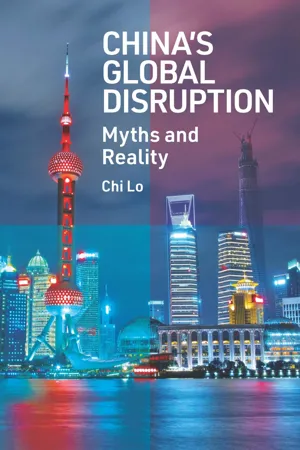
About this book
Those who study China's domestic economics tend to focus on its businesses, industries, supply chains, and energy market disruption through anecdotal case studies, which often point to impending collapse. This hardly squares with the dominant views of international relations scholarship, much of which focuses on system-level analyses and tends to predict that China will inevitably achieve ever-greater global power. It is no wonder that so many long-held assumptions about China have an air of paradox to them.
Here Chi Lo presents the first full-length study to bring systemic analyses into dialog with domestic analyses, and in so doing, to show how each can challenge or refine the assumptions of the other. Taking on key presuppositions about the resilience (or otherwise) of China's economic fundamentals, and explaining why much of the global "common sense" about China is misinformed, this book applies evidence-based research to provide a novel picture of China's development and its place within the global economic system.
China's Global Disruption: Myths and Reality is a must-read for students and researchers in both international studies and economics, and it is of keen interest to policymakers and practitioners concerned with China's ever-evolving place within the international political economy.
Tools to learn more effectively

Saving Books

Keyword Search

Annotating Text

Listen to it instead
Information
Chapter 1
China's Global Disruption: From Digital Currency to COVID-19
China's emergence in the global stage as a new influential player has raised many concerns about its disruption to the global order in social, economic, financial and political aspects. The world will have to accommodate this new rising power. But it is confused and the contaminated information used by many media and analysts is not helping to gain better understanding of China's impact on the global system.
Two events in late 2019 and early 2020 have heightened the China disruption. The first is the launching of a national digital currency by the People's Bank of China (PBoC), the central bank, in December 2019. The move makes the world nervous about a potential digital currency war between China and the United States rocking the global financial system. For China, a national digital currency could help deepen the renminbi internationalisation process and challenge the prevailing international monetary order that the US dollar dominates. The second is the COVID-19, or coronavirus, outbreak between December 2019 and early 2020 in China that ground the Chinese economy to a halt and hit global growth, even before it became a pandemic as declared by the World Health Organisation in March 2020 (BBC, 2020), by hurting global tourism and breaking the global supply chains. This health crisis certainly speaks volumes about the China disruption to the world economy.
The Rise of a Chinese Digital Currency
China has been working on creating a national digital currency since 2014, but Facebook's intention to launch a cryptocurrency, Libra, 1 in 2019, seemed to give China a push to get ahead of the competition. The PBoC launched in December 2019 a national digital currency called the Digital Currency Electronic Payment (DCEP), involving the Big Four State Banks 2 and Big Three Telecoms companies 3 in Shenzhen and Suzhou as pilots.
In general, cryptocurrencies have raised concerns by global regulators about their potential risks in disrupting monetary policy and financial stability and controlling money laundering, terrorist financing and other illicit usages (Araya, 2018). But the PBoC's cryptocurrency is different. When it creates the DCEP, it can see everything and anything because it is the regulator and the clearing house for the digital currency's transactions so that illicit usage can be properly controlled, in principle. By jumping the gun by creating DCEP, China has inspired many developed-world central banks to accelerate their programmes to provide digital currencies for general usage and to strengthen their regulatory oversight of cryptocurrencies. This competition is not simply on reaping the seigniorage, it is also on the government's ability to regulate and tax the economy globally.
Arguably, the worry about China's DCEP disrupting the global monetary order stems from the strategic competition between China and the United States and the lack of trust between the two countries. In the short term, the rise of a Chinese digital currency is not going to undermine the US dollar dominance of global trade and finance, at least the large part that is legal, regulated and taxed. America's deep and liquid capital markets, strong institutions and the rule of law will trump Chinese efforts to achieve any financial dominance in the medium term (Smart, 2018). Crucially, the fact that despite China's rising economic clout, there is still so little acceptance of the renminbi by the international community speaks volumes about the renminbi's lack of credibility.
China will have to sort out its policy for the renminbi's convertibility first before it can push its internationalisation ambition further. It will be a long process for China to sort out its market distortions due to capital controls, lack of transparency, governance problems and restrictions on foreign ownership of Chinese assets before the renminbi could displace the US dollar as the premier global currency. But the DCEP's challenge to the US dollar dominance is real and intensifying (Lo, 2020) as it may serve as a catalyst for prompting changes in China.
However, when it comes to managing the unofficial and non-mainstream activities, especially those that China and the United States do not share any common interests, the threat of a widely used, state-backed, Chinese digital currency could indeed make a big difference to the world order. For example, in the case of a US-regulated digital currency which is traceable by US authorities, if some countries on the US sanction list were to use it to finance illicit activities, the US authorities could potentially block the transactions and catch offenders under US laws.
However, if the cryptocurrency were to come out of China, the United States would have little levers to pull. Of course, the United States and other Western regulators could ban the use of the Chinese cryptocurrency in their respective jurisdictions, but they would be powerless to stop it from being used/abused in other parts of the world where US regulations do not apply or are not followed closely. This oversight problem could even extend to underground activities in the United States and the rest of the world (Araya, 2018).
That is why global regulators have a strong incentive to rein in cryptocurrencies by prohibiting their general usage. The regulatory barriers make existing digital currencies highly illiquid and, thus, limit their circulation. If the United States and the West can work with China on regulating digital currencies, the emergence of a Chinese government–backed digit currency, like DCEP, would just be a market development under Chinese regulatory oversight. It should not be a concern for global disruption.
But not so for China and the United States (and the West) when they do not share the same interests. In the hypothetical case of a US-regulated digital currency, the United States may be able to prohibit its usage to finance North Korea's nuclear development programme, for example, but it would not be able to do so if the digital currency were to run out of China. An incentive incompatibility problem arises here as China and the United States do not share a common policy interest in dealing with North Korea and they do not trust each other when pursuing their respective policies (Albert, 2019; Calamur, 2017a).
By jumping the gun by creating DCEP, China has inspired many developed-world central banks to accelerate their programmes to provide digital currencies for general usage and to strengthen their regulatory oversight of cryptocurrencies. This competition is not simply on reaping the seigniorage, it is also on the government's ability to regulate and tax the economy globally.
From the US perspective, having a cryptocurrency is also a competition with China on boosting one's currency as the dominant global reserve currency to advance the country's foreign policy claims. Just as technology has disrupted business and finance, media and politics, a digital renminbi could disrupt America's ability to pursue its broader national interest by leveraging faith and general acceptance in the US dollar. The United States certainly wants to defend the status quo of a dominant global US dollar while China's crypto-renminbi is catching up fast to challenge that dominance (Lo, 2020).
Chinese President Xi Jinping's ‘Chinese Dream’ is intended to spread China's global influence through his Belt and Road Initiative (BRI) that covers almost 70 countries and has extended more than USD1 trillion in foreign loans since inception in 2013. 4 The BRI is supposed to work with the renminbi internationalisation efforts on building an empire for a global renminbi (Lo, 2017). The creation of DCEP is part of this grand expansion plan to facilitate the realisation of the Chinese Dream in the long term. In other words, Beijing hopes that launching DCEP will help boost the BRI and renminbi internationalisation efforts simultaneously. But this has created a jittery about a new global power shaking up the world system.
Crypto-renminbi to Challenge the US Dollar
China's incentive to climb the global ladder is indeed strong. It overtook the United States as the world's largest goods trading country in 2013, and has since been in the top two positions as the world's largest trading nation. There is a clear disconnect between the highest proportion of the world's trade going through China and the trade's denomination in US dollar.
Back in 2009, China launched the renminbi internationalisation programme to promote its foreign trade role. In 2010, just 1.0% of China's foreign trade was denominated in renminbi. That jumped to 27.8% in 2015. The PBoC even set up China's own international payments system, the China International Payment Service (CIPS), in 2015, to facilitate cross-border renminbi settlements and as an attempt to break the dominance of the US dollar–dominated payments system. Participants in CIPS include global banks such HSBC, JP MorganChase, Citibank, BNP Paribas and Deutsche Bank.
However, deliveries of these expansion initiatives have not been satisfactory for China. After 2015, the renminbi's share in foreign trade settlement has shrunk (Fig. 1.1). Furthermore, the bulk of the renminbi trade settlement came from Hong Kong, meaning that its usage was quite limited in other countries. On the international payments front, compared to Society for Worldwide Interbank Financial Telecommunication (SWIFT), 5 the US-dominated messaging system for international payments, CIPS is much smaller. It only had 900 members as of 2018, compared to SWIFT's 10,000 membership. SWIFT data also show that the renmimbi's share of international payments was just 1.9% in 2019, despite 10 years of internationalisation efforts.

Fig. 1.1. Greater China* RMB Trade Settlement.
The International Monetary Fund (IMF) added the renminbi to its Special Drawing Right (SDR) basket, an international reserve asset, in October 2016. China regarded that move as an international reco...
Table of contents
- Cover
- Title
- Copyright
- Dedication
- Table of Contents
- List of Abbreviations
- Preface
- Chapter 1 China's Global Disruption: From Digital Currency to COVID-19
- Chapter 2 The Chinese Emperor Shock
- Chapter 3 The China–US Tech Race
- Chapter 4 The Sum of All Fears
- Chapter 5 China's Role in the Global Market Cycle
- Chapter 6 The Debt Time Bomb
- Chapter 7 The Crooked Debate of China's Debt Risk
- Chapter 8 China and the Currency War
- Chapter 9 From Trade War to Global Disruption
- Chapter 10 Renminbi Internationalisation
- Chapter 11 The Disruptive Belt and Road Initiative
- Chapter 12 Global Disruption – The New Normal
- References
- Index
Frequently asked questions
Yes, you can cancel anytime from the Subscription tab in your account settings on the Perlego website. Your subscription will stay active until the end of your current billing period. Learn how to cancel your subscription
No, books cannot be downloaded as external files, such as PDFs, for use outside of Perlego. However, you can download books within the Perlego app for offline reading on mobile or tablet. Learn how to download books offline
Perlego offers two plans: Essential and Complete
- Essential is ideal for learners and professionals who enjoy exploring a wide range of subjects. Access the Essential Library with 800,000+ trusted titles and best-sellers across business, personal growth, and the humanities. Includes unlimited reading time and Standard Read Aloud voice.
- Complete: Perfect for advanced learners and researchers needing full, unrestricted access. Unlock 1.4M+ books across hundreds of subjects, including academic and specialized titles. The Complete Plan also includes advanced features like Premium Read Aloud and Research Assistant.
We are an online textbook subscription service, where you can get access to an entire online library for less than the price of a single book per month. With over 1 million books across 990+ topics, we’ve got you covered! Learn about our mission
Look out for the read-aloud symbol on your next book to see if you can listen to it. The read-aloud tool reads text aloud for you, highlighting the text as it is being read. You can pause it, speed it up and slow it down. Learn more about Read Aloud
Yes! You can use the Perlego app on both iOS and Android devices to read anytime, anywhere — even offline. Perfect for commutes or when you’re on the go.
Please note we cannot support devices running on iOS 13 and Android 7 or earlier. Learn more about using the app
Please note we cannot support devices running on iOS 13 and Android 7 or earlier. Learn more about using the app
Yes, you can access China’s Global Disruption by Chi Lo in PDF and/or ePUB format, as well as other popular books in Business & Business General. We have over one million books available in our catalogue for you to explore.