The Handbook of New Zealand Mammals is the only definitive reference on all the land-breeding mammals recorded in the New Zealand region (including the New Zealand sector of Antarctica). It lists 65 species, including native and exotic, wild and feral, living and extinct, residents, vagrants and failed introductions. It describes their history, biology and ecology, and brings together comprehensive and detailed information gathered from widely scattered or previously unpublished sources.
The description of each species is arranged under standardised headings for easy reference. Because the only native land-breeding mammals in New Zealand are bats and seals, the great majority of the modern mammal fauna comprises introduced species, whose arrival has had profound effects both for themselves and for the native fauna and flora. The book details changes in numbers and distribution for the native species, and for the arrivals it summarises changes in habitat, diet, numbers and size in comparison with their ancestral stocks, and some of the problems they present to resource managers.
For this third edition, the text and references have been completely updated and reorganised into Family chapters. The colour section includes 14 pages of artwork showing all the species described and their main variations, plus two pages of maps.
Certificate of Commendation, The Royal Zoological Society of NSW 2021 Whitley Awards: Zoology Handbook
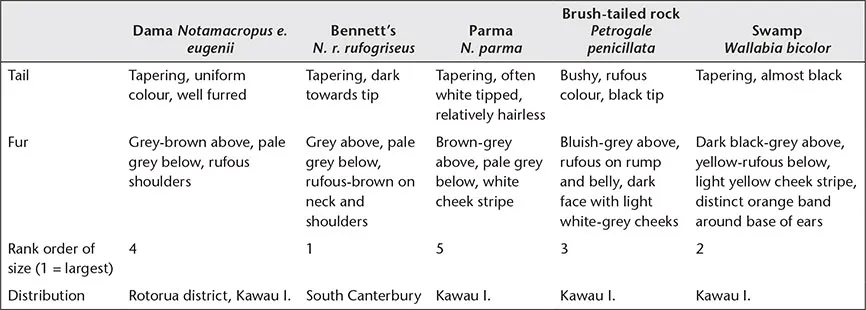
The Macropodidae (‘big feet’) is a large family of terrestrial and arboreal marsupials belonging to the order Diprotodontia. They are the most familiar animals of Australia. About 59 species in 13 genera are living today, and many more are known as fossils. Six wallaby species are or have been successfully established in New Zealand (Plate 1). The distinguishing marks of the five members of the family now living in New Zealand are summarised in Table 1.1 in comparison with the only other established marsupial, the brushtail possum (Family Phalangeridae). All are regarded as unwelcome in New Zealand, and have long been subject to control or eradication wherever possible.
In 2012, New Zealand’s remaining wallabies were removed from the Wild Animal Control Act 1977 and the Wildlife Act 1953, and redefined under the Biosecurity Act 1993 as ‘unwanted organisms’. This change in legal status is currently in effect until 20 September 2021. Unwanted organism status is likely to remain in effect until wallabies are deemed adequately covered as ‘pests’ under official pest management plans (regional or national).
In addition, two other macropodids were liberated in New Zealand, but both have since disappeared: the common wallaroo (Osphranter robustus) on Kawau I. between 1860 and 1870, and an unidentified kangaroo (Osphranter sp. or Macropus sp.) on Dunrobin Station and Bluff Hills in 1868. Four other marsupial species, each from a different family, were imported but have not established wild populations. The long-nosed potoroo or rat-kangaroo (Potorous tridactylus, Family Potoroidae) was liberated at an unknown location by the Auckland Acclimatisation Society in 1867; the quoll or marsupial cat (Dasyurus sp., Family Dasyuridae) in 1868; the southern brown bandicoot (Isoodon obesulus, Family Peramelidae) in 1873; and the eastern (or common) ring-tailed possum (Pseudocheirus peregrinus, Family Pseudocheiridae) in 1867.108
Genus NOTAMACROPUS
This genus includes seven species of wallabies, of which at least four have been introduced to New Zealand. Three are still present (N. eugenii, N. r. rufogriseus and N. parma), whereas N. dorsalis (p. 17) and an unidentified species of wallaby at Mt Nimrod, Timaru, 1903, have disappeared.105 The Notamacropus wallabies are small- to medium-sized members of the family Macropodidae. They are mostly residents of forest/scrub habitats and are primarily solitary or moderately gregarious, in contrast to the Macropus kangaroos and red kangaroo (Osphranter rufus) in Australia, which are highly gregarious inhabitants of open woodlands and grasslands.
Table 1.1: Distinguishing marks of wallabies in New Zealand.
Also called tammar, Kangaroo Island or silver-grey wallaby.
Description
Distinguishing marks – see Table 1.1.
The dama is one of the smallest of the Notamacropus wallabies, but has the general appearance and all the characteristics typical of the Family Macropodidae. Its pelage is generally grey-brown above, paler grey below, with rufous shoulders. The long tapering tail is uniformly grey; the ears are long and pointed. When hopping the forelimbs are usually held apart and away from the body. Damas also lope using all four limbs and tail (a pentapedal gait). They frequently lie down on their side, unlike parma wallabies. When alerted they stand with their forelimbs held out from the chest ready to take flight. They groom, using their tongues, teeth, forepaws and the syndactyl toes of the hind feet.94
Chromosome number 2n = 16.
Dental formula I 3⁄1 C 0⁄0 Pm 1⁄1 M 4⁄4 = 28. The molar tooth row moves forward throughout life, continually providing new surfaces for chewing coarse herbage.
Field sign
The signs of grazing and browsing by wallabies cannot be easily distinguished from that of other herbivores, but their almost square and flattened faecal pellets are distinctly different from those of other mammals. The long narrow hind feet, claws of the main toes, and dragging tail leave characteristic tracks on soft substrates.
Measurements
See Table 1.2.
Variation
Dama wallabies differ significantly in body size between habitats, probably as an adaptive response to the nutritional value of the food available. In the Rotorua region they are generally larger than on Kawau I., and those inhabiting forest/pasture margins in the Rotorua district are larger than those from within forest.
History of colonisation
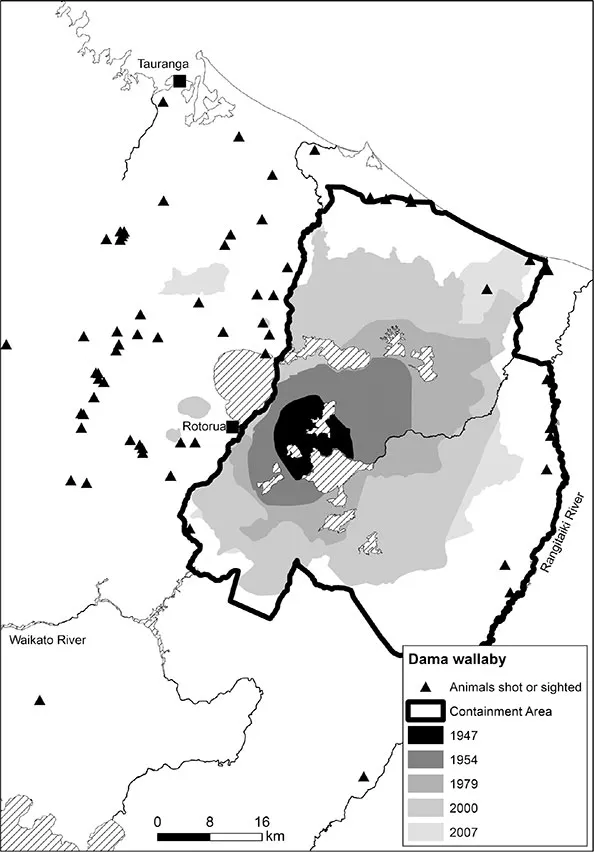
The first dama wallabies to reach New Zealand were released on Kawau I. (2257 ha) in ~1870 by Sir George Grey,105 originating from a population on Kangaroo I., Australia.24 More were liberated in the Rotorua district in 1912 and 1940, and these individuals probably came from Kawau I.89 The 1912 release point was probably at the southern end of Lake Okareka, and from there damas extended their range mainly north and east. Reports of further spread and high numbers began to appear by the late 1940s and early 1950s. Estimates of the mainland area occupied since release are imprecise because of the difficulty of accurately defining the outer limits reached, but suggest they occupied 87 km2 in 1947, 362 km2 in 1954, 754 km2 in 1979, and 1697 km2 in 2000.16 The average rate of range expansion on the mainland over 88 years (1912–2000) was ~19 km2 per year.
Table 1.2: Body measurements of adult dama wallabies in New Zealand and Australia (mean ± s.d.).
Distribution
World. The dama or tammar wallaby was formerly widespread in southern mainland Australia, but is now restricted to south-western Western Australia and several islands off the southern and western coast (Houtman Abrolhos Archipelago, Garden I., Recherché Archipelago, and Kangaroo I.; also formerly endemic on Flinders I., Thistle I., St Francis I. and St Peter I., but is now extinct on those and on many other islands).24 Of the two genetically distinct subspecies, the eastern nominate, N. e. eugenii, the probable progenitor of the New Zealand stock, became extinct in the wild in mainland South Australia but has since been reintroduced (see below).
New Zealand (Fig. 1.1). The mainland population, centred on a core range around the Rotorua lakes, is still expanding. From there, wallabies have spread into three main areas:84 south of the Paeroa Range to the Waikato River, south of Rainbow Mountain, and south-west of Mt Ngongotaha into the southern Mamaku Range. By 2000 they were also being reported from many other areas.16 As of 2015, these areas totalled ~2000 km2; but if areas with suspected low density populations are included, their mainland range increases to ~4100 km2.40 On Kawau I., dama were historically widespread, varying in density between habitat types.95 Recent control operations may have significantly reduced their numbers.27,102
Habitat
The dama prefers ‘edge’ habitats, because it requires relatively dense vegetation for shelter and cover during the day, with access to grasses and pasture species for feeding at night. Kawau I. once had extensive pastures, but after farming was abandoned in 1973, most stock were removed and the drier upland pastures were invaded by kānuka (Kunzia ericoides) and mānuka (Leptospermum scoparium) scrub. Damas are well adapted to dry conditions, and predominate in the upland areas of Kawau I.46
In the Rotorua district dama wallabies inhabit predominantly podocarp/tawa/mixed hardwood forest with adjoining areas of mānuka scrub, bracken (Pteridium esculentum), and pasture. Exotic forests also provide suitable cover and access to grass and weeds along roadsides and in young plantations. Many damas live solely within forest, but these do less well than those with ready access to grassed clearings or pasture. Some individuals will travel up to 500 m to feed on pasture.104
Figure 1.1: Historical and current distribution and confirmed sightings and kills (2000–16) of dama wallabies in Bay of Plenty and Waikato.40 The cross hatched areas represent lakes.
Food
Diet. The dama is primarily a grazer.48,104 On Kawau I. grasses are the main food, although damas there also eat many kānuka leaves (his...
Table of contents
Cover
Title Page
Copyright
Contents
Preface to the Third Edition
Contributors to the Third Edition
Acknowledgements
Editors’ introduction
Preamble to species accounts
1 Family Macropodidae
Colour plates
2 Family Phalangeridae
3 Family Erinaceidae
4 Families Vespertilionidae and Mystacinidae
5 Family Leporidae
6 Family Muridae
7 Families Otariidae and Phocidae
8 Family Canidae
9 Family Mustelidae
10 Family Felidae
11 Family Equidae
12 Family Suidae
13 Family Bovidae
14 Family Cervidae
Glossary and abbreviations
Key to skulls
Index to animal species
Frequently asked questions
Yes, you can cancel anytime from the Subscription tab in your account settings on the Perlego website. Your subscription will stay active until the end of your current billing period. Learn how to cancel your subscription
No, books cannot be downloaded as external files, such as PDFs, for use outside of Perlego. However, you can download books within the Perlego app for offline reading on mobile or tablet. Learn how to download books offline
Perlego offers two plans: Essential and Complete
Essential is ideal for learners and professionals who enjoy exploring a wide range of subjects. Access the Essential Library with 800,000+ trusted titles and best-sellers across business, personal growth, and the humanities. Includes unlimited reading time and Standard Read Aloud voice.
Complete: Perfect for advanced learners and researchers needing full, unrestricted access. Unlock 1.4M+ books across hundreds of subjects, including academic and specialized titles. The Complete Plan also includes advanced features like Premium Read Aloud and Research Assistant.
Both plans are available with monthly, semester, or annual billing cycles.
We are an online textbook subscription service, where you can get access to an entire online library for less than the price of a single book per month. With over 1 million books across 990+ topics, we’ve got you covered! Learn about our mission
Look out for the read-aloud symbol on your next book to see if you can listen to it. The read-aloud tool reads text aloud for you, highlighting the text as it is being read. You can pause it, speed it up and slow it down. Learn more about Read Aloud
Yes! You can use the Perlego app on both iOS and Android devices to read anytime, anywhere — even offline. Perfect for commutes or when you’re on the go. Please note we cannot support devices running on iOS 13 and Android 7 or earlier. Learn more about using the app
Yes, you can access The Handbook of New Zealand Mammals by Carolyn M. King, David M. Forsyth, Carolyn M. King,David M. Forsyth,Carolyn King,David Forsyth in PDF and/or ePUB format, as well as other popular books in Biological Sciences & Ecology. We have over one million books available in our catalogue for you to explore.