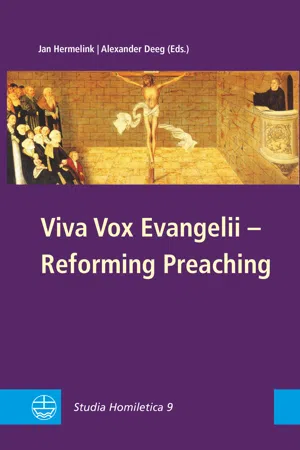
This volume contains the proceedings of an international homiletical conference, held in summer 2012 in Wittenberg (Germany). The theme "Viva Vox Evangelii – Reforming Preaching" focuses on the vivid and multivoiced performance of preaching; it is worked out by researchers from North and South America, South Africa, India as well as from North and Middle Europe.The contributions deal with the different social, political, cultural and religious contexts of preaching, and they reflect on the consequences for content and form of the respective sermon. Additionally, the volume gives examples of original sermons from various religious traditions. Many articles are responding to each other, so in effect the volume displays an inspiring view on the international research in homiletics today.Der Band dokumentiert eine internationale Tagung zur Predigtlehre, die im Sommer 2012 in Wittenberg stattfand. Das Tagungs-Motto 'Viva Vox Evangelii – Reforming Preaching', das den lebendigen, vielstimmigen Vollzug der Predigt fokussiert, wird von Forscherinnen und Forschern u. a. aus Nord- und Südamerika, Südafrika, Indien sowie aus Nord- und Mitteleuropa bearbeitet, und zwar nicht nur im Blick auf die Predigt selbst, sondern auch hinsichtlich ihrer ganz unterschiedlichen sozialen, politischen, kulturellen und religiösen Kontexte. Dazu kommt die Dokumentation exemplarischer Predigten aus verschiedenen kirchlichen Traditionen. Viele Texte beziehen sich dialogisch aufeinander, so dass insgesamt ein höchst anregendes Bild der internationalen homiletischen Forschung der Gegenwart entsteht.
eBook - ePub
Viva Vox Evangelii - Reforming Preaching
Studia Homiletica 9
- 436 pages
- English
- ePUB (mobile friendly)
- Available on iOS & Android
eBook - ePub
About this book
Trusted by 375,005 students
Access to over 1.5 million titles for a fair monthly price.
Study more efficiently using our study tools.
Information
WORKING PAPERS
THE PREACHER AS ›DIAKONOS‹ ACCORDING TO JOHN 12 : 26
Gert Breed
Research on the diakon-word group gained momentum with the study by Collins1 and later also Hentschel and others.2 Collins’ results appeared, among others, in the latest edition of A Greek-English lexicon of the New Testament and other early Christian literature.3 The core of Collins’ findings is that the diakon word group does not primarily indicate »humble ministry« or »table service by a waiter« as was previously accepted. By an intensive study of all the texts in the New Testament where the diakon word group occurs, as well as a study of extra-Biblical literature, he shows that this word group has the meaning of »the one sent«, »representative« or »go-between«. A diakonos is someone who received a specific assignment and must report on his diakonia (ministry) to the sender/principal. In the New Testament the sender/principal is usually a congregation and/or God.
Other researchers mostly agree that the diakon-word group does not exclusively or even mostly express humble service motivated by love for one’s fellow man, but rather appears in the range of meaning that includes representative, messenger and envoy. However, there are still several aspects related to the use of this word group on which no agreement has been reached by far.4 Although most parts of Scripture where this word group appears have been studied, all parts of Scripture have not yet been adequately investigated, and often the Scriptural context in which it appears has not been taken into account adequately. Little attention has been paid to the Gospel of John in this regard. The consequences of the results have not been applied to preachers and their calling.
This article aims to do exegesis of John 12 : 26 and inquires about the meaning of this word group as it comes to the fore in light of Scripture context, the chapter and the book. The study seeks to answer the question as to what the diakon-word group’s meaning implies for the ministry of preaching.
2 John 12 : 26
If any man serves (diakoneo) me, let him follow me;
and where I am, there shall also my servant (diakonos) be:
if any man serve (diakoneo) me, him will my Father honour (KJV).
I WHO CAN BE JESUS’ DIAKONOS?
On inquiry into the range of meaning in which the diakon-word group is used in this verse, it is important to establish to whom the word tis (12 : 26a) refers. According to Louw and Nida5 this word refers to someone or something undefined. Verse 26a could in other words be translated as »If anyone serves me«.
Who is Jesus talking to, considering the context in which this verse appears? Throughout the chapter Jesus is presented as surrounded by crowds of people who, after the resurrection of Lazarus, came to see Lazarus and Jesus. Many were there due to Passover. The high priests adjudicate this event with the telling words »Behold, the world is gone after him«. (12 : 19). These words by the high priests are presented by the author as prophetic, because just after that, he mentions the arrival of the Greeks who asked to see Jesus.6 Jesus himself refers to this when he says that his crucifixion will result in Him drawing all (pantas) to Him (12 : 32). This attraction of all people begins with the arrival of the Greeks.7 The new pattern according to which people will come to Jesus, starts here. In future, when Jesus is no longer on earth (when he has been elevated, 12 : 32), people from all over the world (all) will be drawn to Jesus by his followers (like Phillipus and Andreas). This is the hour that has come. Verse 26 should be understood in light of this.8 The word »tis« therefore literally refers to whoever from all of humanity wants to serve Jesus.
From verse 29 it is clear that Jesus was again surrounded by a crowd of people when He said the words of verse 26. Jesus says the words of verse 26 in direct reaction to the request of the Greeks to see Him. It is not clear whether the Greeks were present while He said it, but his words are in either case an answer to their request and could be communicated to them by the disciples. The arrival of the Greeks also makes it clear to Jesus that the hour of his final suffering and his death has arrived (verse 23 : 24). Now He proclaims to all what it entails to serve Him. Jesus speaks to the Greeks, to his disciples, the entire crowd and even to those leaders who believed in Him, but who did not want to confess it out of fear (12 : 42). He proclaims to them what it entails to serve Him. The directive in John 12 : 26 is therefore a general prescription that is valid for every believer, and due to the piling up of the diakon-word group this can be viewed as a definition of what it means to be a diakonos of Jesus Christ.
Collins’9 opinion that diakonia primarily describes the service work of people in the special services (offices) is questionable based on Jesus’ definition of diakonia. It is clear that the author of the Gospel of John was of the conviction that every person who follows Jesus, could also be a diakonos.
We are living in the hour which dawned on Jesus with the coming of the Greeks. The preacher is a diakonos amongst other diakonoi in this hour. Therefore the aim of every sermon must be to call everyone to become a diakonos of Jesus Christ and, in the particular way that is articulated in the text of the sermon, how to live as a diakonos. The whole of the liturgy must lead the congregation to the confirmation and the experience of them being servants of Christ. The congregation have to know their calling to be able to lead even more people to become diakonoi of Jesus Christ. The preacher is preaching to equip the saints for their diakonia (Ephesians 4 : 12) that is part of his diakonia.
II SERVE (DIAKONEO) AND FOLLOW (AKOLOUTHEO).
From verse 26 can be deducted that a person cannot serve Jesus if such a person does not also follow Him. It is therefore important to establish what follow means in the context of John 12 : 26. John 12 forms the conclusion of the first part of the Gospel of John.10 The first part (Chapters 1 – 12) is often referred to as the book in which Jesus’ miracles are described. The second part (Chapters 12 – 20) is referred to as the book in which the suffering (and glorification) of Christ is described.11 Coetzee12 provides the following structure for the book:
Introduction: 1 : 1 – 51
Body: 2 : 1 – 20,31
Part 1: Signs followed by claims – 2 : 1 – 7 : 52
Part 2: Claims followed by signs – 8 : 12 – 11 : 54
Part 3: Signs followed by claims – 11 : 55 – 19 : 16
Part 4: Final signs with apophthegms interwoven – 19 : 17 – 20 : 27
Part 5: Climax and conclusion – 20 : 28 – 31
Epilogue: 21 : 1 – 25
Appendix: 7 : 53 – 8 : 11
John 12 therefore forms part of the third section of the body where signs are followed by claims. Coetzee calls John 12 : 1 – 50 the first episode in which Jesus, the true King who came to die for his people, is described. John 12 starts with the announcement that Jesus arrived in Bethany six days before Passover. In the sentences following this, his arrival is linked to the resurrection of Lazarus and Jesus’ anointing by Mary, as well as Judas’ betrayal (verse 1 – 4). All these three events point to Jesus’ death. Jesus’ explanation of Mary’s deed makes it clear that He is going to die and will be buried, and that He will not be with them forever. The resurrection of Lazarus leads crowds flocking in, something that finally convinces the leaders of the Jews that Jesus has to be killed. The entire chapter stands in the shadow of Jesus’ approaching suffering and death.13 However, Jesus is also glorified as king and Messiah by Martha’s anointing, the crowds, the Greeks and the Father himself. The contrast of the King who has to suffer and die, and who conquers through death, runs through the entire chapter.
The image that Jesus uses (verse 24) to explain the necessity and purpose of his death combines all these themes. Jesus is like a grain of wheat that has been sown, the grain has to die to fulfil its purpose, namely to carry much fruit (verse 24). The much fruit comprises all who Jesus will draw towards him (verse 32). Jesus says that his soul is distraught in anticipation of this suffering. The question arises in Him of whether He should ask that the Father should save Him from this hour of death. However, he comes to the conviction that He cannot do this because the purpose of His coming to the earth is fulfilled in the events of this hour. For this reason His decision is that He would rather glorify His Father by completing this charge (verses 27 : 28).14 Therefore to follow Christ means to also come to this decision after consideration, and to fulfil the task given by the Father, even if this could mean your death.
The structure of verses 23 – 28 makes it clear that whoever serves Jesus has part in the events of this hour:15
Verses 20 – 22: The request of the Greeks – they want to speak to Jesus.
Verse 23: Jesus answers by saying that the hour of his glorification has come.
Verse 24: Jesus explains the hour with the image of the grain of wheat that has to die.
Verse 25: Jesus applies the principle of life through death to his followers.16
Verse 26: Jesus explains what it means to serve Him.
Verse 27: Jesus declares his anxiety for this hour, his struggle and his answer that He does not want to side-step the hour, but wants to glorify the Father.
Verse 27 (Jesus’s exposition of the hour) continues where verse 24 (the announcement that the hour has come and the meaning of this hour) stopped, and verses 25 and 26 are incerpts that describe the influences of the hour on those who want to serve Jesus.17 The structure used here makes it clear that Jesus’ followers are made part of the hour that has come for Jesus with the arrival of the Greeks.18 The request of the Greeks not only ushers in this particular hour in Jesus’ life, but also a particular hour in the lives of those who serve Him. Jesus’ assignment was limited to the Jews (Matthew 15 : 24), the disciples would carry the Gospel to the nations. The hour in which Jesus’ task is transferred to His followers concurs with Jesus’ glorification, which comes to life in His death, resurrection and ascension. Serving Jesus means to follow Him, to follow Him means to become part of his task, and this directive asks that one should be willing to loose one’s life in order to glorify God in this manner by bearing much fruit (verse 25).19 »Within the confines of the antithetical parallelism in 12 : 25 – 26, service functions as explanation of what it means to hate one’s life.«20
Serving Jesus does not mean that one should attempt to repeat his unique reconciliatory work, but rather that one should, like Him, be willing to give one’s life in service to God and His calling so tha...
Table of contents
- Cover
- Title
- Imprint
- Preface
- Table of contents
- The Hand on the Book - Address on Opening Evening
- »Viva Vox Evangelii« – Preaching the Gospel in a multitude of VoicesPresidential Address
- KEYNOTE LECTURES AND RESPONSES
- SERMONS
- WORKING PAPERS
- FINAL COMMENTARIES
- More books
- Footnotes
Frequently asked questions
Yes, you can cancel anytime from the Subscription tab in your account settings on the Perlego website. Your subscription will stay active until the end of your current billing period. Learn how to cancel your subscription
No, books cannot be downloaded as external files, such as PDFs, for use outside of Perlego. However, you can download books within the Perlego app for offline reading on mobile or tablet. Learn how to download books offline
Perlego offers two plans: Essential and Complete
- Essential is ideal for learners and professionals who enjoy exploring a wide range of subjects. Access the Essential Library with 800,000+ trusted titles and best-sellers across business, personal growth, and the humanities. Includes unlimited reading time and Standard Read Aloud voice.
- Complete: Perfect for advanced learners and researchers needing full, unrestricted access. Unlock 1.5M+ books across hundreds of subjects, including academic and specialized titles. The Complete Plan also includes advanced features like Premium Read Aloud and Research Assistant.
We are an online textbook subscription service, where you can get access to an entire online library for less than the price of a single book per month. With over 1.5 million books across 990+ topics, we’ve got you covered! Learn about our mission
Look out for the read-aloud symbol on your next book to see if you can listen to it. The read-aloud tool reads text aloud for you, highlighting the text as it is being read. You can pause it, speed it up and slow it down. Learn more about Read Aloud
Yes! You can use the Perlego app on both iOS and Android devices to read anytime, anywhere — even offline. Perfect for commutes or when you’re on the go.
Please note we cannot support devices running on iOS 13 and Android 7 or earlier. Learn more about using the app
Please note we cannot support devices running on iOS 13 and Android 7 or earlier. Learn more about using the app
Yes, you can access Viva Vox Evangelii - Reforming Preaching by Jan Hermelink, Alexander Deeg in PDF and/or ePUB format, as well as other popular books in Theology & Religion & Christian Ministry. We have over 1.5 million books available in our catalogue for you to explore.