- 48 pages
- English
- ePUB (mobile friendly)
- Available on iOS & Android
eBook - ePub
The Castles of Sion
About this book
What might the small city of Sion look like without its two castles? The striking fortifications on the Valeria and Tourbillon hills and the Majorie and Vidomnat buildings form part of the medieval built fabric of the Valais canton's capital. They evoke a time when Catholic bishops and the cathedral Chapter controlled the gateway to the Great St Bernard and Simplon passes – two major historic trade routes across the Swiss Alps. Discover Sion's medieval atmosphere, and its treasure of the rarest and unique artefacts.
Information

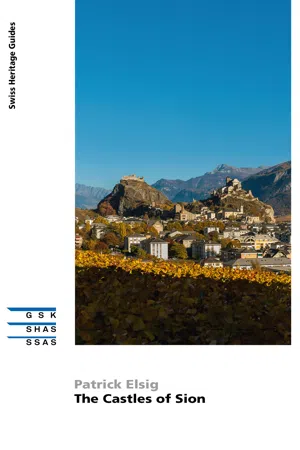
View of the city of Sion: Tourbillon Castle on the hill to the left. On the hill to the right, the castle or capitular village of Valeria, with the Jesuit Church below. The Dog Tower, the Majorie Tower and the Vidomnat building stand on the ridge below the castle of Tourbillon.
Representative and symbolic buildings
A lasting medieval imprint
The small city of Sion in the Swiss Valais valley has seen a continual human presence since the Neolithic period (5200–2200 BCE). Evidence can be found at the outstanding prehistoric burial site at Le Petit Chasseur with its engraved anthropomorphic steles. Moreover, at the nearby Don Bosco site, archaeologists recently discovered barrow or tumulus graves from the late Bronze (1000–800 BCE) and early Iron Ages (800–450 BCE). The Roman city, too, is gradually revealing itself as urban construction works are being carried out – baths here, a suburban villa there.
However, it is difficult to establish the original size of the city, as it has largely been destroyed by more recent construction work. On the other hand, and especially in the old town, the informed observer will notice the medieval city’s lasting imprint. After all, the unique Sion skyline was created during the Middle Ages when the Valeria and Tourbillon Castles were constructed on the two hills that stand guard in the Valais plain. Owing to Sion’s modest development over the centuries, much of its medieval fabric remains. Moreover, the relative poverty of its inhabitants prompted them to preserve still useful artefacts. The result is a historical legacy rarely found elsewhere – including manuscripts, archives, furnishings, and ancient weapons – the prime example being the organ at Valeria Castle, which is the world’s oldest such instrument still in operation.
Two hills for two powers
The two hills perfectly symbolise the regional division of power during the Middle Ages. In 999 CE, King Rudolf III of Burgundy handed the temporal rights over the County of Valais to the bishop of Sion. From then on, the bishop exercised both temporal and spiritual power over the territory, and had to defend Sion against neighbouring lords, in particular the House of Savoy, which quickly seized the Great St Bernard Pass. The local nobility also made claims, as did, eventually, the local population. From the seventeenth century, the bishop was forced to share his power with the Diet, a body of elected civic representatives.
Medieval bishops delegated certain administrative tasks relating to their fiefdom to the canons of the cathedral Chapter, an institution probably created during the Carolingian age to support the cathedral, both spiritually and in terms of religious services and other work in this sacred edifice. Soon after its establishment, the Chapter began to enjoy a degree of independence. Throughout the medieval period, it acted as a form of “Ministerial Council” to the bishop, but also frequently formed a counterforce to the prelate’s authority.
This state of affairs was reflected in the castles of Sion. Valeria Castle, on the lower of the two hills, was the seat of the cathedral Chapter while Tourbillon Castle, on the higher hill, was the bishop’s exclusive residence. It should be noted that the prelate at that time still bestowed some minor privileges, in particular the low jurisdiction, upon local lords. From their fortified towers scattered up and down Valais, those lords exercised the offices of major and vidomne, to mention only the two best known ones. Their fortresses, known as the Majorie and the Vidomnat (or Sénéchalie in earlier times) stood in Sion, on the ridge at the foot of Tourbillon Hill. When the then bishop purchased the Majorie in the fourteenth century, he instantly became the owner of most of the city’s north ridge facing Valeria. Now the two hills stood for two powers.
The city’s fortifications
Alongside their function as dwelling places and their powerful symbolism, the castles also complemented Sion’s fortifications. The city was entirely encircled by a wall punctuated by defensive towers and fortified gates. Historic engravings show that the wall dating from around 1300 was able to contain the city’s modest development until the end of the Ancien Régime. As the wall had lost its function, and hindered urban expansion in the nineteenth century, most of it was demolished. Only a few sections still remain, notably the Tour des Sorciers, which was originally a corner tower, and also served as a prison. Parts of other defensive sections have been conserved, in particular the wall that runs between the two hills. It incorporates the small gate called the Porte de Covent, and shuts off the valley to the east of the site.

Sion within its medieval city wall (Hans Ludolff’s etching; Matthäus Merian, publ. 1641).

View of Sion and Valeria from the north-east (Eugène Cicéri, 1865; colour lithograph). Some of the buildings were demolished soon after.
Valeria Castle
Castle or fortified village?
To understand how the site of Valeria was organised, it is important to know that it provided accommodation for up to twenty canons and their personnel. This explains the size of the church, which was not intended to be used by the local population. It should also be remembered that, unlike the canons “regular” at Saint-Maurice Abbey or at the Great St Bernard Hospice, who followed a rule, or regula in Latin, the canons of the Sion cathedral Chapter were “seculars” chosen from among the clergy in the diocese to meet the needs of the institution. Rather than a simple cell, each canon had his own dwelling house; some larger spaces were provided for joint meetings. That would explain the original number of civil buildings, although no more than a third of them survives. By contrast to Tourbillon Castle and its feudal structure, what is commonly known as Valeria Castle would once have been more like a medieval fortified village, with houses and lanes around the church at its centre.

Romanesque capitals, details.
A thousand years of construction in three major phases
Earliest structures and defences (11th–14th centuries)
The current church is pre-dated by only one masonry wall, now reduced almost to ground level. Some remnants of an early medieval, perhaps even Roman building are too insubstantial to allow for a plausible hypothesis regarding its purpose. It may have been a symbolic edifice, probably for religious purposes, as suggested by the position of the Valeria Hill in relation to archaeological finds made in the city below.
Records for the Valeria...
Table of contents
- Representative and symbolic buildings
- Appendix
Frequently asked questions
Yes, you can cancel anytime from the Subscription tab in your account settings on the Perlego website. Your subscription will stay active until the end of your current billing period. Learn how to cancel your subscription
No, books cannot be downloaded as external files, such as PDFs, for use outside of Perlego. However, you can download books within the Perlego app for offline reading on mobile or tablet. Learn how to download books offline
Perlego offers two plans: Essential and Complete
- Essential is ideal for learners and professionals who enjoy exploring a wide range of subjects. Access the Essential Library with 800,000+ trusted titles and best-sellers across business, personal growth, and the humanities. Includes unlimited reading time and Standard Read Aloud voice.
- Complete: Perfect for advanced learners and researchers needing full, unrestricted access. Unlock 1.4M+ books across hundreds of subjects, including academic and specialized titles. The Complete Plan also includes advanced features like Premium Read Aloud and Research Assistant.
We are an online textbook subscription service, where you can get access to an entire online library for less than the price of a single book per month. With over 1 million books across 990+ topics, we’ve got you covered! Learn about our mission
Look out for the read-aloud symbol on your next book to see if you can listen to it. The read-aloud tool reads text aloud for you, highlighting the text as it is being read. You can pause it, speed it up and slow it down. Learn more about Read Aloud
Yes! You can use the Perlego app on both iOS and Android devices to read anytime, anywhere — even offline. Perfect for commutes or when you’re on the go.
Please note we cannot support devices running on iOS 13 and Android 7 or earlier. Learn more about using the app
Please note we cannot support devices running on iOS 13 and Android 7 or earlier. Learn more about using the app
Yes, you can access The Castles of Sion by Patrick Elsig in PDF and/or ePUB format, as well as other popular books in Art & Architecture General. We have over one million books available in our catalogue for you to explore.