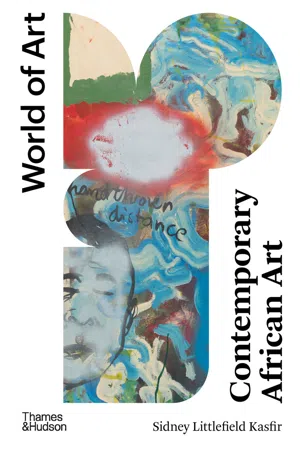
Contemporary African art has grown out of the diverse histories and cultural heritage of the African continent and its diaspora. It is not characterized by any particular style, technique or theme, but by a bricolage-like attitude towards art-making, incorporating and building upon the structures from which older, precolonial and colonial genres were made. In this revised and updated edition of Contemporary African Art, Sidney Littlefield Kasfir examines the major themes, developments and accomplishments in African art of the 20th and 21st centuries. Organized thematically, the book includes new chapters on the history of African photography and the growth of the global art market, alongside significant discussions of patronage and mediation, artistic training and national and diaspora identities.
- English
- ePUB (mobile friendly)
- Available on iOS & Android
eBook - ePub
Contemporary African Art
About this book
Trusted by 375,005 students
Access to over 1.5 million titles for a fair monthly price.
Study more efficiently using our study tools.
Information
Topic
ArtSubtopic
African ArtChapter 1
New Genres: Inventing African Popular Culture
The introduction considered the continual renegotiation between the past and present in relation to precolonial art forms. This chapter introduces new genres of art that owe their emergence to three of the social processes that accompanied European colonialism in Africa: urbanization, the introduction of Western technology and material culture, and the expansion of literacy through formal schooling. To these must be added a fourth, considered fully in Chapter 5, that underlies all of these changes: the development of an ‘art market’ under European patronage. The first three set the stage for the development of a new, town-and-literacy-based popular culture, while the fourth pronounced certain of these developments ‘art’ and introduced them into institutionalized art-world settings.
Urban arts and colonialism
The creation of large urban centres where none existed before, as well as the transformation of older, precolonial cities, brought together people from a plethora of ethnic groups and different visual and performance traditions. While most city dwellers in Africa have continued to retain strong ties to the upcountry communities where they originated, unlike their relatives in the rural areas they are no longer essentially self-sufficient. Instead, they depend upon salaries, wage labour or various forms of entrepreneurship to provide them with food, clothing, rent money and school fees, as well as whatever luxuries they can afford. While African cities have produced a large class of unemployed and under-employed workers, they have also created a distinctive urban class of consumers whose tastes and aspirations are different from those in rural areas and are frequently shaped by ideas and goods from the colonial (and ex-colonial) metropolis. These ideas and goods are creolized and reinvented in an African cultural setting that is distinctively different from the European one from which they originated. Not only are Western ideas and goods appropriated, but extensive cultural borrowing and reinterpretation also occurs among the many indigenous subcultures that make up the urban centre. To add further to the complexity, these cultural imports no longer come only from the former colonizing countries in Western Europe. Since independence, African markets have been saturated with cheap manufactured goods from China and other Asian countries and from Eastern Europe, and in many other respects, it is America and the African diaspora that are the sources of the most powerful images of modernity – not only clothing, hairstyles and luxury goods, but also musical styles such as reggae and rap, and in the colonial period, jazz.[12]

10 Seydou Keïta, Untitled, 1958/9. This image, among Keïta’s best-known, displays the aspiration towards modernity and close connection with French as well as indigenous ideals of beauty and status in late-colonial Bamako, Mali.
New arts and goods, new political awareness and daily contact with imported media were part of this urban subculture right from its late nineteenth-century beginnings – radios, newspapers, Bibles, telephones, postal systems, identity cards, imported foods (both crops and cuisine), bars and Western fashion all took root and in due course were transformed into local versions, some highly distinctive and others emulations of their European counterparts. In recent decades, imported films (often produced for ‘Third World’ consumption) and pirated music have become ubiquitous in African cities, while both imported and locally produced television programmes have found a ready market among urban consumers. Countries such as Nigeria, Ghana and South Africa have their own music and film industries. Indigenous filmmaking for international audiences has been limited mainly to South Africa and francophone West African countries such as Mali, but is sporadically developing elsewhere. In Nigeria, for example, the emerging film industry began with Ministry of Information documentaries and locally produced television dramas, which, in turn, were modelled on live performances of plays by local theatre troupes.
These new visual genres, like their counterparts in literature and oral culture, call for their own modes of interpretation, which are inevitably different from those applicable to older forms. Not only are the new genres frequently created out of materials and techniques not used in older ones, but they may also involve different production conditions. To paraphrase Elizabeth Tonkin’s argument about oral performances, while genres have certain ‘repeatable and stereotypic features’, they will be misunderstood if they are treated solely as expressive forms in themselves, detached from their production conditions. This is one reason why exhibitions of contemporary African art are so frequently misunderstood by both critics and the public, who see them only as ‘detribalized’ aberrations from tradition.
One major difference between francophone and anglophone countries in Africa stems from their distinctive colonial policies. The British policy of Indirect Rule, constructed by Lord Lugard after the First World War, stated that ‘native peoples’ (as they were described in the colonial documents) should be allowed to accept change at their own rate and in their own way. To implement this, British colonies were to be governed by indigenous rulers at district and local level. Indeed, where there were not any such local rulers, the colonial government created them by appointing salaried ‘white men’s chiefs’. Among other things, this meant there could be little British influence on everyday life and material culture. The French, on the other hand, tried consciously to acculturate the African populations of their colonies, making them citizens of France – the effect of which is readily seen today in the French influence on styles of dress, food and entertainment in urban areas. The Congolese sapeur, who imitates the latest Parisian men’s fashions in dress down to the smallest detail, has no counterpart in anglophone countries. The difference between French and British territories was most obvious when a single people was divided between the two. The Hausa homeland, for example, includes both northern Nigeria (a former British colony) and southern Niger (a former French colony). On the Niger side of the border, French baguettes were still being sold on street corners by Hausa traders in 1980, while on the Nigerian side, street vendors hawked traditional Hausa sweetmeats. Conversely, Hausa architecture is much better preserved on the Niger side, due to the French enthusiasm for mosque preservation programmes, inspired by architect Eugène Viollet-le-Duc, while in Nigeria buildings are crumbling, subject to the vicissitudes of weather and local politics.
Goods from abroad have had at least two major effects: they have turned Africans into global consumers and they have in certain areas strongly undercut local manufacturing traditions. This is most noticeable with locally made pottery, weaving and ironworking, all of which have been partly displaced by imported enamelware and plastic, factory-made cloth and mass-produced hoes and other iron implements. Goods that have survived this competition are specialized and particular to local cultures – certain types of prestige cloth used in ceremonies, elaborate leatherwork for horses or ritual pottery and iron ornaments, with which foreign manufactured goods cannot compete.[11] Where patrons have continued to demand them, these types of goods are still being made. Handmade crafts also survive, and occasionally flourish, particularly in areas far from urban markets where manufactured goods are expensive and hard to come by. Local goods that are easily and relatively cheaply replaced – handmade but strictly utilitarian clay pots for cooking and carrying water, or knives and hoes made by local blacksmiths – have disappeared on a large scale, giving way in most cities and rural areas to aluminium pots, plastic jerrycans and hoes imported from China. However, both old and new types do often coexist in the same community and even the same household.

11 A Hausa trader selling dyed leather horse trappings, Kurmi crafts market, Kano, Nigeria, 1989
Urban Africans are not only consumers and patrons of the new visual media, they are also its producers. In African cities, a majority of workers are employed in what economists call the ‘informal sector’, which includes all those businesses and industries, usually small-scale and conducted in alleys and marketplaces rather than in factories or offices, that operate without formal structures.[13] Among them are the sign-painters, furniture makers, blacksmiths, tailors, photographers, builders, drum makers, woodcarvers, street painters, jewelers and producers of all manner of curios from banana-fibre pictures to soapstone elephants. ‘Recyclia’, goods handmade from previously used materials, account for a good deal of this production, some of which is traditional (cow tails transformed into fly-whisks), some ingenious (Christmas-tree decorations used as hair ornaments), some merely cheaper substitutions (plastic replacing ivory ornaments) and some driven by utility (suitcases made from discarded rolled sheet metal). In Kenya, all these forms of material culture production, as well as related kinds of small-scale artisanship such as bicycle and radio repair, are known collectively as Jua Kali (Swahili: ‘hot sun’), which refers to the informal outdoor spaces where they are practised.

12 Ghanaian ‘expensive cut’ barber’s sign advertising the ‘flat-top’ hairstyle fashionable in the USA in the 1990s

13 A sign-painter’s kiosk, Government Road, Mombasa, Kenya, 1991
To understand fully that these urban forms are simultaneously art and commodity, historian Bogumil Jewsiewicki argues, one must re-examine the assumptions implicit in most critical discourse in the West. The most deeply grounded of these is the belief that an artwork ought to be singular – a one-of-a-kind creation. The other assumption is that an artwork is not a commodity (see Chapter 5). Much of the art being produced in Africa, especially in urban workshops, is marketed unpretentiously as merchandise. It only begins to take on an ‘art’ status when it becomes part of Western or elite collections.
Flour-sack painters in the Congo
Perhaps the best-documented example of a quintessentially urban genre enjoying both art and commodity status is the flour-sack paintings of Kinshasa, Kisangani and Lubumbashi, Congo (then Zaire), made during the 1970s.[14] The artist-entrepreneurs who made them originally created pictures for a clientele not very different, in economic and social terms, from themselves. Paintings on flour sack stretched over a frame were carried about and marketed on the streets, often by young boys working for the painters, and were intended for a local audience of urban workers and clerks. But given the vast distances and poor communications in a country such as the Congo, both the thematic content and the primary audience for this art populaire varied from place to place.
In Kisangani, the major city in northeast Congo, the invasion of paratroopers during the attempted Katanga secession became a popular theme for urban paintings. Historical themes such as this and the 1961 assassination of the Prime Minister Patrice Lumumba have been more characteristic of the eastern mining-zone cities than of Kinshasa.[15] Even though there is little or no tourist or foreign patronage, a market for paintings has also developed among an emergent entrepreneurial class involved in gold trafficking. Much more recently, a parallel genre has begun to develop at Kilembe copper mines in western Uganda. In Kinshasa, both themes and patronage have been more wide ranging. Gradually, as a few foreigners – scholars, journalists, resident expatriates – noticed and purchased the work of these street painters, it became known among a small group of cognoscenti and its status grew from straightforward decoration for the clerical worker’s rented rooms to collectible art. By this proce...
Table of contents
- Cover
- Title Page
- About the Author
- Dedication
- Contents
- Preface
- Introduction
- Chapter 1: New Genres: Inventing African Popular Culture
- Chapter 2: Africans Photographed, African Photographers
- Chapter 3: Transforming the Workshop
- Chapter 4: Patrons and Mediators
- Chapter 5: Art and Commodity
- Chapter 6: The African Artist: Shifting Identities in the Postcolonial World
- Chapter 7: The Idea of a National Culture: Decolonizing African Art
- Chapter 8: Migration and Displacement
- Chapter 9: The Global Contemporary Art World and Africa
- Bibliography
- Acknowledgments
- List of Illustrations
- Index
- Copyright
Frequently asked questions
Yes, you can cancel anytime from the Subscription tab in your account settings on the Perlego website. Your subscription will stay active until the end of your current billing period. Learn how to cancel your subscription
No, books cannot be downloaded as external files, such as PDFs, for use outside of Perlego. However, you can download books within the Perlego app for offline reading on mobile or tablet. Learn how to download books offline
Perlego offers two plans: Essential and Complete
- Essential is ideal for learners and professionals who enjoy exploring a wide range of subjects. Access the Essential Library with 800,000+ trusted titles and best-sellers across business, personal growth, and the humanities. Includes unlimited reading time and Standard Read Aloud voice.
- Complete: Perfect for advanced learners and researchers needing full, unrestricted access. Unlock 1.5M+ books across hundreds of subjects, including academic and specialized titles. The Complete Plan also includes advanced features like Premium Read Aloud and Research Assistant.
We are an online textbook subscription service, where you can get access to an entire online library for less than the price of a single book per month. With over 1.5 million books across 990+ topics, we’ve got you covered! Learn about our mission
Look out for the read-aloud symbol on your next book to see if you can listen to it. The read-aloud tool reads text aloud for you, highlighting the text as it is being read. You can pause it, speed it up and slow it down. Learn more about Read Aloud
Yes! You can use the Perlego app on both iOS and Android devices to read anytime, anywhere — even offline. Perfect for commutes or when you’re on the go.
Please note we cannot support devices running on iOS 13 and Android 7 or earlier. Learn more about using the app
Please note we cannot support devices running on iOS 13 and Android 7 or earlier. Learn more about using the app
Yes, you can access Contemporary African Art by Sidney Littlefield Kasfir in PDF and/or ePUB format, as well as other popular books in Art & African Art. We have over 1.5 million books available in our catalogue for you to explore.