
eBook - ePub
Costume and Fashion
Information
Topic
DesignSubtopic
Fashion DesignChapter 1
How it all Began
Costume, throughout the greater part of its history, has followed two separate lines of development, resulting in two contrasting types of garment. The most obvious line of division in modern eyes is between male and female dress: trousers and skirts. But it is by no means true that men have always worn bifurcated clothes and women not. The Greeks and Romans wore tunics, that is to say, skirts. Mountain people like the Scots and the modern Greeks wear what are, in effect, skirts. Far Eastern and Near Eastern women have worn trousers, and many continue to do so. The sex division turns out not to be a true division at all.
It is possible to contrast ‘fitted’ and ‘draped’ clothes, most modern clothes falling into the first category and ancient Greek clothes, for example, into the other. History has shown many variations in this respect, and it is possible to find intermediate types. Perhaps the most useful distinction is that drawn by the anthropologists between ‘tropical’ and ‘arctic’ dress.
The great ancient civilizations arose in the fertile valleys of the Euphrates, the Nile and the Indus: all tropical areas, where protection from the cold cannot have been the dominant motive for wearing clothes. Many such motives have been adduced, ranging from the naive idea, based on the story in Genesis, that clothes were worn for reasons of modesty, to the sophisticated notion that they were worn for reasons of display and protective magic. The psychology of clothes, however, has been adequately dealt with elsewhere. In the present study it is proposed largely to ignore these complications and to concentrate on the two questions of form and material.
The early civilizations of Egypt and Mesopotamia are far from being the whole story. Within recent years a much more primitive documentation has become available, largely owing to the discovery and study of cave paintings. Geologists have made us aware of a succession of Ice Ages when the climate of a large part of Europe was extremely cold. Even in the last of the Palaeolithic cultures (that is, cultures in which tools and weapons were made by chipping hard stones like flints) life was lived, as it were, on the edge of the great glaciers which covered much of the continent. In such circumstances, although details of clothing may have been determined by social and psychological considerations, the main motive in covering the body was to keep out the cold, since nature had proved so niggardly in providing homo sapiens with a natural coat of fur.
The animals were more fortunate, and primitive man soon realized that they could be hunted and killed not only for their flesh but for their pelts. In other words he began to wear furs. This presented him with two problems. Not only was the skin of a beast merely wrapped round the shoulders very hampering to his movements, but it left part of the body exposed. He therefore desired to shape it in some way, even if at first he had no means of doing so.
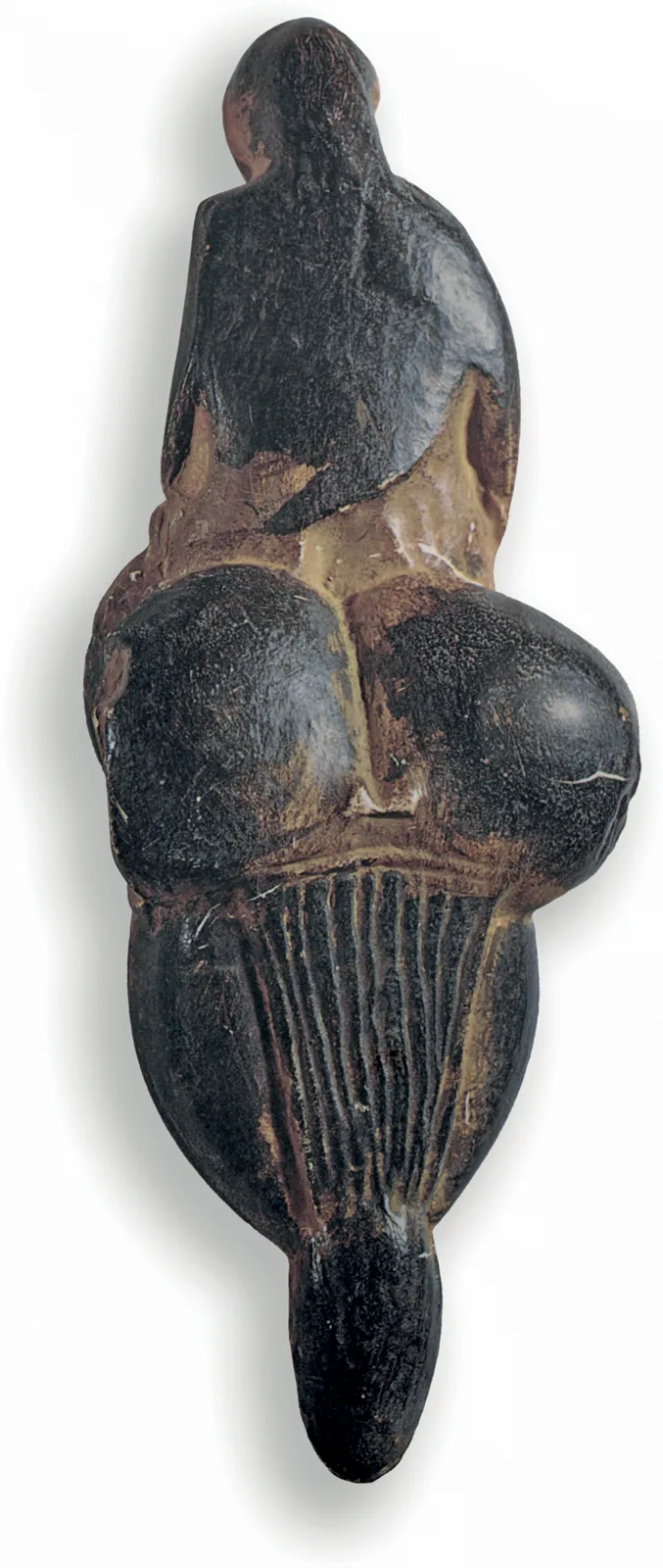
2 Venus of Lespugue. Aurignacian period, France. Distorted female fertility figure showing loin-cloth formed of twisted strands of wool or flax.
The second problem is that the skins of animals, as they dry, become very hard and intractable. Some method had to be found of making them soft and pliable; the simplest method of doing this is by a laborious mastication. The traditional Inuit method involves women spending a considerable part of their time chewing the hides which their husbands bring home from the chase. Another method consists of alternately wetting the hide and beating it with a mallet, having first scraped off any fragments of flesh which may still be adhering to it. Neither process is very satisfactory, however, for, if the hides become wet, the whole labour has to be repeated.
An advance was made when it was discovered that oil or blubber rubbed into the skin helped to keep it pliable for a longer time, that is, until the oil dried out. The next step was the discovery of tanning, and it is strange to think that the essential techniques of this process, so primitive in their inception, are still in use today. The bark of certain trees, notably the oak and the willow, contains tannic acid which can be extracted by soaking the bark in water. The hides are then immersed for considerable periods in the solution and emerge from this process permanently pliable and waterproof.
Such prepared pelts could also be cut and shaped, and we now come to one of the greatest technological advances in human history, comparable in importance to the invention of the wheel and the discovery of fire: the invention of the eyed needle. Large numbers of such needles, made of mammoth ivory, the bones of the reindeer and the tusks of the walrus, have been found in Palaeolithic caves, where they were deposited forty thousand years ago. Some of them are quite small and of exquisite workmanship. This invention made it possible to sew pieces of hide together to make them fit the body. The result was the kind of clothing still worn by Inuit peoples.
Meanwhile, people living in somewhat more temperate climates were discovering the use of animal and vegetable fibres. It is probable that felting was the first step. In this process, developed in Central Asia by the ancestors of the Mongols, wool or hair is combed out, wetted and placed in layers on a mat. The mat is then rolled up tightly and beaten with a stick. The strands of hair or wool are thus matted together and the felt produced is warm, pliable and durable and can be cut and sewn to make garments, rugs and tents.
Another primitive method, also using vegetable fibres, was to make use of the bark of certain trees such as the mulberry or fig. The bark was stripped off and soaked in water. Three layers were then placed on a flat stone, the grain of the middle layer being at right angles to the other two. The layers were then beaten with a mallet until they clung together and the bark cloth resulting was oiled or painted to add to its durability. This process, very similar to that used by the ancient Egyptians to convert papyrus into a writing material, might be regarded as a halfway house between matting and weaving. Bark cloth, however, is not easily cut or sewn, and garments made of it are usually draperies made from a single rectangle of material.
Bark fibres can be used for true weaving, as was done by some Native Americans, but they are not as satisfactory as other vegetable fibres such as flax, hemp and cotton. These, however, require cultivation and are therefore little used by nomadic people in the pastoral stage. Such people had sheep, and wool seems to have been employed in the Neolithic period. In the New World the useful animals were the llama, the alpaca and the vicuña.
Weaving on any extensive scale requires a fixed abode, since a loom tends to be large and heavy and therefore difficult to transport from place to place. The ideal situation for development was a small, settled community surrounded by grazing lands for sheep. The fleece was clipped off by methods closely resembling those in use today; the resultant bunch of fibre was then spun off and the thread woven into cloth on a loom. Once cloth manufacture, on however small a scale, had been established, the way was open for the development of costume as we know it.
The simplest method of using cloth for what is significantly termed ‘clothing’ was to wrap a small rectangle of it round the waist, thus making a sarong, the primitive form of the skirt. Later, another square of cloth was draped over the shoulders and kept in place by fibulae. Clothing of this nature was wused by the Egyptians, the Assyrians, the Greeks and the Romans. In fact draped clothes were the mark of civilization. Tailored clothes were regarded as ‘barbarian’ and the Romans at one time went so far as to decree the death penalty for wearing them.
Draped clothes plainly required a considerable development in the art of weaving in order to produce rectangles of cloth large enough for the purpose. The transition from skins of beasts to woven cloth was not, however, as simple or as immediate as was once supposed. Statuettes and bas-reliefs of the ancient Sumerian civilization of Mesopotamia (third millennium BCE) show figures wearing skirts composed of tufted tissues: that is, cloth which presents the appearance of tufts of wool arranged symmetrically, sometimes as a series of flounces. Once the tufts, or independent strands, were relegated to the borders of the cloth rectangles, they became a fringe, and this vestigial element can be seen very plainly in almost all the garments worn by Assyrians and Babylonians of both sexes.[4]

3 Group of Early Dynastic Statues, Early Dynastic I–II, from Mesopotamia. Skirts are built up of twisted tufts of wool or flax arranged in flounces.

4 The god Abu(?) and a female statue from Tell Asmar. Sumerian, early third millennium BCE. The loin-cloth has become recognizably a skirt and the twisted tufts have shrunk to a fringe.
It has been pointed out that the fringed shawls (for that would seem the most rewarding way to think of them) composing the costume of, for example, Assurbanipal, as seen in his statue in the British Museum, are shown much more tightly draped about the body than could have been the case in real life.[5] The sculptor has eliminated all folds and wrinkles in order to portray more clearly the patterns of the figured cloth.
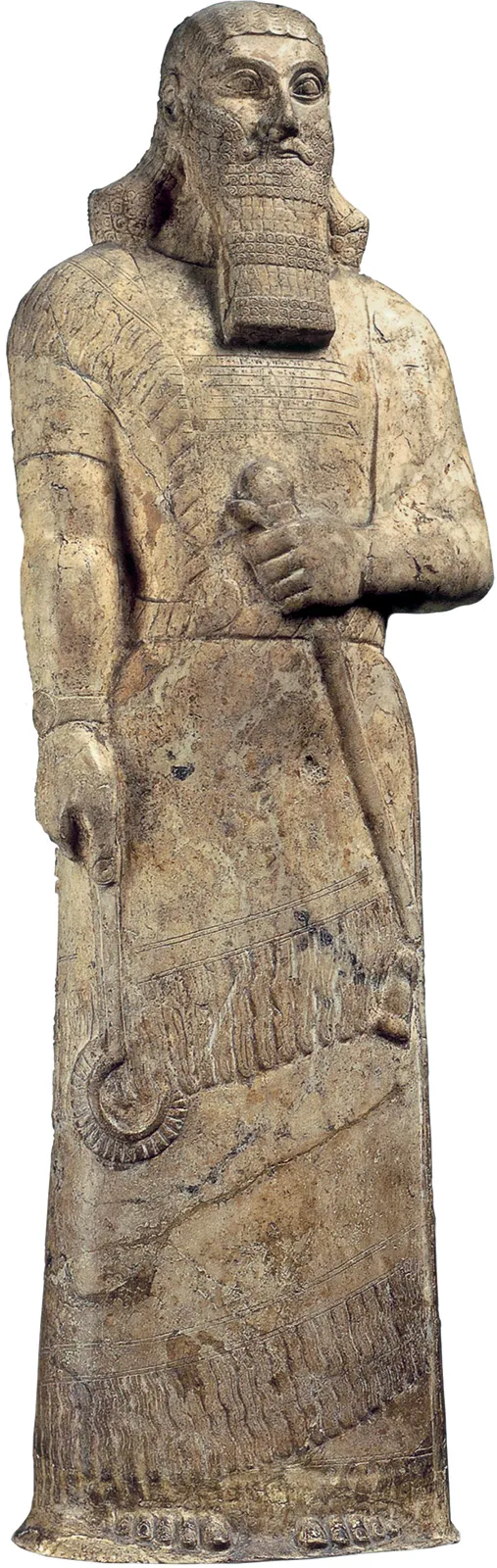
5 Assurbanipal II from Nimrud. Babylonian, 883–859 BCE. Male costume consisting of a long tunic with close-fitting sleeves. The diagonal fringes of the skirt are formed by a shawl thrown over one shoulder.
Women and high dignitaries continued to wear garments of this kind, but they were gradually replaced in ordinary male costume by a kind of tunic with sleeves. It is thought that the sleeves were due to the influence of the mountain people round about, as were also the closed boots. Both would seem to have been unnecessary in the very hot climate of the Euphrates and the Tigris valleys.
Women are seldom represented in the bas-reliefs found at Nineveh, although they are rich in representations of male costume. There are, however, cer...
Table of contents
- Cover
- Title Page
- About the Authors
- Contents
- Foreword
- Chapter 1: How it all Began
- Chapter 2: Greeks and Romans
- Chapter 3: Early Europe
- Chapter 4: The Renaissance and the Sixteenth Century
- Chapter 5: The Seventeenth Century
- Chapter 6: The Eighteenth Century
- Chapter 7: From 1800 to 1850
- Chapter 8: From 1850 to 1900
- Chapter 9: From 1900 to 1939
- Chapter 10: Rationed Fashion to Pluralistic Style
- Chapter 11: At the Turn of the Millennium
- Chapter 12: Fashion Since 2010
- Select Bibliography
- Picture Credits
- Index
- Marketing Page
- Copyright
Frequently asked questions
Yes, you can cancel anytime from the Subscription tab in your account settings on the Perlego website. Your subscription will stay active until the end of your current billing period. Learn how to cancel your subscription
No, books cannot be downloaded as external files, such as PDFs, for use outside of Perlego. However, you can download books within the Perlego app for offline reading on mobile or tablet. Learn how to download books offline
Perlego offers two plans: Essential and Complete
- Essential is ideal for learners and professionals who enjoy exploring a wide range of subjects. Access the Essential Library with 800,000+ trusted titles and best-sellers across business, personal growth, and the humanities. Includes unlimited reading time and Standard Read Aloud voice.
- Complete: Perfect for advanced learners and researchers needing full, unrestricted access. Unlock 1.4M+ books across hundreds of subjects, including academic and specialized titles. The Complete Plan also includes advanced features like Premium Read Aloud and Research Assistant.
We are an online textbook subscription service, where you can get access to an entire online library for less than the price of a single book per month. With over 1 million books across 990+ topics, we’ve got you covered! Learn about our mission
Look out for the read-aloud symbol on your next book to see if you can listen to it. The read-aloud tool reads text aloud for you, highlighting the text as it is being read. You can pause it, speed it up and slow it down. Learn more about Read Aloud
Yes! You can use the Perlego app on both iOS and Android devices to read anytime, anywhere — even offline. Perfect for commutes or when you’re on the go.
Please note we cannot support devices running on iOS 13 and Android 7 or earlier. Learn more about using the app
Please note we cannot support devices running on iOS 13 and Android 7 or earlier. Learn more about using the app
Yes, you can access Costume and Fashion by James Laver in PDF and/or ePUB format, as well as other popular books in Design & Fashion Design. We have over one million books available in our catalogue for you to explore.