eBook - ePub
An Architect's Guide to Construction-Second Edition
Enduring Ways in the Age of Immediacy
- English
- ePUB (mobile friendly)
- Available on iOS & Android
eBook - ePub
An Architect's Guide to Construction-Second Edition
Enduring Ways in the Age of Immediacy
Trusted by 375,005 students
Access to over 1 million titles for a fair monthly price.
Study more efficiently using our study tools.
Information
Topic
ArchitectureSubtopic
Architecture GeneralPart 1—Objectives
Construction administration is not about beautiful design or great planning concepts. Hopefully those have been captured in pre-construction work. There are really only two objectives left to achieve during the construction administration phase: compliance and risk management.

Figure 8—Project Objectives are considered at a project's beginning
The execution of a design is governed by the various contracts and agreements that surround it. The Client-Consultant agreement defines the Consultant’s and Client’s roles and responsibilities, including during construction. The construction agreement between the Client and a Contractor, usually signed long after the Client-Consultant agreement, describes the process of construction more from the contractor’s perspective—a fair approach, as the contractor has ultimate responsibility for construction. As will be discussed in a later Tale, the Client-Consultant and construction agreements are sometimes different regarding designers’ roles.
Another aspect of compliance is where design professions are distinguished from Clients and contractors. Designers have an overarching responsibility to act in the public interest, most clearly in the form of planning and building code compliance, often represented during construction by Regulators such as building code officials. Clients and Contractors assume Consultants protect the public, even when they ask Consultants to change their design during construction.
While a design is being executed in the public interest, the construction administrator also needs to be aware of and manage typical and emergent risks. “Typical” risks include events such as submittal review and payment certification, among others. These are the procedures that form part of virtually all projects but nonetheless involve the risk of making an error. “Emergent” risks are the unexpected aspects of construction, such as discovering different existing construction during renovation or addition, finding unusual soil conditions during excavation, etc. Although they are not explicit in a design, emergent risks must also be managed to resolution. Easier said than done!
Objective #1—Compliance
Our first Tale about compliance touches on the troubles associated with poor communications and record keeping. It is much less serious than our second tale, which compares two building collapses that occurred about thirty years and thousands of miles apart in my country, causing injury and death. They were arguably caused by similar patterns of poor design and construction communications in environments where compliance was difficult to measure at the time.
The events described in the second Tale caused professionals and regulators in my home province to create assurance letters with a view to preventing future tragedies. This they have largely done. The concepts underlying these assurance letters are discussed in the second Tale.
Compliance Tales from the Trenches:
O-1 The Missing Sample…p.16
O-2 Making Commitments with Assurance Letters…p.18

Tale O-1 The Missing Sample
“We met last December and agreed this glass treatment was not correct. I’m sure someone from your office was there, but I didn’t keep notes or minutes….surely you did? And we can’t find the sample!”—Subcontractor to Consultant

Photo 8—Which is the correct glass? Upper or lower?
What’s the point? This is not my story but I have enough details to tell it.
The project was a very tall mixed-use tower, the tallest and last of a whole-block development by the same developer. The first towers in the development were clad in a very distinctive dark glass that the developer loved, but hardly anyone else did—among other characteristics, its darkness exaggerated Vancouver’s winter gloom. When it came time to complete the development, planning authorities insisted on a different, lighter glass for the final tower. The developer reluctantly agreed, samples were submitted and approved, and construction started.
When the building was about one third clad, folks finally began to notice that the glass looked an awful lot like the dark glass on the preceding towers. Eventually city hall noticed and work was stopped on the project. There were many recriminations and litigation was imminent—then suddenly everything went quiet.
Another prominent local architect (different from the original architect) was brought into the project. He negotiated a design “transition” from the questionably colored glass at the base to a different glass on the top of the tower. The tower was completed and occupied without any legal action. What happened?
As it happens, the samples of the glass that was approved for the tower went missing, so there was no way for the planning authorities to prove whether the glass at the base was the correct glass or not.
What are the principles & best practices? it’s not enough to have an approval process. You must document the process and keep the evidence. Where the review process involves samples, I would start with an Action for each submittal to monitor the progress and resolution of its review. In this tale, clear capture of the deliberation by any of the parties might have eliminated later recriminations from regulatory agencies and the broader community.
Where the review process involves a sample, it is important to also label the sample so that when stored with many other samples (there could be hundreds), there is some hope of identifying and retrieving it.
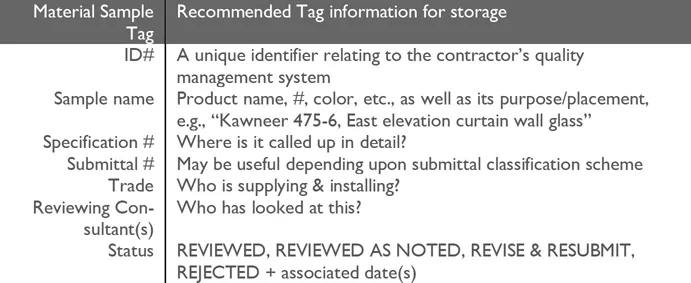
Figure 9—Recommended sample tag content
Consider something like the sample tag above, which includes: a unique ID# that connects the sample to an Action, which Action includes all of the review details; “Sample Name” that is what you know it as—the “6400 Arctic White” label that the manufacturer affixed also becomes “Level 2 east curtain wall” that you have some hope of understanding months or years later. The balance of the entries are self-evident.
Few Consultants or Contractors want to remain as custodians of samples after a project has been completed. In fact, most construction contracts are explicit about transferring samples to the Client as part of the project closeout process. Consultants should generally do the same, remembering to use a transmittal in order to automatically create a record of that transmission. Where the record shows you gave the sample to the Client, and there is any subsequent custody discussion, you will be in the clear.

Tale O-2 Making Commitments with Assurance Letters
“The evidence before this Commission is clear that the waterproofing of the roof failed virtually from the outset. The logical course of action would have been to undertake early and effective remedial measures to protect a valuable asset. Successive owners neglected to do so, and the consequences of that neglect were tragic.” 23—The Honourable Paul R. Belanger, Commissioner, Report of the Elliot Lake Commission of Inquiry, 2014
“In addition to the technical errors were a number of procedural deficiencies in the project delivery system.”—Station Square Commission Report, 198824
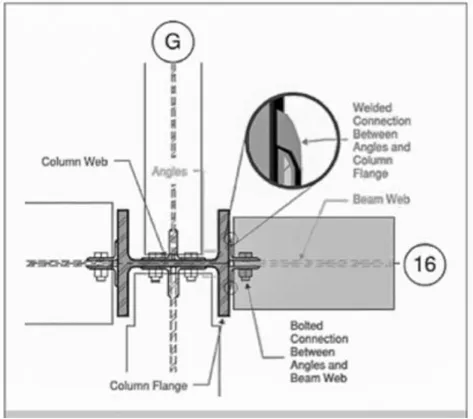
Figure 10—Detail that caused Elliot Lake collapse—water dripped on the weld for 30 years & rusted it out
What’s the point? I had not initially intended to have a ”Tale” about professional assurance letters as they are not yet widespread and I have no dramatic personal experience of them. But as I was completing the first edition of this book, one of my technical editors reminded me that the first report cited above had recently been published. It analyzes the collapse of a 33-year old shopping mall roof in central Ontario, Canada in 2012 that killed two persons and injured several others.
“The Commission of Inquiry studied the responsibilities and obligations of the different members involved in the design and construction for the Save-on-Foods store. A trend that brought concern at the time of construction, which is one that continues today, is the fragmentation of practices [emphasis added by auth...
Table of contents
- Cover
- Title Page
- Copyright Page
- Dedication
- Preface
- Acknowledgements
- Table of Contents
- Introduction to the 2nd Edition
- Part 1—Objectives
- Part 2—Fundamentals
- Part 3—Eleven Elements
- Concluding Tales in the Age of Immediacy
- Conclusions
- List of Tables
- Index
- Endnotes
Frequently asked questions
Yes, you can cancel anytime from the Subscription tab in your account settings on the Perlego website. Your subscription will stay active until the end of your current billing period. Learn how to cancel your subscription
No, books cannot be downloaded as external files, such as PDFs, for use outside of Perlego. However, you can download books within the Perlego app for offline reading on mobile or tablet. Learn how to download books offline
Perlego offers two plans: Essential and Complete
- Essential is ideal for learners and professionals who enjoy exploring a wide range of subjects. Access the Essential Library with 800,000+ trusted titles and best-sellers across business, personal growth, and the humanities. Includes unlimited reading time and Standard Read Aloud voice.
- Complete: Perfect for advanced learners and researchers needing full, unrestricted access. Unlock 1.4M+ books across hundreds of subjects, including academic and specialized titles. The Complete Plan also includes advanced features like Premium Read Aloud and Research Assistant.
We are an online textbook subscription service, where you can get access to an entire online library for less than the price of a single book per month. With over 1 million books across 990+ topics, we’ve got you covered! Learn about our mission
Look out for the read-aloud symbol on your next book to see if you can listen to it. The read-aloud tool reads text aloud for you, highlighting the text as it is being read. You can pause it, speed it up and slow it down. Learn more about Read Aloud
Yes! You can use the Perlego app on both iOS and Android devices to read anytime, anywhere — even offline. Perfect for commutes or when you’re on the go.
Please note we cannot support devices running on iOS 13 and Android 7 or earlier. Learn more about using the app
Please note we cannot support devices running on iOS 13 and Android 7 or earlier. Learn more about using the app
Yes, you can access An Architect's Guide to Construction-Second Edition by Brian Palmquist in PDF and/or ePUB format, as well as other popular books in Architecture & Architecture General. We have over one million books available in our catalogue for you to explore.