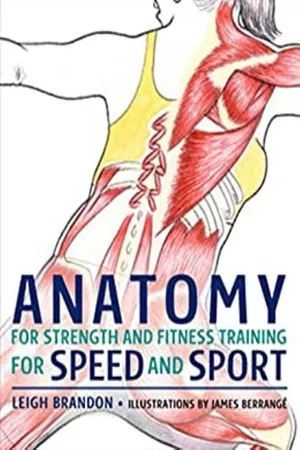
What does it take to succeed in sports? The formula for being a champion can be distilled into several skill sets that are essential for playing at a competitive level, with some of the most important being strength, speed and stamina. This full colour illustrated training guide takes an in-depth look at your muscles at work during various sporting activities, making it crystal clear how to tailor your training to your specific needs. Whether you play football, baseball, tennis, basketball, rugby, lacrosse - the anatomical illustrations used in this book show exactly how your muscles are engaged and how to improve your performance. Not only will athletes get the ultimate look at what happens to their bodies during bursts of speed, they will also find running and sprinting activities, elastic band overspeed activities, stretching activities, exercises to develop the muscles around the knees to limit potential injury, and general lower body development. The book is divided into eight sec
eBook - ePub
Anatomy for Strength and Fitness Training for Speed and Sport
- English
- ePUB (mobile friendly)
- Available on iOS & Android
eBook - ePub
Anatomy for Strength and Fitness Training for Speed and Sport
About this book
Trusted by 375,005 students
Access to over 1.5 million titles for a fair monthly price.
Study more efficiently using our study tools.
Information
HOW TO USE THIS BOOK
Anatomy for Strength and Fitness Training for Speed and Sport is a visual, anatomical and textual analysis of effective exercises that will help you in your chosen sporting field. It is also a guide on how to do the exercises and how to safely and effectively develop speed for your particular sport. The book has three distinct parts: the first is a basic introduction to anatomical definitions, terminology and an overview of the development of speed. Essentially it helps to demystify the language used in part two, making it easier to follow the instructions in that section.
Part two contains five sections: section one covers stretching and warm-up, section two covers ‘the core’, section three covers Primal Pattern® Movements, section four covers maximal strength and power development and section five covers agility, plyometric and speed drills. Within each section, the individual exercises or drills featured are defined and given some background. There is a ‘how to’ guide for doing the exercise, as well as a visual and technical exercise analysis of the main muscles that are working. The start or finish position is usually depicted and training tips may be included.
Part three helps you to understand how you might put these exercises together into a programme over a season to achieve optimal speed and performance.
The adult human body has 639 muscles and 206 bones; this book illustrates approximately 92 muscles involved in movement and stabilization. Many smaller muscles, including the deep, small muscles of the spine and jaw and most muscles of the hands and feet are not given specific attention, in order not to confuse the reader.
This book has been designed to help you to improve your speed in your chosen sport. Before introducing speed training, the body has to be prepared to handle the loads or stress put on the body during such training. Therefore, it is advised that the sections are completed in the following order:
1. Primal Pattern® Movement beginner exercises
2. Primal Pattern® Movement intermediate exercises
3. Primal Pattern® Movement advanced exercises
4. Maximal strength training
5. Power training
6. Speed/agility/plyometric drills
The length of time spent in each phase is dependent on your level of training experience. The more experience you have in training and the stronger you are, the less amount of time you need to spend in each phase. It is advised that you should have one to two years of resistance training before commencing ‘maximal strength’ training.

ANATOMICAL DEFINITIONS AND TERMINOLOGY
Anatomy has its own language and whilst technical, it has a basis in logic, originating from Latin and Greek root words that make it easier to learn and understand the names of muscles, bones and other body parts.
Whether you’re an athlete, personal trainer or strength and conditioning coach, using the correct terminology enables you to interact with other professionals and professional materials.
Like most medical terms, anatomical terms are made up of small word parts, known as combining forms, that fit together to make the full term. These ‘combining forms’ comprise roots, prefixes and suffixes. Knowing the different word parts allows you to unravel the word. Most anatomical terms only contain two parts: either a prefix and a root or a root and a suffix.
For example, if you take the terms subscapular and suprascapular, the root is ‘scapula’, commonly known as the shoulder blade. ‘Supra’ means ‘above’, hence ‘suprascapula’ means something above the shoulder blade and ‘sub’ means ‘below’ indicating in this instance something below the shoulder blade.
Common prefixes, suffixes and roots of anatomical terms


SYSTEMS OF THE BODY
The human body can be viewed as an integration of approximately 12 distinct systems that continuously interact to control a multitude of complex functions. These systems are a co-ordinated assembly of organs, each with specific capabilities, whose tissue structures suit a similar purpose and function.
This book illustrates and analyses the systems that control movement and posture – namely the muscular and skeletal systems, often referred to jointly as the musculoskeletal system.
The other systems are the cardiovascular, lymphatic, nervous, endocrine, integumentary, respiratory, digestive, urinary, immune and reproductive systems.
The muscular system
The muscular system facilitates movement, maintenance of posture and the production of heat and energy. It is made up of three types of muscle tissue: cardiac, smooth and striated.
Cardiac muscle forms the heart walls, while smooth muscle tissue is found in the walls of internal organs such as the stomach and blood vessels. Both are activated involuntarily via the autonomic nervous system and hormonal action.
Striated muscle makes up the bulk of the muscles as we commonly know them. The skeletal system includes the tendons that attach muscle to bone, as well as the connective tissue that surrounds the muscle tissue which is called fascia. A human male weighing 70 kg (154 lbs) has approximately 25–35 kg (55–77 lbs) of skeletal muscle.
Muscle attachments
Muscles attach to bone via tendons. The attachment points are referred to as the origin and the insertion.
The origin is the point of attachment that is proximal (closest to the root of a limb) or closest to the midline, or centre of the body. It is usually the least moveable point, acting as the anchor in muscle contraction.
The insertion is the point of attachment that is distal (furthest from the root of a limb) or furthest from the midline or centre of the body. The insertion is usually the most moveable part, and can be drawn towards the origin.
Knowing the origin and insertion of a muscle, which joint or joints the muscle crosses and what movement is caused at that joint/joints is a key element of exercise analysis.
There are typical features on all bones that act as convenient attachment points for the muscles. A description of typical bone features is given in the table on page 13.


Typical features on a bone

The skeletal system
This consists of bones, ligaments (that join bone to bone) and joints. Joints are referred to as articulations and are sometimes classified as a separate system: the articular system.
Apart from facilitating movement, the primary functions of the skeletal system include supporting the muscles, protecting the soft tissues and internal organs, the storage of surplus minerals and the formation of red blood cells in the bone marrow of the long bones.
Integrated systems
The body’s systems are completely and intricately interdependent. For movement to take place, for example, the respiratory system brings in oxygen and the digestive system breaks down our food into essential nutrients, both of which the cardiovascular system then carries to the working muscles via the blood to facilitate the energy reactions that result in physical work being done.
The lymphatic and circulatory systems help to carry away the waste products of these energy reactions, which are later converted and/or excreted by the digestive and urinary systems. The nervous system interacts with the muscles to facilitate the contraction and relaxation of the muscle tissue. The articular system of joints allows the levers of the body to move.

BODY PLANES AND REGIONS
When learning anatomy and analyzing movement, we refer to a standard reference position of the human body, known as the anatomical position. All movements and locations of anatomical structures are named as if the person were standing in this position (see illustration below).
Regional anatomy
This book is a technical labelling guide to the different superficial parts of the body. In anatomical language, common names such as ‘head’ are replaced with anatomical terms derived from Latin, such as cranial or cranium.
Within the different body regions there are subregions. For example, within the cranial region are the frontal, occipital, parietal and temporal subregions.
Anatomical planes
The body can be divided into three imaginary planes of reference, each perpendicular to the other.
The sagittal plane passes through the body from front to back, dividing it into a right half and a left half. The midline of the body is called the median. If the body is divided in the sagittal plane, directly through its median, this is known as the median sagittal plane. The coronal (frontal plane) passes through the body from top to bottom, dividing it into front and back sections.
The transverse (horizontal) plane passes through the middle of the body at right angles, divi...
Table of contents
- Cover Page
- Title Page
- Copyright Page
- Contents
- How to Use This Book
- PART 2 – THE EXERCISES
- PART 3 – THE PROGRAMME
- References
- Glossary
- Index
- backcover
Frequently asked questions
Yes, you can cancel anytime from the Subscription tab in your account settings on the Perlego website. Your subscription will stay active until the end of your current billing period. Learn how to cancel your subscription
No, books cannot be downloaded as external files, such as PDFs, for use outside of Perlego. However, you can download books within the Perlego app for offline reading on mobile or tablet. Learn how to download books offline
Perlego offers two plans: Essential and Complete
- Essential is ideal for learners and professionals who enjoy exploring a wide range of subjects. Access the Essential Library with 800,000+ trusted titles and best-sellers across business, personal growth, and the humanities. Includes unlimited reading time and Standard Read Aloud voice.
- Complete: Perfect for advanced learners and researchers needing full, unrestricted access. Unlock 1.5M+ books across hundreds of subjects, including academic and specialized titles. The Complete Plan also includes advanced features like Premium Read Aloud and Research Assistant.
We are an online textbook subscription service, where you can get access to an entire online library for less than the price of a single book per month. With over 1.5 million books across 990+ topics, we’ve got you covered! Learn about our mission
Look out for the read-aloud symbol on your next book to see if you can listen to it. The read-aloud tool reads text aloud for you, highlighting the text as it is being read. You can pause it, speed it up and slow it down. Learn more about Read Aloud
Yes! You can use the Perlego app on both iOS and Android devices to read anytime, anywhere — even offline. Perfect for commutes or when you’re on the go.
Please note we cannot support devices running on iOS 13 and Android 7 or earlier. Learn more about using the app
Please note we cannot support devices running on iOS 13 and Android 7 or earlier. Learn more about using the app
Yes, you can access Anatomy for Strength and Fitness Training for Speed and Sport by Leigh Brandon,James Berrange,James Berrange in PDF and/or ePUB format, as well as other popular books in Medicine & Anatomy. We have over 1.5 million books available in our catalogue for you to explore.