eBook - ePub
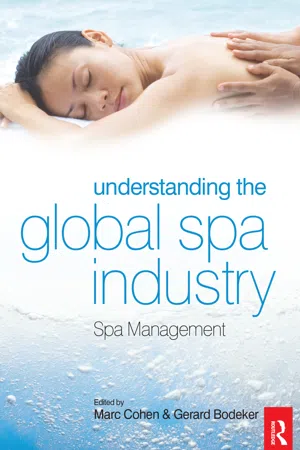
Understanding the Global Spa Industry
- 496 pages
- English
- ePUB (mobile friendly)
- Available on iOS & Android
eBook - ePub
Understanding the Global Spa Industry
About this book
The spa industry is currently the fastest growing segment of the hospitality and leisure industry with revenues exceeding those from amusement parks, box office receipts, vacation ownership gross sales and ski resort ticket sales.
Understanding the Global Spa Industry is the first book to examine management practices in this industry and offers a groundbreaking and comprehensive approach to global spa management, covering everything from the beginnings of the industry through to contemporary management and social and ethical issues.
With contributions from internationally renowned business leaders, practitioners and academics, this unique book is packed with case studies, examples and advice for all those working in, and studying, the international spa industry.
Understanding the Global Spa Industry brings an analytic lens to the spa movement, examining past, current and future trends and the potential for shaping wellness and health services in the 21st century.
Tools to learn more effectively

Saving Books

Keyword Search

Annotating Text

Listen to it instead
Information
PART 1
Planning
CHAPTER 1
Spas, wellness and human evolution
The emergence of a new global industry
The spa industry has recently emerged as a global phenomenon through a convergence of industries, traditions and therapeutic practices. Spa therapies have been around since ancient times in many different forms that reflect the cultural, social and political milieu in which there are embedded. These practices are now being rediscovered, integrated and branded to create a new global industry that draws from a range of aligned industries. These include beauty, massage, hospitality, tourism, architecture, property development, landscape design, fashion, food and beverage, fitness and leisure, personal development, as well as complementary, conventional and traditional medicine.
The global spa industry is a melting pot for a range of products and services that enhance health and well-being. As such, it combines features from regions around the globe, including American commercialism with its emphasis on beauty, pampering and destination experiences; Asian service ethics, holistic therapies and spiritual practices; European medical traditions and clinical acumen; and the indigenous knowledge and environmental consciousness of various tribal cultures. The convergence of these influences has seen spas being taken up by the international hospitality industry, fuelled by the merging of the travel dollar with the health dollar. Thus, spas are now springing up all over the world and have become a standard feature of luxury hotels and resorts.
The global spa industry is still in its infancy and, as yet, there are few robust figures documenting its size and scope. However, even without robust data, it is clear that the spa industry is already large and is growing. It is estimated that spas are a $40 billion global industry with at least 16,000 spas in the USA alone, and over 50,000 spas around the globe (Spafinder, 2007). It is also reported that spas are the fastest growing leisure industry with US figures showing a growth rate of around 20% per year. Furthermore, it is estimated that by 2001 revenues from spas had already overtaken revenues from amusement parks, box office receipts, vacation ownership and ski resorts (ISPA, 2002).
The rapid growth of the spa industry has created many challenges. As a high-touch, people-based business, training, recruiting and managing staff have emerged as major issues. Other major issues are the development of appropriate business models and valuation methods to enable investors to transparently asses their potential for returns. As well as being challenged by financial reporting, spas, like all other businesses, are also being challenged by issues of sustainability and the rise in consumer consciousness that is demanding greater disclosure of business practices as well as environmental and social performance.
While the global spa industry is still evolving, it is apparent that the industry is beginning to embrace wellness as part of its core business. The emergence of the global spa industry can therefore be understood as a natural response to the human desire for wellness and viewed in the context of the evolution of consciousness, globalisation and the many crises the world is now facing.
The birth of a new millennium
A growing body of opinion holds that the new millennia will mark a new phase in human evolution. It is clear that within the lifespan of the current generation, humanity will need to come to terms with the limits to growth and develop sustainable ways of ‘living well in the world’.
Since the publication of ‘Limits to Growth’ by the ‘Club of Rome’ in the early 1970s, there has been an awareness that the world is limited in terms of its physical resources and that the continued existence of humanity is dependent on drastically altering many of the current structures and ways of doing business and developing a sustainable relationship with the environment (Meadows et al., 1972). Humanity has reached a ‘tipping point’ bringing the possibility of either a massive breakdown or a breakthrough into new ways of living.
The new phase in human evolution represents a culmination of thousands of years of human history during which many different cultures, philosophies, traditions and technologies have attempted to address the questions of life, ageing, illness and death. It seems that all people have tried to tackle with the question of: How to live well in the world?
Now, at the turn of the millennium, when humanity has finally fully colonized the planet and has come up against the limits to growth, the question has become even more pertinent with the answers being relevant to the species as a whole. It is also now that the spa industry has emerged as a melting pot for the world’s traditions and knowledge. In doing the spa industry has become a global phenomenon that is poised to unite humanity in the common goal of working out how to be ‘well’. The spa industry is therefore also poised to lead the way and offer solutions on how to achieving sustainable wellbeing on a finite planet.
The health spectrum
Humanity’s search for well-being follows the evolution of medicine which has seen the elaboration of two distinct yet complementary approaches. These approaches parallel the rational and intuitive modes of human consciousness and the top-down and bottom-up approaches to knowledge and are represented by Eastern medicine.
Eastern and Western health traditions are based on holistic thinking that maintains a cosmological perspective outlining a philosophy of life, while Western medicine is based on a reductionist approach, emphasising controlled scientific experimentation and mathematical analysis. These two broad approaches have led to the development of two different approaches to achieving health and well-being (Cohen, 2002).
If health and disease are considered to be at opposite ends of a spectrum, then it is possible to classify health into three broad areas: ill health, average health and enhanced health (Figure 1.1). The divide between ill health and average health is generally defined in Western medical terms which classify diseases based on symptom patterns or other diagnostic parameters. Western medicine uses a bottom-up approach that aims to define and understand illness and develop interventions such as drugs and surgery to treat or prevent the disease and control factors that reduce well-being (‘stressors’).

Figure 1.1 The health spectrum
Compared to the divide between ill health and average health, the divide between average health and enhanced health is less distinct. Enhanced health is more than just being disease free, it assumes high levels of physical strength, stamina, mental clarity, as well as physical beauty and maximal enjoyment and fulfilment from life. This requires the holistic integration of multiple factors that determine physical, psychological, emotional, social, economic, environmental and spiritual health (Cohen, 2003). Within many Eastern philosophies the idea of enhanced health can be extended to the concept of ‘perfect health’ or ‘enlightenment’, whereby a person is ‘at one with the universe’ and hence in a state of perfect bliss or ‘nirvana’.
Bliss is the ultimate aim of Eastern healing and spiritual practices which adopt a top down approach by attempting to elicit bliss through meditation and other practices that enhance wellbeing (‘blissors’). Bliss, or ‘ananda’ in Sanskrit, is considered by Vedic scholars to be innermost level of the individual self, as well as the nature of the whole universe. It is the goal of the path to enlightenment and is found in the deepest experience of meditation and the innermost level of our being (Maharishi, 1986).
The state of bliss can also be considered as the highest aim of the ‘spa experience’ and to be the ultimate in achieving human potential. As the late anthropologist Joseph Campbell states: ‘I think that most people are looking for an experience that connects them to the ecstasy of what it could feel like to be totally alive. To know the unburdened state of total aliveness is the pinnacle of the human potential’ (Campbell, 1998). This state of ‘total aliveness’ referred to by the Campbell is what many people may consider to be ‘wellness’.
What is wellness?
While wellness has an emphasis which is quite distinct from the Western medical focus on illness and pathology, there is, as yet, no rigorously developed definition, theory or philosophy of wellness. At a basic level, wellness can be equated with ‘health’ which, according to the World Health Organization (WHO), is: ‘a state of complete physical, mental and social well-being and not merely the absence of disease or infirmity’ (WHO, 1992). The notion of wellness may be extended further to include not only physical, mental and social dimensions but also sexual, emotional, cultural, spiritual, educational, occupational, financial, environmental, ethical and existential dimensions. As a holistic concept wellness assumes that if any one of these dimensions is deficient then complete wellness cannot be achieved.
Wellness is defined by Corbin and Pangrazi (2001) as: ‘a multi dimensional state of being describing the existence of positive health in an individual as exemplified by quality of life and a sense of well-being’. Another definition by Muller and Kaufmann (2000) suggests that wellness is: ‘A state of health featuring the harmony of body, mind and spirit with self-responsibility, physical fitness/beautycare, healthy nutrition/ diet, relaxations/meditation, mental activity/education and environmental sensitivity/social contacts as fundamental elements’.
While these definitions attempt to capture the essence of wellness by referring to ‘health’, ‘harmony of body, mind and spirit’, ‘quality of life’ and ‘well-being’, they are more descriptive than definitive. Perhaps a more comprehensive definition is that: ‘Wellness is the multidimensional state of being “well”, where inner and outer worlds are in harmony: a heightened state of consciousness enabling you to be fully present in the moment and respond authentically to any situation from the “deep inner well of your being”. Wellness is dynamic and results in a continuous awakening and evolution of consciousness and is the state where you look, feel, perform, and stay “well” and, therefore, experience the greatest fulfilment and enjoyment from life and achieve the greatest longevity’.
This definition implies that the state of wellness allows the greatest flexibility to respond to situations and therefore provides the greatest resilience to stress and disease. Wellness is therefore the best preventive medicine. This definition also suggests that wellness is not a product you can buy or sell. Rather, it is a state of consciousness that guides the quality of our relationships with the world and therefore cannot be viewed separate from the environment in which it occurs. Thus, if ‘health’ is ‘wholeness’, then wellness is the experience of an ever-expanding realisation of what it means to be whole.
Wellness now defines a form of secular spirituality that transcends formal religion. Spas and wellness resorts may therefore be conceptualised in cultural/sociological terms as modern day temples where people can experience rituals, learn to deepen their personal wellness practices, raise their consciousness, become open to enhanced ways of being and deepen their experience of being alive.
At a personal level, striving for wellness directly involves raising consciousness and becoming more aware of both internal and external worlds. Spas have been predicted to play a major role in this process with the suggestion that ‘in the future, wellness retreats and spa will become centers of education, teaching the client how to take care of themselves and enjoy optimum health’ (Stapleton, 2003).
On a transpersonal level the evolution of the spa and well-ness industry can be understood as a natural consequence of the evolution of human consciousness whereby humans are coming to terms with how to live well on the planet. However, while humans have always sought out ways to live well in the world, most global indicators at the turn of the millennium suggest that humanit...
Table of contents
- Cover
- Half Title
- Title Page
- Copyright Page
- Preface
- Table of Contents
- List of Contributors
- List of Figures
- List of Tables
- Part 1 Planning
- Part 2 Profit
- Part 3 Product
- Part 4 Planet
- Part 5 People
- Index
Frequently asked questions
Yes, you can cancel anytime from the Subscription tab in your account settings on the Perlego website. Your subscription will stay active until the end of your current billing period. Learn how to cancel your subscription
No, books cannot be downloaded as external files, such as PDFs, for use outside of Perlego. However, you can download books within the Perlego app for offline reading on mobile or tablet. Learn how to download books offline
Perlego offers two plans: Essential and Complete
- Essential is ideal for learners and professionals who enjoy exploring a wide range of subjects. Access the Essential Library with 800,000+ trusted titles and best-sellers across business, personal growth, and the humanities. Includes unlimited reading time and Standard Read Aloud voice.
- Complete: Perfect for advanced learners and researchers needing full, unrestricted access. Unlock 1.4M+ books across hundreds of subjects, including academic and specialized titles. The Complete Plan also includes advanced features like Premium Read Aloud and Research Assistant.
We are an online textbook subscription service, where you can get access to an entire online library for less than the price of a single book per month. With over 1 million books across 990+ topics, we’ve got you covered! Learn about our mission
Look out for the read-aloud symbol on your next book to see if you can listen to it. The read-aloud tool reads text aloud for you, highlighting the text as it is being read. You can pause it, speed it up and slow it down. Learn more about Read Aloud
Yes! You can use the Perlego app on both iOS and Android devices to read anytime, anywhere — even offline. Perfect for commutes or when you’re on the go.
Please note we cannot support devices running on iOS 13 and Android 7 or earlier. Learn more about using the app
Please note we cannot support devices running on iOS 13 and Android 7 or earlier. Learn more about using the app
Yes, you can access Understanding the Global Spa Industry by Gerry Bodeker, Marc Cohen, Gerry Bodeker,Marc Cohen,Gerard Bodeker in PDF and/or ePUB format, as well as other popular books in Business & Hospitality, Travel & Tourism Industry. We have over one million books available in our catalogue for you to explore.