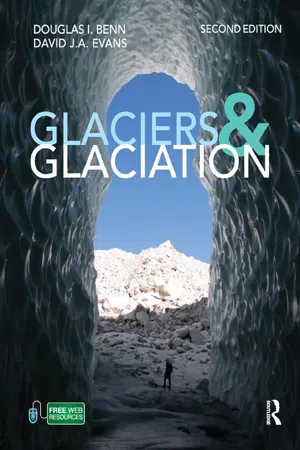
Glaciers and Glaciation is the classic textbook for all students of glaciation. Stimulating and accessible, it has established a reputation as a comprehensive and essential resource.
In this new edition, the text, references and illustrations have been thoroughly updated to give today's reader an up-to-the minute overview of the nature, origin and behaviour of glaciers and the geological and geomorphological evidence for their past history on earth.
The first part of the book investigates the processes involved in forming glacier ice, the nature of glacier-climate relationships, the mechanisms of glacier flow and the interactions of glaciers with other natural systems such as rivers, lakes and oceans.
In the second part, the emphasis moves to landforms and sediment, the interpretation of the earth's glacial legacy and the reconstruction of glacial depositional environments and palaeoglaciology.
- 816 pages
- English
- ePUB (mobile friendly)
- Available on iOS & Android
eBook - ePub
Glaciers and Glaciation, 2nd edition
About this book
PART ONE
GLACIERS

CHAPTER 1
INTRODUCTION

Ice arch on the Ngozumpa Glacier, Nepal, looking towards Cho Oyu (8,201 m) (Doug Benn)
1.1 GLACIER SYSTEMS
The life and death of glaciers and ice sheets have wide-reaching impacts, and can profoundly affect natural ecosystems and human communities. Together with sea ice, lake ice, snow cover and ground ice, glaciers and ice sheets comprise the cryosphere, from the Greek word kryo meaning ‘cold’. Mass and energy are constantly exchanged between the cryosphere and the other major components of the Earth system, the hydrosphere, atmosphere, biosphere and lithosphere. Glaciers are sensitive barometers of climate change, constantly growing and shrinking in response to changes in temperature, snowfall and other factors. In recent decades, a reduction of global ice volume has raised concerns about vanishing water supplies, increased hazards from outburst floods and avalanches, and sea-level change. In earlier times, however, inhabitants of mountain regions suffered loss of land and life as glaciers expanded during the Little Ice Age. To those who lost their farms to advancing ice, glaciers were like threatening monsters (fig. 1.1). Now, glaciers are commonly viewed as endangered species, victims of human-induced climate change (fig. 1.2; Carey, 2007).
Glaciers have shaped the landscapes of huge areas of the Earth's surface, scouring out rock and sediment and depositing thick accumulations of glacial debris. Moraines, laid down like tidemarks at former glacier limits, provide valuable sources of information on past glacier activity and climate change, while ice entombed in Greenland, Antarctica and smaller glaciers and ice caps contains rich archives of former environmental conditions. Glaciers are also endlessly fascinating, beautiful, powerful and wild.

Figure 1.1 In this 1892 engraving by H.G. Willinck, the Mer de Glace in the French Alps is portrayed as an icy dragon creeping down from the high mountains to threaten the valley below (Collection Payot, Conseil Général de la Haut Savoie).

Figure 1.2 Images such as this portrayal of the retreat of Gangotri Glacier, India, are widely employed to convey messages about the impact of anthropogenic climate change (NASA, http://earthobservatory.nasa.gov).

Figure 1.3 Mass and energy fluxes in an idealized glacier system (Brodzikowski and van Loon, 1991).
To understand how glaciers behave, it is helpful to view them as systems, with inputs and outputs, and interactions with other systems, such as the atmosphere, the oceans, rivers and the landscape (fig. 1.3). Mass enters the system in the form of snowfall and rock debris. Because it occupies an elevated position in the Earth's gravitational field, this mass has potential energy, which is expended as the glacier flows downslope. The energy expended is used to warm or melt ice, and must then be dissipated from the system in the form of heat or water. All the while, potential energy is turned into work, inexorably transferring ice and rock from the continents towards the sea.
1.1.1 MASS BALANCE
The gain and loss of ice in glacier systems is known as the mass balance. Snow and ice from direct snowfall, blown snow and avalanching from slopes above the glacier surface are collectively termed accumulation. This snow and ice are then transferred downvalley by glacier movement until they reach areas where they are lost to the system, either by melting, evaporation or the breakaway of ice blocks or icebergs, collectively known as ablation (fig. 1.3). Glaciers grow where climatic and topographic conditions allow the inputs to exceed the losses (i.e. where accumulation exceeds ablation), and glaciers recede where the outputs are greater than the inputs. Energy exchanges between the glacier and the atmosphere above and the solid Earth below also modify the temperature of the ice, so that the total energy store in the glacier can change through time even if the mass remains constant.
Most glaciers can be subdivided into two zones, an inner or upper zone, where annual accumulation exceeds losses by ablation, and an outer or lower zone, where ablation exceeds accumulation. These two zones are known as the accumulation zone and the ablation zone respectively and are separated by the equilibrium line, where annual accumulation and ablation are equal. The position of the equilibrium line (the equilibrium line altitude or ELA) is dictated by local and regional climate and topography. Glacier mass and energy balance form the subject of chapter 2, while iceberg calving is discussed in detail in Chapter 5.
1.1.2 MELTWATER
Meltwater is an extremely important component of glacier systems. Outputs of water from melting glaciers exert a very strong influence on the hydrology of proglacial areas, and feed water into other parts of the global hydro-logical system, including the oceans and the atmosphere. As it flows from glacier margins towards the sea, melt-water shapes the land, carving out gorges and depositing broad spreads of gravel, sand and silt. Within and beneath glacier and ice sheets, liquid water profoundly affects glaciers behaviour, controlling rates of glacier flow and influencing the processes and rates of erosion and deposition. The behaviour and work of meltwater is described in chapter 3.
1.1.3 GLACIER MOTION
Snow and ice are transferred from areas of accumulation to areas of ablation by glacier flow. Flow takes place by a variety of processes, which can be grouped together as sliding, deformation of the ice and deformation of the glacier bed. By one or more of these processes, glaciers move through the landscape, delivering snow and ice to areas where ablation exceeds accumulation, and meltwater and icebergs can leave the system. Rates and patterns of glacier motion depend on the balance between the driving forces (the downslope component of gravitational acceleration) and resisting forces (drag at the bed and margins of the glacier). When the whole system is in balance, rates of glacier flow match the rates that snow and ice is added and lost in the accumulation and ablation areas, so that the inputs, throughputs and outputs exist in a state of dynamic equilibrium. However, various factors can throw the system out of balance, causing glaciers and ice sheets to exhibit all kinds of surprising behaviour, such as rapid advances or retreats that are unrelated to climate. The processes and patterns of glacier motion are discussed in chapter 4. The dynamic behaviour of glaciers and ice caps forms the topic of chapter 5, while that of the Greenland and Antarctic Ice Sheets is examined in chapter 6.
1.1.4 GLACIERS AND SEA-LEVEL CHANGE
Water, in liquid, solid or gaseous form, is constantly moving between the oceans, the atmosphere, the cryosphere and the hydrosphere. These fluxes rarely balance, resulting in changes of storage. Increased storage in glaciers and ice sheets means less in the oceans, and vice versa, so glacier fluctuations can directly affect sea level. Changes in ice volume also influence patterns of loading on the Earth's crust and the distribution of mass around the planet, further influencing local and global sea levels. The influence of glacier fluctuations on past, present and future sea-level change forms the subject of chapter 7.
1.1.5 EROSION AND DEBRIS TRANSPORT
Glaciers are among the most effective agents of erosion on Earth, excavating impressive troughs and fjord basins, and scouring broad areas clear of soil and debris. They are also very efficient transporters of debris, carrying vast amounts of silt, sand, gravel and boulders up to several hundreds of kilometres from their source areas. This debris is then deposited in many types of environment, ranging from the glacier sole to the ocean floor. Processes and forms of glacial erosion form the subject of chapter 8, and the throughput of debris by ice and water is described in chapter 9.
1.1.6 GLACIAL SEDIMENTS, LANDFORMS AND LANDSCAPES
In the mid and high latitudes, the most obvious legacy of glaciers and ice sheets is the range of sediments and land-forms left behind after deglaciation, including corries, troughs, drumlins and moraines. These sediments and landforms can be used to reconstruct the extent and behaviour of former ice masses, and provide important clues to the past and present workings of the global climate system. Glacial sediments and landforms are also important from an engineering point of view, because so much human activity takes place in terrain affected by glacier erosion or deposition. Chapter 10 discusses depositional processes and sediments; chapter 11 examines depositional landforms; and chapter 12 zooms out to the widest scale to describe the overall impact of glaciation on entire landscapes.
1.2 GLACIER MORPHOLOGY
The form glaciers take is a function of climate and topography, and the morphology of any one glacier is unique to its location on the Earth's surface. Consequently, glacier morphologies form a broad continuum, from the smallest niche glacier to the largest ice sheet. For the purposes of description and study, however, it is convenient to subdivide this continuum into different glacier types, based on size, morphology and relationship to topography (Sugden and John, 1976).
1.2.1 ICE SHEETS AND ICE CAPS
Ice sheets and ice caps submerge the landscape, at least in their central portions, and major patterns of ice flow are largely independent of undulations in the bed. However, in the outer regions of ice sheets and ice caps, faster-moving ice streams and outlet glaciers are commonly located in troughs. A size of 50,000 km2 is adopted as the threshold between an ice cap an...
Table of contents
- Cover Page
- Half Title Page
- Title Page
- Copyright Page
- Table of Contents
- Preface to the First Edition
- Preface to the Second Edition
- Acknowledgements
- Part One Glaciers
- Part Two Glaciation
- Appendix List of Symbols Used In Equations
- References
- Index
Trusted by 375,005 students
Access to over 1.5 million titles for a fair monthly price.
Study more efficiently using our study tools.
Frequently asked questions
Yes, you can cancel anytime from the Subscription tab in your account settings on the Perlego website. Your subscription will stay active until the end of your current billing period. Learn how to cancel your subscription
No, books cannot be downloaded as external files, such as PDFs, for use outside of Perlego. However, you can download books within the Perlego app for offline reading on mobile or tablet. Learn how to download books offline
We are an online textbook subscription service, where you can get access to an entire online library for less than the price of a single book per month. With over 1.5 million books across 990+ topics, we’ve got you covered! Learn about our mission
Look out for the read-aloud symbol on your next book to see if you can listen to it. The read-aloud tool reads text aloud for you, highlighting the text as it is being read. You can pause it, speed it up and slow it down. Learn more about Read Aloud
Yes! You can use the Perlego app on both iOS and Android devices to read anytime, anywhere — even offline. Perfect for commutes or when you’re on the go.
Please note we cannot support devices running on iOS 13 and Android 7 or earlier. Learn more about using the app
Please note we cannot support devices running on iOS 13 and Android 7 or earlier. Learn more about using the app
Yes, you can access Glaciers and Glaciation, 2nd edition by Douglas Benn,David J A Evans in PDF and/or ePUB format, as well as other popular books in Physical Sciences & Geography. We have over 1.5 million books available in our catalogue for you to explore.