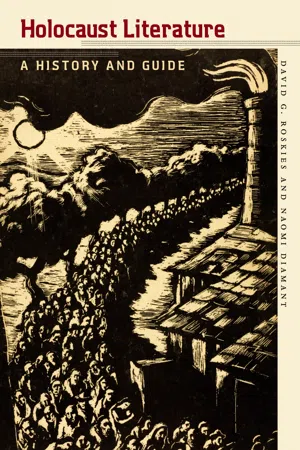
What is Holocaust literature? When does it begin and how is it changing? Is there an essential core that consists of diaries, eyewitness accounts of the concentration camps, and tales of individual survival? Is it the same everywhere: West and East, in Australia as in the Americas, in poetry as in prose? Is this literature sacred and separate, or can it be studied alongside other responses to catastrophe? What works of Holocaust literature will be read a hundred years from now—and why? Here, for the first time, is a historical survey of Holocaust literature in all genres, countries, and major languages. Beginning in wartime, it proceeds from the literature of mobilization and mourning in the Free World to the vast literature produced in Nazi-occupied ghettos, bunkers and places of hiding, transit and concentration camps. No less remarkable is the new memorial literature that begins to take shape within weeks and months of the liberation. Moving from Europe to Israel, the United States, and beyond, the authors situate the writings by real and proxy witnesses within three distinct postwar periods: "communal memory," still internal and internecine; "provisional memory" in the 1960s and 1970s, when a self-conscious Holocaust genre is born; and "authorized memory," in which we live today. Twenty book covers—first editions in their original languages—and a guide to the "first hundred books" show the multilingual scope, historical depth, and artistic range of this extraordinary body of writing.
- English
- ePUB (mobile friendly)
- Available on iOS & Android
eBook - ePub
About this book
Trusted by 375,005 students
Access to over 1.5 million titles for a fair monthly price.
Study more efficiently using our study tools.
Information
Publisher
Brandeis University PressYear
2012Print ISBN
9781611683585
9781611683578
eBook ISBN
9781611683592
[1]
WHAT IS HOLOCAUST LITERATURE?
WHAT IS HOLOCAUST LITERATURE? WHERE DOES IT BELONG, and how is it changing? Is it to be read as a genre of literature about death, war, atrocity, or trauma? Does this vast outpouring of writing invite comparisons with responses to other Jewish catastrophes or with other forms of Jewish resistance? Is it sui generis, to be measured against itself alone and demanding a unique interpretive lens? How may its verbal art be related to the other arts—plastic, graphic, photographic, cinematic, pornographic, acoustic? And finally, why should readers care about this catastrophe when there are already so many others to compete for their attention? Why read literature when the facts can be gleaned from other sources? Why read at all when one can see the movie or watch the video testimony?
Who speaks for the Holocaust? For some, Holocaust literature is everything written, and especially sung, in Yiddish—the loshn-hakdoyshim, or language of the martyrs—by those who perished. For others, it is the distinct voice of the survivors, who speak in a language authentic to the Holocaust—Borowski speaking Polish, Celan speaking German, Delbo speaking French, Levi speaking Italian, Lustig speaking Czech—or those who speak a language that bears witness to the Holocaust—Appelfeld speaking Hebrew, Wiesel speaking English.
How shall they speak? We need this literature to be monumental, commensurate with its subject matter. “For I intend to write a great, immortal epic,” Tadeusz Borowski resolved at the end of his first collection of concentration camp stories, “worthy of this unchanging, difficult world chiseled out of stone” (Borowski 1976, 180). “He told me his story,” Primo Levi recalled, “and today I have forgotten it, but it was certainly a sorrowful, cruel and moving story; because so are all our stories, all different and all full of a tragic, disturbing necessity. We tell them to each other in the evening, and they take place in Norway, Italy, Algeria, the Ukraine and are simple and incomprehensible like the stories in the Bible. But are they not themselves stories of a new Bible?” (1985, 65–66). We, their readers, moreover, expect Borowski’s great, immortal epic and Levi’s stories of a new Bible to emerge, as they did, from the epicenter of evil, the locus of the crime—Auschwitz. Yet from the very beginning and increasingly in our own day, we are drawn to alternative landscapes—Anne Frank’s Secret Annex, Momik’s cellar in Jerusalem, the Spiegelman home in Rego Park, New York—that decenter the horror and play with our desire to domesticate it. There was a time when the heroes of the Holocaust were the fighters and resisters, each remembered by name and political affiliation. Today they are more likely to be Everysurvivor, whose very survival is heroism enough.
Enough questions for now. It is time to propose a working definition at once formal and flexible, true to the past and attentive to the present. And here it is, with its component parts discussed below: “Holocaust literature comprises all forms of writing, both documentary and discursive, and in any language, that have shaped the public memory of the Holocaust and been shaped by it.”
All forms of writing, both documentary and discursive. Genre is the DNA of literature, so to view Holocaust writing through the lens of genre is anything but a dry, academic exercise. Diaries are universally acknowledged to be the core of wartime writing. By reading them in chronological order, we discover a specific type of diary that came into being when the confinement and enslavement of the Jews gave way to their mass extermination. It happened in year 4 of the war. By examining the corpus of wartime writing produced outside the war zone, we discover how literature was used to mobilize the public and then provided the same public with the means for mourning. Inside the war zone we discover reportage, second only to the diary in importance. By noting the recurrence of the coming-of-age story, the bildungsroman, in postwar writing, we recognize (and celebrate) the first such Holocaust story written in the collective voice. By starting from the beginning, we uncover the missing thread of fantasy and allegory. Certain genres rise to prominence, while others are consigned to oblivion. Then the chain may be broken beyond repair.
In any language. The multilingual scope of Holocaust writing makes maximal demands of its readers, none of whom could possibly read the entire corpus in the original. Works originally written in twelve languages are surveyed in this book. Each language is the bearer of religious symbolism, cultural memory and prejudice, national victory and defeat. Language is a mixture of high and low, declarative and cryptic, argot and dialect, doublespeak and “Jewspeak” (see below).
That have shaped the public memory of the Holocaust. Holocaust literature was born and bred in the habitat of public memory. Yet this did not come about all or everywhere at once. (My view of the Holocaust growing up in Yiddish-speaking Montreal was very different from the public perception of it among my cohort on American college campuses, just then engaged in a bitter protest against the war in Vietnam.) The growing public awareness of the Holocaust happened at the intersection of the private and public spheres: real and proxy witnesses began to write and publish, discovering new means of artistic expression and commemoration, but the public sphere was itself divided between Left and Right, East and West. When compiling the evidence of how The World Reacts to the Holocaust (Wyman 1996), the historian David Wyman proceeded country by country, and so do we.
Holocaust literature, as we shall see, unfolds both backward and forward: backward, as previously unknown works are published, annotated, translated, catalogued, and promptly forgotten; and forward, as new works of ever greater subtlety or simplicity come into being. How Holocaust literature came to be given that name is a large part of our story.
And been shaped by it. Holocaust memory unfolded in fits and starts because much of its narrative violated the horizon of expectations of a specific public. Instances of scandalous memory are a way of measuring these gaps, as when an uncensored piece of the Holocaust invaded the protected space of a readership that had made its peace with the past too eagerly and too soon. Fierce controversies over a Holocaust novel, a play, even a poem, moreover, tend to happen in nations that look to literature for self-definition: Russia, Poland, France, Italy, Mandatory Palestine (later the State of Israel), and Yiddishland (that is, the places where Yiddish is spoken). In these polities, the public looks to high culture and literary expression to bridge gaps between the generations. In Anglo-Saxon countries with a stronger and more unifying political culture, writers, poets, and playwrights are far less likely to shake things up or bring them back together. Either way, the course of Holocaust memory never did run smooth.
How This Book Is Different
Until now, Holocaust literature has been defined as belonging to a separate universe beyond normal beginning and end, and therefore demanding a unique interpretive lens. For some, this lens is transcendent, as everything—the genizah of fragments rescued from the ruins, the six million Jewish victims, the survivors, and their rescuers—has been rendered sacred. For others, the absolute extremity of the Holocaust has rendered obsolete, if not obscene, all accepted norms of beauty, human agency, and moral accountability.
This history and guide rejects all such essentialist claims. The push and pull between the sacred and profane, martyrdom and resistance, public memory and the unassimilable facts is the very story that cries out to be told. This being said, we limit our choice to works of secular literature. Be there no mistake about it: Chaim Grade, Jacob Glatstein, Uri Zvi Greenberg, Yitzhak Katzenelson, Zvi Kolitz, and Simkhe Bunem Shayevitsh are secular writers, however much they employ “God talk.” The return to covenantal language is just that—a late return, a studied response, a chapter in literary history, of a piece with something that we shall call “Jewspeak,” the invention of a superidiomatic Jewish voice in an otherwise silent universe. Jewish theological responses to the Holocaust—both during and after it—have their own genealogy, chronology, and audience, demanding a separate curriculum (Katz 2007). Where anthologizers have mixed literary and theological responses (Eliav 1965; A. Friedlander 1968; Roskies 1989), their agenda was explicitly restorative. The attempt to yoke the Good Book to the book is nothing less than utopian—itself a religiously inspired response to the Holocaust.
Cutting to the quick, cultural and literary critics in the West were driven by “a need to locate the epicenter of the earthquake.” They went in anxious search of “a geographical, verbal or symbolic locus of the crime” (Ezrahi 2003, 319–20). Thus it was that Auschwitz was placed at the heart of the epistemological darkness, serving as the axis of a new world order, a pan-European dystopia, and the birthplace of a new language—what Borowski called “crematorium Esperanto” (1976, 35). For Western intellectuals, Auschwitz became the telos, the sum and substance of the Holocaust, the ultimate and exclusive reference point. Once Auschwitz was adopted as a master metaphor, the Jews—crammed into cattle cars at one end of the journey and dragged from the gas chambers as a mass of blue bodies at the other—ceased to be bearers of a distinct cultural identity. They became the Unknown Victims of the Second World War. With the myriad points on the map of the Holocaust reduced to one; with all personal effects plundered or destroyed on arrival at Auschwitz; and with all the inmates—men and women, Gypsies and Jews, the Kapos and Muselmänner—dressed in identical striped uniforms, there emerged a master narrative of absolute extremity and anonymity.
The named survivors of the camps were the ones who spoke for the nameless victims, and in the late 1970s, they in turn began to merge into a single composite identity. By that point, there were a sufficient number of survivors’ testimonies published, translated, and catalogued to invite a collective biographer to step forward. Based on English translations of eyewitness accounts from the Nazi and Soviet concentration camps, Terrence Des Pres drew a group portrait of The Survivor (1976), whose emaciated, brutalized body could withstand the “excremental assault,” survive nightmare and waking, survive “radical nakedness” (Des Pres 1976, chaps. 3, 7) through a kind of biological imperative. Countering this Darwinian scheme was Lawrence Langer, whose aesthetics of atrocity centered on the “choiceless choice,” the denial of all human initiative or volition in Auschwitz (1982, 46; see also 67–129). Either way, on arrival the inmate was severed from spouse and children and then stripped of clothes, personal belongings, and name, so that reading the testimony of the camp survivors, the cultural critic came away with a new set of universal principles that transcended or subverted the existing moral, religious, and rational order. The “postmodern” world began in Auschwitz.
Just as we propose to study Holocaust literature as literature, to follow its meandering course of development wherever it may lead, so we abandon the search for an epicenter of evil. Rather than look to literature to create an “enduring, compelling narrative of mythical dimensions” that can answer all our needs (S. Friedlander 1992, 346), we shall introduce a new term of art, the “Jew-Zone,” at the beginning of the next chapter. In this way we hope to redraw the boundaries of Holocaust literature in both time and space.
Then there is the matter of memory itself. “Memory” has become the new catchword of Holocaust studies, understood to be a species of trauma, and memoir has become the favored genre of Holocaust writing (see N. Levi and Rothberg 2003b, parts V and X). Before abdicating the field to psychoanalytic theory, we should like to take a long, hard look at the ongoing memory work of real and proxy witnesses who have tried since the very beginning to find the part that stands for the whole. The art of fearful metonymy and analogy—especially in its earliest iterations, before the full scale of the catastrophe was known—is another key to our story. We shall read Holocaust literature in the light of Jewish responses to catastrophe in ancient, medieval, and modern times (Ezrahi 1980, 96–148; Mintz 1984; Roskies 1984). That earlier research will inform our discussion of the art of countercommentary—the subtle, ironic, subversive, despairing, and defiant ways in which Scripture was used and abused during wartime, whether by chroniclers and poets in search of analogies to the unprecedented terror, by Soviet Jewish writers trying to suture their wounds, or by survivors and witnesses as different as Anthony Hecht, Primo Levi, Dan Pagis, and Y. D. Sheinson, who wished to translate the spatial into the temporal, and death into life. Shayevitsh’s Lekh-lekho has already introduced us to the personal dynamic of Scriptural countermemory.
Finally, we come to the question of the timeline. “There is now broad consensus amongst scholars,” we read in a definitive anthology of theoretical readings on the Holocaust, “that public awareness of the Holocaust was low in the first decade and a half after the end of World War II, an interval that many think of as a kind of ‘latency period’ but which might also be thought of in terms of what Marxist cultural theory describes as the inevitable ‘cultural lag’ between the emergence of the new and the development of a vocabulary—be it conceptual or artistic—to describe it” (N. Levi and Rothberg 2003a, 6). The new story line reconstructs what was actually written, conceptualized, and artistically developed in the order in which this vast and variegated literature came into being, in lands and languages both large and small. The new periodization of Holocaust literature, the backbone of our book, challenges the broad scholarly consensus on every score. By the time we reach the trial of Adolf Eichmann in 1961, the supposed point of origin of public consciousness of the Holocaust in the Western world, our story is half over.
To tell one story well requires that one not try to tell every story. In The Black Seasons (2005), Michał Głowiński traced his recuperation from wartime trauma and postwar fixation with the annihilation of the Jews to his reading of a Polish encyclopedia. There was still an orderly, alphabetical world out there that could be described in meticulous, boring detail. S. Lillian Kremer’s two-volume Holocaust Literature: An Encyclopedia of Writers and their Work (2003) was supposed to be that kind of disinterested summation. Instead, the selection of authors and the allocation of space to each were based on celebrity, current fashion, and political correctness. There was a four-page entry for “Carl Friedman,” the pseudonym of a Jewish author who never existed, and no entry for Davidson Draenger, Gebirtig, Glik, Gradowski, Gutfreund, Isacovici, Keilson, Kolitz, Kruk, Malaparte, Opoczynski, Orlev, Perle, Rochman, Rosenfeld, Zable, and Zelkowicz, to mention but a few letters in the alphabet. To set the record on a different course, this book starts from the beginning, giving artistic primacy and moral priority to what came first.
The encyclopedic approach to the Holocaust is based on the belief that more is better. As in certain of the Psalms or the Book of Lamentations, there is a deep belief that once one has covered all the letters of the alphabet, one has said it all. But no one reads a literature in alphabetical order. The uninitiated reader needs an annotated guide, and the guide needs a guiding hand—in our case, two. Adhering to the same chronology as the historical overview, we present a suggested reading list in our Guide to the First Hundred Books on an even playing field, with equal time given to all. Each book is there for a reason: it stands alone, surprising or dismaying us, as the case may be, and complicating the very notion of narrative history. Most writers, moreover, appear only once, requiring us to make a judgment call and select a writer’s best or most representative work.
The story could have been told biographically, one writer at a time. It would have been easier for us to distinguish between those prose writers and poets who made the Holocaust their primary path—like Appelfeld, Auerbach, Borowski, Fink, Grynberg, Ka-Tzetnik, Kertész, Levi, Lustig, Rochman, Rosenfarb, Rudnicki, Semprún, Spiegel, and Wiesel—and those who, in Langer’s phrase (1995), “admitted” the Holocaust into their literary and moral imagination, like Amichai, Bellow, Glatstein, Grade, Greenberg, Kiš, Orlev, Ozick, Pagis, Singer, Strigler, Sutzkever, Tournier, and many other writers on our list. Ruth Wisse (2003, 1234) has tackled the problem of biography by drawing a more useful distinction between those who became writers by virtue of their wartime experience and those whose approach to art, reality, and history determined their response to Hitler. There is a strong cultural bias nowadays to favor writers in the first category, since they alone are presumed to map the rupture in human values after Auschwitz. In contrast, in this book writers are prized for their ability to create their own space and establish their own precedent, regardless of where they belong on the Holocaust map or even if they do not belong there at all. Alone among the poets, prose writers, and purveyors of Holocaust memory, Abraham Sutzkever accompanies our story from start to finish.
Encyclopedia entries, despite the animus that provoked this project to begin with, have proved very useful when it came to fleshing out the relationships among writers. The fact that Edgar Hilsenrath met Yakov Lind while waiting in a long line of unemployed workers hoping for a day job in construction in Netanya, Israel (Klingenstein 2004), speaks volumes about the marginalization of German-language writers after the Holocaust, the politics of displacement, the formation of a new cohort, and the evolution of a new anti-aesthetic. Hilsenrath and Lind belong together, even though they subsequently moved far apart. Large as the cast of characters is, however, it is far from being exhaustive. The fact that some appear and reappear while others do not appear at all is both by design and by default. A good storyteller tries to keep the reader guessing.
Every writer “creates” his own precursors, Jorge Luis Borges famously said in his essay on Franz Kafka. “A great work modifies our conception of the past, as it will modify the future” (Borges 1951). Art Spiegelman ranks as such a creative force. The revelatory power of Maus: A Survivor’s Tale (1986) made it imperative that some genealogy be found in the annals of graphic fiction. Even if they did not serve him as models, Kantor’s 1945 The Book of Alfred Kantor (1971), Y. D. Sheinson’s 1946 Passover Service (reprinted in A Survivor’s Hagg...
Table of contents
- Cover Page
- Title Page
- Copyright
- Contents
- List of Illustrations
- Preface
- [1]. What Is Holocaust Literature?
- [2]. Wartime Writing in the Free Zone, 1938–45
- [3]. Wartime Writing in the Jew-Zone, 1939–45
- [4]. Communal Memory, 1945–60
- [5]. Provisional Memory, 1960–85
- [6]. Authorized Memory, 1985–Present
- Guide to the First Hundred Books
- Color Plates
- Acknowledgments
- Works Cited
- Credits
- Index
Frequently asked questions
Yes, you can cancel anytime from the Subscription tab in your account settings on the Perlego website. Your subscription will stay active until the end of your current billing period. Learn how to cancel your subscription
No, books cannot be downloaded as external files, such as PDFs, for use outside of Perlego. However, you can download books within the Perlego app for offline reading on mobile or tablet. Learn how to download books offline
Perlego offers two plans: Essential and Complete
- Essential is ideal for learners and professionals who enjoy exploring a wide range of subjects. Access the Essential Library with 800,000+ trusted titles and best-sellers across business, personal growth, and the humanities. Includes unlimited reading time and Standard Read Aloud voice.
- Complete: Perfect for advanced learners and researchers needing full, unrestricted access. Unlock 1.5M+ books across hundreds of subjects, including academic and specialized titles. The Complete Plan also includes advanced features like Premium Read Aloud and Research Assistant.
We are an online textbook subscription service, where you can get access to an entire online library for less than the price of a single book per month. With over 1.5 million books across 990+ topics, we’ve got you covered! Learn about our mission
Look out for the read-aloud symbol on your next book to see if you can listen to it. The read-aloud tool reads text aloud for you, highlighting the text as it is being read. You can pause it, speed it up and slow it down. Learn more about Read Aloud
Yes! You can use the Perlego app on both iOS and Android devices to read anytime, anywhere — even offline. Perfect for commutes or when you’re on the go.
Please note we cannot support devices running on iOS 13 and Android 7 or earlier. Learn more about using the app
Please note we cannot support devices running on iOS 13 and Android 7 or earlier. Learn more about using the app
Yes, you can access Holocaust Literature by David G. Roskies,Naomi Diamant in PDF and/or ePUB format, as well as other popular books in Literature & Holocaust History. We have over 1.5 million books available in our catalogue for you to explore.