Recognition and Perception of Images
eBook - ePub

Recognition and Perception of Images

  1. English
  2. ePUB (mobile friendly)
  3. Available on iOS & Android
eBook - ePub

Recognition and Perception of Images

About this book

This book is dedicated to the unique interdisciplinary research of imagery processing, recognition and perception. The contents of this book are based on the concepts of mathematical processing, compositional analysis applied in the art and design, and psychological factors of the information perception process.

The conduction of compositional analysis carried out in the course of images processing and recognition, creation of the image project solution and modeling of the conceptual space structures are considered together with the mechanism of their perception.

Edited and written by a group of international experts, the practical applications for industry are covered, including the influence of internet memes on social networks and face recognition technology subject to interferences. The algorithms of perception and improving of accuracy necessary for satellite imagery recognition and complex reflection from the object are represented with the use of artificial neural networks.

Not just a study in how humans recognize and perceive images, this outstanding new volume delves into how these processes are used in technology for continuously evolving industrial applications. Whether for the veteran scientist or engineer, or for the student, this is a must-have for any library.
Frequently asked questions

Yes, you can cancel anytime from the Subscription tab in your account settings on the Perlego website. Your subscription will stay active until the end of your current billing period. Learn how to cancel your subscription.
No, books cannot be downloaded as external files, such as PDFs, for use outside of Perlego. However, you can download books within the Perlego app for offline reading on mobile or tablet. Learn more here.
Perlego offers two plans: Essential and Complete
  • Essential is ideal for learners and professionals who enjoy exploring a wide range of subjects. Access the Essential Library with 800,000+ trusted titles and best-sellers across business, personal growth, and the humanities. Includes unlimited reading time and Standard Read Aloud voice.
  • Complete: Perfect for advanced learners and researchers needing full, unrestricted access. Unlock 1.4M+ books across hundreds of subjects, including academic and specialized titles. The Complete Plan also includes advanced features like Premium Read Aloud and Research Assistant.
Both plans are available with monthly, semester, or annual billing cycles.
We are an online textbook subscription service, where you can get access to an entire online library for less than the price of a single book per month. With over 1 million books across 1000+ topics, we’ve got you covered! Learn more here.
Look out for the read-aloud symbol on your next book to see if you can listen to it. The read-aloud tool reads text aloud for you, highlighting the text as it is being read. You can pause it, speed it up and slow it down. Learn more here.
Yes! You can use the Perlego app on both iOS or Android devices to read anytime, anywhere — even offline. Perfect for commutes or when you’re on the go.
Please note we cannot support devices running on iOS 13 and Android 7 or earlier. Learn more about using the app.
Yes, you can access Recognition and Perception of Images by Iftikhar B. Abbasov in PDF and/or ePUB format, as well as other popular books in Technology & Engineering & Aeronautic & Astronautic Engineering. We have over one million books available in our catalogue for you to explore.

1
Perception of Images. Modern Trends

Iftikhar B. Abbasov
Southern Federal University, Academy of Engineering and Technology, Department of Engineering Graphics and Computer Design, Taganrog, Russia
Abstract
This chapter outlines the survey of some current lines of research in the field of visual information perception. The peculiarities of the eye anatomy of vertebrates, the structural elements of the visual system, the process of the senses and the perceptual organization of visual information by the brain are analyzed. The modes of eye movements, the structure of the eye bulb, current methods and means of eye movement recording are described. The questions concerning the perception of contour, light contrast and types of color sensing disorders are represented. The concepts of figure and ground are defined, and the factors of gestalt grouping, subjective contours and images recognition in space are analyzed. The peculiarities of monocular and binocular vision are pointed out. The process of perceptual organization, constancy factors, types of visual illusions and causes of their occurrence are described.
Keywords: Visual system, sense, perception, types of eye movements, color sensing disorder, factors of gestalt grouping, monocular and binocular vision, visual illusions

1.1 Visual System

1.1.1 Some Modern Research

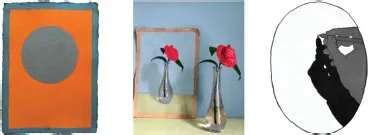
Let’s specify some works with a focus on the questions relating to visual perception. The work of [Pepperell, 2019] deals with the conceptual problems of visual perception with respect to the field of art. The author is a painter, and some of his pictures in the context of which the phenomenon of perception of works of pictorial art (Figure 1.1.1) is envisaged are represented in the work. In the opinion of the author the science is based on rational descriptions, and the art uses artful, aesthetic and philosophical concepts. The statement of German von Helmholtz about the perception of the external environment is mentioned. The qualities of our senses are projected on the objects in the external environment. They seem to be colorful, red or green, cold or warm, with smell or taste. Even understanding that these concepts are subjective and belong to the properties of our nervous system, the art can help us understand the complicated perception problems.
In the opinion of the author the perception of the real world and perception of images of the real world represent the extremely knotty problem associated with the rationality notion. The study of these problems may help us achieve progress in understanding perception in the context of art and current scientific and intellectual breakthroughs.
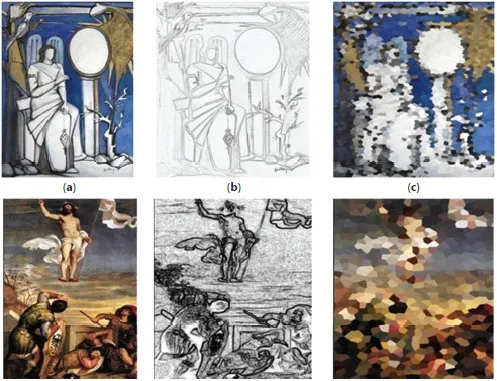
The results of a study of neuroelectrical brain activity in the course of perception of a particular set of images are presented in the work of [Maglione et al., 2017]. The original (Original set) and stylized pictures by Titian and a contemporary painter were shown to the selected group of people who passed the art studies. The stylized pictures were got from the original ones by means of leaving the color patches (Color set) and contour forms (Style set) (Figure 1.1.2). The picture and its processed images of L.D. Kampan, the modern painter, are represented in the first row, and the picture by Tiziano Vecellio and the relevant processed analogs in the second row. The research subjects were randomly affected by the offered irritators.
In the course of experimentation it has been found that the Original set induced more emotions than other sets of pictures during the first 10 seconds. The emotions brought out by Color and Style sets were intensified in 30 seconds. However, the emotions held steady for the first Original set. The evidences of cortical activity stream from the parietal and central regions to prefrontal and frontal regions in the course of viewing of images of all data sets were detected throughout the whole experiment. This result is congruent with the idea that active perception of images with the sustained cognitive attention in the parietal and central regions leads to the forming of judgments about their aesthetic valuation in the frontal region of head.
Schematic illustration of three paintings labeled, grey on orange, flower, and drawing drawing.
Figure 1.1.1 “Grey on orange”, “Flower”, “Drawing drawing” [Pepperell, 2019].
Schematic illustration of an example of three groups of stimuli tested in study (Original, column (a); Style, column (b); Color, column (c).
Figure 1.1.2 Example of three groups of stimuli tested in study (Original, column (a); Style, column (b); Color, column (c) [Maglione et al., 2017]).
It has been found that different regions of the brain including not only the frontal but also the motional and parietal cortical layers take part in the valuation of perceivable stimuli. It is necessary to admit that the prefrontal dorsolateral brain cortex is selectively activated by the only stimuli considered to be attractive. At the same time, the prefrontal activity is generally activated during the valuation of both pleasant and unpleasant stimuli. The value of research is that the neuroelectric visualization may be used for receiving useful information relating to the evolution of the aesthetic view of people who perceive the images from simple stimuli to the works of art.
The work of [Tikhomirov et al., 2018] is dedicated to the study of agnosia of visual objects to determine the pathologies of the brain. The visual agnosia has arisen in the case of damage of brain cortex structure responsible for the analysis and synthesis of information thus leading to the violation of the perceptual process and recognition of visual stimuli. The contemporary views about the neuroanatomical and neurophysiological basis of the visual process are described. The medical cases of visual objects agnosia and peculiarities of neuropsycological diagnostics and post-hospital rehabilitation of patients are presented.
The visual objects of different origin such as object images...

Table of contents

  1. Cover
  2. Table of Contents
  3. Title Page
  4. Copyright
  5. Abstract
  6. Preface
  7. 1 Perception of Images. Modern Trends
  8. 2 Image Recognition Based on Compositional Schemes
  9. 3 Sensory and Project Images in the Design Practice
  10. 4 Associative Perception of Conceptual Models of Exhibition Spaces
  11. 5 Disentanglement For Discriminative Visual Recognition
  12. 6 Development of the Toolkit to Process the Internet Memes Meant for the Modeling, Analysis, Monitoring and Management of Social Processes
  13. 7 The Use of the Mathematical Apparatus of Spatial Granulation in The Problems of Perception and Image Recognition
  14. 8 Inverse Synthetic Aperture Radars: Geometry, Signal Models and Image Reconstruction Methods
  15. 9 Remote Sensing Imagery Spatial Resolution Enhancement
  16. 10 The Theoretical and Technological Peculiarities of Aerospace Imagery Processing and Interpretation By Means of Artificial Neural Networks
  17. Index
  18. End User License Agreement