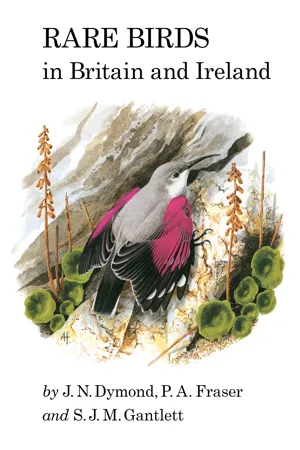
This trio of rare-bird specialists have produced not only a book of great fascination for those who delight in rarities for their own sake, but one that offers valuable information on changing patterns of arrival which may indicate changes of status of these birds within their breeding range.
This book is a successor to two earlier works, Scarce Migrant Birds in Britain and Ireland (Sharrock 1974) and Rare Birds in Britain and Ireland (Sharrock 1976). It unifies both of the earlier books and updates them, adding more than 80 species to the previous total.
The authors have analysed and considered some 45,000 records of scarce and rare birds in Britain and Ireland for the period 1958-85. Extreme rarities outside the period are also listed. More than 300 species accounts are now included, most of them accompanied by histograms of weekly and seasonal occurrences, with maps showing distribution by counties in spring and autumn or at particular times of the year. For rarities with twelve or fewer occurrences during the period 1958-85, the place, date and other relevant information is given for each record.
Every species is illustrated by a line drawing, more than 150 of them commissioned for this book, the remainder being selected from the two earlier works.
- 368 pages
- English
- ePUB (mobile friendly)
- Available on iOS & Android
eBook - ePub
About this book
Trusted by 375,005 students
Access to over 1.5 million titles for a fair monthly price.
Study more efficiently using our study tools.
Information
White-billed Diver
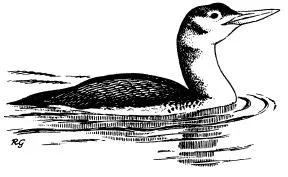
Breeds Arctic, from western USSR eastwards to Canada. Winters in adjacent coastal waters.
Resembles Great Northern Diver G. immer, but bill never has dark culmen ridge and is usually held pointing upwards, like Red-throated Diver G. stellata. Brit. Birds, 64: 519; 67: 257; 79: 365.

All but two of the 79 records in 1958–85 were between October and June, with a pronounced peak in the second half of that period, suggesting a small but regular wintering population and midwinter movement across the North Sea from Norwegian waters.

The numbers of birds seen have increased considerably during the course of the 28-year period (11 in the first ten years of the period and 50 in the last ten years). This compares with only 18 before 1958. The identification problem makes it difficult to draw conclusions from these figures, but the dramatic increase does seem likely to be real, at least in part, rather than entirely reflecting the increasing number and vigilance of observers. There was only one autumn record during 1958–72 but since then autumn records have become almost annual. The reported slight shift of the Gulf Stream in recent years and the consequent slight fall in sea temperature to the north of the British Isles may result in more White-billed Divers (and other Arctic species) coming further south to winter in British waters.
As might be expected from a species likely to be coming from Arctic Norwegian waters, the majority of records have come from the East Coast and especially Scotland. The spring peak in Shetland perhaps suggests a northerly departure route. One noteworthy individual returned each year from 1978 to at least 1988 to overwinter in the inshore waters between Whalsay and Mainland, Shetland.

Pied-billed Grebe
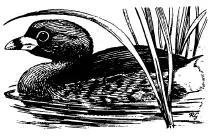
Breeds North, Central and South America. Canadian population winters south to USA.
Slighty larger than Little Grebe Tachybaptus ruficollis but with thick, short, stubby bill; plumage mostly grey-buff, darker above than below; in summer the pale bill has a vertical dark central bar, and the throat is black. Brit. Birds, 58: 305; 60: 290, 295; 72: 329.

Seemingly an unlikely transatlantic vagrant, at least nine were found during 1958–85 (and three since); some have stayed for long periods. Surprisingly for an American bird, four of the twelve records have come from the eastern side of the country.

These are the only records, and the nine in the period are mapped:
Somerset: a series of records probably involving one individual: Blagdon Lake on 22nd December 1963; Chew Valley Lake from 17th August to 23rd October 1965, 15th May 1966, 22nd July to 2nd November 1966, 14th May to 2nd October 1967; Blagdon Lake from 14th May to 5th June 1968; and Chew Valley Lake on 4th–5th July 1968.
Yorkshire: Beaverdyke Reservoir, near Harrogate, from 9th June to 24th November 1965.
Norfolk: Welney on 9th–12th November 1968.
Kirkcudbrightshire (Dumfries and Galloway): Carlingwark Loch, Castle Douglas on 1st–8th October 1975.
Aberdeenshire (Grampian): Loch of Strathbeg from 9th January to 27th March 1977.
Yorkshire (North Yorkshire): Gouthwaite Reservoir from 23rd April to 15th May 1977.
Dorset: Radipole Lake from 25th January to 4th February 1980; and subsequently at Studland from 10th February to 27th April 1980.

Outer Hebrides (Western Isles): Loch na Liana Moire, Askernish, South Uist from 8th June 1983 to 22nd August 1985.
Caernarvonshire (Gwynedd): Aber Ogwen from 13th November to 30th December 1984.
Glamorgan (Mid Glamorgan): Kenfig Pool from 31st January to 25th April 1987, and again from 31st October 1987 to 1st April 1988.
Dumfries-shire (Dumfries & Galloway): Lochmaben on 24th–25th April 1987.
Wexford: Lady’s Island Lake from 24th May to 19th June 1987.
Black-browed Albatross
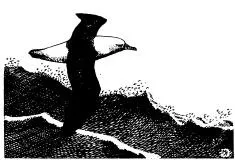
Breeds on islands of southern oceans. Winters north to Tropics.
Larger than a Gannet Sula bassana and shaped like a huge Fulmar Fulmarus glacialis...
Table of contents
- Cover
- Copyright page
- Contents
- Introduction
- Acknowledgements
- Species Accounts
- Category D Species
- Extreme Vagrants
- References and bibliography
Frequently asked questions
Yes, you can cancel anytime from the Subscription tab in your account settings on the Perlego website. Your subscription will stay active until the end of your current billing period. Learn how to cancel your subscription
No, books cannot be downloaded as external files, such as PDFs, for use outside of Perlego. However, you can download books within the Perlego app for offline reading on mobile or tablet. Learn how to download books offline
Perlego offers two plans: Essential and Complete
- Essential is ideal for learners and professionals who enjoy exploring a wide range of subjects. Access the Essential Library with 800,000+ trusted titles and best-sellers across business, personal growth, and the humanities. Includes unlimited reading time and Standard Read Aloud voice.
- Complete: Perfect for advanced learners and researchers needing full, unrestricted access. Unlock 1.5M+ books across hundreds of subjects, including academic and specialized titles. The Complete Plan also includes advanced features like Premium Read Aloud and Research Assistant.
We are an online textbook subscription service, where you can get access to an entire online library for less than the price of a single book per month. With over 1.5 million books across 990+ topics, we’ve got you covered! Learn about our mission
Look out for the read-aloud symbol on your next book to see if you can listen to it. The read-aloud tool reads text aloud for you, highlighting the text as it is being read. You can pause it, speed it up and slow it down. Learn more about Read Aloud
Yes! You can use the Perlego app on both iOS and Android devices to read anytime, anywhere — even offline. Perfect for commutes or when you’re on the go.
Please note we cannot support devices running on iOS 13 and Android 7 or earlier. Learn more about using the app
Please note we cannot support devices running on iOS 13 and Android 7 or earlier. Learn more about using the app
Yes, you can access Rare Birds in Britain and Ireland by J.N Dymond,P.A Fraser,S.J.M Gantlett in PDF and/or ePUB format, as well as other popular books in Biological Sciences & Zoology. We have over 1.5 million books available in our catalogue for you to explore.