An important new volume showcasing a wide range of faith-based responses to one of today's most pressing social issues, challenging us to expand our ways of understanding.
Land of Stark Contrasts brings together the work of social scientists, ethicists, and theologians exploring the profound role of religion in understanding and responding to homelessness and housing insecurity in all corners of the United States—from Seattle, San Francisco, and Silicon Valley to Dallas and San Antonio to Washington, D.C., and Boston.
Together, the essays of Land of Stark Contrasts chart intriguing ways forward for future initiatives to address the root causes of homelessness. In this way they are essential reading for practical theologians, congregational leaders, and faith-based nonprofit organizers exploring how to combine spiritual and material care for homeless individuals and other vulnerable populations. Social workers, nonprofit managers, and policy specialists seeking to understand how to partner better with faith-based organizations will also find the chapters in this volume an invaluable resource.
Contributors include James V. Spickard, Manuel Mejido Costoya and Margaret Breen, Michael R. Fisher Jr., Laura Stivers, Lauren Valk Lawson, Bruce Granville Miller, Nancy A. Khalil, John A. Coleman, S.J., Jeremy Phillip Brown, Paul Houston Blankenship, María Teresa Dávila, Roberto Mata, and Sathianathan Clarke.
Co-published with Seattle University's Center for Religious Wisdom and World Affairs
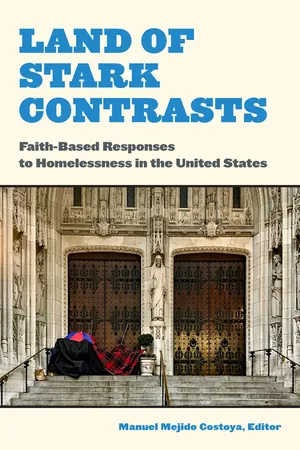
eBook - ePub
Land of Stark Contrasts
Faith-Based Responses to Homelessness in the United States
- 384 pages
- English
- ePUB (mobile friendly)
- Available on iOS & Android
eBook - ePub
Land of Stark Contrasts
Faith-Based Responses to Homelessness in the United States
About this book
Trusted by 375,005 students
Access to over 1.5 million titles for a fair monthly price.
Study more efficiently using our study tools.
Information
Publisher
Fordham University PressYear
2021Print ISBN
9780823293964
9780823293957
eBook ISBN
9780823293971
PART I
Public Religion and Community Revitalization
Talking About Homelessness
Shifting Discourses and the Appeal to Religion in America’s Seventh-Largest City
James V. Spickard
Talk matters. This is not news. Scholars from Epictetus to W. I. and Dorothy Thomas have argued that “if men define situations as real, they are real in their consequences.”1 How we frame a social problem shapes how we try to solve it. This is as true for homelessness as it is for racial and ethnic conflicts, a country’s tendency to go to war, or environmental change. The terms we use to grasp these problems shape the solutions we consider.
A decade ago, Anthony Marcus noted that “the social problems that drove men and women to beg for change or just pass idle days in public could have been understood … in a variety of … ways.”2 People could have noticed a lack of affordable housing, in which case providing housing would have been an obvious answer. People might have focused on an employment crisis, which would have recommended public works jobs. The situation could equally have been read as a crisis of public health, or of education, or indeed as a combination of all of these (which is surely the case).
However, none of this happened. Instead, the dominant discourse presented homelessness as a crisis of individuals. It focused on their addictions, their mental health, their disabilities, their work difficulties, their fractiousness, their lack of skills, or their personal bad luck. The result was a series of individual solutions: drug rehab, A.A., mental health programs, medical care, job skills training, résumé writing, or helping unhoused people fill out applications for public assistance. Though these all aided individuals, none addressed the systemic problems that increased homelessness in the first place. As Vincent Lyon-Callo pointed out in his case study of a homeless shelter in Northampton, Massachusetts, training individuals to write applications for jobs that do not exist can distract even shelter workers from identifying sources of housing that are readily available.3
Like all discourses, talk about homelessness changes from time to time and place to place. Some elements are relatively stable, such as the distinction between the “worthy” and the “unworthy” poor, between “locals” and “transients,” or between those “ready to help themselves” and those “trying to milk the system.” These ideas have dominated much of American history.4 They portray homelessness as a matter of flawed individuals, typically vagrant, on whom government aid was wasted.
In contrast, the 1930s Great Depression produces a different view. A crashed economy, massive unemployment, and capitalism’s seeming inability to restore prosperity prompted government action. Public works projects, income support, and a host of new financial regulations were intended to stabilize markets while aiding the poor. Later federal spending on the G.I. Bill, defense and aerospace, and the Interstate Highway system stimulated the economy and created a new, professionally based middle class.5 Keynesian management produced a stable economy, decreased social inequality, and created a decades-long dearth of street homelessness. It was not until the economic crises of the early 1980s that homelessness again became a major part of American city life.6
By then, however, Ronald Reagan had been elected president on a platform that saw government as the problem, so government solutions were not forthcoming. Administration officials argued that deregulated markets are the best means for distributing goods and services in all times and places.7 Michael Burawoy has called this ideology “third-wave marketization.”8 The periods 1775–1830, 1914–33, and 1980–present each used “market fundamentalism” to dismantle worker protections, shred social safety nets, and deregulate businesses.9 Each one also increased poverty and social inequality, and each ultimately resulted in an economic crash. The first two waves aroused considerable working-class and religious push-back, exemplified by the Chartist, trade union, and social gospel movements. Despite the economic crises that followed financial deregulation—1989–91, 1997–98, 2001, 2007–8, 2010–12—third-wave marketization has not given those movements much traction.10
Burawoy’s term “marketization” is attractive, but it leaves out one key element of the contemporary discourse about homelessness: an emphasis on individuals. The term “neoliberalism” does a better job. That ideology combines a belief in the sanctity of markets with a focus on the individual roots of social problems.11 Prime Minister Margaret Thatcher’s famous “There is no such thing as society” quote is typical: neoliberalism emphasizes personal responsibility and the role of the private sector in helping those in need. In Thatcher’s words, “The quality of our lives will depend upon how much each of us is prepared to take responsibility for ourselves and each of us [is] prepared to turn round and help by our own efforts those who are unfortunate.”12 Government, in this view, should play at best a minor role.
Thatcher did not talk about religious involvement in helping others, but Americans certainly do. Polling data show stable support for religious groups helping the poor, and those polled even think they are best at doing some of the needed tasks. A 2009 Pew study, for example, showed that 52 percent of Americans thought religious organizations were more effective than private organizations and government at feeding homeless people.13 Sixty-nine percent said they favored allowing religious groups to apply for government funding to provide social services. Other polls have shown similar support for private-sector charities’ involvement in tasks that from the ’30s to the ’60s were seen as government responsibilities.14 Neoliberalism prefers such private action. Its emphasis on markets leads it to think private activity is more efficient; its focus on individuals leads it to favor helping people personally rather than changing social systems. The result is a discourse primed to encourage religious involvement in charity work but not in social change.15
Jason Hackworth has studied the effects of neoliberal discourse on both city planning and on the work of religious charities. He reminds us that the picture is inevitably complex. “Neoliberalism, like many other ‘-isms,’ is a highly contingent process that manifests itself, and is experienced differently, across space.”16 In this chapter, I shall examine a specific space—San Antonio, Texas—to show the shifts in this city’s discourse surrounding homelessness and the effect that discourse has had on its proposed solutions. Please remember: this is a study of discourse, not an evaluation of the San Antonio organizations working to help homeless people. In both discourse and programs, religion plays an important role.
San Antonio, Texas
With a population of nearly 1.5 million, San Antonio is the nation’s seventh-largest city. It is, however, only the twenty-fourth-largest metropolitan area because it has annexed almost all of its suburbs, including the wealthy suburbs on its northern tier. The city sprawls across 465 square miles, nearly as many as Los Angeles, which has three times its population. Transportation depends on cars. An inner ring of elevated freeways circles the downtown business district, separating it from heavily Latino neighborhoods to the west and south and a traditionally Black neighborhood to the east (see Figure 1). Those neighborhoods are largely working class and have long been the source of the low-wage labor that serves the city’s light industry.17

Figure 1. San Antonio Neighborhood Poverty Trends, 1980–2010 (Source: Heywood Sanders, “Cityscrapes: Lands of the Lost,” San Antonio Current, December 17, 2014, accessed December 6, 2020, www.sacurrent.com )
Whites and upper-income Latinos live to the north and commute to the city center over a series of ring-and-spoke freeways. Housing there is newer, and those areas have the best schools and city services. What little crosstown bus service there is travels north during the morning and back south during the afternoon—carrying maids, cleaners, and others to and from their North Side workplaces. The result is the most income-segregated city in the U.S.18 and the third-most-economically segregated large city, when one combines income, education, and occupational measures.19 This inequality primes the city for homelessness.
As in many cities, homeless people have long congregated downtown. They found services and transportation there, and many had previously lived in the chronically poor neighborhoods immediately to the east and west. City leaders have openly worried that having visible homeless in that area would interfere with tourism, the city’s third-largest industry.20 There was thus some pressure to find another place for them. There was, however, also resistance to using a “leaf blower mentality” to force homeless people to move without solving their problems.21
In the summer of 2003, San Antonio’s then-mayor, Ed Garza, established a Task Force on Hunger and Homelessness to come up with solutions. Chaired by council member Patti Radle, the homelessness subcommittee filed a report in January 2005 that recommended a series of programs for people who are temporarily or episodically homeless, plus a Ten-Year Plan to end chronic homelessness.22 These plans focused on both systemic and individual risk factors. They involved a combination of emergency shelters, transitional housing programs, permanent supportive housing, and increased public housing, plus “safe havens” for those who cannot follow restrictive program rules. The city council adopted the plan by unanimous vote on January 27, 2005.
This plan is striking, given the neoliberal discourse prominent at the time. Rather than seeing homelessness as a matter of broken individuals, it identified five systemic factors that contribute to homelessness. The first of these was the city’s lack of affordable housing, which the report noted had been exacerbated by “a significant reduction in public housing units” in recent years.23 Other factors were “low-wage jobs that do not pay enough for a worker to afford decent housing,” “limited or non-existent transportation to better-paying jobs,” and “an educational system that leaves many unprepared for the job market.”24 The only systemic factor that spoke to individual behavior was a “fragmented, under-funded mental hea...
Table of contents
- Cover
- Half Title
- Title Page
- Copyright
- Contents
- Half Title
- Introduction
- Part I – Public Religion and Community Revitalization
- Part II – Religious Worldviews and the Common Good Reimagined
- Part III – Theological Insights for Homeless Ministries
- Acknowledgments
- List of Contributors
- Index
Frequently asked questions
Yes, you can cancel anytime from the Subscription tab in your account settings on the Perlego website. Your subscription will stay active until the end of your current billing period. Learn how to cancel your subscription
No, books cannot be downloaded as external files, such as PDFs, for use outside of Perlego. However, you can download books within the Perlego app for offline reading on mobile or tablet. Learn how to download books offline
Perlego offers two plans: Essential and Complete
- Essential is ideal for learners and professionals who enjoy exploring a wide range of subjects. Access the Essential Library with 800,000+ trusted titles and best-sellers across business, personal growth, and the humanities. Includes unlimited reading time and Standard Read Aloud voice.
- Complete: Perfect for advanced learners and researchers needing full, unrestricted access. Unlock 1.5M+ books across hundreds of subjects, including academic and specialized titles. The Complete Plan also includes advanced features like Premium Read Aloud and Research Assistant.
We are an online textbook subscription service, where you can get access to an entire online library for less than the price of a single book per month. With over 1.5 million books across 990+ topics, we’ve got you covered! Learn about our mission
Look out for the read-aloud symbol on your next book to see if you can listen to it. The read-aloud tool reads text aloud for you, highlighting the text as it is being read. You can pause it, speed it up and slow it down. Learn more about Read Aloud
Yes! You can use the Perlego app on both iOS and Android devices to read anytime, anywhere — even offline. Perfect for commutes or when you’re on the go.
Please note we cannot support devices running on iOS 13 and Android 7 or earlier. Learn more about using the app
Please note we cannot support devices running on iOS 13 and Android 7 or earlier. Learn more about using the app
Yes, you can access Land of Stark Contrasts by Manuel Mejido Costoya in PDF and/or ePUB format, as well as other popular books in Teologia e religione & Politica sociale. We have over 1.5 million books available in our catalogue for you to explore.