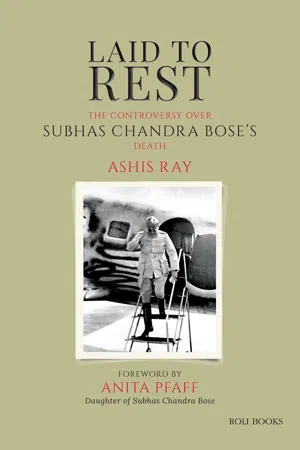
"Laid to Rest: The Controversy over Subhas Chandra Bose's Death is the most comprehensive compilation of hard evidence ever presented on the still hotly-debated demise of one of the heroes of the Indian freedom movement. It pieces together a plethora of first-hand, eye-witness accounts of the plane crash at Taipei that resulted in Subhas Bose breathing his last in a Japanese military hospital, his cremation and the transfer of his ashes to Japan, where they remain till date. In a veritable tour de force, the book presents irrefutable, overwhelming testimonies from survivors of the crash, people who were at Bose's bedside when he passed away, attendees at the cremation and couriers of the mortal remains to Tokyo and ultimately to its current resting place at Renkoji temple. Indian, Japanese and Taiwanese nationals unite to provide an unimpeachable and unanimous verdict. The publication decimates conspiracy theories; and questions successive Indian governments for ignoring the plaintive cry of Bose's Austrian widow and economist daughter to apply closure to a needless and never ending controversy."
- 352 pages
- English
- ePUB (mobile friendly)
- Available on iOS & Android
eBook - ePub
Laid to Rest: The Controversy over Subhas Chandra Bose's Death
About this book
Trusted by 375,005 students
Access to over 1.5 million titles for a fair monthly price.
Study more efficiently using our study tools.
Information

LAID TO
REST
OTHER LOTUS TITLES
| Ajit Bhattacharjea | Sheikh Mohammad Abdullah: Tragic Hero of Kashmir |
| Aitzaz Ahsan | The Indus Saga: The Making of Pakistan |
| Ajay Mansingh | Firaq Gorakhpuri: The Poet of Pain & Ecstasy |
| Alam Srinivas | Women of Vision: Nine Business Leaders in Conversation |
| Amarinder Singh | The Last Sunset: The Rise & Fall of the Lahore Durbar |
| Bertil Falk | Feroze: The Forgotten Gandhi |
| Hamish Mcdonald | Ambani & Sons |
| Kunal Purandare | Ramakant Achrekar: A Biography |
| Lucy Peck | Agra: The Architectural Heritage |
| Lucy Peck | Delhi a Thousand Years of Building: An INTACH-Roli Guide |
| Madan Gopal | My Life and Times: Munshi Premchand |
| M.J. Akbar | Byline |
| M.J. Akbar | Blood Brothers: A Family Saga |
| M.J. Akbar | Have Pen, Will Travel: Observations of a Globetrotter |
| M.J. Akbar | India The Siege Within: Challenges to a Nation’s Unity |
| M.J. Akbar | Kashmir: Behind the Vale |
| M.J. Akbar | Nehru: The Making of India |
| M.J. Akbar | The Shade of Swords: Jihad and the Conflict between Islam and Christianity |
| Maj. Gen. Ian Cardozo | Param Vir: Our Heroes in Battle |
| Maj. Gen. Ian Cardozo | The Sinking of INS Khukri: What Happened in 1971 |
| Madhu Trehan | Tehelka as Metaphor |
| Moin Mir | Surat: Fall of a Port, Rise of a Prince Defeat of the East India Company in the House of Commons |
| Monisha Rajesh | Around India in 80 Trains |
| Noorul Hasan | Meena Kumari: The Poet |
| Peter Church | Added Value: The Life Stories of Indian Business Leaders |
| Peter Church | Profiles in Enterprise: Inspiring Stories of Indian Business Leaders |
| Prateep K. Lahri | Decoding Intolerance: Riots and the Emergence of Terrorism in India |
| Rajika Bhandari | The Raj on the Move: Story of the Dak Bungalow |
| Ralph Russell | The Famous Ghalib: The Sound of my Moving Pen |
| R.V. Smith | Delhi: Unknown Tales of a City |
| Salman Akthar | The Book of Emotions |
| Shahrayar Khan | Bhopal Connections: Vignettes of Royal Rule |
| Shantanu Guha Ray | Mahi: The Story of India’s Most Successful Captain |
| Sharmishta Gooptu | Bengali Cinema: An Other Nation |
| Shrabani Basu | Spy Princess: The Life of Noor Inayat Khan |
| S. Hussain Zaidi | Dongri to Dubai |
| Sunil Raman & Rohit Aggarwal | Delhi Durbar: 1911 The Complete Story |
| Sunetra Choudhury | Behind Bars: Prison Tales of India’s Most Famous |
| Thomas Weber | Going Native: Gandhi’s Relationship with Western Women |
| Thomas Weber | Gandhi at First Sight |
| Vappala Balachandran | A Life In Shadow: The Secret Story of ACN Nambiar A forgotten Anti-Colonial Warrior |
| Vir Sanghvi | Men of Steel: India’s Business Leaders in Candid Conversation |
| Zubin Mehta | Zubin Mehta: The Score of My Life |
FORTHCOMING TITLES
| Prateep K. Lahiri | A Tide in the Affairs of Men: A Public Servant Remembers |
| Aruna Roy | The RTI Story: A People’s Movement for Transparency |

ROLI BOOKS
This digital edition published in 2018
First published in 2018 by
The Lotus Collection
An Imprint of Roli Books Pvt. Ltd
M-75, Greater Kailash- II Market
New Delhi 110 048
Phone: ++91 (011) 40682000
Email: [email protected]
Website: www.rolibooks.com
Copyright © Ashis Ray, 2018
All rights reserved.
No part of this publication may be reproduced, transmitted, or stored in a retrieval system, in any form or by any means, whether electronic, mechanical, print reproduction, recording or otherwise, without the prior permission of Roli Books. Any unauthorized distribution of this e-book may be considered a direct infringement of copyright and those responsible may be liable in law accordingly.
eISBN: 978-81-936260-5-4
All rights reserved.
This e-book is sold subject to the condition that it shall not, by way of trade or otherwise, be lent, resold, hired out, or otherwise circulated, without the publisher’s prior consent, in any form or cover other than that in which it is published.
Dedicated to
Emilie Schenkl, who died without closure on her husband’s remains
Roma Ray, who I hope will forgive me for disagreeing with her beloved father Sarat Bose
And to the people of India, who love Subhas Bose so dearly…
‘Take nothing on its looks; take everything on evidence. There’s no better rule.’
Charles Dickens in Great Expectations
Contents
Foreword
Raison d’etre
1. A Left-wing Patriot
2. Enemy of the Raj
3. Cock-and-bull Stories
4. Last Days
5. The Crash
6. Death of a Hero
7. Cremation
8. The Remains
9. Narasimha Rao Intervenes
10. Towards a Solution
Annexures
Bibliography
Index
Personalities
• Subhas Chandra Bose, also called Chandra Bose by the Japanese, addressed as Netaji or respected leader by most Indians, a leading personality in the Indian freedom movement who died as a result of a plane crash.
• Colonel Habibur Rehman, or Habib, Bose’s aide-de-camp who survived the crash.
• Lieutenant Colonel Shiro Nonogaki, or Nonogaki, of the Japanese army who survived the crash.
• Major Taro Kono, or Kono, of the Japanese army who survived the crash.
• Captain Keikichi Arai, or Arai, of the Japanese air force who survived the crash.
• Lieutenant Colonel Tadeo Sakai of the Japanese army who survived the crash.
• Major Ihaho Takahashi, or Takahashi, of the Japanese army who survived the crash.
• Captain M. Nakamura, ground engineer at Taihoku airport.
• Dr. Taneyoshi Yoshimi, or Yoshimi, a doctor who attended to Bose at a Taihoku hospital after the crash.
• Dr. Toyoshi Tsuruta, or Tsuruta, a doctor who attended to Bose at a Taihoku hospital after the crash.
• Tsan Pi Sha, or Tsan, a nurse who attended to Bose at a Taihoku hospital after the crash.
• Juichi Nakamura, an interpreter who was at Bose’s bedside when he passed away.
• Kazo Mitsui, a medical orderly who worked at the Taihoku hospital and said he was present in the room when Bose passed away.
• Dr. Yoshio Ishii, a doctor who attended to Bose at a Taihoku hospital after the crash.
• Lieutenant Colonel Hiroji Takamiya of the (Japanese) Formosa military police who saw Bose in a critical condition at the hospital.
• Chang Chuan, who guarded Bose’s body after his death.
• Li Chin Qui and Tan Chi Chi, clerks at Taihoku’s Municipal Bureau of Health and Hygiene who handled Bose’s body before issuing a cremation certificate.
• Chu Tsung, keeper of the crematorium where Bose was cremated.
• Major Nagatomo, who was in-charge of arrangements for the cremation of Bose’s body.
• Sub-Lieutenant Tatsuo Hayashida, or Hayashida, who hand-carried Bose’s remains to Tokyo.
• Subbier Appadurai Ayer, or Ayer, minister of broadcasting and publicity in the Provisional Government of Free India (PGFI) who received Bose’s remains in Tokyo.
• S.S. Virik, who carried Bose’s remains to Renkoji temple in Tokyo.
• Reverend Kyoei Mochizuki, head priest of Renkoji temple (where Bose’s remains are preserved) who conducted the funeral service.
Places
• Orissa, now Odisha
• Calcutta, now Kolkata
• Bombay, now Mumbai
• Madras, now Chennai
• Poona, now Pune
• Peking, now Beijing
• Rangoon, now Yangon
• Burma, now Myanmar
• Saigon, now Ho Chi Minh City
• Tourane, now Da Nang
• Taihoku, now Taipei, also spelt Taipeh
• Formosa, now Taiwan
Foreword
PROFESSOR DR ANITA BOSE PFAFF
Netaji Subhas Chandra Bose can be considered a tragic hero, a most unfortunate man since he did not live to see his beloved country – India – free of foreign occupation, oppression and colonial exploitation. But he can also be considered a fortunate man, because seventy-two years after his death many of his compatriots – who may not have even seen him personally – remember, love and respect him as their hero and idol.
For some he was and remains a person ‘larger than life’, a legend who could have achieved anything – even living beyond the normal maximum life expectancy or growing further inches as an adult person. This is not entirely surprising. Because looking back at what he did, many of his actions certainly were heroic, highly risky and inconceivable for most ‘ordinary’ people. Going out to look after people sick with cholera as a mere teenager, being ‘rusticated’ as a student leader for confronting his arrogant British professor rather aggressively, resigning from the Indian Civil Service (ICS) after being appointed for a highly coveted post, escaping from home arrest by the British to embark on an adventurous and dangerous journey via Afghanistan and the Soviet Union to Germany during World War II, were some of his actions. The most dangerous and adventurous step was, maybe, a journey from Germany to the Far East in German and Japanese submarines during the ongoing World War II. It is not quite surprising that during that period reports of his death were received which were later proven wrong.
If we consider that this romantic hero lived during a period of time which now is history, we have to take into account that his life unfolded without modern means of transportation and communication. Those were the years when flying from Europe to India took several days. Short-wave radio transmissions, telegraph and telephone without direct dialling between countries and continents were in use then. Moreover, the later part of his life fell into a period of a savage, almost world-wide war when even the normal means of communication and transportation were not available.
Netaji’s death was, once again, reported in the late summer of 1945, at the cataclysmic end of World War II. Those were certainly times when gaining proof of what had happened was not easy. On top of these difficulties, there existed vested interests by various countries to keep certain facts secret. Information was partly classified for many years and the fact that a number of documents were kept classified far beyond the usual period of thirty years, gave rise to added speculation: ‘Who is hiding something? Why?’
Apart from the historical background we have to consider the personal and emotional side as well. A number of persons close to Netaji, first and foremost his brother Sarat and his wife Emilie, my mother, felt an unusually deep personal love and commitment to him. His death was unbearable and almost inconceivable for them. Not surprisingly, following the first shock on receiving the news of his death in a plane crash in what is now called Taipei they started hoping and speculating, ‘What if he has managed to escape once again? Is it possible?’
At the end of World War II, Netaji was certainly one of the most hated persons for the British rulers. It has since then become known that plans for his assassination had existed much earlier – during the time after his escape from India to Germany in 1941. Had he fallen into...
Table of contents
- Laid to Rest
Frequently asked questions
Yes, you can cancel anytime from the Subscription tab in your account settings on the Perlego website. Your subscription will stay active until the end of your current billing period. Learn how to cancel your subscription
No, books cannot be downloaded as external files, such as PDFs, for use outside of Perlego. However, you can download books within the Perlego app for offline reading on mobile or tablet. Learn how to download books offline
Perlego offers two plans: Essential and Complete
- Essential is ideal for learners and professionals who enjoy exploring a wide range of subjects. Access the Essential Library with 800,000+ trusted titles and best-sellers across business, personal growth, and the humanities. Includes unlimited reading time and Standard Read Aloud voice.
- Complete: Perfect for advanced learners and researchers needing full, unrestricted access. Unlock 1.5M+ books across hundreds of subjects, including academic and specialized titles. The Complete Plan also includes advanced features like Premium Read Aloud and Research Assistant.
We are an online textbook subscription service, where you can get access to an entire online library for less than the price of a single book per month. With over 1.5 million books across 990+ topics, we’ve got you covered! Learn about our mission
Look out for the read-aloud symbol on your next book to see if you can listen to it. The read-aloud tool reads text aloud for you, highlighting the text as it is being read. You can pause it, speed it up and slow it down. Learn more about Read Aloud
Yes! You can use the Perlego app on both iOS and Android devices to read anytime, anywhere — even offline. Perfect for commutes or when you’re on the go.
Please note we cannot support devices running on iOS 13 and Android 7 or earlier. Learn more about using the app
Please note we cannot support devices running on iOS 13 and Android 7 or earlier. Learn more about using the app
Yes, you can access Laid to Rest: The Controversy over Subhas Chandra Bose's Death by Ashis Ray in PDF and/or ePUB format, as well as other popular books in History & Indian & South Asian History. We have over 1.5 million books available in our catalogue for you to explore.