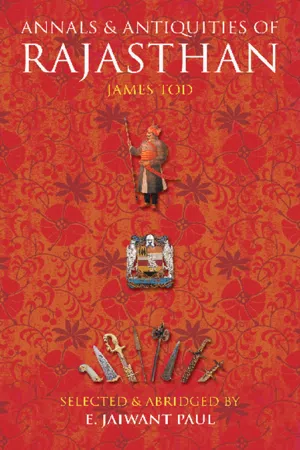
A landmark historical work, written at the cusp of modernity in the early nineteenth century, Annals and Antiquities of Rajasthan was Lieutenant Colonel James Tod's classic tribute to this grand desert region of India. Tod - mesmerized by this region and its inhabitants, the Rajpoots - dedicated himself to examining everything about Rajasthan through indigenous documentation, architectural relics, inscriptions, and medieval poetry. For twenty years, Tod delved deep into its long history, its legends and folklore, its social customs and its art. He also conducted geographical research and made the first accurate map of Rajasthan in 1815. This pioneering book condenses the two thick volumes of Tod's Annals and presents them in an accessible and comprehensive manner. While Tod's original style has been preserved, some gaps and inaccuracies have been clarified by the author. A treasury of invaluable material for historians and general readers alike, the Annals cover the history of six important regions of Rajasthan - Mewar, Marwar, Jessulmer, Bikaner, Amber, and Haravati - and give an engaging account of Rajpoot life from the twelfth century onwards. Many of the surviving traditions of Rajpoots that have their roots in bloody battles, tribal conquests, or petty rivalries, and the Rajpoots'inherent chivalry, loyalty, devotion and zeal have been perceptively discussed. This abridgement also illuminates how the history of the subcontinent was successively written and perceived by the British.
- 142 pages
- English
- ePUB (mobile friendly)
- Available on iOS & Android
eBook - ePub
Annals & Antiquities of Rajasthan
About this book
Trusted by 375,005 students
Access to over 1.5 million titles for a fair monthly price.
Study more efficiently using our study tools.
Information

ANNALS OF MEWAR
The princes of Mewar are considered the first of the thirty-six royal tribes. With the exception of Jessulmer, Mewar is the only dynasty which has outlived eight centuries of foreign domination and the Rana still holds the same territory as when the invader from Gazni first crossed the Indus. The Rana’s family claim descent from Rama’s son Loh, who is stated to have built Lahore, the ancient Lohkot, and ruled the area. According to genealogical lists Keneksen, fifty-sixth in descent from the deified Rama, was the founder of the Mewar dynasty. He emigrated from northern India to Saurashtra in AD 145.
His descendants captured territory in Saurashtra from the Parmara race and established themselves in the region. The capital of the new domain was set up at Balabhipoora, which is close to the present city of Bhavnagar. Nine generations ruled from here but little is known about them. History meets us again in AD 524 when Balabhipoora was invaded by another branch of Scythians who were based around the Indus. The Sooryavansi heroes fell in the defence of Balabhipoora and the capital was left desolate.
The only person to survive this calamity was the favourite wife of the Rana. She was not in Balabhipoora at the time of the siege and had gone to a shrine to seek blessings for the child she was going to bear. On her return journey she got news of the calamity that had engulfed the capital. Grief-stricken, she sought refuge in a mountain cave and there delivered a son. Sometime later, she submitted the child to the care of a Brahmini and charged her to bring him up as a Brahmin, and to marry him to a Rajpoot princess. She then mounted the funeral pyre and joined her lord. The Brahmini brought up the child like her own. She named him Goha, or cave born, and hence his descendants came to be known as Gehlotes. The child was difficult and by the time he was eleven years old, he had become unmanageable. He spent his days in the forests in the company of Bhils whose way of life suited his daring nature far more than that of the gentle Brahmins. So completely did he win the love of this wild tribe by his strength and courage that they elected him as their prince of Edur (Idar), a fact mentioned by Abul Fazal. The mark of sovereignty was bestowed on Goha by the Bhil chieftain drawing blood from a cut on his thumb and placing a teeka on Goha’s forehead. The Bhils have performed this rite for an astonishing 1,500 years to the present day, whenever a king is crowned in Mewar.

Author’s Note: The annals of ancient times are based more on legends, but as we progress in time, there is greater historic fidelity of events. They may be divided into the improbable, probable and certain.
This story of Goha seizing power from the Bhils has parallels in other parts of Rajasthan, Madhya Pradesh and Gujarat. Various indigenous rulers, usually the Bhils and Meenas, were overthrown by leaders of Rajpoot clans. Refer to the annals of Amber-Jeipoor, mentioned later in this work, where Dhole Rae, the founder of the Cuchwaha dynasty, slew his benefactor the Meena chieftain and took over control.
BAPPA RAWAL
History then fades again and we know little of the subsequent eight princes, who ruled this lovely mountainous region. Centuries go past and we come to Nagadit, the eighth ruler after the fall of Balabhipoora. For reasons we do not know, the Bhils rebelled against him and slew him. His infant son Bappa was, however, saved and taken to Nagda about ten miles north of Oodipoor. ‘Bappa was the founder of a line of a hundred kings, feared as a monarch and adored as more than mortal and according to the legend, still living (chernjiva).’ In the Annals is a highly fanciful account of the time when Bappa met an ascetic who blessed him. Shorn of its fantasy, the story is that at some time in his youth Bappa met an ascetic in the forest named Harita. He became the boy’s spiritual guide and taught him to recognize the local deity Eklingji as the supreme lord of Mewar. Eventually he saw in the boy such nobility that he appointed him the vessel of Eklingji on earth. He also bestowed on Bappa invulnerability to weapons.
Many other tales are told of Bappa’s childhood when he lived with the Bhils in the forest. One day the Solanki princess of Nagda with several Rajpoot maidens came to the forest where Bappa was tending the sacred kine. They asked him to find a rope so that they could enjoy the pastime of swinging. Bappa suggested that before he provided the rope they should all play the game of marriage. In jest the scarf of the princess was fastened to Bappa’s garment and all the Rajpoot girls joined hands and went through the marriage ritual around a mango tree. Some years later when a suitable princely match was arranged for the princess by the Solanki chief, the family priest on studying her palm made the startling announcement that she was already married.
There was the greatest consternation but a secret shared by so many could not remain one for long and the chief of Nagda soon knew who the culprit was. Bappa, warned of the danger and accompanied by two Bhil companions, fled to the mountains. This frivolity of Bappa’s proved to be the origin of his greatness, though it burdened him not only with a wife but all the maidens who had taken part in the ceremony!
At this time Cheetore was ruled by a prince of the Paramara clan and as Bappa’s mother was a princess of the same race, he anticipated a favourable reception there. He was not disappointed when he made his way to Cheetore. The chief welcomed Bappa with friendliness and respect. He was enrolled as a military leader and an estate was conferred upon him.
Author’s Note: The incomparable fortress of Cheetore figures so prominently in the annals of Mewar that a brief description is necessary. The fort is built on top of a precipitous flat-topped hill surrounded by about fourteen kilometres of massive walls and battlements. These are so wide that ‘a team of eight horses could gallop their summit.’ The steep serpentine approach is guarded by seven massive gateways located at strategic points. Inside the fort are temples, palaces, bazaars, schools; home for an entire community. It also contains lakes and mountain springs. Below the hill are flat fertile plains. Bappa Rawal established the capital of Mewar here where it remained for several centuries. Cheetore is rooted deep in the psyche of the Rajpoots and there is sanctity in its very name.
The Paramara chief of Cheetore known as the Mori was surrounded by numerous nobles, who held estates on the tenure of military service. He was, however, disliked by them for his high-handedness. So intense was their resentment that when a foreign foe threatened his territory, they refused the royal summons to arms and preferred giving up their lands and privileges rather than join him in battle. The Mori then turned to Bappa, who readily undertook the conduct of war. The nobles, though dispossessed of their lands, joined him as they were ashamed of staying aloof from the battle that threatened Cheetore. Bappa not only emerged victorious and crushed the enemy, but by his military skill and courage won the respect and admiration of the disgruntled nobles. At the end of the campaign, the nobles refused to enter Cheetore or to yield allegiance to the Mori. They refused all efforts at reconciliation and a year later they attacked Cheetore and carried the city by assault. They then invited Bappa to become their chief and transferred their allegiance to him. Tempted by the crown, Bappa threw gratitude to the winds, overthrew the Paramara chief who had been his benefactor and became the lord of Cheetore.
It was in AD 713 that the Arab general Mohammad bin Kasim crossed the Indus and conquered Sind. Not wishing to be limited to this desolate land, he penetrated further inland. According to earlier Arabian authorities, he raided Kathiawar and Malwa. During the campaign, Kasim was defeated by Bappa Rawal and forced to retreat. The Arabs were thus restricted to the bleak and inhospitable desert area of Sind. Any doubts about the historical veracity of Kasim being defeated by Bappa are set to rest by finding, at this time in Cheetore, Dahir, who Abul Fazal records was the lord of Sind. The destruction of Dahir’s capital by Kasim was the reason for his being in Cheetore. After Kasim’s attack was defeated the Arabs retreated by way of Saurashtra and Sind pursued by Bappa. He found the ancient seat of his ancestors, Gajni (Cambay) in the possession of an Islamite named Selim. Bappa attacked and forced Selim to surrender. It vouches for the veracity of the annals that they record the fact, so contrary to their religion, of Bappa marrying the daughter of the conquered Selim. We may infer that it was from the influence acquired by this union that Bappa ultimately abandoned the sovereignty of Mewar and the title of ‘Hindu Sooraj’.
The close of Bappa’s career is the strangest part of the legend. Advanced in years, Bappa abandoned his children and his country and carried his arms to distant Khorassan in Iran. He established himself there, married new wives among the ‘barbarians’ and had several more sons there. According to an old volume belonging to the Dailware chief, Bappa overcame many kings in the west including Kandahar, Cashmere and Cafferistan. The chronicles record that when he died at the age of hundred, the Hindus wished to cremate him while the barbarians wanted to bury him. But as the dispute raged and the coffin was raised, innumerable lotus flowers were found in the place of the remains of mortality: there were conveyed and planted in a lake. This is precisely what is related about the end of the Persian Noshirwan.
Author’s Note: Bappa Rawal, this highly revered ruler has been identified by several historians as the Mewar chief Kalabhoja, ‘the destroyer of Mori’. This recognition is based on various inscriptions which relate to this period (AD 713).
Between Bappa and the important epoch of Samarsi (1193) four centuries intervened during which time the Gehlote banner, bearing the golden sun on a crimson field, flew proudly from the ramparts of Cheetore. During this period eighteen princes ruled. The Khoman Rasa, the ancient Mewar chronicle, records an Islamite invasion during the reign of Khoman (812 to 836). Khoman is a name remarkable in the history of Mewar. The invasion was again led from Sind by Mahmoon, a son of the famous Caliph Haroun al Rashid. The history of the caliphs emphasizes only successful expeditions or those that had some lasting results and seldom alludes to those that failed. According to the Khoman Rasa, Khoman, at the head of thirty-eight princes representing the flower of Rajpoot chivalry, not only defended his capital but led out his forces and routed the Arabs on an open plain and took their leader captive. The chronicle details the name and place of abode of each of the clans that came to the aid of Khoman. He fought twenty-four great battles against other adversaries in his reign and his name is so revered in Oodipoor that to this day, you hear the salutation ‘Khoman aid you’. When he was old, Khoman, on the advice of the Brahmins, abdicated his throne in favour of his son. This advice turned out to be wrong and Khoman returned with a vengeance, resumed his throne, slew all the Brahmins and almost exterminated the caste from his kingdom.
SAMARSI AND PRITHVIRAJ CHOHAN
The long dynastic chain from Kaneksen in the second century to Samarsi in the thirteenth century cannot be traced with perfect accuracy but the two extremities are riveted in truth. The fifteen princes between Khoman and Samarsi may be dismissed as ‘illiterate and valiant, they plundered in their youth and raised churches in their old age and were fond of arms, horses and hunting’. It may also be supposed that they squabbled with their vassals within when not harassed by an enemy without.
We next come to Samarsi who ascended the Mewar throne in the late twelfth century. Anungpal Tuar, who could justly be termed as the paramount sovereign of Hindustan, ruled at Delhi. The Tuar dynasty had been in occupation of Delhi for 400 years. Anungpal had given one of his daughters in marriage to the Chohan prince of Ajmere and another daughter to the Rahtore prince of Canauj. Their sons were the famous Prithviraj Chohan of Ajmere and the infamous Jaichund Rahtore of Canauj. Having no son Anungpal abdicated in favour of his grandson Prithviraj. Jaichund, an important king and jealous of Prithviraj, refused to acknowledge the latter’s supremacy and put forward his own claim to the throne of Delhi. Thus originated the rivalry between the Chohans and the Rahtores which ended in the destruction of both.
To accomplish the downfall of his rival, Jaichund of Canauj resorted to the dangerous expedient of asking for help from Shabudin, the Tartar of Gazni (Mohammed Ghori). Prithviraj, in turn, solicited the aid of Samarsi of Mewar who agreed not only because he had married Prithviraj’s sister, but also because Jaichund had allied himself with the barbarian. It was agreed that Prithviraj should fight the Rahtores while Samarsi would march towards Gazni to intercept the forces of Shabudin. Samarsi accordingly fought several indecisive battles, which gave time to Prithviraj to defeat the Rahtores and join him. Their united forces, in a brilliantly fought battle, defeated Shabudin at Tarain in AD 1191. The battlefield is about 100 miles south of Lahore. The impetuous charge of the Rajpoots scattered the Turkish army like a cloud. Prithviraj’s brother Govindraj came face to face with Ghori and hurling a lance at him, seriously wounded Ghori. The victorious Prithviraj pursued the enemy for forty miles but his cavalry was finally outpaced by Ghori’s retreating Khurasani horses.
Author’s Note: Tod has devoted surprisingly little space to Prithviraj, one of the most splendorous and charismatic rulers. Born in 1166 Prithviraj extended his conquests over north India. This brought him in conflict with the powerful king of Canauj, Jaichund. The hostility was further intensified when Prithviraj abducted Jaichund’s daughter, Princess Sanyogita, from her swayamvara ceremony. The tale has been immortalized in Chund Bardai’s Prithvirajraso (refer to the annals of Marwar). This event is believed to have occurred shortly before the second battle between Mohammed Ghori and Prithviraj.
Before this final battle of Tarain, Ghori had made six different attempts to invade the Punjab but had been repulsed by Chohan forces.
Some years later Shabudin repeated his invasion with a vast force of 120,000 men and Samarsi of Mewar was again constrained to use his buckler in defence of Delhi and its prince. Prithviraj had been disgracefully inactive and had delayed mobilizing his force. Many of his former Rajpoot allies, due to jealousy and revenge, remained indifferent spectators.
Samarsi is represented by the bard Chund as ‘brave, cool and skilful in the fight; prudent, wise and eloquent in council, pious and decorous; beloved by his own chiefs . . . none in the field could better dress the squadron for battle, none guide his steed or use his lance with more address.’ Prithviraj and his court advanced seven miles out of Delhi to meet Samarsi and he was hailed with songs of joy. Samarsi read his brother-in-law an indignant lecture on his unprincipled inactivity and lack of preparation for the forthcoming fight.
Prithviraj foolishly fell for a ruse of Ghori whereby the latter agreed to a truce if he was allowed possession of western Punjab. The Rajpoots relaxed their vigil instead of being alert. In the dark of night Ghori’s forces attacked en masse. The Rajpoots were taken by surprise but in the bloody encounter the Rajpoots fought as only Rajpoots can. In three days of desperate fighting, Samarsi was slain along with 13,000 of his best troops and Prithviraj was taken prisoner. Samarsi’s beloved wife, Pirtha, on hearing of the fatal issue, her husband slain, her brother Prithviraj captive, the heroes of Delhi and Cheetore ‘asleep on the banks of the Caggar in the wave of steel’, joined her lord through the flame. One of the Samarsi’s sons fled to the mountains of Nepal and there spread the Gehlote line.
Author’s Note: History books say that Prithviraj was slain in the battle. According to Chund Bardai, Prithviraj was captured, taken to Afghanistan, blinded and kept prisoner. His prowess as an archer was legendary and though blinded he could still find his aim if given an indication of direction and distance. Sultan Shabudin once asked Prithviraj to demonstrate his archery to visitors from India. The event gathered a large crowd and just as Prithviraj was about to start, an Indian sage recited a couplet:
‘Char bans, chaubis gaz, ungal asht praman
Ta uchyo baitha hai Sultan,...
Table of contents
- Cover
- About the Book
- Annals & Antiquities of Rajasthan
- Title Page
- Copyright
- Dedication
- Contents
- Introduction
- Annals of Mewar
- Annals of Marwar
- Annals of Bikaner
- Annals of Jesulmer
- Annals of Amber or Dhoon Dar
- Annals of Haravati
- Pictures
- Back Page
Frequently asked questions
Yes, you can cancel anytime from the Subscription tab in your account settings on the Perlego website. Your subscription will stay active until the end of your current billing period. Learn how to cancel your subscription
No, books cannot be downloaded as external files, such as PDFs, for use outside of Perlego. However, you can download books within the Perlego app for offline reading on mobile or tablet. Learn how to download books offline
We are an online textbook subscription service, where you can get access to an entire online library for less than the price of a single book per month. With over 1.5 million books across 990+ topics, we’ve got you covered! Learn about our mission
Look out for the read-aloud symbol on your next book to see if you can listen to it. The read-aloud tool reads text aloud for you, highlighting the text as it is being read. You can pause it, speed it up and slow it down. Learn more about Read Aloud
Yes! You can use the Perlego app on both iOS and Android devices to read anytime, anywhere — even offline. Perfect for commutes or when you’re on the go.
Please note we cannot support devices running on iOS 13 and Android 7 or earlier. Learn more about using the app
Please note we cannot support devices running on iOS 13 and Android 7 or earlier. Learn more about using the app
Yes, you can access Annals & Antiquities of Rajasthan by James Tod,E. Jaiwant Paul in PDF and/or ePUB format, as well as other popular books in History & History of Medieval Art. We have over 1.5 million books available in our catalogue for you to explore.