Transcatheter Mitral Valve Therapies
  1. English
  2. ePUB (mobile friendly)
  3. Available on iOS & Android
eBook - ePub

About this book

TRANSCATHETER MITRAL VALVE THERAPIES

An essential survey of the advancing field of transcatheter mitral valve repair and replacement

Minimally invasive transcatheter therapies have revolutionized the treatment of structural heart disease. Greatly improving outcomes for higher-risk patients, transcatheter aortic valve replacement is now established as a safe and effective alternative to invasive surgery. The mitral valve, however, poses further challenges. Contending with one of the heat's most anatomically and pathologically complex components, practitioners and engineers have yet to perfect a stream-lined, widely deliverable therapy—though they are getting closer and closer to this goal.

Transcatheter Mitral Valve Therapies provides a far-reaching survey of the field of mitral interventions in its current state. Highlighting the stumbling blocks preventing transcatheter mitral valve replacement's widespread adoption, the book's international group of contributors discuss the improvements to be made in repair and replacement procedures, as well as the adjunctive use of imaging and pharmacologic therapies. This ground-breaking text:

  • Provides detailed explanations of transcatheter repair, transcatheter replacement, and adjunctive procedures
  • Features chapters on the use of imaging to aid in patient selection, procedure planning, and intra-operative guidance
  • Discusses the importance of minimally invasive approaches for mitral valve repair
  • Examines anticoagulation following transcatheter mitral valve interventions
  • Outlines the possible future of transcatheter mitral valve therapy

Transcatheter Mitral Valve Therapies is an important, up-to-date resource for interventional cardiologists, as well as all clinical researchers and practitioners seeking information on this vital and developing treatment.

Frequently asked questions

Yes, you can cancel anytime from the Subscription tab in your account settings on the Perlego website. Your subscription will stay active until the end of your current billing period. Learn how to cancel your subscription.
No, books cannot be downloaded as external files, such as PDFs, for use outside of Perlego. However, you can download books within the Perlego app for offline reading on mobile or tablet. Learn more here.
Perlego offers two plans: Essential and Complete
  • Essential is ideal for learners and professionals who enjoy exploring a wide range of subjects. Access the Essential Library with 800,000+ trusted titles and best-sellers across business, personal growth, and the humanities. Includes unlimited reading time and Standard Read Aloud voice.
  • Complete: Perfect for advanced learners and researchers needing full, unrestricted access. Unlock 1.4M+ books across hundreds of subjects, including academic and specialized titles. The Complete Plan also includes advanced features like Premium Read Aloud and Research Assistant.
Both plans are available with monthly, semester, or annual billing cycles.
We are an online textbook subscription service, where you can get access to an entire online library for less than the price of a single book per month. With over 1 million books across 1000+ topics, we’ve got you covered! Learn more here.
Look out for the read-aloud symbol on your next book to see if you can listen to it. The read-aloud tool reads text aloud for you, highlighting the text as it is being read. You can pause it, speed it up and slow it down. Learn more here.
Yes! You can use the Perlego app on both iOS or Android devices to read anytime, anywhere — even offline. Perfect for commutes or when you’re on the go.
Please note we cannot support devices running on iOS 13 and Android 7 or earlier. Learn more about using the app.
Yes, you can access Transcatheter Mitral Valve Therapies by Ron Waksman, Toby Rogers, Dr. Ron Waksman,Dr. Toby Rogers,Dr. Ted Feldman, Ron Waksman, Toby Rogers, Ted Feldman in PDF and/or ePUB format, as well as other popular books in Medicine & Cardiology. We have over one million books available in our catalogue for you to explore.

Information

Year
2021
Print ISBN
9781119490685
eBook ISBN
9781119490654
Edition
1
Subtopic
Cardiology

1
The Pathology of Mitral Valve Disease

Maria E. Romero, Sho Torii, and Renu Virmani
CVPath Institute, Inc., Gaithersburg, MD, USA

1.1 Introduction

Mitral valve (MV) insufficiency is a major causation of heart failure and cardiac death, with complications of arrhythmia, endocarditis, and sudden cardiac death [1, 2]. The most common clinical finding in degenerative valve disease is elongation and or rupture of the chordal apparatus resulting in leaflet prolapse, and varying degrees of mitral valve regurgitation due to abnormal leaflet coaptation during ventricular contraction [3]. Up to one third of all patients requiring mitral valve repair/replacement are at high operative risk for surgery [4]. Surgical mitral valve treatment is still the gold standard for treating severe mitral valve insufficiency; however, controversy exists as to whether early surgical intervention in asymptomatic patients before the onset of ventricular changes improves the outcome of patients with severe degenerative mitral valve disease [2, 5–7]. For patients with high surgical risk, transcatheter mitral valve device has become a therapeutic option [8]. This chapter highlights the mitral valve anatomy, pathophysiology of normal mitral valve, mitral stenosis (MS), and mitral regurgitation (MR).

1.2 General Anatomy of the Mitral Valve

The mitral valve is a two‐leaflet valve with a saddle‐shaped annulus and its valvular plane facing anteriorly, inferiorly, and to the left [9–12]. The mitral valve apparatus, both functionally and morphologically, consists of a constellation of individual structures, which consist of the annulus, anterior and posterior leaflets, chordae tendineae, papillary muscles (PMs), and also include the left ventricular wall and the left atrium which are essential for the valve to function normally. The valve is obliquely located in the heart and has a close relation to the aortic valve [13].

1.2.1 Mitral Annulus

The mitral annulus, the hinge line of the valvular leaflets, is “D”‐shaped, unlike the aortic annulus which is circular (Figure 1.1a). The geometric “saddle shape” of the mitral annulus has the highest point of the saddle located in the middle of the anterior leaflet. During ventricular systolic phase, the mitral annulus folds at the intercommissural axis. This folding helps coaptation of the leaflet and prevents leaflet distortion along the lines of annular attachment, and reduces the pressure exerted on the mitral valve leaflets [15]. The normal annular circumference is <10 cm and the normal mitral valve orifice area is 4–6 cm2. The anterior annulus spans the left and right fibrous trigones and is anatomically coupled to the aortic annulus (Figure 1.2). The right fibrous trigone is thicker with more fibrous tissue than left fibrous trigone; however, there is significant variability from heart to heart [16]. Both the trigones are extension of the fibrous tissue at the two ends of the aortomitral continuity. The central fibrous body is formed by the membranous septum together with the right trigone. The atrioventricular conduction bundle passes through the right fibrous trigone. There is a close relationship of the coronary sinus to the posterior mitral annulus and the left circumflex artery lies adjacent to the left trigone and passes inferior to continuation of the coronary sinus (Figure 1.3). The annulus opposite the area of valvular fibrous continuity tends to be weaker in terms of lacking a well‐formed fibrous cord. This is the area affected in annular dilatation and also most often involved in calcification of the annulus [13].
Photos depict normal mitral valve. (a) Gross atrial view of the mitral valve showing anterior and posterior leaflets. (b) The anterior leaflet is larger, and the chordae arise from the ventricular surface at 45° angle. (c) A histological section of a mitral valve leaflet demonstrates the atrial surface which is rich in elastic fibers and collagen, glycosaminoglycans-rich spongiosa in the mid portion, and dense collagenous tissue which is observed on the ventricular surface of the leaflet.
Figure 1.1 Normal mitral valve. (a) Gross atrial view of the mitral valve showing anterior and posterior leaflets. (b) The anterior leaflet is larger, and the chordae arise from the ventricular surface at 45° angle. The anterior leaflet is separated from the posterior leaflet by the commissures (*) with fan‐shaped branching commissural chordae. The posterior leaflet has three, often poorly defined, scallops, each with chordal attachments. (c) A histological section of a mitral valve leaflet (Movat pentachrome stain) demonstrates the atrial surface which is rich in elastic fibers and collagen, glycosaminoglycans‐rich spongiosa in the mid portion (green), and dense collagenous tissue (yellow) which is observed on the ventricular surface of the leaflet. Abbreviations: AML, anterior mitral leaflet; PML, posterior mitral leaflet.
Source: Reproduced with permission from Torii et al. [14].
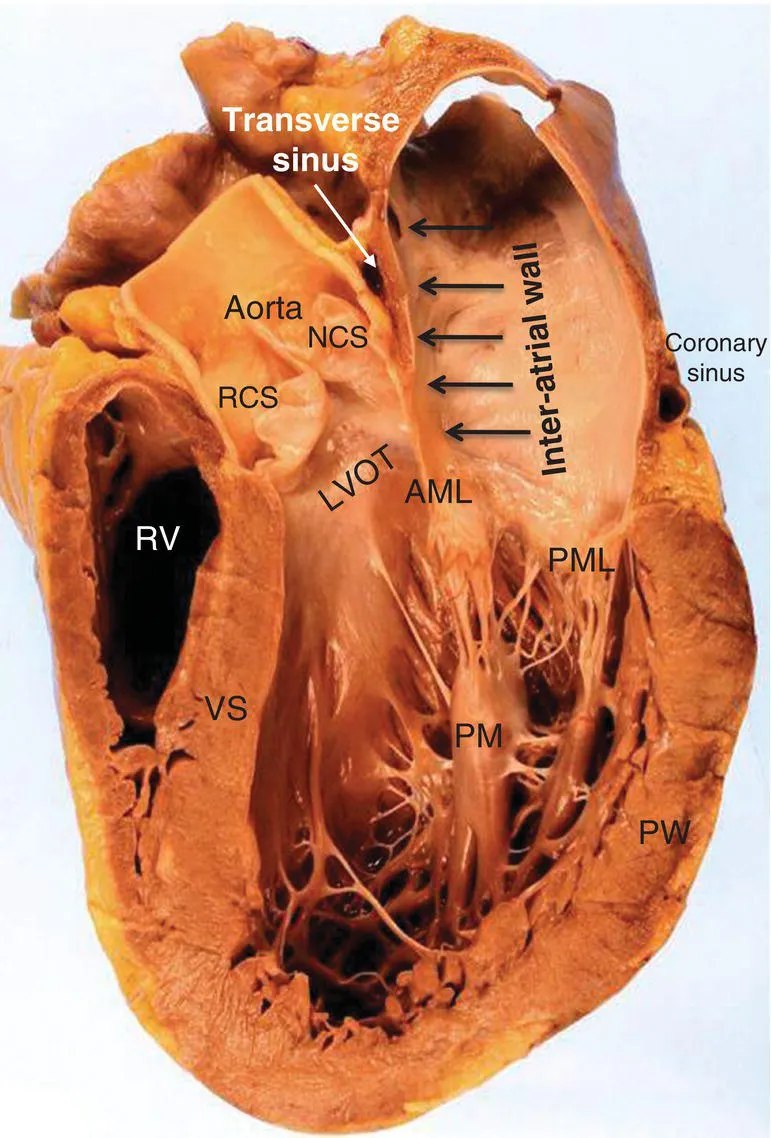
Photo depicts long axis view of the heart demonstrating the fibrous continuity of the anterior leaflet with the non-coronary sinus. The atrioventricular junction is shown in the longitudinal view; the interatrial septal wall (arrows) is separated by the transverse sinus from the aorta.
Figure 1.2 Long axis view of the heart demonstrating the fibrous continuity of the anterior leaflet with the non‐coronary sinus. The atrioventricular junction is shown in the longitudinal view; the interatrial septal wall (arrows) is separated by the transverse sinus from the aorta. Note the fibrous continuity of the anterior leaflet with the non‐coronary sinus. Abbreviations: AML, anterior mitral leaflet; NCS, non‐coronary sinus; PML, posterior mitral leaflet; PM, papillary muscle; RCS, right coronary sinus; RV, right ventricle; VS; ventricul...

Table of contents

  1. Cover
  2. Table of Contents
  3. Title Page
  4. Copyright Page
  5. List of Contributors
  6. Introduction—The Mitral Book
  7. 1 The Pathology of Mitral Valve Disease
  8. 2 The Importance of Minimally Invasive Approaches for Mitral Valve Repair
  9. 3 When to Intervene—Should Surgical Guidelines Apply to Transcatheter Techniques in Treating Mitral Regurgitation?
  10. 4 Transcatheter Mitral Valve Therapies
  11. 5 CMR Assessment of Mitral Regurgitation
  12. 6 CT Planning for TMVR and Predicting LVOT Obstruction
  13. 7 General Principles and State‐of‐the‐Art Echocardiographic Evaluation of the Mitral Valve
  14. 8 Intraprocedural Echocardiography for MitraClip
  15. 9 Intraprocedural Echocardiography for Transcatheter Mitral Valve Replacement
  16. 10 Transcatheter Repair
  17. 11 MitraClip™ for Secondary Mitral Regurgitation
  18. 12 The Edwards PASCAL Transcatheter Valve Repair System
  19. 13 The Development of a Novel Percutaneous Treatment for Secondary Mitral Regurgitation—The Carillon® Mitral Contour System®
  20. 14 A Fully Percutaneous Mitral Ring
  21. 15 Transcatheter Mitral Cerclage Annuloplasty
  22. 16 The Transapical Off‐Pump Mitral Valve Repair with the NeoChord Implantation (TOP‐MINI)
  23. 17 AltaValve™—A Transcatheter Mitral Valve Regurgitation Treatment Technology
  24. 18 The ARTO Transcatheter Mitral Valve Repair System
  25. 19 Transcatheter Mitral Annuloplasty
  26. 20 Transapical and Transseptal Access for Transcatheter Mitral Valve Replacement
  27. 21 Mitral Valve‐in‐Valve and Valve‐in‐Ring Therapies
  28. 22 Edwards SAPIEN in Native Mitral Annular Calcification (MAC)
  29. 23 Transcatheter Mitral Valve Replacement
  30. 24 TIARA Transcatheter Mitral Replacement System
  31. 25 Caisson Transcatheter Mitral Valve Replacement System
  32. 26 Transcatheter Mitral Valve Replacement with the CardiAQ‐Edwards and EVOQUE Prostheses
  33. 27 Intrepid
  34. 28 Laceration of the Anterior Mitral Leaflet to Prevent Outflow Obstruction (LAMPOON)
  35. 29 Use of Alcohol Septal Reduction Therapy to Facilitate Transcatheter Mitral Valve Replacement
  36. 30 Direct Transatrial Approach with Resection of the Anterior Mitral Leaflet to Prevent Outflow Tract Obstruction
  37. 31 Transcatheter Closure of Mitral Paravalvular Leak
  38. 32 Management of Iatrogenic Interatrial Septal Defect—To Close or not to Close?
  39. 33 Antithrombotic Therapy in Transcatheter Mitral Valve Intervention
  40. Index
  41. End User License Agreement