- 200 pages
- English
- ePUB (mobile friendly)
- Available on iOS & Android
eBook - ePub
About this book
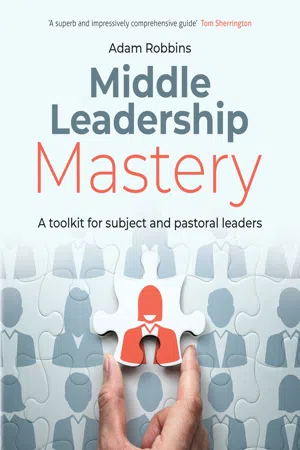
To make the best decisions possible, middle leaders need to have a nuanced understanding of the consequences of their actions. In this pragmatic book, Adam Robbins aims to boost their role-specific expertise to help them achieve that goal - and offers them a preferable alternative to learning from their mistakes.
Instead of relying on generic leadership theories,
Middle Leadership Mastery collates perspectives from psychology and cognitive science to share evidence-informed guidance on a wide range of topics - from supporting staff and students in crisis and managing wellbeing, to quality-assuring teaching and curriculum design.
Adam Robbins draws on his sixteen years' experience of teaching in a deprived area to illustrate his points with stories and anecdotes from the front line, demonstrating how middle leaders can better understand their context and deliver the best outcomes from a variety of starting points.
Information
Topic
EducationSubtopic
Education GeneralChapter 1
Leading the curriculum
No thief, however skilful, can rob one of knowledge, and that is why knowledge is the best and safest treasure to acquire.
L. Frank Baum1
For many years curriculum design has been in the hands of central government in each of the UK nations, not in the hands of classroom teachers. Teachers’ training and planning time has focused on pedagogy and engagement. Now that all teachers have a responsibility for curriculum design, it falls to middle leaders to ensure that their curriculum is appropriately constructed and implemented. One key decision is regarding whether we build a curriculum with a foundation of knowledge or skills, as this will frame the very nature of our students’ education. To make informed curriculum decisions, you need to see the big picture of education’s role within society. This chapter aims to provide some of that context and offer some guidance about how to plan and implement your curriculum.
Why is the first chapter about curriculum?
Leading the curriculum is the most impactful thing that a middle leader can do. Every middle leadership role has an impact on the curriculum. Heads of subjects obviously play a role, but beneath them key stage leaders help to shape the curriculum within their areas. The curriculum is not limited to subjects taught within the school; pastoral leaders also provide a curriculum based on the work they lead with tutors, with support staff and in assemblies. The curriculum identifies the entirety of the knowledge and skills students need to acquire. This permeates through all classes and through multiple years, shaping the planning and delivery of all lessons. Your curriculum is your tool to stretch the most able and ensure all students are progressing.
Often the power of curriculum is ignored or overlooked by middle leaders as their attention is drawn more towards operational tasks. While leaders should make time for such tasks, this is not their main purpose. Another reason why curriculum often gets pushed to the bottom of the to-do list is a perceived lack of control over it. Multi-academy trusts often stipulate a degree of control over the curriculum. Governments also stipulate what is expected nationally. While there will be some trusts with incredibly tight control of what knowledge is taught and when, the national curriculum is actually incredibly vague. For example, the Key Stage 3 guidance for history comprises a grand total of 1,242 words, most of which are non-statutory suggestions of topics.2 So, middle leaders have a degree of flexibility regarding what is taught, when it’s taught and to what depth. Even where tight external control is placed on the curriculum, you as a leader are duty-bound to ensure that it is fit for purpose in your context, make changes if necessary, and ensure that your team understands the thinking behind your decisions. At the end of the day, you are ultimately accountable to your students; they are the ones you must look in the eye on results day.
Knowledge-rich vs 21st-century skills
Over the last 50 years the curriculum has been subject to shifting priorities. The idea that skills are more important than knowledge permeated education in the 1980s.3 Under the label of ‘21st-century skills’, curricula shifted away from a foundation of knowledge to one of skills. More recently, some schools have been moving back towards a knowledge-rich curriculum. I first want to outline the theories behind the knowledge-rich curriculum movement to explain why it is the best choice for our students. Later we will discuss how to construct your curriculum and how to evaluate its success.
The reasoning behind a skills-based curriculum went that knowledge will become obsolete in the future. Due to the internet and the accessibility of knowledge, freely available, to all mankind, students will not need to know facts and figures. Instead, they will need a range of flexible skills to allow them to tackle the jobs of the future. The argument goes that if a student can search for the information – for example, the process by which a bill becomes law – then they should only be judged on how they can apply those facts to a given scenario. They should be expected to show various thinking skills, like problem-solving and creativity, within this context. So, education should emphasise the demonstration of these traits over the acquisition of relevant knowledge.
Cognitively, this is a load of nonsense. Knowledge is the prerequisite for skills within any domain. Try teaching any skill – for example, making a cup of tea. There is a certain amount of knowledge required for the skill to be acquired successfully. Firstly, there are the declarative facts, those which can be seen as objective. In this case, these are all the objects involved, their locations and intrinsic properties. Then there is the procedural knowledge: the knowledge associated with how things fit together in a sequence. In this case, it would include the operation of the equipment (tap, kettle, etc.) as well as the sequence of techniques (how to use a tea bag, straining, the addition of milk, etc.). So, the skill of making a decent cup of tea is in fact the culmination of a large body of different types of knowledge, as Figure 1 shows.

Figure 1: Making a cup of tea
Declarative knowledge: Knowledge about facts.
Procedural knowledge: Knowledge about how to do something.
This is often ignored by those favouring a skills-based, 21st-century curriculum because they suffer from the curse of knowledge, which impacts their ability to communicate effectively.4 In a skills-based curriculum the danger is that the teacher takes the knowledge they have acquired for granted and assumes that everyone else has already acquired it. This is a potentially dangerous choice and often disadvantages those students who have missed certain assumed experiences.
Curse of knowledge: A well-demonstrated cognitive bias, meaning that an individual falsely assumes that others have the same background information as they have.
In the example of making a cup of tea, the knowledge required might be too familiar and obvious, and you might remain unconvinced. So, to illustrate this further, consider learning to drive. In Figure 2 I’ve tried to break down driving in the same way.

Figure 2: How to drive a car
Driving is a complex process, so it is a great analogy for learning in any context. I’ve put the majority of the most basic requirements in the diagram but have ignored how knowledge of differing weather conditions impacts decisions for simplicity’s sake. Notice how driving has a significant extra domain of knowledge: the Highway Code. I am sure that if you were asked to recall the rules of the Highway Code, you would be far from encyclo-paedic, just like I am. However, you will know most of the basic rules of the road. You might not be able to fully recall this prior knowledge, but it will be demonstrated by the choices you make in the moment.5 It’s there in the background as tacit knowledge, helping you to perform a complex task with relative ease on a daily basis.
Tacit knowledge: Knowledge that is gained through experience and is hard to communicate to others because we are unaware it exists.
Let’s consider two anecdotes about learning to drive as illustrations of the power of knowledge. I learnt to drive when I was about 17 and a half. It took me 25 lessons and two practical tests. Like a typical teen, it took me ages to master the clutch, but also many lessons to learn the rules about junctions, the size of an adequate gap to pull out into, etc. My friend Bill did not learn to drive until he was in his early thirties. Like me, his first few lessons focused on the basic controls and in this respect he was equally poor. His instructor predicted that he would need at least 25 lessons. Within 12 lessons he had passed his test. Once he had grasped how to use the mechanical functions of the car, he was ready. He already had years of experience of the Highway Code as an attentive adult passenger. He was relatively fluent in how the rules were applied as he had witnessed a large array of situations in real life. He just had an inability to physically control the car. His prior knowledge accelerated his progress in the skill of driving.
A knowledge-rich curriculum is not devoid of skills; it prioritises the acquisition of knowledge before it is successfully applied using skills. This explains why teachers often complain about students’ skills being non-transferrable. How often do teachers bemoan that a student’s writing skills do not translate from English into other subjects? Or that they can form a coherent argument in history but not in literature; they can analyse a painting and its imagery but not a poem; they can evaluate evidence from a science experiment but not climate data in geography? This is evidence of the domain-specific nature of knowledge.
A student will first gain inflexible knowledge that is completely limited to the area in which it was originally taught. As their expertise improves, they will develop flexible knowledge that can be applied more broadly and to a wider variety of situations. The ability to execute the widest application of the most flexible knowledge is often called ‘creativity’ or ‘problem-solving skills’. When a student has flexible knowle...
Table of contents
- Praise
- Title Page
- Acknowledgements
- Contents
- Introduction
- Chapter 1: Leading the curriculum
- Chapter 2: Leading teaching and learning
- Chapter 3: Leading assessment
- Chapter 4: Leading quality assurance
- Chapter 5: Leading teacher development
- Chapter 6: Decision making
- Chapter 7: Pastoral issues
- Chapter 8: Leading others
- Chapter 9: Wellbeing
- Conclusion
- Bibliography
- Copyright
Trusted by 375,005 students
Access to over 1.5 million titles for a fair monthly price.
Study more efficiently using our study tools.
Frequently asked questions
Yes, you can cancel anytime from the Subscription tab in your account settings on the Perlego website. Your subscription will stay active until the end of your current billing period. Learn how to cancel your subscription
No, books cannot be downloaded as external files, such as PDFs, for use outside of Perlego. However, you can download books within the Perlego app for offline reading on mobile or tablet. Learn how to download books offline
Perlego offers two plans: Essential and Complete
- Essential is ideal for learners and professionals who enjoy exploring a wide range of subjects. Access the Essential Library with 800,000+ trusted titles and best-sellers across business, personal growth, and the humanities. Includes unlimited reading time and Standard Read Aloud voice.
- Complete: Perfect for advanced learners and researchers needing full, unrestricted access. Unlock 1.5M+ books across hundreds of subjects, including academic and specialized titles. The Complete Plan also includes advanced features like Premium Read Aloud and Research Assistant.
We are an online textbook subscription service, where you can get access to an entire online library for less than the price of a single book per month. With over 1.5 million books across 990+ topics, we’ve got you covered! Learn about our mission
Look out for the read-aloud symbol on your next book to see if you can listen to it. The read-aloud tool reads text aloud for you, highlighting the text as it is being read. You can pause it, speed it up and slow it down. Learn more about Read Aloud
Yes! You can use the Perlego app on both iOS and Android devices to read anytime, anywhere — even offline. Perfect for commutes or when you’re on the go.
Please note we cannot support devices running on iOS 13 and Android 7 or earlier. Learn more about using the app
Please note we cannot support devices running on iOS 13 and Android 7 or earlier. Learn more about using the app
Yes, you can access Middle Leadership Mastery by Adam Robbins in PDF and/or ePUB format, as well as other popular books in Education & Education General. We have over 1.5 million books available in our catalogue for you to explore.