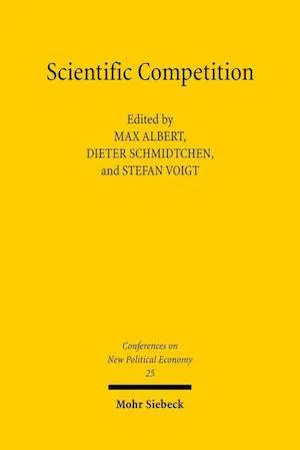
Is science a 'market of ideas'? Not according to the economics of science. Science is competitive, but scientific competition is not market competition. Nor is scientific competition the same as competition between universities. Scientific competition is, first of all, competition between individual scientists. Current science policies shift the boundary between scientific competition, where scientists provide public goods in the hope to acquire status among their peers, and market competition in science, where the results of research are private property protected by patents or other means, in favor of the market. However, the economic ring of the political slogans cannot conceal a serious lack of understanding of scientific competition behind the reform proposals.
- 327 pages
- English
- PDF
- Available on iOS & Android
eBook - PDF
Scientific Competition :
About this book
Trusted by 375,005 students
Access to over 1.5 million titles for a fair monthly price.
Study more efficiently using our study tools.
Information
Subtopic
Business DevelopmentIndex
BusinessTable of contents
- Cover
- Contents
- Max Albert: Introduction
- Paula Stephan: Job Market Effects on Scientific Productivity
- Bernd Fitzenberger: Job Market Effects on Scientific Productivity (Comment)
- Günther G. Schulze: Tertiary Education in a Federal System: The Case of Germany
- Stefan Voigt: Tertiary Education in a Federal System (Comment)
- Gustavo Crespi and Aldo Geuna: The Productivity of UK Universities
- Christian Pierdzioch: The Productivity of UK Universities (Comment)
- Michael Rauber and Heinrich W. Ursprung: Evaluation of Researchers: A Life Cycle Analysis of German Academic Economists
- Werner Güth: Evaluation of Researchers (Comment)
- Martin Kolmar: Markets versus Contests for the Provision of Information Goods
- Roland Kirstein: Scientific Competition: Beauty Contests or Tournaments? (Comment)
- Christine Godt: The Role of Patents in Scientific Competition: A Closer Look at the Phenomenon of Royalty Stacking
- Christian Koboldt: Royalty Stacking: A Problem, but Why? (Comment)
- Nicolas Carayol: An Economic Theory of Academic Competition: Dynamic Incentives and Endogenous Cumulative Advantages
- Dominique Demougin: An Economic Theory of Academic Competition (Comment)
- Dorothea Jansen: Research Networks – Origins and Consequences: First Evidence from a Study of Astrophysics, Nanotechnology and Micro-economics in Germany
- Henrik Egbert: Networking in Science and Policy Interventions (Comment)
- Christian Seidl, Ulrich Schmidt and Peter Grösche: A Beauty Contest of Referee Processes of Economics Journals
- Max Albert and Jürgen Meckl: What Should We Expect from Peer Review? (Comment)
- Jesús P. Zamora Bonilla: Methodology and the Constitution of Science: A Game-theoretic Approach
- Gebhard Kirchgässner: Is It a Gang or the Scientific Community? (Comment)
- Christian List: Distributed Cognition: A Perspective from Social Choice Theory
- Siegfried K. Berninghaus: Distributed Cognition (Comment)
- Contributors and Editors
Frequently asked questions
Yes, you can cancel anytime from the Subscription tab in your account settings on the Perlego website. Your subscription will stay active until the end of your current billing period. Learn how to cancel your subscription
No, books cannot be downloaded as external files, such as PDFs, for use outside of Perlego. However, you can download books within the Perlego app for offline reading on mobile or tablet. Learn how to download books offline
Perlego offers two plans: Essential and Complete
- Essential is ideal for learners and professionals who enjoy exploring a wide range of subjects. Access the Essential Library with 800,000+ trusted titles and best-sellers across business, personal growth, and the humanities. Includes unlimited reading time and Standard Read Aloud voice.
- Complete: Perfect for advanced learners and researchers needing full, unrestricted access. Unlock 1.5M+ books across hundreds of subjects, including academic and specialized titles. The Complete Plan also includes advanced features like Premium Read Aloud and Research Assistant.
We are an online textbook subscription service, where you can get access to an entire online library for less than the price of a single book per month. With over 1.5 million books across 990+ topics, we’ve got you covered! Learn about our mission
Look out for the read-aloud symbol on your next book to see if you can listen to it. The read-aloud tool reads text aloud for you, highlighting the text as it is being read. You can pause it, speed it up and slow it down. Learn more about Read Aloud
Yes! You can use the Perlego app on both iOS and Android devices to read anytime, anywhere — even offline. Perfect for commutes or when you’re on the go.
Please note we cannot support devices running on iOS 13 and Android 7 or earlier. Learn more about using the app
Please note we cannot support devices running on iOS 13 and Android 7 or earlier. Learn more about using the app
Yes, you can access Scientific Competition : by Max Albert, Stefan Voigt, Dieter Schmidtchen in PDF and/or ePUB format, as well as other popular books in Business & Business Development. We have over 1.5 million books available in our catalogue for you to explore.