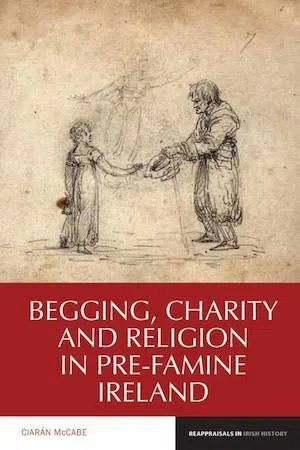
Beggars and begging were ubiquitous features of pre-Famine Irish society, yet have gone largely unexamined by historians. This book explores at length for the first time the complex cultures of mendicancy, as well as how wider societal perceptions of and responses to begging were framed by social class, gender and religion. The study breaks new ground in exploring the challenges inherent in defining and measuring begging and alms-giving in pre-Famine Ireland, as well as the disparate ways in which mendicants were perceived by contemporaries. A discussion of the evolving role of parish vestries in the life of pre-Famine communities facilitates an examination of corporate responses to beggary, while a comprehensive analysis of the mendicity society movement, which flourished throughout Ireland in the three decades following 1815, highlights the significance of charitable societies and associational culture in responding to the perceived threat of mendicancy. The instance of the mendicity societies illustrates the extent to which Irish commentators and social reformers were influenced by prevailing theories and practices in the transatlantic world regarding the management of the poor and deviant. Drawing on a wide range of sources previously unused for the study of poverty and welfare, this book makes an important contribution to modern Irish social and ecclesiastical history.
- 320 pages
- English
- PDF
- Available on iOS & Android
eBook - PDF
Begging, Charity and Religion in Pre-Famine Ireland :
About this book
Trusted by 375,005 students
Access to over 1.5 million titles for a fair monthly price.
Study more efficiently using our study tools.
Information
Subtopic
Irish HistoryIndex
HistoryTable of contents
- Cover
- Contents
- List of Figures
- List of Tables
- Acknowledgements
- Abbreviations
- Note on Editorial Conventions
- Introduction
- I. Begging and Alm-Giving: Framing the Issues
- II. Responses I: Cross-Denominational Approaches
- III. Responses II: Denominational Approaches
- Conclusion
- Bibliography
- Index
Frequently asked questions
Yes, you can cancel anytime from the Subscription tab in your account settings on the Perlego website. Your subscription will stay active until the end of your current billing period. Learn how to cancel your subscription
No, books cannot be downloaded as external files, such as PDFs, for use outside of Perlego. However, you can download books within the Perlego app for offline reading on mobile or tablet. Learn how to download books offline
Perlego offers two plans: Essential and Complete
- Essential is ideal for learners and professionals who enjoy exploring a wide range of subjects. Access the Essential Library with 800,000+ trusted titles and best-sellers across business, personal growth, and the humanities. Includes unlimited reading time and Standard Read Aloud voice.
- Complete: Perfect for advanced learners and researchers needing full, unrestricted access. Unlock 1.5M+ books across hundreds of subjects, including academic and specialized titles. The Complete Plan also includes advanced features like Premium Read Aloud and Research Assistant.
We are an online textbook subscription service, where you can get access to an entire online library for less than the price of a single book per month. With over 1.5 million books across 990+ topics, we’ve got you covered! Learn about our mission
Look out for the read-aloud symbol on your next book to see if you can listen to it. The read-aloud tool reads text aloud for you, highlighting the text as it is being read. You can pause it, speed it up and slow it down. Learn more about Read Aloud
Yes! You can use the Perlego app on both iOS and Android devices to read anytime, anywhere — even offline. Perfect for commutes or when you’re on the go.
Please note we cannot support devices running on iOS 13 and Android 7 or earlier. Learn more about using the app
Please note we cannot support devices running on iOS 13 and Android 7 or earlier. Learn more about using the app
Yes, you can access Begging, Charity and Religion in Pre-Famine Ireland : by Ciarán McCabe in PDF and/or ePUB format, as well as other popular books in History & Irish History. We have over 1.5 million books available in our catalogue for you to explore.