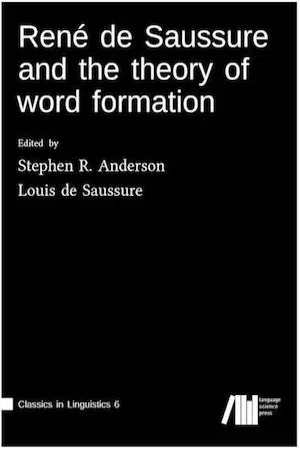
This volume presents two works elaborating a general theory of words and their structure written by René de Saussure, younger brother of Ferdinand de Saussure. Although originating in René de Saussure's concerns for the structure of Esperanto, these essays are clearly intended to articulate a general account of word formation in natural language. They appear here in the French original with facing English translations, accompanied by some remarks on René de Saussure's life and followed by essays on the Esperantist background of his analysis (by Marc van Oostendorp), the contemporary relevance of his morphological theory (by Stephen Anderson), and the semantic theory of words underlying his analysis (by Louis de Saussure). These two works have remained essentially unknown to the community of scholars in general linguistics since their publication in 1911 and 1919, respectively, although Esperantists have been aware of them. They develop in quite explicit form a theory of what would later be called morphemic analysis, based primarily on data from French (with some material from German and English, as well as occasional examples from other Indo-European languages). In its fundamental aspect, René's view of word formation differed significantly from that of his brother, who saw the structure of complex words as revealed not through their decomposition into smaller "atomic" units but rather in the relations between words, relations which could be presented in analogical form and which anticipate rule-based theories of morphological structure. The contrast between the two brothers' views thus anticipates basic issues in current theorizing about word structure.
eBook - PDF
René de Saussure and the theory of word formation :
- 259 pages
- English
- PDF
- Available on iOS & Android
eBook - PDF
René de Saussure and the theory of word formation :
About this book
Trusted by 375,005 students
Access to over 1.5 million titles for a fair monthly price.
Study more efficiently using our study tools.
Information
Subtopic
LinguisticsTable of contents
- Contents
- Introduction
- I The 1911 text
- II The 1919 text
- III Commentary
Frequently asked questions
Yes, you can cancel anytime from the Subscription tab in your account settings on the Perlego website. Your subscription will stay active until the end of your current billing period. Learn how to cancel your subscription
No, books cannot be downloaded as external files, such as PDFs, for use outside of Perlego. However, you can download books within the Perlego app for offline reading on mobile or tablet. Learn how to download books offline
We are an online textbook subscription service, where you can get access to an entire online library for less than the price of a single book per month. With over 1.5 million books across 990+ topics, we’ve got you covered! Learn about our mission
Look out for the read-aloud symbol on your next book to see if you can listen to it. The read-aloud tool reads text aloud for you, highlighting the text as it is being read. You can pause it, speed it up and slow it down. Learn more about Read Aloud
Yes! You can use the Perlego app on both iOS and Android devices to read anytime, anywhere — even offline. Perfect for commutes or when you’re on the go.
Please note we cannot support devices running on iOS 13 and Android 7 or earlier. Learn more about using the app
Please note we cannot support devices running on iOS 13 and Android 7 or earlier. Learn more about using the app
Yes, you can access René de Saussure and the theory of word formation : by Louis de Saussure, Stephen R. Anderson in PDF and/or ePUB format, as well as other popular books in Languages & Linguistics & Linguistics. We have over 1.5 million books available in our catalogue for you to explore.