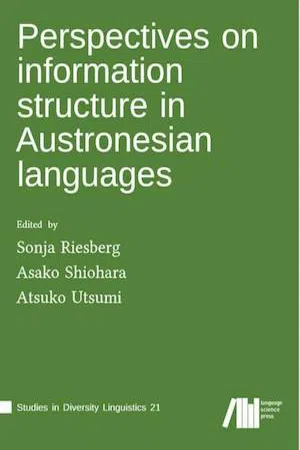
Information structure is a relatively new field to linguistics and has only recently been studied for smaller and less described languages. This book is the first of its kind that brings together contributions on information structure in Austronesian languages. Current approaches from formal semantics, discourse studies, and intonational phonology are brought together with language specific and cross-linguistic expertise of Austronesian languages. The 13 chapters in this volume cover all subgroups of the large Austronesian family, including Formosan, Central Malayo-Polynesian, South Halmahera-West New Guinea, and Oceanic. The major focus, though, lies on Western Malayo-Polynesian languages. Some chapters investigate two of the largest languages in the region (Tagalog and different varieties of Malay), others study information-structural phenomena in small, underdescribed languages. The three overarching topics that are covered in this book are NP marking and reference tracking devices, syntactic structures and information-structural categories, and the interaction of information structure and prosody. Various data types build the basis for the different studies compiled in this book. Some chapters investigate written texts, such as modern novels (cf. Djenar's chapter on modern, standard Indonesian), or compare different text genres, such as, for example, oral narratives and translations of biblical narratives (cf. De Busser's chapter on Bunun). Most contributions, however, study natural spoken speech and make use of spoken corpora which have been compiled by the authors themselves. The volume comprises a number of different methods and theoretical frameworks. Two chapters make use of the Question Under Discussion approach, developed in formal semantics (cf. the chapters by Latrouite & Riester; Shiohara & Riester). Riesberg et al. apply the recently developed method of Rapid Prosody Transcription (RPT) to investigate native speakers' perception of prosodic prominences and boundaries in Papuan Malay. Other papers discuss theoretical consequences of their findings. Thus, for example, Himmelmann takes apart the most widespread framework for intonational phonology (ToBI) and argues that the analysis of Indonesian languages requires much simpler assumptions than the ones underlying the standard model. Arka & Sedeng ask the question how fine-grained information structure space should be conceptualized and modelled, e.g. in LFG. Schnell argues that elements that could be analysed as "topicâ€_x009d_ and "focusâ€_x009d_ categories, should better be described in terms of 'packaging' and do not necessarily reflect any pragmatic roles in the first place.
eBook - PDF
Perspectives on information structure in Austronesian languages :
- 440 pages
- English
- PDF
- Available on iOS & Android
eBook - PDF
Perspectives on information structure in Austronesian languages :
About this book
Trusted by 375,005 students
Access to over 1 million titles for a fair monthly price.
Study more efficiently using our study tools.
Information
Subtopic
LinguisticsTable of contents
- Contents
- Preface and Acknowledgements
- I Information status and NP marking
- II Information structure and syntactic constructions
- III Information structure and prosody
Frequently asked questions
Yes, you can cancel anytime from the Subscription tab in your account settings on the Perlego website. Your subscription will stay active until the end of your current billing period. Learn how to cancel your subscription
No, books cannot be downloaded as external files, such as PDFs, for use outside of Perlego. However, you can download books within the Perlego app for offline reading on mobile or tablet. Learn how to download books offline
Perlego offers two plans: Essential and Complete
- Essential is ideal for learners and professionals who enjoy exploring a wide range of subjects. Access the Essential Library with 800,000+ trusted titles and best-sellers across business, personal growth, and the humanities. Includes unlimited reading time and Standard Read Aloud voice.
- Complete: Perfect for advanced learners and researchers needing full, unrestricted access. Unlock 1.4M+ books across hundreds of subjects, including academic and specialized titles. The Complete Plan also includes advanced features like Premium Read Aloud and Research Assistant.
We are an online textbook subscription service, where you can get access to an entire online library for less than the price of a single book per month. With over 1 million books across 990+ topics, we’ve got you covered! Learn about our mission
Look out for the read-aloud symbol on your next book to see if you can listen to it. The read-aloud tool reads text aloud for you, highlighting the text as it is being read. You can pause it, speed it up and slow it down. Learn more about Read Aloud
Yes! You can use the Perlego app on both iOS and Android devices to read anytime, anywhere — even offline. Perfect for commutes or when you’re on the go.
Please note we cannot support devices running on iOS 13 and Android 7 or earlier. Learn more about using the app
Please note we cannot support devices running on iOS 13 and Android 7 or earlier. Learn more about using the app
Yes, you can access Perspectives on information structure in Austronesian languages : by Sonja Riesberg, Asako Shiohara, Atsuko Utsumi in PDF and/or ePUB format, as well as other popular books in Languages & Linguistics & Linguistics. We have over one million books available in our catalogue for you to explore.