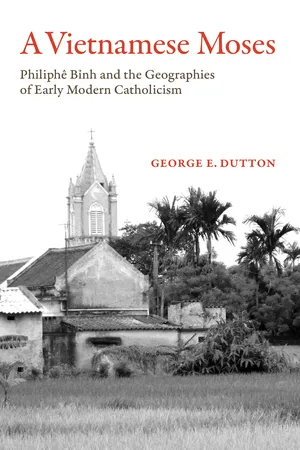
A Vietnamese Moses is the story of Philiphê Bình, a Vietnamese Catholic priest who in 1796 traveled from Tonkin to the Portuguese court in Lisbon to persuade its ruler to appoint a bishop for his community of ex-Jesuits. Based on Bình's surviving writings from his thirty-seven-year exile in Portugal, this book examines how the intersections of global and local Roman Catholic geographies shaped the lives of Vietnamese Christians in the early modern era. The book also argues that Bình's mission to Portugal and his intense lobbying on behalf of his community reflected the agency of Vietnamese Catholics, who vigorously engaged with church politics in defense of their distinctive Portuguese-Catholic heritage. George E. Dutton demonstrates the ways in which Catholic beliefs, histories, and genealogies transformed how Vietnamese thought about themselves and their place in the world. This sophisticated exploration of Vietnamese engagement with both the Catholic Church and Napoleonic Europe provides a unique perspective on the complex history of early Vietnamese Christianity. "Makes a significant contribution to a growing body of international research that brings Asian Christianity into the global domain." -BARBARA WATSON ANDAYA, coauthor of A History of Early Modern Southeast Asia, 1400–1830 "Like the life this book traces, A Vietnamese Moses crosses borders and genres. A remarkable achievement." -CHARLES KEITH, author of Catholic Vietnam: A Church from Empire to Nation GEORGE E. DUTTON is Professor of Vietnamese History in the Department of Asian Languages and Cultures and Director of the Center for Southeast Asian Studies at the University of California, Los Angeles.
eBook - ePub
A Vietnamese Moses : Philiphê Bình and the Geographies of Early Modern Catholicism
- English
- ePUB (mobile friendly)
- Available on iOS & Android
eBook - ePub
A Vietnamese Moses : Philiphê Bình and the Geographies of Early Modern Catholicism
About this book
Trusted by 375,005 students
Access to over 1.5 million titles for a fair monthly price.
Study more efficiently using our study tools.
Information
Subtopic
Asian HistoryIndex
History1

Philiphê Bỉnh and the Catholic Geographies of Tonkin
Philiphê Bỉnh, who would later also style himself as Felippe do Rosario, introduced himself to an imagined future reader in the preface to his notebook of miscellany, Sách sổ sang chép các việc (Notebook that transmits and records all matters):
I am the priest Philiphê Bỉnh, of the province of Hải Dương, prefecture of Hạ Hồng, district of Vĩnh Lại, village of Ngải Am, hamlet of Ðịa Linh. I was born in the year 1759, the same year that King Jose of the country Portugal destroyed the Order of the Virtuous Lord Jesus in his realm. When I reached the age of seventeen in the year 1775 and entered my teacher’s home, the order had already been destroyed two years previously in Rome, because the Virtuous Pope Clemente XIV disbanded the Order of the Virtuous Lord Jesus on the 22nd of July in the year 1773. However, prior to disbanding the order, and at the beginning of that year, eight members of the order arrived in Annam: Master Tito and Master Bảo Lộc [Paul] had gone to Quảng [Nam], and the rest of the missionaries, Masters Ni, Thiện, Phan, Luis, and Cần traveled to Ðàng Ngoài [“Tonkin”]. Thus, in that year [1775], I went with Master Luis and left my home.1
This brief introduction precisely situates Bỉnh in a particular place and at a distinct moment in time, while also foreshadowing the complex trajectory his life would eventually take. It is noteworthy for how Bỉnh positions himself geographically both locally and globally. He begins by describing the location of his home village, using a standard Vietnamese formulation that proceeds from the province through lower levels of administrative organization all the way down to the hamlet. He then shifts registers from a localized Vietnamese geographical articulation to a globalized one, one that speaks to the new geographical realities of his Catholic community. He writes of Portugal—his community’s point of origin—and of Rome, the center of global Catholic authority but also the locale from which the order to disband the Jesuits emerged. Bỉnh also refers to the larger Vietnamese context in which Vietnamese Catholics and European missionaries lived and worshipped—the land of Quang (Cochinchina) and the northern region of Ðàng Ngoài (Tonkin) in which he lived.
From this introduction, we learn that Bỉnh was a native of Hải Dương, which lay to the southeast of Thăng Long (present-day Hà Nội) and was part of the coastal region drained by the Red River and its branches. A network of canals and rivers crisscrossed his home district of Vĩnh Lại, which lay directly on the coast.2 While otherwise unremarkable, Bỉnh’s home village of Ngải Am did merit mention in nineteenth-century geographical texts as the site of a temple dedicated to a thirteenth-century Chinese empress dowager, famous for having committed suicide by drowning rather than risk capture by pursuing Mongol troops. Her spirit later manifested itself in Ngải Am, and several miracles were attributed to it, prompting locals to erect the temple.3
Bỉnh’s hamlet itself was fairly ordinary, but the larger prefecture in which it was situated had a certain historical reputation. According to Phan Huy Chú’s early nineteenth-century gazetteer, the Hoàng Việt địa dự chí (Geographical records of the imperial Việt), Hạ Hồng prefecture was noted for its production of upright Confucian scholars.4 Bỉnh’s home district of Vĩnh Lại made two notable contributions to their ranks. One of these, Ðào Công Chính, was a child prodigy who passed the local civil service examination at the age of thirteen, the tiến sĩ (presented scholar) examination in 1661 at the age of twenty-three, and later served on an embassy to China.5 The other was one of the most famous Vietnamese scholar-officials of the premodern period, Nguyễn Bỉnh Khiêm (1491–1585), a man whom Keith Taylor has described as the “moral center” of sixteenth-century Ðại Việt.6 Khiêm first served the Lê dynasty and then, when it was overthrown in 1527 by the Mạc family, agreed to serve the new rulers. After several years of service to the new dynasty, Khiêm retired to his home village, where he spent most of his time composing poetry.7 After his death, a temple to Khiêm’s memory was erected in Vĩnh Lại. This temple has been refurbished numerous times during the succeeding centuries and is today a popular tourist destination. Indeed, it is probably the only real tourist attraction in this small corner of Vietnam.8
Although it produced a few notable scholars, the region was primarily known for its agriculture, as the land was well watered by its numerous rivers, which deposited rich topsoil along their courses. Sericulture was particularly important, with many households involved in raising silkworms and selling their cocoons. Many families also cultivated areca palm, cotton, and water-pipe tobacco, as an early nineteenth-century gazetteer records.9 Today residents continue to produce tobacco, which can be seen along the roadsides during the harvest season spread out on drying racks, smoldering fires lit under them to speed the curing process. These tobacco crops are alternated with paddy rice production as the seasons change, offering the area some measure of crop diversification. These practices are probably not greatly altered from the late eighteenth century, and Bỉnh undoubtedly witnessed the rituals of tobacco drying and rice transplanting during his early childhood years.

MAP 3. Map showing the locations of important sites of Catholic communities and churches in coastal Tonkin. It also shows the dividing line between the Eastern and Western Vicariates of Tonkin as of 1678.
Vĩnh Lại was also very close to the sea, to which it was connected by a wide river, and given its coastal location it was among the sites to which Roman Catholicism spread in the early years of the mission. Many of the early Portuguese Jesuit missionaries landed along this section of Tonkin’s coast, which stretched southward from the modern city of Hải Phong. The coastal denizens, poor farmers, but especially those practicing maritime occupations such as fishing and trading, became the primary targets of conversion efforts.10 During the seventeenth century this region of Tonkin became a stronghold of Vietnamese Catholicism, and the coastal landscape quickly became dotted with modest wooden churches, religious houses, and schools. The European missionaries took advantage of the easy travel afforded by the region’s many rivers to spread their message and subsequently to minister to scattered communities, many of whom did not have their own permanent clergy.
The arrival of these Portuguese Jesuit missionary priests in Tonkin had been an outgrowth of the order’s very successful evangelizing project in Japan, initiated by Francis Xavier in the 1540s. This Jesuit mission to Japan had been dominated by Portuguese priests (later joined by smaller numbers of Spaniards), but when the Japanese ruler abruptly cracked down on the new religion and its adherents in the 1590s these missionaries were forced to look elsewhere in Asia to continue their mission. They turned their sights to the still largely unexplored lands of Ðại Việt. For logistical reasons these first Vietnamese Portuguese missions were formally carried out under the auspices of the Jesuit “Province of Japan,” and it was to this existing ecclesiastical territory that the newly opened Vietnamese church territories were appended.11 Consequently, the earliest Vietnamese Catholics, guided by Portuguese Jesuit priests, found themselves classified as an annex to the distant and culturally dissimilar Japanese Province, evidence of the peculiarities of Catholic ecclesiastical geographies that would persist in the following centuries. For Vietnamese converts, however, it was not this Japanese connection but the one to Portugal, the homeland of their new priests, that was significant. Indeed, the Portuguese connection led many Vietnamese to refer to the newly introduced religion as “Ðạo Hoa Lang”—the Way of the Portuguese, a label that survived the subsequent national diversification of the mission field.12
Although it did not have the initial success enjoyed by the Jesuit ventures in the southern Vietnamese territory of Cochinchina, the mission to Tonkin slowly took root after some hesitation on the part of the Trịnh rulers, seigniorial lords who controlled a kingdom nominally ruled by the Lê dynasty. By 1626 the first priests were permitted to reside in the capital Thăng Long.13 The Jesuits’ primary successes, however, lay in the coastal regions, which provided both easier access by boat and relatively safe distance from potentially hostile authorities at the more inland capital. In these areas, and particularly the stretch between what are today the cities of Hải Phong and Thanh Hoá, Jesuit missionaries established communities of Catholics. Estimates for the number of early converts vary considerably, but some suggest that the number of Tonkinese Christians stood at around 80,000 by the year 1639 and had increased more than fourfold to 350,000 by 1663.14
Ironically, the man who emerged as the most prominent figure in this early wave of Padroado Jesuit missionaries was not Portuguese but a Frenchman from Avignon, Father Alexandre de Rhodes. De Rhodes first traveled to Cochinchina in 1624 and undertook two years of language study in preparation for his missionary work. After completing his studies, in 1626 he traveled to Tonkin and quickly became active in this territory. De Rhodes had arrived at a critical juncture in modern Vietnamese history, for only three years after his arrival in Vietnam the seigniorial families who controlled the northern and southern Vietnamese territories commenced a civil war that would play out episodically over the next forty-five years. During this time both camps were highly sensitive to outsiders, whom they regarded as potential agents of the enemy—an attitude that complicated the status of resident Europeans. Under the circumstances, de Rhodes’s position became increasingly precarious, and in 1630 he was expelled by the northern rulers and forced to retreat to Portuguese Macao, where events forced him to remain for the next decade. When he was finally able to return to Vietnam in 1640, de Rhodes traveled to the southern realm of the Nguyễn rulers. He remained there for seven more years until his presence sufficiently irritated the southern rulers that he was condemned to death in absentia and thus finally forced to leave the Vietnamese territories for good.
De Rhodes returned to Europe in 1649 convinced of the rich possibilities for conversion presented by the Vietnamese territories. He tried to persuade Pope Innocent X to send large numbers of Jesuits to Ðại Việt to take advantage of this opportunity.15 The pope, however, proceeded cautiously, unwilling to endorse de Rhodes’s project without further study. Frustrated, de Rhodes was forced to look elsewhere for support. In 1652 he traveled to Paris, where he found considerably more enthusiasm for his project and as well as several seminarian candidates deemed ready to make the journey to Asia. This effort caught the attention of the Portuguese, who vowed to block any French interference in their Padroado mission domain in Asia. “The Portuguese ambassador [to the papal state] made it known to the Pope that no French missionaries could be sent to Vietnam; that Portugal would be responsible for the nomination and maintenance of any Vietnamese clergy; and that should French missionaries be sent, there would be war against them.”16
The Jesuit was not discouraged, however, and appealed next to the cardinals of the Congregation of the Propaganda Fide. The Propaganda Fide had been established in 1622 in an effort to impose direct papal authority over the global Catholic Church that was being created in historically non-Catholic regions. While it took de Rhodes some time to persuade its leadership, the Propaganda Fide eventually endorsed the project, which had the secondary benefits of eroding the power of the Portuguese and the Jesuits, each of which was viewed with antipathy by the Propaganda leadership.17 In the spring of 1658, the members of the Propaganda Fide agreed to take two interrelated steps. The first was to designate the mission territories across Indochina as apostolic vicariates, an act of geographical legerdemain designed to sidestep Padroado authority. The move effectively created a new form of ecclesiastical jurisdiction, one whose leaders were answerable to the papacy rather than to the Iberian monarchs or their delegates.18 Apostolic vicariates were created in various corners of the globe typically as temporary measures covering regions that did not yet have sufficient numbers of Christians to justify the creation of formal dioceses that would be part of the global Catholic hierarchy. The apostolic vicars were appointed to titular bishoprics of previously established but often defunct Christian communities, typically ones located in parts of the Middle East. Such appointments gave them the necessary ecclesiastical authority to oversee these communities but nevertheless brought them into direct conflict with the existing bishops appointed by Portuguese rulers under the Padroado system. In the Vietnamese case this was the bishop of Macao, whose diocese extended well into the Vietnamese realms.19
The second step taken by the Propaganda, in close cooperation with de Rhodes, was to create an entirely new missionary apparatus, the Foreign Missions Society of Paris (Missions Étrangerès de Paris, MEP).20 The MEP rapidly become a central institution in the story of Vietnamese Catholicism and more generally in the specifically French Catholic mission project across Asia. Unlike religious orders such as the Jesuits, whose members were united through vows that created a particular brotherhood, the MEP was founded as a congregation. Such an organization, whose members were referred to as seculars, was composed of a body of priests bound by a common commitment to a particular missionary objective. Once the apostolic vicariates and a new secular mission society had been created, the only remaining step was to link the two, and in 1660 two Frenchmen affiliated with the MEP were selected as apostolic vicars. François Pallu was named to head the mission responsible for Tonkin, Laos, and five provinces in southwestern China, while Pierre Lambert de la Motte was given authority over Cochinchina, four southeastern Chinese provinces, and the island of Hainan.
The appointment of the apostolic vicars, as Georg Schurhammer has pointed out, marked the beginnings of open conflict pitting those representing the Padroado-based community, which owed its origins and political allegiance to the Portuguese and Spanish rulers, against the Propaganda-based community, whose loyalty was to the papacy and in particular the institution of the Propaganda Fide.21 Whether or not de Rhodes had anticipated it, the appointment of the French non-Jesuits Pallu and de la Motte to a mission area long dominated by Portuguese Jesuits represented the opening salvo in what would become a long-running contest for ecclesiastical authority in Ðại Việt. It was a battle whose course was determined partly by doctrinal differences, partly by a pursuit of power for its own sake, and partly by complex national politics, which in seventeenth- and eighteenth-century Europe were still closely bound to religious affairs. Eventually Philiphê Bỉnh would find himself caught up in this contest in the late eighteenth century.
THE BEGINNINGS OF CONFLICT: MEP BISHOPS TRAVEL TO ANNAM
T...
Table of contents
- Cover
- Title
- Copyright
- Dedication
- Contents
- List of Illustrations
- Acknowledgments
- Introduction
- 1. Philiphê Bỉnh and the Catholic Geographies of Tonkin
- 2. A Catholic Community in Crisis
- 3. Journeys: Macao, Goa, and Lisbon
- 4. Arrival in Lisbon and First Encounters
- 5. Invoking the Padroado: Bỉnh and Prince Dom João
- 6. Waiting for Bỉnh in Tonkin and Macao
- 7. Life in Lisbon and the Casa do Espirito Santo, 1807–33
- 8. The Tales of Philiphê Bỉnh
- Epilogue
- Appendix 1: Time Line
- Appendix 2: Cast of Characters
- Appendix 3: Texts Used by Bỉnh in His Writing Projects
- List of Abbreviations
- Notes
- Bibliography
Frequently asked questions
Yes, you can cancel anytime from the Subscription tab in your account settings on the Perlego website. Your subscription will stay active until the end of your current billing period. Learn how to cancel your subscription
No, books cannot be downloaded as external files, such as PDFs, for use outside of Perlego. However, you can download books within the Perlego app for offline reading on mobile or tablet. Learn how to download books offline
Perlego offers two plans: Essential and Complete
- Essential is ideal for learners and professionals who enjoy exploring a wide range of subjects. Access the Essential Library with 800,000+ trusted titles and best-sellers across business, personal growth, and the humanities. Includes unlimited reading time and Standard Read Aloud voice.
- Complete: Perfect for advanced learners and researchers needing full, unrestricted access. Unlock 1.5M+ books across hundreds of subjects, including academic and specialized titles. The Complete Plan also includes advanced features like Premium Read Aloud and Research Assistant.
We are an online textbook subscription service, where you can get access to an entire online library for less than the price of a single book per month. With over 1.5 million books across 990+ topics, we’ve got you covered! Learn about our mission
Look out for the read-aloud symbol on your next book to see if you can listen to it. The read-aloud tool reads text aloud for you, highlighting the text as it is being read. You can pause it, speed it up and slow it down. Learn more about Read Aloud
Yes! You can use the Perlego app on both iOS and Android devices to read anytime, anywhere — even offline. Perfect for commutes or when you’re on the go.
Please note we cannot support devices running on iOS 13 and Android 7 or earlier. Learn more about using the app
Please note we cannot support devices running on iOS 13 and Android 7 or earlier. Learn more about using the app
Yes, you can access A Vietnamese Moses : Philiphê Bình and the Geographies of Early Modern Catholicism by George E. Dutton,George Dutton in PDF and/or ePUB format, as well as other popular books in History & Asian History. We have over 1.5 million books available in our catalogue for you to explore.