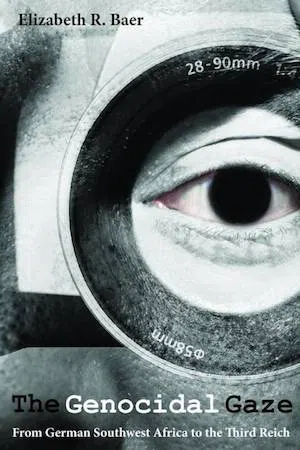
The first genocide of the twentieth century, though not well known, was committed by Germans between 1904–1907 in the country we know today as Namibia, where they exterminated hundreds of Herero and Nama people and subjected the surviving indigenous men, women, and children to forced labor. The perception of Africans as subhuman—lacking any kind of civilization, history, or meaningful religion—and the resulting justification for the violence against them is what author Elizabeth R. Baer refers to as the "genocidal gaze, â€_x009d_ an attitude that was later perpetuated by the Nazis. In The Genocidal Gaze: From German Southwest Africa to the Third Reich, Baer uses the metaphor of the gaze to trace linkages between the genocide of the Herero and Nama and that of the victims of the Holocaust. Significantly, Baer also considers the African gaze of resistance returned by the indigenous people and their leaders upon the German imperialists.
- 208 pages
- English
- PDF
- Available on iOS & Android
eBook - PDF
The Genocidal Gaze : From German Southwest Africa to the Third Reich
About this book
Trusted by 375,005 students
Access to over 1.5 million titles for a fair monthly price.
Study more efficiently using our study tools.
Information
Subtopic
African Literary CriticismIndex
LiteratureTable of contents
- Cover
- Title Page
- Copyright
- Dedication
- Contents
- List of Illustrations
- Acknowledgments
- Introduction
- One: The African Gaze of Resistance in Hendrik Witbooi and Others
- Two: The Genocidal Gaze in Gustav Frenssen’s Peter Moor’s Journey to Southwest Africa
- Three: Uwe Timm’s Critique of the Genocidal Gaze in Morenga and In My Brother’s Shadow
- Four: William Kentridge’s Black Box / Chambre Noire: The Gaze on / in the Herero Genocide, the Holocaust, and Apartheid
- Five: Ama Ata Aidoo’s Our Sister Killjoy: The African Gaze of Resistance Today
- Afterword
- Notes
- Bibliography
- Index
Frequently asked questions
Yes, you can cancel anytime from the Subscription tab in your account settings on the Perlego website. Your subscription will stay active until the end of your current billing period. Learn how to cancel your subscription
No, books cannot be downloaded as external files, such as PDFs, for use outside of Perlego. However, you can download books within the Perlego app for offline reading on mobile or tablet. Learn how to download books offline
Perlego offers two plans: Essential and Complete
- Essential is ideal for learners and professionals who enjoy exploring a wide range of subjects. Access the Essential Library with 800,000+ trusted titles and best-sellers across business, personal growth, and the humanities. Includes unlimited reading time and Standard Read Aloud voice.
- Complete: Perfect for advanced learners and researchers needing full, unrestricted access. Unlock 1.5M+ books across hundreds of subjects, including academic and specialized titles. The Complete Plan also includes advanced features like Premium Read Aloud and Research Assistant.
We are an online textbook subscription service, where you can get access to an entire online library for less than the price of a single book per month. With over 1.5 million books across 990+ topics, we’ve got you covered! Learn about our mission
Look out for the read-aloud symbol on your next book to see if you can listen to it. The read-aloud tool reads text aloud for you, highlighting the text as it is being read. You can pause it, speed it up and slow it down. Learn more about Read Aloud
Yes! You can use the Perlego app on both iOS and Android devices to read anytime, anywhere — even offline. Perfect for commutes or when you’re on the go.
Please note we cannot support devices running on iOS 13 and Android 7 or earlier. Learn more about using the app
Please note we cannot support devices running on iOS 13 and Android 7 or earlier. Learn more about using the app
Yes, you can access The Genocidal Gaze : From German Southwest Africa to the Third Reich by Elizabeth R. Baer in PDF and/or ePUB format, as well as other popular books in Literature & African Literary Criticism. We have over 1.5 million books available in our catalogue for you to explore.