eBook - ePub
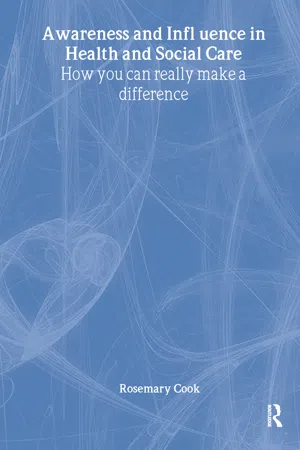
Awareness and Influence in Health and Social Care
The Epidemiologically Based Needs Assessment Reviews, Gynaecology - Second Series
- 256 pages
- English
- ePUB (mobile friendly)
- Available on iOS & Android
eBook - ePub
Awareness and Influence in Health and Social Care
The Epidemiologically Based Needs Assessment Reviews, Gynaecology - Second Series
About this book
'This is a book about the skills, habits and behaviours that make people influential. The good news is that influence is not just for 'senior' people or people in specific jobs any more. The old hierarchies are breaking down and 'front line' expertise is valued by policy-makers more than ever before. You can be well-known and influential from anywhere. Anyone can do it - if they are prepared to put some personal effort into it...' This comprehensive, easy-to-read guide covers every kind of influential activity and teaches you how to make the most of every opportunity across all levels. It is the only practical text on the topic, designed specifically for health and social care professionals. The insider information, helpful tips, checklists and developmental exercises throughout aid in application, and top tips from professionals currently influencing different arenas of national policy and practice help give you an edge. This book is ideal for nurses in acute and primary care, including health visitors and midwives. Professionals in social care, allied health and clinical science will also find it invaluable, as will postgraduate health and social care students undertaking development and leadership courses.
Trusted by 375,005 students
Access to over 1.5 million titles for a fair monthly price.
Study more efficiently using our study tools.
Information
Topic
MedicineSubtopic
Health Care DeliverySECTION 1
Principles
CHAPTER 1
How to use this book: scope and approach
This is a book about increasing your awareness and your influence. It has three key aims:
- to help you to find new ways to expand your knowledge of practice, policy and the service in which you work
- to suggest how you can build expertise in some key practical skills needed for influence
- to show how you can use these skills to increase your influence on the people who develop health policy, practice and the health service.
Since everyone starts with a different combination of experience, personality and ambition, it would be impossible for the contents of this book to be exactly right for every person using it. Parts of it will seem obvious and unnecessary to some people, while for others, the same ideas and suggestions will be exciting and challenging. What is already everyday behaviour to one person is a leap in the dark for another. There is no ‘one size fits all’ solution for success.
So one way to use this book would be to look down the list of contents, and dip into those sections that seem to have something new to offer you. Alternatively, it can be read from beginning to end, as consolidation of your existing skills and practices, but with the expectation of finding at least one or two new ideas for further professional development.
Throughout the book you will find devices to help you relate the contents of each section to your own situation. These include:
- ‘mirror moments’: for reflection on the issue under discussion, its impact on you and your practice, and your attitude to it
- personal development exercises: tasks aimed specifically at exercising a particular skill
- ‘portfolio pointers’: ideas for recording your actions in your personal professional portfolio
- checklists for action: things you could do to increase your awareness, develop your networks and enhance your influence, even before you finish the book.
These devices are all aimed at making the book a useful tool for development, rather than simply an interesting read. Try to find time to stop and undertake the activities suggested — they will make sure that you finish the book already more aware, and more influential, than you started, and with an improved professional portfolio to prove it.
- The ‘need to know’ boxes provide additional information on relevant topics. If you have ever wondered what ‘Chatham House Rules’ means, where to get support for ‘whistleblowing’ or which topics are exempt from disclosure under the Freedom of Information Act, this is where you will find the information.
Throughout the book are quotes from key individuals who are already policy makers, influencers, professional leaders and role models across the health and social care spectrum. Their advice on the topics covered in this book adds weight and substance to the topics discussed.
Together, the different tools and devices in this book should provide you with both the recipe and the ingredients for a more aware and influential future.
What is covered in the book?
There is an almost endless list of topics that could be useful to health and social care workers looking for help to develop skills and enhance their development. This book covers many of the more common questions that are asked on leadership courses and in individual meetings with professionals who are keen to develop their influence, but are not sure how to proceed. These include:
- how do I build up a professional network?
- how do I spread good practice outside of my unit?
- how do I record ‘influence’ in my personal professional profile?
- how should I contribute to a strategy meeting, a meeting with a government minister, or a professional conference?
- could I write an article for a professional journal?
- who is ‘in charge’ of policy on my particular topic?
- is it possible to combine an influential career with a family?
- can I have influence without leaving the workplace?
- what if my employer is not supportive?
- what will happen if I speak out?
These topics form the backbone of subsequent sections, together with other tips and topics that contribute to the development of awareness and influence.
Who is it for?
It will be clear from these sample questions that the advice given — and other topics and skills discussed in this book — are applicable across the whole spectrum of the health and social care professions. I have used examples of nurses, midwives, allied health professionals, healthcare scientists and social care workers randomly through the text: wherever one group is mentioned, the text is usually applicable to other workers in the health and social care too.
It will also apply to professionals of different grades, positions and practice areas, working for different employers. As the introduction made clear, the need for a book like this arises partly because traditional hierarchies are being removed or inverted, role models are harder to find, and the potential for national exposure and influence, regardless of ‘status’, has never been greater. So there is no particular level of professional at which this book is aimed: it is equally relevant to the student and the director, the practitioner and the service commissioner.
Where does this advice come from?
The source of the advice, ideas and tips in this book is much broader than my own experience. I have brought together what I have learned from many other influential people whom I have watched and emulated over the years: midwives, managers, doctors, nurses, civil servants and scientists. It is their amalgamated wisdom, leadership, example and support that have been summarised here, together with my own experiences and mistakes, to produce a toolkit for you to use and to pass on.
It is important to stress that the ideas in this book do not necessarily represent the best or only way to go about expanding your awareness and influence. There are many other ways to achieve the same ends, and you may have found your own equally valid and successful approach. But these ideas have all worked for someone, in some circumstances, so they are worthy of inclusion on their own merits.
The approach
This book does not contain any theory. It does not explain models of leadership, or the empirical basis of networking. It is practical, and practice based, in the widest sense: real world practice, in all fields, not only clinical practice. If it sometimes appears didactic — ‘do this, do that’ — then this is just shorthand for ‘you could consider …’ or ‘why not try …?’ View all suggestions through the window of your own situation, ambition, experience and talents, weigh up the advice, and choose those elements of it that you want to try. Above all, if you want to increase your awareness and influence, make a start — do something!
PORTFOLIO POINTER
Reading this book, undertaking some of the development activities contained in it and applying them to your own practice or area of work, could be recorded in your personal professional portfolio as a contribution to meeting your continuing professional development (CPD) requirements. There are many specific suggestions for what to record in your portfolio in the course of the following chapters. If you don’t have a portfolio, this would be a good time to start one! Some professional organisations sell them, or give them to members. Otherwise an ordinary ring binder file will do as a convenient place to keep together your important professional information. See Box 1.1 for what sort of documents and records to keep in your portfolio.
BOX 1.1 What to put in a personal professional file (portfolio)
A personal portfolio will usually contain:
- qualification certificates
- evidence of other training courses or events attended
- reflections on learning or further training needs
- reflections on future career or job aspirations, and plans to achieve them.
It could contain:
- copies of your latest CV
- programmes of conferences you have attended/spoken at
- articles or letters you have had published
- thank you letters from groups or committees you contributed to
- appraisals from your current job
- contact network maps.
CHAPTER 2
Awareness and influence: what do they mean?
Awareness in health and social care comes in two forms:
- awareness of knowledge for practice, and
- awareness of the context of practice.
Knowledge for practice — the facts, figures, theories, judgements and ideas used every day in the care of patients or clients, or the education, management and development of practice and practitioners — is not the focus of this book. That is the kind of knowledge gained in formal education, through courses and reflection on practice, or through reading journals or textbooks. But it can be knowledge gained and used in isolation, focused sharply on the daily task. It is essential for practice, but it will not necessarily take the practitioner outside of their practice to influence others.
Awareness of the context of practice is different. Knowing the context is like looking up from the wound dressing to take in the whole patient. It is seeing the daily task — clinical or otherwise — as part of a bigger picture. It is a kind of professional holism, rather than a job-focused’ approach. And, for reasons that will be squareussed more in the next section, it is an essential prerequisite for influence.
MIRROR MOMENT
Stop and reflect on this. Do you concentrate solely on your knowledge for practice, reading clinical or technical articles but skipping over news and analysis sections of journals? Are you proud of the fact that you just get on with the job, and...
Table of contents
- Cover
- Title Page
- Copyright Page
- Dedication
- Table of Contents
- About the author
- Acknowledgements
- Introduction
- Section 1: Principles
- Section 2: Developing Awareness
- Section 3: Developing Influence
- Section 4: Being Visible
- Index
Frequently asked questions
Yes, you can cancel anytime from the Subscription tab in your account settings on the Perlego website. Your subscription will stay active until the end of your current billing period. Learn how to cancel your subscription
No, books cannot be downloaded as external files, such as PDFs, for use outside of Perlego. However, you can download books within the Perlego app for offline reading on mobile or tablet. Learn how to download books offline
Perlego offers two plans: Essential and Complete
- Essential is ideal for learners and professionals who enjoy exploring a wide range of subjects. Access the Essential Library with 800,000+ trusted titles and best-sellers across business, personal growth, and the humanities. Includes unlimited reading time and Standard Read Aloud voice.
- Complete: Perfect for advanced learners and researchers needing full, unrestricted access. Unlock 1.5M+ books across hundreds of subjects, including academic and specialized titles. The Complete Plan also includes advanced features like Premium Read Aloud and Research Assistant.
We are an online textbook subscription service, where you can get access to an entire online library for less than the price of a single book per month. With over 1.5 million books across 990+ topics, we’ve got you covered! Learn about our mission
Look out for the read-aloud symbol on your next book to see if you can listen to it. The read-aloud tool reads text aloud for you, highlighting the text as it is being read. You can pause it, speed it up and slow it down. Learn more about Read Aloud
Yes! You can use the Perlego app on both iOS and Android devices to read anytime, anywhere — even offline. Perfect for commutes or when you’re on the go.
Please note we cannot support devices running on iOS 13 and Android 7 or earlier. Learn more about using the app
Please note we cannot support devices running on iOS 13 and Android 7 or earlier. Learn more about using the app
Yes, you can access Awareness and Influence in Health and Social Care by Rosemary Cook,Alison Davies in PDF and/or ePUB format, as well as other popular books in Medicine & Health Care Delivery. We have over 1.5 million books available in our catalogue for you to explore.