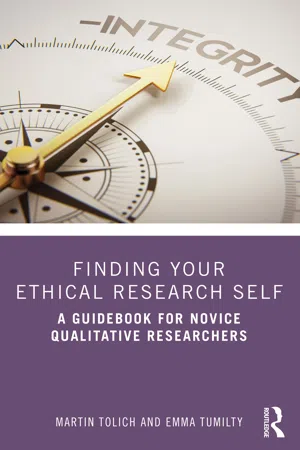
Finding Your Ethical Research Self
A Guidebook for Novice Qualitative Researchers
- 198 pages
- English
- ePUB (mobile friendly)
- Available on iOS & Android
Finding Your Ethical Research Self
A Guidebook for Novice Qualitative Researchers
About this book
Finding Your Ethical Research Self introduces novice researchers to the need for ethical reflection in practice and gives them the confidence to use their knowledge and skill when, later as researchers, they are confronted by big ethical moments in the field.
The 12 chapters build on each other, but not in a linear way. Core ethical concepts like consent and confidentiality once established in the early chapters are later challenged. The new focus becomes how to address qualitative research ethics when confidentiality and consent take on a limited form. This approach helps students understand that the application of concepts always requires thoughtful adaptation in different contexts and the book provides guidance on how to do this. Classroom/workbook exercises develop alternative solutions to create process consent, internal confidentiality, and engage reference groups, as examples. The first eight chapters allow students to develop their ethical research self before thinking through how they might address formal ethics review. Formal ethics review is deliberately not introduced until Chapter 9. Chapter 10 offers practical help to elements of review, before Chapter 11 emphasises the key message by providing examples of researchers' dilemmas in the field using vignettes and discussion. By providing these examples, students become aware that these can arise, explore how they might arise, and recognise how they might deal with them in the moment when they are unavoidable.
With numerous examples of ethical dilemmas and issues and questions and exercises to encourage self-reflection, this reflexive, learn-by-doing model of research ethics will be highly useful to the novice researcher, undergraduate, and postgraduate research student.
Trusted by 375,005 students
Access to over 1 million titles for a fair monthly price.
Study more efficiently using our study tools.
Information
Chapter 1
The one-minute ethicist
Why write the text, the cartoons [Figures 1 and 2] say it all.Professor Emeritus
- I knew pretty much nothing. I knew a little about ethics committees, but nothing about the actual lived ethics experience.
- Prior to class, the only understanding of [research] ethics I had was a standard textbook definition: conducting research ethically means to do research in a safe and secure manner where participants’ wellbeing and interests are safeguarded during the pursuit of knowledge.
- My prior knowledge of qualitative ethics was limited to writing a paragraph for “ethical consideration” for undergrad courses.
- I began this class with what I felt was a reasonably comprehensive knowledge of the basic ethical concepts that might be encountered within quantitative social science research. What I quickly learnt is just how different qualitative and quantitative research ethics are.
- As I did not understand the amount of theory that goes behind qualitative ethics, I found myself expecting this course to be more about applying for ethics approval.

After a little housekeeping, brief introductions and handing out course outlines, I took a digital recorder from my pocket and placed it on the tabletop. I then did something awkward; I switched on the recorder and a tiny red light blinked. With it, the room fell into an uneasy silence.
The walls seemed at once to close in, and disappear altogether. I felt watched, judged even, and painfully aware of the small device now listening to my every sound. With tightness rising in my throat, nerves and thoughts collided. My immediate reactions ranged from inquisitive to cautious, playful to suspicious, when out of all the consternation emerged a singularly clear voice. “Is this ethical?” asked one of my fellow students. “That’s a great question” responded the lecturer. “What do you mean is that ethical?” Again silence reigned, the lecturer abdicated the floor. As if to help the lecturer out another student translated the question. “She means do you need our consent to have that tape recorder on?” “That is a good question”, the lecturer said. “Do I?”
Table of contents
- Cover
- Half Title
- Endorsement Page
- Title Page
- Copyright Page
- Dedication
- Table of Contents
- Acknowledgements
- Chapter 1: The one-minute ethicist
- Chapter 2: Organising the reader
- Chapter 3: Is eve’s story Venkatesh’s story?
- Chapter 4: When consent is uninformed, empower participants and activate a reference group
- Chapter 5: Do quantitative and qualitative research have similar ethical considerations?
- Chapter 6: The limits of confidentiality in unstructured interviews and focus groups
- Chapter 7: Irregular types of informed consent in narrative research, autoethnography, photovoice, and participant observation
- Chapter 8: Negotiating ethics within a memorandum of understanding (MOU)
- Chapter 9: Formal ethics review: Research governance is not research ethics
- Chapter 10: Don’t invent the (ethics) wheel: Use TREAD, The research ethics application database
- Chapter 11: Researching in harm’s way
- Chapter 12: Looking back: The path was always there
- Appendix: How teachers can use the book
- References
- Index
Frequently asked questions
- Essential is ideal for learners and professionals who enjoy exploring a wide range of subjects. Access the Essential Library with 800,000+ trusted titles and best-sellers across business, personal growth, and the humanities. Includes unlimited reading time and Standard Read Aloud voice.
- Complete: Perfect for advanced learners and researchers needing full, unrestricted access. Unlock 1.4M+ books across hundreds of subjects, including academic and specialized titles. The Complete Plan also includes advanced features like Premium Read Aloud and Research Assistant.
Please note we cannot support devices running on iOS 13 and Android 7 or earlier. Learn more about using the app