- 208 pages
- English
- ePUB (mobile friendly)
- Available on iOS & Android
eBook - ePub
US Airborne Tanks, 1939–1945
About this book
This book explores the design and deployment of American airborne tanks from the earliest concepts to their actual use.
From their first introduction at the Battle of the Somme in the First World War, tanks proved to be one of the most important military developments in the history of warfare. Such was their influence on the battlefield, both as infantry support and as an armored spearhead, their presence could determine the outcome of any battle. Another significant development during the 1930s was that of airborne forces, with a number of countries experimenting with air-dropped troops. Such a concept offered the possibility of inserting soldiers behind the front lines to sow fear and confusion in the enemy's rear. However, such troops, parachuting from aircraft, could only be lightly armed, thus limiting their effectiveness. It is understandable, therefore, that much thought was given to the practicalities of airlifting tanks that could be dropped, or deposited, alongside paratroopers. Tanks, though, are heavy, cumbersome vehicles and before there could be any thought of carrying them by air, much lighter models would have to be produced. Charles Roberts' fascinating book opens with an investigation into the efforts in the 1930s by Britain, the Soviet Union and the USA into the development of, or adaptation of, light tanks for airborne operations. It was, inevitably, the start of the Second World War which accelerated efforts to produce an airborne tank and the means of delivery. The use of conventional powered aircraft to carry the tanks, limited their use to existing airfields which negated their employment with airborne troops landing in the open countryside. Another method of delivery had to be found, and this took the form of the glider, which could be landed in a field behind enemy lines. The combination of light tank and glider made the aim of airborne forces being supported by armor a realistic proposition – and as a result, the 28th Airborne Tank Battalion was born. This detailed and comprehensive study deals with every aspect of design and deployment of American airborne tanks from the earliest concepts to their actual use, by British units, on D-Day and during Operation Varsity, the Rhine crossing.
Trusted by 375,005 students
Access to over 1 million titles for a fair monthly price.
Study more efficiently using our study tools.
Information
Chapter 1
The Airborne Tank Concept
Walter Christie was an engineer with experience in designing race cars and other unique vehicles. During the First World War, he developed a prototype wheeled gun carriage for the US Army. The Ordnance Board had certain specifications for an airborne armored vehicle, which did not conform to Christie’s idea of what a military vehicle should look like. He refused to alter his designs to match these military specifications and engaged in disagreements with the Ordnance Board, which essentially killed his project with the Army. In 1928, Christie patented a suspension system for tanks that was revolutionary. It involved independent road wheels using a control arm and spring system for each wheel, which resulted in very high-speed cross-country mobility. There were no support rollers for the track since the road wheels were large and supported the track at the top of each wheel. A tank using this system was called the model 1928. The tracks were removable so that the tank could travel on the large road wheels at high speed. The armor on the tank was thin and sloped, thus deflecting only small projectiles, such as those fired by infantry rifles.
The Christie suspension was an innovation for its time in that each road wheel of the tracked vehicle absorbed terrain variations independently of the other wheels, resulting in a smoother and faster ride. The wheel was large enough to act as the return roller for the track. When the track was removed, the larger wheels gave good road performance at high speeds on both prepared and unprepared roadways. One problem with the design was the space required for the coil springs. Later tank designs looked similar to Christie’s but used a torsion bar in place of a spring. The torsion bar would be mounted at the bottom of the hull, taking up less space.
In 1932, Christie produced a prototype airborne tank, as seen on p. 6. It was technically not a tank but an armored assault vehicle, since it did not have a rotating turret. The accepted definition of a tank is an armored tracked vehicle with a rotating turret, with the crew fully enclosed. Despite this, it is typically referred to as the Christie airborne tank. It carried one 75mm gun and several machine guns. The armor was 0.375- to 0.5in-thick steel plate. Maximum speed was 60mph on track, and 120mph with the tracks removed and stored on the vehicle. The suspension conformed to the patent with aluminum wheels and pneumatic tires developed by the Firestone Tire and Rubber Company. The length of the Christie prototype was 22ft, width 7ft and height about 5ft 8in. The engine was a V12 rated at 750HP. Weight was approximately 5 tons. The transmission had three forward gears and one reverse as well as a power take-off unit for a propeller used by the airplane wing attachment. Fuel capacity was 89 gallons. The main structure of the vehicle was a double hull. The inner hull had aluminum plates and the outer hull had steel plates. The aluminum plates, which significantly reduced the weight of the vehicle, were a source of concern for the US military, which believed they were too thin. The rear road wheels were powered to propel the vehicle when the tracks were stored. The detachable biplane assembly was used for independent flight operation. The unit was designed to taxi to the runway and accelerate to take-off speed using the road wheels. As the flying ‘tank’ began to lift, the propeller would take over and the unit would become airborne. The driver/pilot would guide the aircraft to the landing zone, accelerate the wheels or tracks to the proper landing speed, land, detach the biplane assembly and proceed to the battle area. The wings would then be picked up for possible future use.

A Christie T-3 tank model 1931 delivered to the US Army for evaluation. (Chamberlain and Pugh, T.3 Christie)

The 1931 patent of the Christie suspension system. This was a revolutionary design that was copied, fully or partially, by many countries. This allowed for high speed and good ride over rough terrain capability. This also significantly improved the feasibility of an airborne tank since it could travel at high speed without the tracks attached, which could be installed after landing.(US Patent Office, patent number 1,836,446)
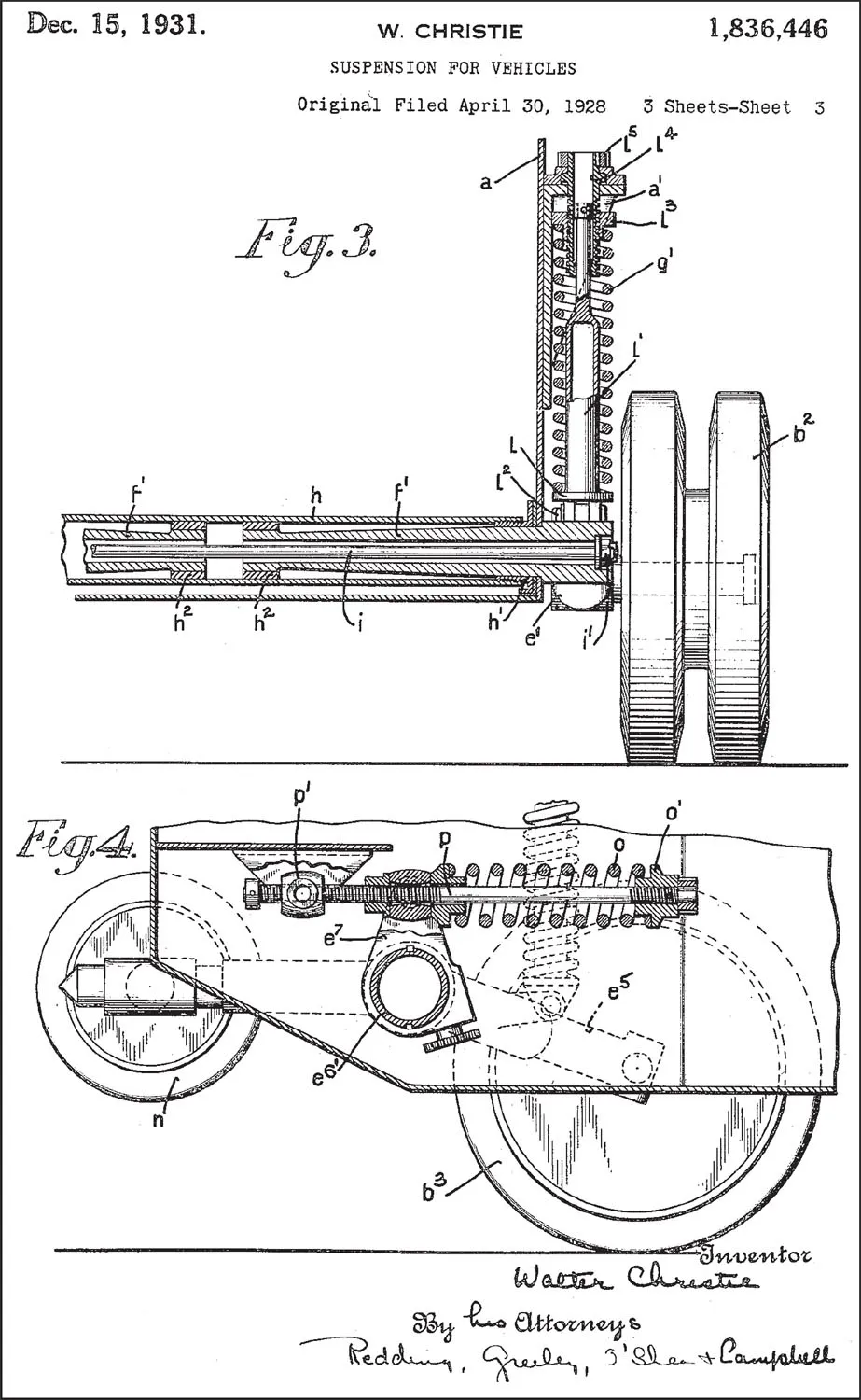
A detailed view of the Christie suspension system. The top drawing describes the suspension system for the road wheels on each side of the vehicle. The bottom drawing describes the suspension system for the front of the vehicle which controls track tension. (US Patent Office, patent number 1,836,446)
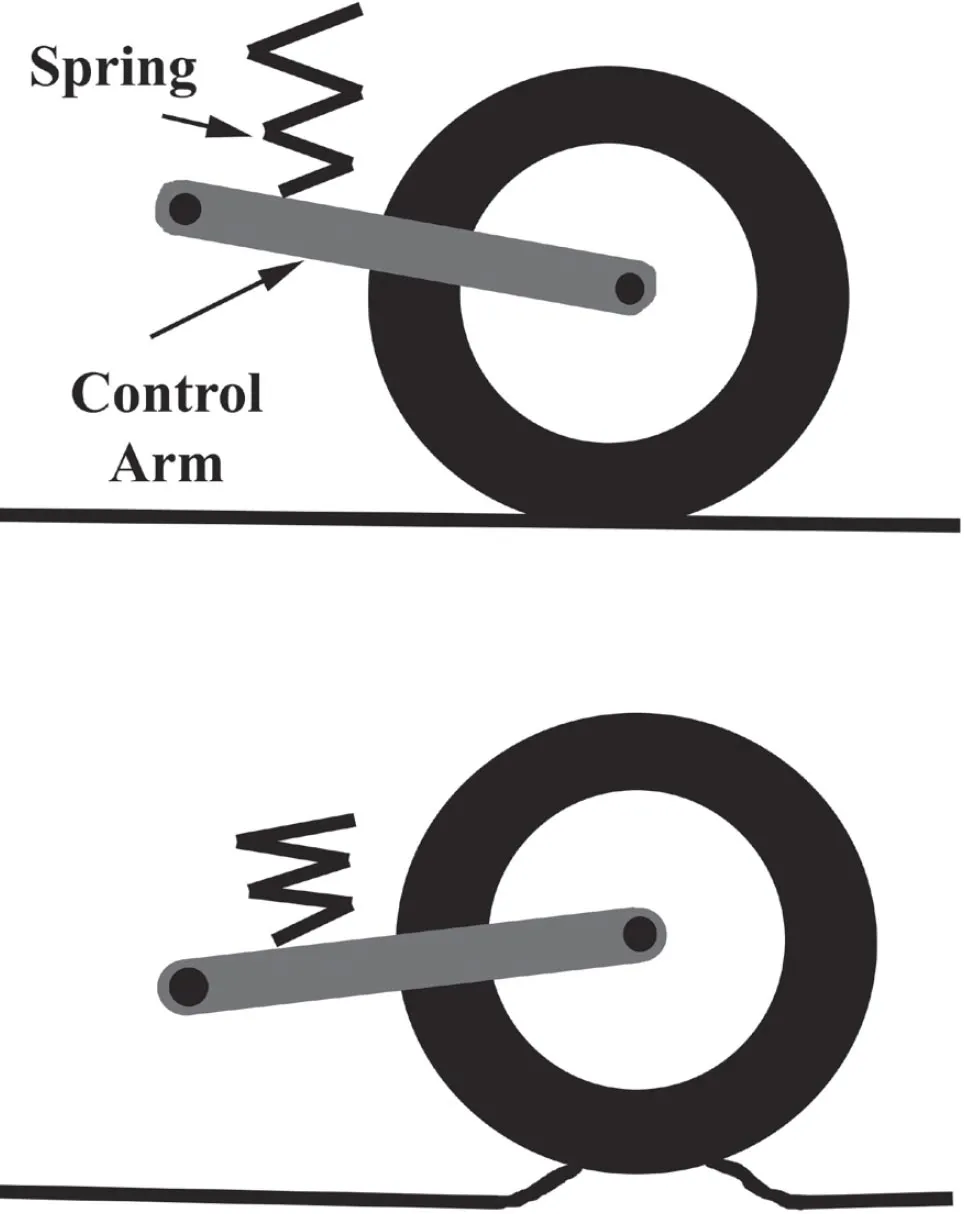
A simplified drawing of the Christie suspension system. The control arm moves up and down to absorb irregularities in the terrain.

The Christie-designed airborne armored car M-1933. (Chamberlain and Pugh, T.3 Christie)


The Walter Christie-designed M1932 airborne tank produced by the Wheel Track Layer Corporation. (Chamberlain and Pugh, T.3 Christie)
The US Army purchased several Christie tank prototypes for testing. The Tank Board wanted tanks with significant armor at the expense of mobility. Christie argued for thinner armor and high speed. This disagreement resulted in the US Army never adopting these designs. Christie, upset with the rejection of his designs by his own government, started peddling his ideas to the Russians, the British and the Polish, despite not having approval from the State Department to do so. Christie continued work on new designs which led to the airborne tank in 1932.
Christie envisioned a flying tank that flew on its own power. A 1000HP engine would not only drive the tank wheels but also drive a propeller through a power take-off mechanism. The drawings below and on the next page illustrate the concept. The armored vehicle, not technically a tank since the turret does not rotate, is equipped with a 75mm gun and is sufficiently light in weight to be transported by the detachable wing system. The Christie armored vehicle could operate with the tracks removed, so the system is technically feasible in that the armored vehicle could land at high speed. There is a power take-off at the rear of the engine with a rotating shaft rising vertically to a bevel gear that drives the main propeller shaft. The vertical shaft detaches quickly when the airframe is released. The armored vehicle can travel at nearly 100mph so landing, say at 60mph, would not be a problem. The secret to his design was the light weight of the armored vehicle, making it feasible for airborne operations.


Christie’s concept of the powered airborne tank. (Modern Mechanics and Inventions, Vol. VIII)
Despite all the innovative ideas and prototypes, Christie’s designs were never produced. Several foreign countries utilized parts or all of the Christie designs and patent. Christie’s designs were light weight, low profile, high speed and well armed, but deficient in armor protection.
The Russian Antonov A-40 was an airborne tank design using an existing T-60 light tank. The glider would be towed aloft using a large aircraft, released over the battlefield, land, discard the glider adapter wings and proceed...
Table of contents
- Cover
- Title
- Copyright
- Contents
- Acknowledgements and Picture Credits
- Introduction
- Chapter 1: The Airborne Tank Concept
- Chapter 2: The US Airborne Tank
- Chapter 3: The 151st Airborne Tank Company and the 28th Airborne Tank Battalion in the Second World War
- Chapter 4: US Airborne Tank Usage in the Second World War
- Appendix: 151st Airborne Tank Company Daily Log
- Recommended Reading
Frequently asked questions
Yes, you can cancel anytime from the Subscription tab in your account settings on the Perlego website. Your subscription will stay active until the end of your current billing period. Learn how to cancel your subscription
No, books cannot be downloaded as external files, such as PDFs, for use outside of Perlego. However, you can download books within the Perlego app for offline reading on mobile or tablet. Learn how to download books offline
Perlego offers two plans: Essential and Complete
- Essential is ideal for learners and professionals who enjoy exploring a wide range of subjects. Access the Essential Library with 800,000+ trusted titles and best-sellers across business, personal growth, and the humanities. Includes unlimited reading time and Standard Read Aloud voice.
- Complete: Perfect for advanced learners and researchers needing full, unrestricted access. Unlock 1.4M+ books across hundreds of subjects, including academic and specialized titles. The Complete Plan also includes advanced features like Premium Read Aloud and Research Assistant.
We are an online textbook subscription service, where you can get access to an entire online library for less than the price of a single book per month. With over 1 million books across 990+ topics, we’ve got you covered! Learn about our mission
Look out for the read-aloud symbol on your next book to see if you can listen to it. The read-aloud tool reads text aloud for you, highlighting the text as it is being read. You can pause it, speed it up and slow it down. Learn more about Read Aloud
Yes! You can use the Perlego app on both iOS and Android devices to read anytime, anywhere — even offline. Perfect for commutes or when you’re on the go.
Please note we cannot support devices running on iOS 13 and Android 7 or earlier. Learn more about using the app
Please note we cannot support devices running on iOS 13 and Android 7 or earlier. Learn more about using the app
Yes, you can access US Airborne Tanks, 1939–1945 by Charles C. Roberts in PDF and/or ePUB format, as well as other popular books in History & Military & Maritime History. We have over one million books available in our catalogue for you to explore.