An enticing history of food and drink in Western art and culture
Eating and drinking can be aesthetic experiences as well as sensory ones. The Hungry Eye takes readers from antiquity to the Renaissance to explore the central role of food and drink in literature, art, philosophy, religion, and statecraft.
In this beautifully illustrated book, Leonard Barkan provides an illuminating meditation on how culture finds expression in what we eat and drink. Plato's Symposium is a timeless philosophical text, one that also describes a drinking party. Salome performed her dance at a banquet where the head of John the Baptist was presented on a platter. Barkan looks at ancient mosaics, Dutch still life, and Venetian Last Suppers. He describes how ancient Rome was a paradise of culinary obsessives, and explains what it meant for the Israelites to dine on manna. He discusses the surprising relationship between Renaissance perspective and dinner parties, and sheds new light on the moment when the risen Christ appears to his disciples hungry for a piece of broiled fish. Readers will browse the pages of the Deipnosophistae—an ancient Greek work in sixteen volumes about a single meal, complete with menus—and gain epicurean insights into such figures as Rabelais and Shakespeare, Leonardo and Vermeer.
A book for anyone who relishes the pleasures of the table, The Hungry Eye is an erudite and uniquely personal look at all the glorious ways that food and drink have transfigured Western arts and high culture.
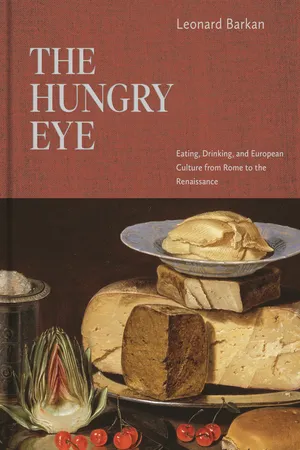
eBook - ePub
The Hungry Eye
Eating, Drinking, and European Culture from Rome to the Renaissance
- 320 pages
- English
- ePUB (mobile friendly)
- Available on iOS & Android
eBook - ePub
About this book
Trusted by 375,005 students
Access to over 1.5 million titles for a fair monthly price.
Study more efficiently using our study tools.
Information
Topic
ArteSubtopic
Storia dell'arte
Reading for the Food

In principle, at least, the Greeks distinguished rigorously between two phases of a formal meal (fig. 1.1). First came the deipnon, with many and varied courses of food, and then the symposion, which was principally devoted to drink, as the word itself (συν-πίνω; “drink together”) suggests. This latter phase could move onward into the wee hours with loose talk among the (inevitably) all-male diners or even to erotic activity involving the visits of slave girls, hetaerae, and the like.1
How, then, shall we comprehend the most famous symposium of all, scripted by Plato, in which Socrates and his learned colleagues quite soberly discuss the nature of love? One path to an understanding would have to travel through the opening pages of the dialogue, in which there are only the vaguest references to love—Socrates flatters Agathon’s beauty while also offering some sarcastic insinuations about his intelligence—but a plethora of references to dinner, including who got invited or didn’t get invited, the introduction of Socrates as a guest who brings another person along but arrives late himself, and a description of the officially sanctioned arrangement of the dinner couches.
Most particularly, though, there is a discussion about drink. The symposiasts seem to be pursuing a quite canonical structure for the meal. Having concluded the eating portion of the occasion, “They poured a libation to the god, sang a hymn, and—in short—followed the whole ritual. Then they turned their attention to drinking.”2 But this attention is devoted mostly to how they won’t be drinking. Both Pausanias and Aristophanes, it turns out, already have hangovers from the night before, Agathon is also a bit the worse for wear, and the physician Eryximachus is prepared to offer a medical lecture about the evils of alcohol (which we are all spared). They also agree to dismiss the flute girl, whose sensuous entertainment is of a piece with heavy drinking.

1.1. Triptolemos Painter, Banquet scene (symposium) on red figure kylix (drinking cup), 5th century BCE. Antikensammlung, Staatliche Museen, Berlin
What sort of occasion is this, then? In the “Table Talk” section of his Moralia, Plutarch will triumphantly point out that the food consumed on sympotic occasions leaves nothing but “yesterday’s smell,”3 whereas the wise words of philosophy remain eternally fresh, and that, he says, is why the Symposium includes no account of the menu but only of the conversation. (An observation, it should be pointed out, offered in the midst of several chapters in the “Table Talk” filled with minute gastronomic observations.) Nevertheless, Plato has designed a narrative in which the most transcendent of philosophical matters is framed around a meal. The deipnon phase of the evening is duly, if briefly, chronicled, but the drinking phase that is supposed to follow, though coyly offered as a possibility, is cancelled in favor of rigorous teetotaling and some apparently contrary set of activities. Yet, if the alcoholic phase does not take place, why is the dialogue given the name of a drinking party?
. . .
The great philosopher of a later age Immanuel Kant spent some years developing a set of lectures that would eventually become Anthropology from a Pragmatic Point of View.4 Neither exactly anthropological nor pragmatic in the modern senses, these lectures represent Kant’s wish to branch out from the world of purely abstract philosophical reasoning, of metaphysics or epistemology, in favor of something closer to a description of human activity, especially cognition, as it actually takes place.
Throughout his work in both these areas, Kant was intensely concerned with aesthetics, and especially aesthetic judgments. In the Critique of Judgment, the ruminations are at base abstract and logical. He is laboring to define the philosophical status of judgments about beauty and what sort of truth they might contain, as distinct from judgments about, say, ethics. His Anthropology, on the other hand, aspires to describe and analyze actual human processes, and so he is less interested in the validity of aesthetic judgments than in the human faculties that produce them. Consequently, it is no longer abstract logic that governs his thinking but rather a description of human subjectivity, with its capacities for pleasure and displeasure.
The term that encapsulates aesthetic judgment and human subjectivity is, inevitably, taste; and Kant remains sufficiently a philosophical systematizer to be searching for universals in this apparently individualist realm. “The word taste,” he writes, in a section of Anthropology entitled “On the feeling for the beautiful,” “is also taken for a sensible faculty of judgment, by which I choose not merely for myself, but also according to a certain rule which is represented as valid for everyone.”5 He proceeds to do quite a bit of philosophical heavy lifting around the conflict between individual judgments and universal rules, citing, for instance, the distinct traditions of the Germans versus the English in regard to the way they begin their meals, the Germans preferring soup, the English solid foods.
But the whole matter of taste, once it has made a transit through mealtime, requires of Kant that a separate Anmerkung, or note, be appended to this section—a practice he does not follow elsewhere in the Anthropology. “How could it have happened,” Kant begins his Anmerkung, “that modern languages in particular have designated the aesthetic faculty of judging with an expression (gustus, sapor) that merely refers to a certain sense organ (the inside of the mouth)?” (Anthropology, 139). It’s worth paying special attention to that “merely” (bloß). In Kant’s search to find a through line between aesthetics and universals, to offer a philosophical account of taste, the inside of the mouth looms threateningly. Why indeed should that particular bodily sensation, whether generated by German cabbage soup or English soused mackerel, have become archetype and eponym for so many aesthetic experiences of greater importance than anything produced by mere amuse-bouches?6
. . .
In 1435, Leon Battista Alberti produced his highly influential treatise On Painting, which he wrote first in Latin and then translated, with some changes, into Italian. In a quite brief stretch of pages, Alberti celebrates the glories of painting, covers technical issues in representation and perspective, and enunciates up-to-date rules for pictorial decorum. In particular, he canonizes a certain kind of narrative composition, which he calls a historia, endowing it with cultural significance very much along the lines that Horace bestowed on poetry in his Ars poetica.
Laying down the guidelines for this composition, Alberti arrives at questions having to do with what he calls compositio. He doesn’t like a picture to be too empty or too crowded, and he goes on to say,
In a “historia” I strongly approve of the practice I see observed by the tragic and comic poets, of telling their story with as few characters as possible. In my opinion there will be no “historia” so rich in variety of things that nine or ten men cannot worthily perform it.7
Alberti is drawing an analogy between the number of characters in a classical drama and the number of bodies in a painting. The parallel makes sense: he is, after all, talking about narrative; and the ancient dramas with which he may have been familiar (say, Terence and Seneca)8 could well stand as paradigms for economy of storytelling, readily transferrable from the three dimensions of the theater to the two dimensions of panel paintings. We are, in other words, witnessing a logical shift from one aesthetic medium to another; in a familiar intermedial mode, Alberti wishes to garner some of the prestige accorded to classical text and transfer it to modern painting.9
But Alberti does not close with the theatrical analogy. Having established the limit of nine or ten persons in a painting on the authority of the ancient dramatists, he caps off this discussion by saying, “I think Varro’s dictum is relevant here: he allowed no more than nine guests at dinner, to avoid disorder.” The swerve from Sophocles to the supper table, surprising in itself, becomes even more striking when we look back at Alberti’s source. He hasn’t actually read Varro; he couldn’t have, since that text is lost.10 Instead, he has drawn this classical injunction from its citation in the Attic Nights of Aulus Gellius,11 one of those pedantic and meandering compendia that acted as a sort of late antique Wikipedia ever available to furnish humanists with classical exempla.
In the context of the Attic Nights, Varro’s opinion about dinner parties is not an analogy for something else, as it is in Alberti; it is simply advice about dinner parties. But within that text, the prescription regarding hospitality is itself justified by analogies: “The number of the guests,” says Varro, or so Aulus Gellius tells us, “ought to begin with that of the Graces and end with that of the Muses” (13.11)—that is, between three and nine. In fact, Alberti may have known, and Varro certainly did know, that the number nine for a dinner was a consequence of the triclinium,12 which, in one of its forms, consisted of three couches with three diners on each; hence, the association with the Muses was itself a kind of mythological back-formation. In any event, Alberti, the lawgiver for painting, has found the justification for one of his rules in a gastronomic context that itself sought authority from the classical subjects of Graces and Muses. Graces and Muses are, of course, time-honored pictorial subjects in their own right. But Alberti ignores painterly practice as an exemplum for painting and instead reaches around to the dinner table. He also has to sidestep the fact that paintings of actual dinners within his own culture, such as Last Suppers or weddings at Cana, could scarcely ever be squeezed into the numbers of Varro’s guest list. On the other hand, dozens of panel paintings in the Albertian tradition,13 often sacred altarpieces whose subjects have nothing whatever to do with mealtime, end up following his dinner-inflected prescription, though without looking much like dinner parties.
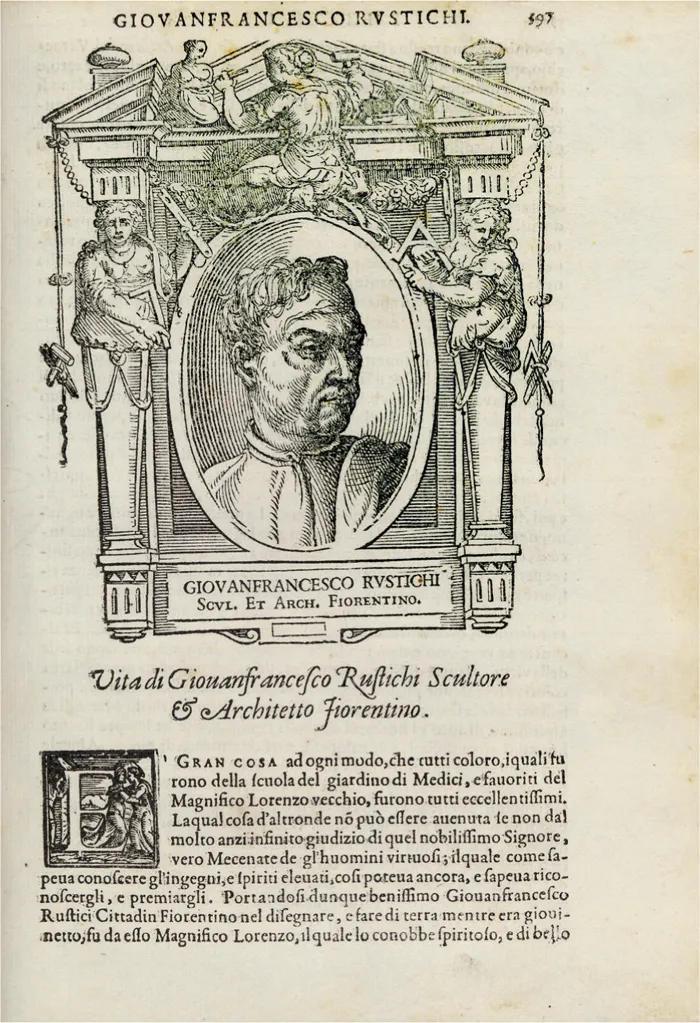
1.2. Portrait of Giovanni Francesco Rustici in a decorated frame, in Giorgio Vasari, Le vite de’ piu eccellenti pittori, scultori, e architettori, Florence, 1568
. . .
For the final, expanded edition (1568) of his Lives of the Painters, Sculptors, and Architects, Giorgio Vasari composed almost two hundred artists’ lives.14 Not all of them were Donatellos and Raphaels, of course, nor did Vasari possess encyclopedic information about every one of his subjects. When a biography needed to be fleshed out, he often had recourse either to anecdotal material (sometimes more formulaic than historically accurate) or to the recounting of personality traits that turned the biography into something like a humoral character sketch.
Giovanni Francesco Rustici (fig. 1.2) seems to have required both of these strategies. Vasari presents him as the archetypal eccentric: he has a pet porcupine; he fills a room with garter snakes; he dabbles in necromancy. He is also something of a well-intentioned schlemiel: though he was “a man of surpassing goodness, and very loving to the poor,” his career is forever going awry.15 More surprisingly, in telling Rustici’s story, Vasari interrupts the customary sequence of career milestones—apprenticeship, commissions won or lost, works produced—with an account of Rustici’s membership in a circle of artist-gourmets. On one evening in that company, for instance, Vasari tells us,
the contribution of Rustici was a cauldron in the form of a pie, in which was Ulysses dipping his father in order to make him young again; which two figures were boiled capons that had the form of men, so well were the limbs arranged, and all with various things good to eat. Andrea del Sarto presented an octagonal temple, similar to that of S. Giovanni, but raised upon columns. The pavement was a vast plate of jelly, with a pattern of mosaic in various colors; the columns, which had the appearance of porphyry, were sausages, long and thick; the socles and capitals were of Parmesan cheese; the cornices of sugar, and the tribune was made of sections of marchpane. In the centre was a choir-desk made of cold veal, with a book of lasagne that had the letters and notes of the music made of pepper-corns; and the singers at the desk were cooked thrushes standing with their beaks open, and with certain little shirts after the manner of surplices, made of fine cauls of pigs, and behind them, for the basses, were two fat young pigeons, with six ortolans that sang the soprano. (2.524)

1.3. François Boucher, Pensent-ils au raisin? (Are They Thinking about the Grapes?), 1747. Art Institute of Chicago
The above, it should be noted, is a small fraction of Vasari’s full...
Table of contents
- Cover Page
- Title Page
- Dedication
- Copyright Page
- Contents
- Acknowledgments
- Introduction
- Chapter One: Reading for the Food
- Chapter Two: Rome Eats
- Chapter Three: Fooding the Bible
- Chapter Four: The Debate over Dinner
- Chapter Five: Mimesis, Metaphor, Embodiment
- Notes
- Index
- Image Credits
Frequently asked questions
Yes, you can cancel anytime from the Subscription tab in your account settings on the Perlego website. Your subscription will stay active until the end of your current billing period. Learn how to cancel your subscription
No, books cannot be downloaded as external files, such as PDFs, for use outside of Perlego. However, you can download books within the Perlego app for offline reading on mobile or tablet. Learn how to download books offline
Perlego offers two plans: Essential and Complete
- Essential is ideal for learners and professionals who enjoy exploring a wide range of subjects. Access the Essential Library with 800,000+ trusted titles and best-sellers across business, personal growth, and the humanities. Includes unlimited reading time and Standard Read Aloud voice.
- Complete: Perfect for advanced learners and researchers needing full, unrestricted access. Unlock 1.5M+ books across hundreds of subjects, including academic and specialized titles. The Complete Plan also includes advanced features like Premium Read Aloud and Research Assistant.
We are an online textbook subscription service, where you can get access to an entire online library for less than the price of a single book per month. With over 1.5 million books across 990+ topics, we’ve got you covered! Learn about our mission
Look out for the read-aloud symbol on your next book to see if you can listen to it. The read-aloud tool reads text aloud for you, highlighting the text as it is being read. You can pause it, speed it up and slow it down. Learn more about Read Aloud
Yes! You can use the Perlego app on both iOS and Android devices to read anytime, anywhere — even offline. Perfect for commutes or when you’re on the go.
Please note we cannot support devices running on iOS 13 and Android 7 or earlier. Learn more about using the app
Please note we cannot support devices running on iOS 13 and Android 7 or earlier. Learn more about using the app
Yes, you can access The Hungry Eye by Leonard Barkan in PDF and/or ePUB format, as well as other popular books in Arte & Storia dell'arte. We have over 1.5 million books available in our catalogue for you to explore.