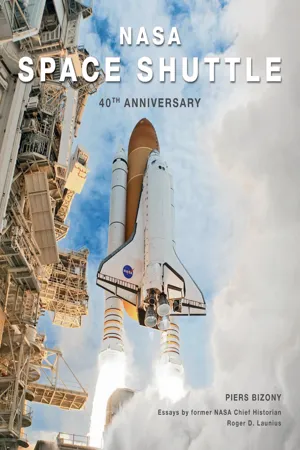
Written and curated by recognized historians of space exploration, NASA Space Shuttle: 40th Anniversary is the authoritative photo history of the iconic space program.
Officially known as the Space Transportation System (STS), the Space Shuttle program operated from 1981 to 2011. During that time, five Shuttle systems took part in 135 missions under the operation of NASA. This approach—namely reusable spacecraft—revolutionized space exploration. NASA Space Shuttle: 40th Anniversary traces the STS’s 30-year operational history. Essays by former NASA chief historian Roger Launius are accompanied by a collection of incredible Shuttle photography and imagery mined from the depths of NASA’s archives by aerospace historian Piers Bizony—all of it presented in large-format color.
Readers will witness the pre-1981 evolution, the missions, astronauts, ground personnel and infrastructure, and amazing accomplishments of the Shuttle program and its spacecraft: Columbia, Challenger, Discovery, Atlantis, and Endeavour. From the launch site at Cape Kennedy, Florida, to mission control in Houston, Texas, to the landing site at Edwards Air Force Base, all aspects of Shuttle operation are covered, including key roles in efforts such as the Hubble Telescope and International Space Station, as well as the tragedies of Challenger and Columbia disasters.
Every carefully chosen image in NASA Space Shuttle: 40th Anniversary tells an aspect of the Shuttle story. The resulting book is not only a unique view of a key chapter of NASA history—it’s a compelling collection of stunning NASA photography and illustrations.
Trusted by 375,005 students
Access to over 1.5 million titles for a fair monthly price.
From our descendants’ perches on other planets or distant space cities, they will look back at our achievement with wonder.
JOURNALIST WALTER CRONKITE OUR INFINITE JOURNEY, 2003
“When the blast of a rocket launch slams you against the wall and all the rust is shaken off your body, you will hear the great shout of the universe and the joyful crying of people who have been changed by what they’ve seen,” enthused the great science fiction novelist Ray Bradbury in 1995. If anything, Bradbury, a writer seldom prone to understatement, played down the ferocity of a Space Shuttle launch. The experience was both electrifying and exhilarating. “The sound vibrates the earth,” said Bett Kelso, a Cocoa Beach resident who watched all of them. “I stand in my front yard and I feel the staccato—it’s like a machine gun staccato, except much more powerful.” Novelist Kurt Vonnegut likened it to a sexual experience. “How would taxpayers feel if they found out they were buying orgasms for a few thousand freaks within a mile of the launch pad? And it’s a very satisfactory orgasm. I mean, you are shaking and you do take leave of your senses.”
The Space Shuttle dominated human spaceflight for thirty years as the world’s first reusable rocket vehicle, lifting off 135 times over three decades, on a variety of impressive missions. In the process, this spacecraft turned Earth orbit into a normal realm for human activity. America’s first astronauts—especially during the Mercury, Gemini, and Apollo programs—were pioneers, explorers in the truest sense of the term. But frontiers do not remain frontiers forever, as more people reach them, engage in useful activities, and occupy and use them. This happened in the American West and it also is taking place now in orbit. And the Shuttle was the vehicle that made this possible.
The Shuttle also set in place the process of humankind becoming a spacefaring species. In his book Our Infinite Journey, published in 2003, legendary journalist Walter Cronkite captured the thrill, not just of the launches, but also their broader attributes, in a reflection written at the turn of the twenty-first century. “Indeed, we are the lucky generation,” he stated. In this era we “first broke our earthly bonds and ventured into space. From our descendants’ perches on other planets or distant space cities, they will look back at our achievement with wonder at our courage and audacity, and with appreciation at our accomplishments, which assured the future in which they live.”
An X-15 wind tunnel model undergoes testing in 1957. Given more development time, the world’s first hypersonic rocket plane might have reached all the way into orbital space.
A 1967 wind tunnel model of an M2-F2 lifting body is heated to demonstrate its ability to behave as a hybrid between a heat-resistant capsule and a vehicle capable of gliding toward a runway. The full-scale prototype was based on this design.
A Century-Old Vision
The basic idea of a rocket plane has existed for nearly a hundred years. From the 1920s onward, once it became clear that rockets were the only effective means of reaching space, the notion of a reusable winged rocket, often referred to as a “spaceplane,” dominated the thinking of almost everyone involved in such cosmic ambitions, whether in real life or mere fantasy. Spaceplanes, for example, were indispensable to Buck Rogers. His winged reusable “Patrol Ship” served as a faithful workhorse for the hero and his sidekicks, taking off horizontally like an airplane and hurtling beyond a planet’s gravity and into the depths of space.
Although Buck’s ship was never a character in its own right, his fans embraced it so thoroughly that it became an icon, introducing audiences to outer space as a new environment for swashbuckling adventure. As former NASA astronaut Fred Gregory recalled in 2001 about the real-life program in which he worked, “We had such great ideas about where we were going to go and what we were going to do; I was caught up in it. But, of course, I grew up with Buck Rogers.”
At the same time...
Table of contents
Cover
Title Page
Contents
Introduction
1 Building the Bird
2 Loss and Recovery
3 Ending an Era
4 Honor and Legacy
Index
Image Credits
Copyright
Frequently asked questions
Yes, you can cancel anytime from the Subscription tab in your account settings on the Perlego website. Your subscription will stay active until the end of your current billing period. Learn how to cancel your subscription
No, books cannot be downloaded as external files, such as PDFs, for use outside of Perlego. However, you can download books within the Perlego app for offline reading on mobile or tablet. Learn how to download books offline
Perlego offers two plans: Essential and Complete
Essential is ideal for learners and professionals who enjoy exploring a wide range of subjects. Access the Essential Library with 800,000+ trusted titles and best-sellers across business, personal growth, and the humanities. Includes unlimited reading time and Standard Read Aloud voice.
Complete: Perfect for advanced learners and researchers needing full, unrestricted access. Unlock 1.5M+ books across hundreds of subjects, including academic and specialized titles. The Complete Plan also includes advanced features like Premium Read Aloud and Research Assistant.
Both plans are available with monthly, semester, or annual billing cycles.
We are an online textbook subscription service, where you can get access to an entire online library for less than the price of a single book per month. With over 1.5 million books across 990+ topics, we’ve got you covered! Learn about our mission
Look out for the read-aloud symbol on your next book to see if you can listen to it. The read-aloud tool reads text aloud for you, highlighting the text as it is being read. You can pause it, speed it up and slow it down. Learn more about Read Aloud
Yes! You can use the Perlego app on both iOS and Android devices to read anytime, anywhere — even offline. Perfect for commutes or when you’re on the go. Please note we cannot support devices running on iOS 13 and Android 7 or earlier. Learn more about using the app
Yes, you can access NASA Space Shuttle by Roger D. Launius,Piers Bizony in PDF and/or ePUB format, as well as other popular books in Technology & Engineering & 20th Century History. We have over 1.5 million books available in our catalogue for you to explore.