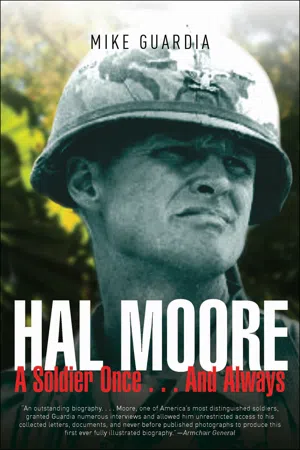
The definitive biography of Harold G. Moore, hero of the Vietnam War and author of the bestselling memoir of the battle at Ia Drang.
Hal Moore, one of the most admired American combat leaders of the last fifty years, has until now been best known to the public for being portrayed by Mel Gibson in the movie
We Were Soldiers. In this first-ever, fully illustrated biography, we finally learn the full story of one of America's true military heroes.
A 1945 graduate of West Point, Moore's first combats occurred during the Korean War, where he fought in the battles of Old Baldy, T-Bone, and Pork Chop Hill. At the beginning of the Vietnam War, Moore commanded the 1st Battalion of the 7th Cavalry in the first full-fledged battle between US and North Vietnamese regulars. Drastically outnumbered and nearly overrun, Moore led from the front, and though losing seventy-nine soldiers, accounted for 1,200 of the enemy before the Communists withdrew. This Battle of Ia Drang pioneered the use of "air mobile infantry"—delivering troops into battle via helicopter—which became the staple of US operations for the remainder of the war. He later wrote of his experiences in the bestselling book
We Were Soldiers Once . . .
and Young.
Following his tour in Vietnam, he assumed command of the 7th Infantry Division, forward-stationed in South Korea, and in 1971, he took command of the Army Training Center at Fort Ord, California. In this capacity, he oversaw the US Army's transition from a conscript-based to an all-volunteer force. He retired as a lieutenant general in 1977.
Hal Moore graciously allowed the author interviews and granted full access to his files and collection of letters, documents, and never-before-published photographs.
- 232 pages
- English
- ePUB (mobile friendly)
- Available on iOS & Android
eBook - ePub
About this book
Trusted by 375,005 students
Access to over 1.5 million titles for a fair monthly price.
Study more efficiently using our study tools.
Information
CHAPTER ONE

EARLY YEARS
The story of Harold Gregory Moore, Jr. begins in the foothills of southern Appalachia. Born on February 13, 1922 in Bardstown, Kentucky, “Hal” was the eldest of four children born to Harold Sr. and Mary Moore (neé Crume). At the time of Moore’s birth, Bardstown was a small wisp of a community with a population of less than 4,000. Nestled deep in the highlands of the Ohio River Valley, the rural Bardstown was a perfect place for Moore to feed his adventurous spirit. Like most boys growing up in smalltown Kentucky, he immersed himself in the local variety of team sports—football, basketball, and baseball. His true childhood passion, however, was always the great outdoors. From an early age, he had a near-insatiable appetite for camping, hunting, and fishing. Very often, he would disappear into the woods behind his house, pitch a tent by his favorite fishing hole, and remain out there for days before returning home to show off his latest catch.1

Moore’s childhood home in Bardstown, Kentucky. Photo by author
Life in the Moore household revolved around three tenets: hard work, loyalty to the family, and devotion to the Catholic faith. The elder Moore was a strict, yet very loving father—Victorian in his principles, yet simple in his tastes. Every morning, he would rise early to attend the 6:00 a.m. Mass at the Basilica of St. Joseph. And although he never finished high school, Harold Sr. was one among the most respected insurance agents in western Kentucky. Mary was a homemaker and, by all accounts, the emotional bedrock of the family. She was a Methodist, but agreed to raise the children Catholic. Yet Harold and Mary’s denominational differences never bothered them once. In fact, as Hal recalled, his mother “was more Catholic in some of her ways, as she would go to church and light candles for our family all of her life.”2

Snow day in Bardstown, 1937. Pictured from left to right are: Hal Moore, Bill Moore, Betty Moore, and an unidentified childhood friend. The Bill Moore Collection
Throughout the Great Depression, the Moores fared better than most. For even during the hardest of economic times, Hal remembered that “my father had good work and we always had plenty to eat.” Hal and his siblings also took part-time jobs within the community. “I cut grass for a number of people, I caddied at the local golf course, and I worked Saturdays as a clerk at the local grocery store.” And, from an early age, the young Moore possessed a remarkable fascination with all things military. Indeed, when he wasn’t riding his bicycle, casting lines at the local fishing hole, or taking care of his younger siblings (Betty, Bill, and Ballard), Moore could be found at the Bardstown Public Library, devouring any book he could find on military history. He particularly enjoyed reading about the great battlefield commanders of the American Revolution and the Civil War. From George Washington to Winfield Scott, these men embodied the same values which Moore sought to maintain in his own life. And by the dawn of his teenage years, Hal knew that he had found his calling.

The former campus of St. Joseph’s Preparatory School in Bardstown, Kentucky, where Hal Moore graduated with the Class of 1940. The school closed its doors in 1968, following years of financial hardship and declining enrollment. Photo courtesy of Kenny Browning
Aware of his son’s enthusiasm for the military, Harold Sr. approached him with a suggestion that he apply to the United States Military Academy at West Point. It was 1937 and Hal was then a sophomore at St. Joseph’s Preparatory School in Bardstown. The younger Moore was fascinated by West Point’s legacy of leadership. Its graduates included many of the heroic leaders whom he had read about at the local library—including Ulysses S. Grant, Robert E. Lee, Stonewall Jackson, and John J. Pershing. Since its founding in 1802, West Point had been the nation’s premier military academy and the primary source of commissioned officers for the US Army. A rockbound citadel ensconced on the banks of the Hudson River, West Point lay some fifty miles north of New York City. The school was renowned for its uncompromising standards of honor and discipline—and the gothic architecture of the campus complemented its reputation as one of the most rigorous schools in America.
Gaining admission to West Point, however, was no easy task. The applicant files read like a virtual “Who’s Who” of America’s best young scholars. Valedictorians, National Merit Scholars, and Eagle Scouts were among the many who sought to join the Long Gray Line. Admission to the Academy was further restricted by a Congressional nomination process. A prospective cadet first had to obtain a nomination from his Congressman or Senator to be considered for admission. Moore certainly had the academic credentials, but he knew that his chances of receiving a nomination from the “backwoods of Kentucky” were slim to none.3

The 1938 St. Joseph’s Football Team. Moore is Number 21, seated in the first row, second from the left. St. Joseph’s Alumni Association

St.Jospeh’sgraduating class of 1940. Moore stands in the second row, second from the right. St. Joseph’s Alumni Association
Opportunity knocked, however, on the afternoon of February 12, 1940. A seventeen-year-old Hal Moore was lying bed-ridden with pneumonia when his father came home with exciting news. Coming into the bedroom where Mary was tending to her ill son, the elder Moore wasted no time. Hal recalled that “the local representative of U.S. Senator A.B. ‘Happy’ Chandler had informed Dad that the senator had a patronage job opening in the Senate Book Warehouse in Washington—and it was mine if I wanted it.” The pay was a mere $30 per week, ($485.71 in 2012 dollars) but to a seventeen-year-old in 1940, it was an enviable sum. His father needed an answer immediately and, if Hal accepted the job, he would be on the next train to Washington DC.4
Hal realized that this may have been his only chance to gain an appointment. However, he still needed to finish high school. He was currently in his last semester at St. Joseph’s and only a few credits shy of graduation. But Moore’s father, always one step ahead, had already spoken to the school’s principal. It turned out that the principal agreed to let Hal graduate in June if he could finish the remaining credits at another school in Washington. The following morning, on Hal’s eighteenth birthday, he and his father left Bardstown on the 5:00 a.m. train. “We spent the night in West Virginia and reached Washington DC on February 14 in the afternoon,” Moore said.5
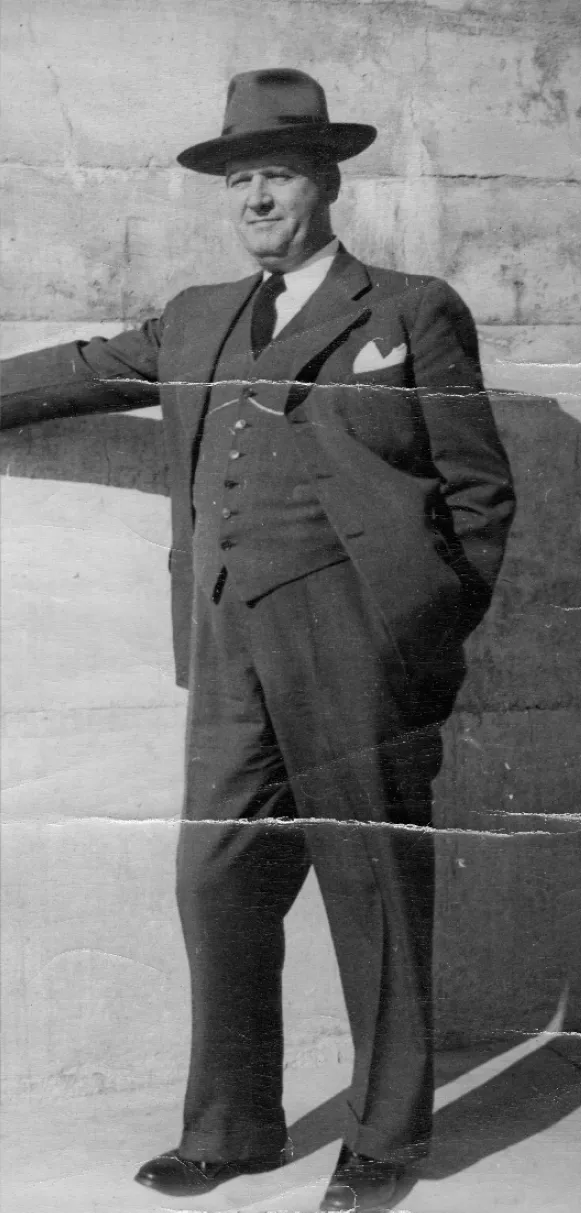
Harold G. Moore, Sr. The elder Moore was a devout Catholic and strove to ensure that his children received the finest education. The Ballard Moore Collection
Arriving in Washington, Moore rented a room from an elderly couple, enrolled at a local night school, and made an appointment with the nearest doctor to treat his lingering pneumonia. The following day, he reported to the Senate Book Warehouse. His job consisted mostly of clerical tasks—inventorying, stocking, and shipping various titles. Mundane and repetitive as it was, Moore still embraced his job with a delightful enthusiasm. Every day, he rose from his bed in the hopes that he would find a congressman or senator with an unfilled appointment to his dream school. “Every month I pored over the list from the War Department of unfilled West Point appointments, and went knocking on the doors of senators and congressmen on Capitol Hill trying to persuade one of them to give me that appointment,” Moore said. “I had no luck in the beginning, but I kept studying that list and walking the halls of Congress.”6
Trolling the halls of Congress by day, Moore finished his high school credits for Algebra and English by night. That June, he returned to Bardstown to walk across the stage with his graduating class at St. Joseph’s. Although he had not yet received an appointment to the Academy, Moore vowed to remain in Washington until he did. In the meantime, he continued to work at the Senate Book Warehouse and enrolled at George Washington University. Moving out of his rented room, he pledged his membership to the Kappa Sigma fraternity and became their house manager in the fall of 1940.
All the while, Moore continued his quest for a nomination to West Point. Ironically, his fortunes changed on December 7, 1941. Early that morning, the Imperial Japanese Navy launched a surprise attack on Pearl Harbor. “I was shocked, like everyone else in America,” Moore said. Prior to the attack, nearly everyone had considered Japan’s military an inferior force. No one had anticipated a first strike against Hawaii, much less from the Japanese. The following day, the US declared war on the Axis Powers, and “President Franklin D. Roosevelt signed legislation granting every senator and representative an additional appointment to both the Military and Naval academies.”7
Sensing an opportunity, Hal went to Senator Chandler’s office, brimming with hope that the new manpower needs would secure his nomination. Unfortunately, the senator had already given his last slot to another young man. Undeterred, Moore went to see his local congressman, Rep. Ed Creal (4th District, Kentucky). Creal sheepishly told him that he, too, had just given away his last slot. Creal did, however, have an open appointment to the US Naval Academy, and offered it to Moore.
Although Moore had no desire to go to Annapolis, he thanked Creal for the appointment. But suddenly, Moore had an idea: “What if I can find another Congressman who would appoint me to West Point in exchange for Representative Creal’s Naval Academy appointment?” Creal was surprised by the young Moore’s proposal, but agreed to it if Hal could find a congressman willing to make the swap. Hal soon found his way into the office of Congressman Eugene E. Cox, representing the 2nd District of Georgia. “I walked into his office and I was greeted by his secretary, a Mrs. J.C. Robinson.” Moore recalled. “She showed me into his office and I asked the Congressman if he would swap my Naval Academy appointment.” Impressed by the young man’s tenacity, Moore left that day with an appointment from the 2nd District of Georgia.8
...Table of contents
- Cover
- Title Page
- Contents
- Introduction
- Chapter 1: Early Years
- Chapter 2: The Military Life
- Chapter 3: Korea
- Chapter 4: The Road to Vietnam
- Chapter 5: Ia Drang
- Chapter 6: The Coastal Campaign, 1966
- Chapter 7: Command Decisions
- Chapter 8: When War Is Done
- Epilogue: A Life in Words
- Appendix: Moore’s Citation for the Distinguished Service Cross
- Notes
- Bibliography
- Copyright
Frequently asked questions
Yes, you can cancel anytime from the Subscription tab in your account settings on the Perlego website. Your subscription will stay active until the end of your current billing period. Learn how to cancel your subscription
No, books cannot be downloaded as external files, such as PDFs, for use outside of Perlego. However, you can download books within the Perlego app for offline reading on mobile or tablet. Learn how to download books offline
Perlego offers two plans: Essential and Complete
- Essential is ideal for learners and professionals who enjoy exploring a wide range of subjects. Access the Essential Library with 800,000+ trusted titles and best-sellers across business, personal growth, and the humanities. Includes unlimited reading time and Standard Read Aloud voice.
- Complete: Perfect for advanced learners and researchers needing full, unrestricted access. Unlock 1.5M+ books across hundreds of subjects, including academic and specialized titles. The Complete Plan also includes advanced features like Premium Read Aloud and Research Assistant.
We are an online textbook subscription service, where you can get access to an entire online library for less than the price of a single book per month. With over 1.5 million books across 990+ topics, we’ve got you covered! Learn about our mission
Look out for the read-aloud symbol on your next book to see if you can listen to it. The read-aloud tool reads text aloud for you, highlighting the text as it is being read. You can pause it, speed it up and slow it down. Learn more about Read Aloud
Yes! You can use the Perlego app on both iOS and Android devices to read anytime, anywhere — even offline. Perfect for commutes or when you’re on the go.
Please note we cannot support devices running on iOS 13 and Android 7 or earlier. Learn more about using the app
Please note we cannot support devices running on iOS 13 and Android 7 or earlier. Learn more about using the app
Yes, you can access Hal Moore by Mike Guardia in PDF and/or ePUB format, as well as other popular books in History & Military Biographies. We have over 1.5 million books available in our catalogue for you to explore.