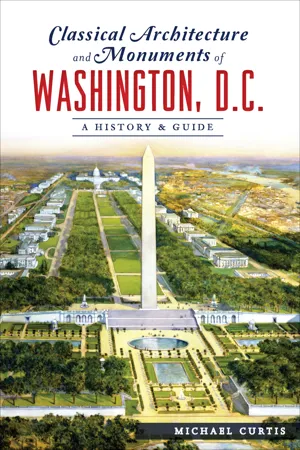
A look at the statues, monuments, and buildings of the classically designed capital city—from the National Mall to Colonial Alexandria.
Classical design formed our nation's capital. The soaring Washington Monument, the columns of the Lincoln Memorial and the spectacular dome of the Capitol Building speak to the founders' comprehensive vision of our federal city. Learn about the L'Enfant and McMillan plans for Washington, D.C., and how those designs are reflected in two hundred years of monuments, museums and representative government. View the statues of our Founding Fathers with the eye of a sculptor and gain insight into the criticism and controversies of modern additions to Washington's monumental structure. Author Michael Curtis guides this tour of the heart of the District of Columbia.
eBook - ePub
Classical Architecture and Monuments of Washington, D.C.
A History & Guide
- 163 pages
- English
- ePUB (mobile friendly)
- Available on iOS & Android
eBook - ePub
About this book
Trusted by 375,005 students
Access to over 1.5 million titles for a fair monthly price.
Study more efficiently using our study tools.
Information
Topic
ArchitectureSubtopic
Architecture GeneralTOUR V
HONORING HEROES
TOUR SITES
THE LINCOLN MEMORIAL
THE VIETNAM WARVETERANS MEMORIAL
THE KOREAN WAR VETERANS MEMORIAL
THE NATIONAL WORLD WAR II MEMORIAL
FREEDOM AND SACRIFICE
There is nothing inherently sacred in the western end of the National Mall; it is high land created by Americans from mosquitoinfested swamps. The meaning of this land is that which we give it: We give this place meaning in the remembrance of citizen sacrifice in the struggle for freedom. The Lincoln Memorial, the World War II Memorial, the Korean War Veterans Memorial, and the Vietnam War Veterans Memorial each concern a particular sacrifice for freedom: the Lincoln Memorial, for the freedom of American slaves, the sacrifice of 750,000 men in the War to End Slavery, including the sacrifice of President Lincoln himself, among the last to die in the war; the World War II Memorial, for the freedom of all the world, even those citizens of the Axis Powers (Germany, Italy, Japan), the sacrifice of 405,000; the Korean War Veterans Memorial, for the freedom of Koreans from communist conquest, the sacrifice of 37,000; the Vietnam War Veterans Memorial, for the freedom of the Vietnamese from communist adventurism, the sacrifice of 58,000 dear, beloved souls.
In quantitative reading, we lose meaning in accumulated numbers. In the consideration before us, to more fully understand the nature of, the experience of ultimate sacrifice, let us, in familiar horror, see in our own mind’s eye that last vision through the soldier’s eye, the blood and the slaughter, the field, tree and sky, the moment of final, painful, labored breath so that we, in the most humane, sincere sympathy, might feel some measure of what was lost in that ending moment of life. And now, let us consider the purpose that compelled the soldier’s personal sacrifice in the cause of freedom, in the extension of freedom to family, to friends, to those who might be strange in habit, separated by distance and custom but familiar in humanity, in love and in hope. From Lincoln at Gettysburg:
It is for us the living, rather, to be dedicated here to the unfinished work which they who fought here have thus far so nobly advanced. It is rather for us to be here dedicated to the great task remaining before us—that from these honored dead we take increased devotion to that cause for which they gave the last full measure of devotion—that we here highly resolve that these dead shall not have died in vain—that this nation, under God, shall have a new birth of freedom—and that government of the people, by the people, for the people, shall not perish from the earth.
FREEDOM AND LIBERTY
The freedom which we enjoy in our government extends also to our ordinary life. There, far from exercising a jealous surveillance over each other, we do not feel called upon to be angry with our neighbor for doing what he likes.… We throw open our capital to the world, and never by alien acts exclude foreigners from any opportunity of learning or observing, although the eyes of an enemy may occasionally profit by our liberality; trusting less in system and policy than to the native spirit of our citizens; while in education, where our rivals from their very cradles by a painful discipline seek after manliness, at Athens we live exactly as we please, and yet are just as ready to encounter every legitimate danger.
—Thucydides, in the voice of Pericles, funeral oration for Athenians fallen in battle against Sparta, History of the Peloponnesian War
Note: From this same speech we read, “If we look to the laws, they afford equal justice to all in their private differences,” the origin of our concept “equal justice under law.”
The evolution of freedom is traced in the development of Greek words for liberty, the etymology of which would be exceedingly onerous here; instead, a telling gloss upon freedom’s conceptual development in classical Western Civilization. The notion of freedom was not born in the realization that freedom is a possession but in the realization that this thing, “freedom” (liberty, independence, eleutheria), could be lost in submission to Asiatic Persia (circa 479 BC), and this anticipated loss extended freedom’s comprehension through courts, assembly, property and in most every civic arena where freedom might have opportunity to supplement its meaning and where, through Plato and others who distrusted the will of the people, often for good cause, that freedom encountered its first restrictions. The Delian League was that political construction formed to oppose foreign Persian tyranny in rule, customs, manners, and language; this league was also, in the cause of freedom, the source of the Athenian Empire, an empire that broadly extended native Athenian democracy, sometimes by force. Athenians understood that democracy, although not synonymous with freedom, was antagonistic to oligarchy in all its many forms. This Athenian antagonism toward Persian and Spartan oligarchy was inherited by Alexander, who, in the defeat of Persia, liberated Hellas (Greece) and extended Hellenism from India through Carthage into Rome, and all the while freedom continued to augment, supplement, refine and distil into unique expressions. The Romans created rights and privileges of citizenship; Cynics found happiness in freedom from possessions, manners and passions; Christians expressed freedom in conscience and in an immortal soul free of status, of sin and of death; Europeans realized freedom as release from the land and its overlords; and passing on, we Americans presume freedom to pursue those industries of virtue and improvement that bring material, spiritual, and familial happiness. You will have noticed that each acquisition of freedom occasioned some species of war, cultural, national, or personal.
WARS FOR LIBERTY
The time is now at hand which will probably determine if Americans are to be freemen or slaves. The fate of unknown millions will now depend, under God, on the courage and conduct of this army.
—George Washington
It is a fact proven in deed that freedom is achieved by victory in war, that freedom is lost by defeat in war. Peace does not occasion freedom; the repose in victory occasions peace: “Those who expect to reap the blessing of freedom must, like men, undergo the fatigue of supporting it,” according to Thomas Paine. We have witnessed the development of freedom through resistance, victory and personal virtue; here, on land raised from a swamp, at the sunset of our capital’s border, is found the spiritual resting place of those Americans who sacrificed their lives for our freedom.
SITE 1
THE LINCOLN MEMORIAL (1914–1922)
Architect: Henry Bacon
Sculptors: Daniel Chester French and Evelyn Beatrice
Longman Painter: Jules Guérin
PARTISAN POLITICS
When, in 1902, the McMillan commissioners proposed a memorial to Lincoln at the National Mall’s western border, the obstacle most daunting was the commemorative highway, a form of Appian Way from Washington through the memorial grounds to Gettysburg. Highway advocates observed that a classical building was inappropriate for a prairie president, considering his pants rather than his disposition of mind, I suppose. Not everyone favors the classical Beaux Arts (beautiful arts), as not everyone favored the Emancipation Proclamation; Republicans accused Democrats of being partisans who would make a highway to divert attention from the Republican Lincoln and to redirect attention to the popular soldiers, and then, the burgeoning highway industry and eager automobile manufacturers, with eagle perception, recognized in seventy miles of roads the opportunity for profit. The debate continued: Democrats broadcast base motives for Lincoln’s temple, staining Republicans as cruel representatives of the socially elite, “cold, heartless marble” and “hurling the nation’s memory into pagan darkness” were by stiff-backed Democrats expostulated in the House of Congress. One confused congressman, Joe Cannon [R], vowed that never would he allow a monument to Lincoln in “that Goddamned swamp.” Congressmen bluster, candidates pose, industry lobbies and, occasionally, reason prevails: The Lincoln Memorial bill passed.
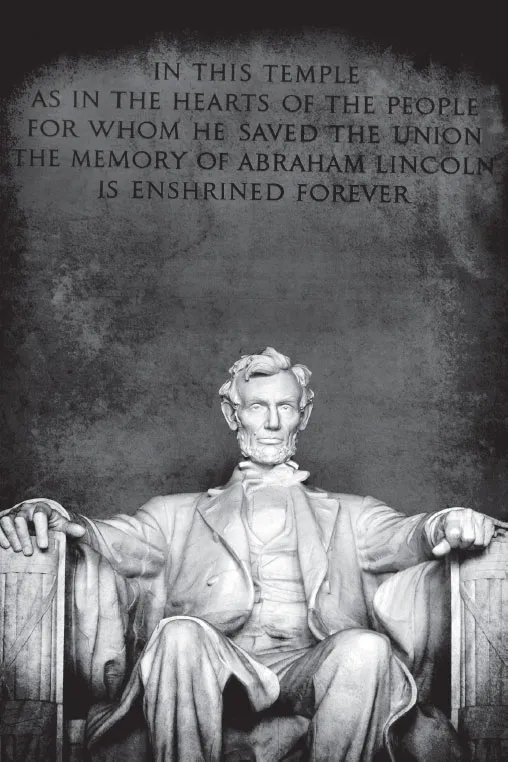
Abraham Lincoln; Daniel Chester Fr...
Table of contents
- Front Cover
- Half Title
- Title Page
- Copyright
- Dedication
- Contents
- Preface. Our Classical Heritage
- Acknowledgements
- Introduction. Washington: The Classical City
- TOUR I. THE NATIONAL MALL
- TOUR II. CAPITOL HILL
- TOUR III. THE PRESIDENT’S HOUSE AND GARDEN
- TOUR IV. THE LIBERTY STROLL
- TOUR V. HONORING HEROES
- TOUR VI. THE FEDERAL TRIANGLE
- TOUR VII. DECLINE OF PURPOSE
- TOUR VIII. CAPITOL HILL ENVIRONS
- TOUR IX. COLONIAL ALEXANDRIA
- EPILOGUE. CONTEMPORARY MEMORIALS
- Appendix I. The Greek Architectural Orders
- Appendix II. Washington, D.C. Site Map
- Appendix III. Historic Documents
- Bibliography
- About the Author
Frequently asked questions
Yes, you can cancel anytime from the Subscription tab in your account settings on the Perlego website. Your subscription will stay active until the end of your current billing period. Learn how to cancel your subscription
No, books cannot be downloaded as external files, such as PDFs, for use outside of Perlego. However, you can download books within the Perlego app for offline reading on mobile or tablet. Learn how to download books offline
Perlego offers two plans: Essential and Complete
- Essential is ideal for learners and professionals who enjoy exploring a wide range of subjects. Access the Essential Library with 800,000+ trusted titles and best-sellers across business, personal growth, and the humanities. Includes unlimited reading time and Standard Read Aloud voice.
- Complete: Perfect for advanced learners and researchers needing full, unrestricted access. Unlock 1.5M+ books across hundreds of subjects, including academic and specialized titles. The Complete Plan also includes advanced features like Premium Read Aloud and Research Assistant.
We are an online textbook subscription service, where you can get access to an entire online library for less than the price of a single book per month. With over 1.5 million books across 990+ topics, we’ve got you covered! Learn about our mission
Look out for the read-aloud symbol on your next book to see if you can listen to it. The read-aloud tool reads text aloud for you, highlighting the text as it is being read. You can pause it, speed it up and slow it down. Learn more about Read Aloud
Yes! You can use the Perlego app on both iOS and Android devices to read anytime, anywhere — even offline. Perfect for commutes or when you’re on the go.
Please note we cannot support devices running on iOS 13 and Android 7 or earlier. Learn more about using the app
Please note we cannot support devices running on iOS 13 and Android 7 or earlier. Learn more about using the app
Yes, you can access Classical Architecture and Monuments of Washington, D.C. by Michael Curtis in PDF and/or ePUB format, as well as other popular books in Architecture & Architecture General. We have over 1.5 million books available in our catalogue for you to explore.