- 112 pages
- English
- ePUB (mobile friendly)
- Available on iOS & Android
eBook - ePub
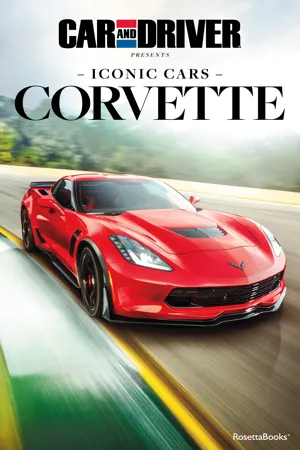
Iconic Cars: Corvette
About this book
This fully illustrated volume explores the evolution of this classic American sports car from the original 1950s models to today's Corvette Stingray.
The Chevrolet Corvette is a treasured American icon and one of the world's most popular sports cars. The experts at Car and Driver, who have tested nearly every version of this sleek machine, now offer a curated selection of articles, reviews, and news—featuring 81 color photographs—from more than 50 years of Corvette history.
You'll ride shotgun with Brock Yates on a 4,000-mile road trip to that "wilderness boulevard of dreamers and fortune hunters and runaways and outcasts—the Alaska Highway." You'll meet Zora Arcus-Duntov, the engineer most closely associated with the distinctive designs of the early '60s Stingrays, and learn about "dead-end 'Vettes"—showcars with startling innovations that wound up ignored and discarded.
The Chevrolet Corvette is a treasured American icon and one of the world's most popular sports cars. The experts at Car and Driver, who have tested nearly every version of this sleek machine, now offer a curated selection of articles, reviews, and news—featuring 81 color photographs—from more than 50 years of Corvette history.
You'll ride shotgun with Brock Yates on a 4,000-mile road trip to that "wilderness boulevard of dreamers and fortune hunters and runaways and outcasts—the Alaska Highway." You'll meet Zora Arcus-Duntov, the engineer most closely associated with the distinctive designs of the early '60s Stingrays, and learn about "dead-end 'Vettes"—showcars with startling innovations that wound up ignored and discarded.
Frequently asked questions
Yes, you can cancel anytime from the Subscription tab in your account settings on the Perlego website. Your subscription will stay active until the end of your current billing period. Learn how to cancel your subscription.
No, books cannot be downloaded as external files, such as PDFs, for use outside of Perlego. However, you can download books within the Perlego app for offline reading on mobile or tablet. Learn more here.
Perlego offers two plans: Essential and Complete
- Essential is ideal for learners and professionals who enjoy exploring a wide range of subjects. Access the Essential Library with 800,000+ trusted titles and best-sellers across business, personal growth, and the humanities. Includes unlimited reading time and Standard Read Aloud voice.
- Complete: Perfect for advanced learners and researchers needing full, unrestricted access. Unlock 1.4M+ books across hundreds of subjects, including academic and specialized titles. The Complete Plan also includes advanced features like Premium Read Aloud and Research Assistant.
We are an online textbook subscription service, where you can get access to an entire online library for less than the price of a single book per month. With over 1 million books across 1000+ topics, we’ve got you covered! Learn more here.
Look out for the read-aloud symbol on your next book to see if you can listen to it. The read-aloud tool reads text aloud for you, highlighting the text as it is being read. You can pause it, speed it up and slow it down. Learn more here.
Yes! You can use the Perlego app on both iOS or Android devices to read anytime, anywhere — even offline. Perfect for commutes or when you’re on the go.
Please note we cannot support devices running on iOS 13 and Android 7 or earlier. Learn more about using the app.
Please note we cannot support devices running on iOS 13 and Android 7 or earlier. Learn more about using the app.
Yes, you can access Iconic Cars: Corvette by Car and Driver in PDF and/or ePUB format, as well as other popular books in Technology & Engineering & Automotive Transportation & Engineering. We have over one million books available in our catalogue for you to explore.
Information
The Marque of Zora
He had help, of course, but one man fought to make the Corvette what it is.

BY PETE LYONS
PHOTOGRAPHY BY HUMPHREY SUTTON AND BRUCE LANCASTER
from the June 1989 Issue of Car and Driver
It is dim, but you can see that there are 27 of them. They fill the large, high space, tightly aligned in rows between the pillars. Each huddles anonymously under its own soft, earth-toned cover; collectively they resemble some strange, subterranean crop of exotic mushrooms, quietly growing in value here in the temperature-controlled darkness.
A metallic shriek. The big steel door rolls up, and the cold north light of Boston pierces the garage. It shines silver on the close-trimmed hair of the man who enters. He is not a young man, but he moves in quick strides. At rest his stance is almost military. His eyes take in the scene. It is Zora.
Deferentially, his companions guide him among the cars, uncovering one after another for his inspection. He studies them with unfeigned interest, peering at each closely, intimately. Obviously, they stir memories. Clearly, these machines are his. The collection may belong to a man named Chapman. But the Corvettes are Duntov’s. Zora Arkus-Duntov will celebrate his 80th birthday this year. He still takes stairs two at a time. He still flies his own Rockwell 112 Commander. He still haunts the pits at Indy each spring, marketing his engineering expertise. Several times a year he attends mass gatherings of the faithful, relishing—and selling—his ongoing, near-mythic stature as Mr. Corvette, the father of America’s only true sports car.
Mr. Corvette’s work is well represented here. Steve Chapman’s collection of choice, cherry Corvettes of every vintage is the realization of a dream begun during his boyhood days in Queens, New York. Now a successful Boston-based commercial real-estate developer, Chapman has the wherewithal to indulge his passion for Corvettes. With the help of Corvette purchasing consultant Mike Kitain, Chapman has amassed a collection thought to be currently worth in excess of $1.25 million. It is appreciating at an estimated 20 to 25 percent annually. Some individual cars have allegedly shown monthly increases on that order or more. As investment media, good, original Corvettes are outperforming real estate, financial instruments, and precious metals.

Zora finds himself nonplused by this development. “I never dreamed of it. I fought each cent increase. The overriding thought was to provide a Corvette that everybody can own.” So the sharp turn upmarket that began with the 1984 model was not in the original spirit of the car? His response is almost a growl. “No! Not at all.”
Duntov’s Russian accent is stage-heavy, and can demand close attention to decipher. It is worth the effort. He is a man whose sheer force of personality broke through the gray walls of a mammoth corporation to infuse a single, significant product with his own identity. He was not part of the very beginning, but for two decades the Corvette, America’s sports car, built by Chevrolet for General Motors, reflected the personal experience, tastes, priorities, and ambitions of a German-educated Russian émigré.
As three of the collection’s machines are readied for Car and Driver tests, Zora slips into a 1965 coupe. He settles the whole length of his back into the seat. He places both hands on the wheel in the racer’s nine-and-three position. He flicks his eyes over the gauges. He fingers the gear shift and a switch or two. He voices his thoughts: “This car, ergonomically, was very right. For ‘68, they laid the man back 30 degrees, marred relationship to gear lever. You had to tilt to get into third. Nobody notice, but I notice.”
Duntov himself had taken responsibility for the cockpit layout of the 1963-67 series, the Corvette’s second generation, the model he appears to most regard as his own. “You see, the instruments are all ahead of the driver, not like ‘68, where the little ones are in the middle. Tachometer, I fought with Styling, insisted the graduations should be every 100 rpm. They wanted to match speedometer, but there it doesn’t matter, graduations every 2 mph okay. But tachometer, I fought, because if you’re a racer it’s important.” He reaches to touch the bright trim around the instrument. “But I did not tell them to make shiny.”
Mr. Corvette was in fact a racer. And still is. He’s always been a two-stairs-at-a-time kind of guy. He goes for it. “Curiosity” and “persistence,” he says—those are the two words that explain his success. And hard times as a child.
“Okay, I spill my lebenslauf, “ he agrees amiably. He begins his life story with a small joke. “I was born on the 25th of December, 1909.” A Christmas boy! “Yes. And I carry this curse all my life.” Ah, presents only once a year. “Yes!”
Zora was born in Belgium, on the outskirts of Brussels—but only because his Russian father, a mining engineer, was studying in Liège. Within a year the family returned to what is now Leningrad, on the Baltic. Zora had yet to reach his eleventh birthday when the revolution struck. Many Russians had already left. “But my parents, you know, ‘That’s Russia in trouble.’ Therefore they stay there and help with the work.”
Everybody had to work. Zora learned about hustle then. “Life was difficult. And every day I carry a gun, protecting rations. Was my duty to pick up the food rations. Quarter-pound of bread was one, in one place. Then another place, quarter-pound of sausage. Five places. Then, bring home. Was a long walk. So I carry a gun. Never use it, but . . .”
In 1926 the family moved to Berlin, where Zora spent seven years completing a university education at the Institute of Charlottenburg. That’s where he made friends who got him involved in racing—and nearly in trouble with the Nazis. Out one day in a buddy’s supercharged Mercedes 300 convertible, Zora failed to return a salute from a personage in another vehicle. There weren’t many cars on the street in those days, Zora points out. “Everybody in Berlin then knew my friend’s car. And Goebbels called him and said, ‘What the hell, you did not reply to my Heil Hitler today!’ But was not him, was me!” Fortunately, it was too early in the madness for anything serious to come of it.

After graduation Duntov took up his career in mechanical engineering and quickly found himself involved in numerous interesting projects. Particularly keen on the possibilities of supercharging, he wrote a paper that gained him international attention—and with it a commission from a machine-tool manufacturer for a marketable blower. In 1935 the Duntov-designed supercharger appeared on numerous small cars throughout central Europe. That success and his racing contacts led to a consulting arrangement with Mercedes-Benz, where he enjoyed free run of the race shop. Zora still has snapshots that prove he was on drinking terms with such giants of the Grand Prix team as Rudolf Caracciola and Alfred Neubauer. He himself raced in various small-bore categories.
As the thirties progressed, the Arkus-Duntovs found it prudent to move to Paris. Zora did well enough there to buy a Ford V-8. That’s when he took up a sideline as a gold smuggler. The old eyes twinkle with the memory: “Gold in France had become illegal. But in Belgium, still perfectly legal. Therefore my closest friend—he is dead now—he finally came up with scheme. On Ford axle is reinforcement structure, a tube. Tube is right diameter for containing gold coins.
“I kiss my mother good night, close my door, and half an hour later I take my car. I meet my friend, we load the gold. And I hold the record, two hours twenty minutes, from Folies-Bergère to Gare du Midi in Brussels. Every trip I bring in, I am guessing, but like $5000. I bought my father a car.”
It was during these nocturnal record runs to Belgium in his Ford that the young engineer conceived of the cylinder heads that would bear his family name. On the route was a particular long downhill where the little flathead V-8 would wind up to around 6000 rpm. “And that give me the idea, that this Ford engine, if equipped with a good, free-breathing head . . .” Implementation of the idea had to wait until Zora had moved to the U.S. and, with his brother, Yura, opened Ardun Mechanical in Brooklyn. The mainstay of the business was commercial work, such as aircraft propellers, but the Ardun heads the brothers turned out boosted the Ford’s stock 90-hp output to about 175.
Zora joined Chevrolet in 1953 and was assigned to the young Corvette project. His first job there involved aerodynamics; airflow around the car was carrying exhaust back into the cockpit. He soon cured that and almost as quickly integrated himself into the entire Corvette program. It would remain his life for the next two decades. In 1968 the title “chief Corvette engineer” formalized a fait accompli.
Chapman’s million-dollar garage brings it all back “like an avalanche.” Looking over a pristine example of the original, embedded-headlight, slab-sided 1953 model, Zora remarks that this Corvette’s aerodynamic shape was the best of the cars he supervised. Later revisions made it much draggier—especially the bluff headlights, the taller roofline, and, curiously enough, the scalloped sides. “Yes, just behind the front wheel, lot of turbulence when they made this.” Zora was acutely aware of the aero problems, because he built up a special ‘56 and drove it to a world flying-mile record of 150.583 mph on Daytona Beach.
Ford was a direct competitor in those days but backed out of the sports-car market. Zora still reckons it was a “mistake” for Ford to drop its two-seater Thunderbird. And irksome personally: “If Ford had continued, it would have accelerated Corvette development!”
That development went along well enough. Duntov’s energy was instrumental in the achievement of fuel injection, the four-speed all-synchro transmission, and more.
And then came the 1963 model. Chevrolet’s second-generation Corvette was an extremely advanced piece of work by contemporary world standards. Short wheelbase, good balance, all-independent suspension, those studied cockpit ergonomics, even retractable headlights—as someone quoted Zora on its introduction, it was the first Corvette that he would have been proud to be seen driving in Europe.
It definitely reflected his own firm hand, his determination to build a serious sports car over the objections of people who were concerned about comfort. “The engineers complained, ‘Harshness.’ Okay, I introduce variable-rate springs. This car has variable-rate springs in front and rear. Has comparatively plush ride, but still keeping lean reduced, because progressive springs do that for you.”
But not quite everything about the ‘63 was to Zora’s liking. He had two disputes with Bill Mitchell about its body shape, which derived from the styling chief’s Stingray road-racer project.
“Mitchell’s Stingray, when I first took the car on the track, my worst fear is realized. The car like to lift. It was extremely light—maybe weigh 1600, 1650 pounds—and at 150 mph the car sit on the rebound straps. You can steer the car, because remainder of the weight is still there, but very light steering. Bill Mitchell, aerodynamics did not enter his head. Aesthetic, aesthetic, only aesthetic. Therefore I eventually lost interest with Bill Mitchell.”

It was precisely this front-end aerodynamic lift that had led Duntov to duct the radiator exit air out the top of the nose of the Stingray’s predecessor, the Corvette SS that ran at Sebring in 1957. When it became clear that the ‘63 street car was going to wear the basic Stingray lifting body, Duntov tried to ameliorate the problem by specifying louvered outlets on top of the hood. But he was shot down. Objections were raised that hot air might enter the cockpit and that rain would pour into the engine bay. “So I bend, say okay. And one year we have false louvers. It’s my fault, I’m guilty.”
That one year the Corvette also had the famous split rear window. It was another Mitchell idea—and another one Duntov hated. “You see, in driving this car, you can’t see backwards. It was a big, big fight. And Ed Cole [Chevrolet general manager] decided, lining up with Mitchell. Okay, first pre-production car, I took Bill Mitchell on the test track, and he agreed you couldn’t see.
“But I find that when driving at night, when the car behind you has a high beam, this division protect you. That’s a plus for the split window, but I keep it quiet.” Zora chuckles.
If he has one big regret about his 23 years at Chevy, he says, it’s his failure to get a mid-engined Corvette into production. He tried. He bu...
Table of contents
- Title Page
- Copyright
- Corvette SS
- The Corvette Test
- America’s Best Sports Car: Bricklin or Corvette?
- The Lost Corvettes
- Northwest Passage
- Northwest Passage Part II
- Building the Yukon Corvette
- Duntov Turbo Corvette
- The Marque of Zora
- Chevrolet Corvette
- Happy Birthday to Us
- Corvette vs. Corvette
- The Road to Remorses, The Road to Divorces
- Weapons Grade
- More Iconic Cars Books