- 110 pages
- English
- ePUB (mobile friendly)
- Available on iOS & Android
eBook - ePub
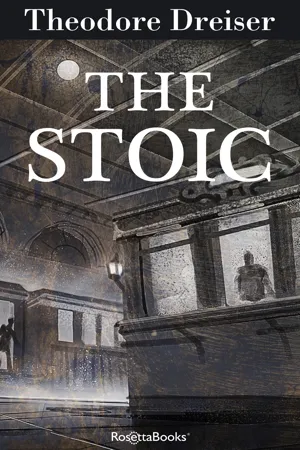
The Stoic
About this book
The conclusion to the trilogy based on a real railway tycoon's life, with "an amazingly intricate description of high-rolling 19th-century finance" (
The Wall Street Journal).
Based on the life of railway tycoon Charles Tyson Yerkes, the epic Trilogy of Desire weaves a tale of American capitalism through the rise and fall of Frank Cowperwood. Following The Financier and The Titan, the third novel follows Cowperwood as he heads across the sea to London for a chance to develop a new underground railway system. Though still married to his estranged wife, Aileen, he has found a new paramour in Berenice—among others. Doing what he does best, Frank puts his plans in motion to conquer London's transportation market, guaranteeing the bulk of the profits for himself. However, as his age begins to catch up with him, an illness makes it clear these are the last years of his life, and he must negotiate personal and financial challenges to make his lasting mark on the world—a quest that will ultimately be completed by one of the women in his life.
Based on the life of railway tycoon Charles Tyson Yerkes, the epic Trilogy of Desire weaves a tale of American capitalism through the rise and fall of Frank Cowperwood. Following The Financier and The Titan, the third novel follows Cowperwood as he heads across the sea to London for a chance to develop a new underground railway system. Though still married to his estranged wife, Aileen, he has found a new paramour in Berenice—among others. Doing what he does best, Frank puts his plans in motion to conquer London's transportation market, guaranteeing the bulk of the profits for himself. However, as his age begins to catch up with him, an illness makes it clear these are the last years of his life, and he must negotiate personal and financial challenges to make his lasting mark on the world—a quest that will ultimately be completed by one of the women in his life.
Tools to learn more effectively

Saving Books

Keyword Search

Annotating Text

Listen to it instead
Information
THE STOIC

Chapter 1
THERE were two most disturbing problems confronting Frank Cowperwood at the time of his Chicago defeat, when, so reducingly and after so long a struggle, he lost his fight for a fifty-year franchise renewal.
First, there was his age. He was nearing sixty, and while seemingly as vigorous as ever, it would be no easy matter, he felt, with younger and equally resourceful financiers on the scene, to pile up the great fortune which assuredly would have been his if his franchise had been extended. That fortune would have been all of $50,000,000.
Secondly, and of even greater importance, in his realistic judgment, was the fact that by this time he had still not achieved social connections of any value; in other words, social prestige. Of course, his youthful incarceration in the penitentiary in Philadelphia had not helped matters, and then, too, his natural varietism, plus his unfortunate marriage to Aileen, who had been no real social help, and his own determined and almost savage individualism, had alienated many who otherwise might have been friendly to him.
For Cowperwood was not one to make friends of those less forceful, subtle, or efficient than himself. It smacked too much of meaningless self-depreciation and was, at best, in his opinion, a waste of time. On the other hand, he found, the strong and cunning or genuinely significant were not always easy to acquire as friends. Particularly here in Chicago, where he had fought so many of them for position and power, they had chosen to combine against him, not because he represented morals or methods different from any they were willing to practice or accept in others, but rather because he, a total stranger, had ventured on financial preserves presumably their own and had risen to greater wealth and power, and in less time, than they had. Moreover, he had attracted the wives and daughters of some of the very men who were most jealous of him financially, and so they had set out to ostracize him socially and had well-nigh succeeded in doing so.
So far as sex was concerned, he had always desired individual freedom and proceeded ruthlessly to achieve it. At the same time, he had always held the thought that somewhere he might well meet a woman so superior that in spite of himself he might be held, not to absolute faithfulness—he was never willing to count upon that in regard to himself—but rather to a genuine union of understanding and affection. For eight years now he had felt that he had really found that ideal individual in the girl, Berenice Fleming. Obviously, she was not overawed by his personality or his fame, nor at all impressed by his usual arts. And because of that, as well as the deep aesthetic and sensual spell she cast over him, there had arisen in him a conviction that she, with her youth, beauty, mental awareness, and certainty as to her own personal value, could contrive and maintain the natural social background for his force and wealth, assuming, of course, that he were ever free to marry her.
Unfortunately, for all his determination in connection with Aileen,* he had not been able to divest himself of her. For one thing, she was determined not to give him up. And to have added a contest for freedom to his difficult railway fight in Chicago would have been too much of a burden. Moreover, in Berenice's attitude, he saw no trace of the necessary acceptance. Her eyes appeared to be set toward men not only younger than himself but with conventional social advantages which his personal record made it impossible for him to offer her. This had given him his first real taste of romantic defeat, and he had sat alone in his rooms for hours at a time convinced that he was hopelessly beaten in his battle for greater fortune and for the love of Berenice.
And then suddenly she had come to him and announced a most amazing and unexpected surrender, so that he experienced a sense of rejuvenation which almost at once definitely restored his old constructive mood. At last, he felt, he had the love of a woman who could truly support him in his quest for power, fame, prestige.
On the other hand, as frank and direct as had been her explanation of why she had come—"I thought you really might need me now . . . I have made up my mind"—still, there was on her part a certain hurt attitude in regard to life and society which moved her to seek reparation in some form for the cruelties she felt had been imposed on her in her early youth. What she was really thinking, and what Cowperwood, because of his delight at her sudden surrender did not comprehend, was: You are a social outcast, and so am I. The world has sought to frustrate you. In my own case, it has attempted to exclude me from the sphere to which, temperamentally and in every other way, I feel I belong. You are resentful, and so am I. Therefore, a partnership: one of beauty and strength and intelligence and courage on both sides, but without domination by either of us. For without fair play between us, there is no possibility of this unsanctioned union enduring. This was the essence of her motive in coming to him at this time.
And yet Cowperwood, aware as he was of her force and subtlety, was not so fully aware of her chain of thought in this direction. He would not have said, for instance, looking upon her on that wintry night of her arrival (perfect and flowery out of an icy wind), that she was as carefully and determinedly aligned mentally. It was a little too much to expect of one so youthful, smiling, gay and altogether exquisite in every feminine sense. And yet she was. She stood daringly, and yet secretly somewhat nervously, before him. There was no trace of malice in regard to him; rather love, if a desire to be with him and of him for the remainder of his days on these conditions might be called love. Through him and with him she would walk to such victory as might be possible, the two of them wholeheartedly and sympathetically co-operating.
And so, on that first night, Cowperwood turned to her and said: "But Bevy, I'm really curious as to this sudden decision of yours. To think you should come to me now just when I have met my second really important setback."
Her still blue eyes enveloped him as might a warming cloak or a dissolving ether.
"Well, I've been thinking and reading about you for years, you know. Only last Sunday, in New York, I read two whole pages about you in the Sun. They made me understand you a little better, I think."
"The newspapers! Did they, really?"
"Yes, and no. Not what they said about you critically, but the facts, if they are facts, that they pieced together. You never cared for your first wife, did you?"
"Well, I thought I did, at first. But, of course, I was very young when I married her."
"And the present Mrs. Cowperwood?"
"Oh, Aileen, yes. I cared for her very much at one time," he confessed. "She did a great deal for me once, and I am not ungrateful, Bevy. Besides, she was very attractive, very, to me at that time. But I was still young, and not as exacting mentally as I am now. The fault is not Aileen's. It was a mistake due to inexperience."
"You make me feel better when you talk that way," she said. "You're not as ruthless as you're said to be. Just the same, I am many years younger than Aileen, and I have the feeling that without my looks my mind might not be very important to you."
Cowperwood smiled. "Quite true. I have no excuses to offer for the way I am," he said. "Intelligently or unintelligently, I try to follow the line of self-interest, because, as I see it, there is no other guide. Maybe I am wrong, but I think most of us do that. It may be that there are other interests that come before those of the individual, but in favoring himself, he appears, as a rule, to favor others."
"I agree, somehow, with your point of view," commented Berenice.
"The one thing I am trying to make clear to you," went on Cowperwood, smiling affectionately at her, "is that I am not seeking to belittle or underestimate any hurt I may have inflicted. Pain seems to go with life and change. I just want to state my case as I see it, so that you may understand me."
"Thanks," and Berenice laughed lightly, "but you needn't feel you are on the witness stand."
"Well, almost. But please let me explain a little about Aileen. Her nature is one of love and emotion, but her intellect is not, and never was, sufficient for my needs. I understand her thoroughly, and I am grateful for all she did for me in Philadelphia. She stood by me, to her own social detriment. Because of that I have stood by her, even though I cannot possibly love her as I once did. She has my name, my residence. She feels she should have both." He paused, a little dubious as to what Berenice would say. "You understand, of course?" he asked.
"Yes, yes," exclaimed Berenice, "of course, I understand. And, please, I do not want to disturb her in any way. I did not come to you with that in view."
"You're very generous, Bevy, but unfair to yourself," said Cowperwood. "But I want you to know how much you mean to my entire future. You may not understand, but I acknowledge it here and now. I have not followed you for eight years for nothing. It means that I care, and care deeply."
"I know," she said, softly, not a little impressed by this declaration.
"For all of eight years," he continued, "I have had an ideal. That ideal is you."
He paused, wishing to embrace her, but feeling for the moment that he should not. Then, reaching into a waistcoat pocket, he took from it a thin gold locket, the size of a silver dollar, which he opened and handed to her. One interior face of it was lined with a photograph of Berenice as a girl of twelve, thin, delicate, supercilious, self-contained, distant, as she was to this hour.
She looked at it and recognized it as a photograph that had been taken when she and her mother were still in Louisville, her mother a woman of social position and means. How different the situation now, and how much she had suffered because of that change! She gazed at it, recalling pleasant memories.
"Where did you get this?" she asked at last.
"I took it from your mother's bureau in Louisville, the first time I saw it. It was not in this case, though; I have added that."
He closed it affectionately and returned it to his pocket. "It has been close to me ever since," he said.
Berenice smiled. "I hope, unseen. But I am such a child there."
"Just the same, an ideal to me. And more so now than ever. I have known many women, of course. I have dealt with them according to my light and urge at the time. But apart from all that, I have always had a certain conception of what I really desired. I have always dreamed of a strong, sensitive, poetic girl like yourself. Think what you will about me, but judge me now by what I do, not by what I say. You said you came because you thought I needed you. I do."
She laid her hand on his arm. "I have decided," she said, calmly. "The best I can do with my life is to help you. But we . . . I . . . neither of us can do just as we please. You know that."
"Perfectly. I want you to be happy with me, and I want to be happy with you. And, of course, I can't be if you are going to worry over anything. Here in Chicago, particularly at this time, I have to be most careful, and so do you. And that's why you're going back to your hotel very shortly. But tomorrow is another day, and at about eleven, I hope you will telephone me. Then perhaps we can talk this over. But wait a moment." He took her arm and directed her into his bedroom. Closing the door, he walked briskly to a handsome wrought-iron chest of considerable size which stood in a corner of the room. Unlocking it, he lifted from it three trays containing a collection of ancient Greek and Phoenician rings. After setting them in order before her, he said:
"With which of these would you like me to pledge you?"
Indulgently, and a little indifferently, as was her way—always the one to be pleaded with, not the one to plead—Berenice studied and toyed with the rings, occasionally exclaiming over one that interested her. At last, she said :
"Circe might have chosen this twisted silver snake. And Helen, this green bronze circlet of flowers, perhaps. I think Aphrodite might have liked this curled arm and hand encircling the stone. But I will not chose for beauty alone. For myself, I will take this tarnished silver band. It has strength as well as beauty."
"Always the unexpected, the original!" exclaimed Cowperwood. "Bevy, you are incomparable!" He kissed her tenderly as he placed the ring on her finger.
Chapter 2
THE essential thing which Berenice achieved for Cowperwood in coming to him at the time of his defeat was to renew his faith in the unexpected and, better yet, in his own luck. For hers was an individuality, as he saw it, self-seeking, poised, ironic, but less brutal and more poetic than his own. Where he desired money in order to release its essential content, power, to be used by him as he pleased, Berenice appeared to demand the privilege of expressing her decidedly varied temperament in ways which would make for beauty and so satisfy her essentially aesthetic ideals. She desired not so much to express herself in a given form of art as to live so that her life as well as her personality should be in itself an art form. She had more than once thought, if only she had great wealth, very great power, how creatively she would use it. She would never waste it on great houses and lands and show, but rather surround herself with an atmosphere which should be exquisite and, of course, inspirational.
Yet of that she had never spoken. Rather, it was implicit in her nature, which Cowperwood by no means always clearly interpreted. He realized that she was delicate, sensitive, evasive, elusive, mysterious. And, for these reasons, he was never tired of contemplating her, any more than he was of contemplating nature itself: the new day, the strange wind, the changing scene. What would the morrow be like? What would Berenice be like when next he saw her? He could not tell. And Berenice, conscious of this strangeness in herself, could not enlighten him or any other. She was as she was. Let Cowperwood, or any, take her so.
In addition to all this, she was, he saw, an aristocrat. In her quiet and self-confident way, she commanded respect and attention from all who came in contact with her. They could not evade it. And Cowperwood, recognizing this superior phase of her as the one thing he had always, if almost subconsciously, admired and desired in a woman, was deeply gratified as well as impressed. She was young, beautiful, wise, poised—a lady. He had sensed it even in the photograph of the twelve-year-old girl in Louisville eight years before.
But now that Berenice had come to him at last, there was one thing that was troubling him. That was his enthusiastic and, at the moment, quite sincere suggestion of absolute and single devotion to her. Did he really mean that? After his first marriage, particularly after the experience of children and the quite sober and humdrum nature of his domestic life, he had fully realized that the ordinary tenets of love and marriage were not for him. This was proved by his intrigue with the young and beautiful Aileen, whose sacrifice and devotion he subsequently rewarded by marrying her. Yet that was as much an act of equity as of affection. And subsequent to that, he considered himself wholly liberated, sensually as well as emotionally.
He had no desire to attempt, much less achieve, a sense of permanency. Nonetheless, he had for eight years been pursuing Berenice. And now he was wondering how he should present himself honestly to her. She was, as he knew, so extremely intelligent and intuitive. Lies sufficient to placate, if not really deceive, the average woman, would not advantage him much with her.
And worse, at this time, in Dresden, Germany, there was a certain Arlette Wayne. Only a year ago he had entered on the affair with her. Arlette, previously immured in a small town in Iowa and anxious to extricate herself from a fate which threatened to smother her talent, had written Cowperwood, enclosing a picture of her siren self. But not receiving a reply, she had proceeded to borrow money and appear before him in person in his Chicago office. Where the pictu...
Table of contents
- Title Page
- Copyright Page
- CONTENTS
- Chapter 1
- Chapter 2
- Chapter 3
- Chapter 4
- Chapter 5
- Chapter 6
- Chapter 7
- Chapter 8
- Chapter 9
- Chapter 10
- Chapter 11
- Chapter 12
- Chapter 13
- Chapter 14
- Chapter 15
- Chapter 16
- Chapter 17
- Chapter 18
- Chapter 19
- Chapter 20
- Chapter 21
- Chapter 22
- Chapter 23
- Chapter 24
- Chapter 25
- Chapter 26
- Chapter 27
- Chapter 28
- Chapter 29
- Chapter 30
- Chapter 31
- Chapter 32
- Chapter 33
- Chapter 34
- Chapter 35
- Chapter 36
- Chapter 37
- Chapter 38
- Chapter 39
- Chapter 40
- Chapter 41
- Chapter 42
- Chapter 43
- Chapter 44
- Chapter 45
- Chapter 46
- Chapter 47
- Chapter 48
- Chapter 49
- Chapter 50
- Chapter 51
- Chapter 52
- Chapter 53
- Chapter 54
- Chapter 55
- Chapter 56
- Chapter 57
- Chapter 58
- Chapter 59
- Chapter 60
- Chapter 61
- Chapter 62
- Chapter 63
- Chapter 64
- Chapter 65
- Chapter 66
- Chapter 67
- Chapter 68
- Chapter 69
- Chapter 70
- Chapter 71
- Chapter 72
- Chapter 73
- Chapter 74
- Chapter 75
- Chapter 76
- Chapter 77
- Chapter 78
- Chapter 79
- APPENDIX
Frequently asked questions
Yes, you can cancel anytime from the Subscription tab in your account settings on the Perlego website. Your subscription will stay active until the end of your current billing period. Learn how to cancel your subscription
No, books cannot be downloaded as external files, such as PDFs, for use outside of Perlego. However, you can download books within the Perlego app for offline reading on mobile or tablet. Learn how to download books offline
Perlego offers two plans: Essential and Complete
- Essential is ideal for learners and professionals who enjoy exploring a wide range of subjects. Access the Essential Library with 800,000+ trusted titles and best-sellers across business, personal growth, and the humanities. Includes unlimited reading time and Standard Read Aloud voice.
- Complete: Perfect for advanced learners and researchers needing full, unrestricted access. Unlock 1.4M+ books across hundreds of subjects, including academic and specialized titles. The Complete Plan also includes advanced features like Premium Read Aloud and Research Assistant.
We are an online textbook subscription service, where you can get access to an entire online library for less than the price of a single book per month. With over 1 million books across 990+ topics, we’ve got you covered! Learn about our mission
Look out for the read-aloud symbol on your next book to see if you can listen to it. The read-aloud tool reads text aloud for you, highlighting the text as it is being read. You can pause it, speed it up and slow it down. Learn more about Read Aloud
Yes! You can use the Perlego app on both iOS and Android devices to read anytime, anywhere — even offline. Perfect for commutes or when you’re on the go.
Please note we cannot support devices running on iOS 13 and Android 7 or earlier. Learn more about using the app
Please note we cannot support devices running on iOS 13 and Android 7 or earlier. Learn more about using the app
Yes, you can access The Stoic by Theodore Dreiser in PDF and/or ePUB format, as well as other popular books in Literature & Historical Fiction. We have over one million books available in our catalogue for you to explore.