eBook - ePub
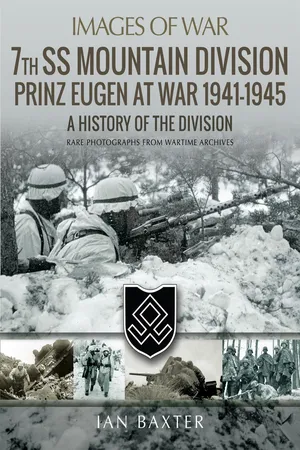
7th SS Mountain Division Prinz Eugen At War, 1941–1945
A History of the Division
- 112 pages
- English
- ePUB (mobile friendly)
- Available on iOS & Android
eBook - ePub
About this book
This volume of rare WWII photographs presents a pictorial history of the Nazi mountain infantry division that fought in Croatia and the Balkans.
Drawing on a superb collection of rare and unpublished photographs, this book tells the story of the 7th SS Mountain Division during the Second World War. Formed in 1941, it consisted of both volunteers and conscripts from the Banat, Independent State of Croatia, Hungary and Romania.
The Prinz Eugen SS Division fought a brutal counterinsurgency campaign against the communist-led Yugoslav Partisan resistance forces in occupied Serbia and Montenegro. It was given the title Prinz Eugen after Prince Eugene of Savoy, a 17th century military leader of the Habsburg Empire. Covering the Divisions history from formation to the end of the war, this volume includes chapters on Operation Weiss, guerilla warfare, and other topics.
Drawing on a superb collection of rare and unpublished photographs, this book tells the story of the 7th SS Mountain Division during the Second World War. Formed in 1941, it consisted of both volunteers and conscripts from the Banat, Independent State of Croatia, Hungary and Romania.
The Prinz Eugen SS Division fought a brutal counterinsurgency campaign against the communist-led Yugoslav Partisan resistance forces in occupied Serbia and Montenegro. It was given the title Prinz Eugen after Prince Eugene of Savoy, a 17th century military leader of the Habsburg Empire. Covering the Divisions history from formation to the end of the war, this volume includes chapters on Operation Weiss, guerilla warfare, and other topics.
Trusted by 375,005 students
Access to over 1 million titles for a fair monthly price.
Study more efficiently using our study tools.
Information
Chapter One
Formation
On 6 April 1941 the German invasion of Yugoslavia and Greece began. The first attacks into Yugoslavia began with the bombing of Belgrade. Simultaneously on the ground, the German 2nd Army (with elements of the 12th Army, First Panzer Group, and an independent panzer corps) attacked. In total there were nineteen divisions, including five panzer divisions, two motorised infantry divisions and two mountain divisions. The attack was overwhelming for the weak and undertrained Yugoslav army and conditions further deteriorated with the Italian and Hungarian Army joining the ground offensive on 11th April.
In spite of the devastating blow, the Yugoslavian people were determined to resist. In a number of areas the countryside was inflamed by local uprisings, and partisan groups began attacking German convoys. Even after the capitulation of Yugoslavia, faction groups began calling on the people to unite in a battle against the occupiers. Many Serb detachments that had refused to surrender to the Germans had taken to the hills. The Chetniks, or what they referred to sometimes as ‘Chetnik detachments of the Yugoslavian Army’, were the first of the two main resistance movements. The Chetniks were composed mostly of Serbs soldiers, local defence units, bands of Serb villagers, anti-partisan auxiliaries, mobilised peasants and armed refugees. All were intent on retaining the Yugoslav monarchy, ensuring the safety of ethnic Serb people, and the establishment of a Great Serbia. The other partisan movement, however, which was led by the communist leader Josip Broz Tito, was regarded as anti-Serbian. Yet it largely cooperated in their anti-Axis activities with Chetnik leaders, actively recruiting partisans that fought side-by-side with Tito’s insurgents.
Brutal guerrilla warfare broke out in 1941 in many parts of Yugoslavia. The deep forests, mountains, hills and valleys, became plagued with guerrilla activities. Partisan detachments began infiltrating enemy lines with snipers firing on German convoys. They put some whole regions in a state of war. Bridges were blown, roads were blocked with tree trunks or wagons, or were mined. Special Partisan detachments severed lines of communications, sabotaging railways and assaulting enemy supply dumps. Squads were dispatched to poison water wells.
Jittery German soldiers often over-reacted. If shots were fired at them from a village in bandit country, houses were torched, villages razed, and the inhabitants, innocent as well as guilty, found themselves facing firing squads. In towns and villages that had seen action against the Partisans, angry files of German soldiers marched through streets, hammering on doors, ordering out their petrified inhabitants and herding them out into the streets. Almost invariably the Germans would murder them in the most abominable fashion.
The indiscriminate killing of women, children and the elderly led to an increase in Partisan activity. Both sides fought savagely. It was a hidden war, unseen by judging eyes, and became dirty and ruthless in the extreme.
To combat the growing partisan issue the higher SS and police leader in Serbia, SS-Obergruppenführer August Meyszner, was issued with the task of putting together a volunteer division. Initially some were recruited from German-speaking Danube Swabia in the Banat region. However, the numbers did not reach an operating strength, so the SS discarded a voluntary recruiting programme and imposed a mandatory military recruitment scheme on all German-speaking people in Croatia and the Banat. This conscription programme was the first of its kind to non-Germans and the recruits were unable to oppose it.
Unlike the premier Waffen-SS divisions now fighting on the Eastern Front, the recruits were not expected to meet very stringent criteria. During their training programme new recruits were not indoctrinated to fight for the Führer, but to cleanse the Balkans from the Partisans. But every man had to obey every order, even if it meant shooting prisoners and committing atrocities against civilians. Under Meyszner’s supervision, this new band of men learnt to be brutal.
In March 1942 the division declared itself a mountain division and was named the SS Freiwilligen Gebirgs Division, and a month later received the honorary title ‘SS Prinz Eugen’.
Each soldier was trained hard and learnt the harshness of the environment in which he had to operate. He had to carry considerable personal kit, and was expected to scale mountains carrying it. The support elements that were available to traditional infantry divisions, such as armoured vehicles, tanks and artillery, were not supposed to be used by the mountain troops. Instead, they were supplied with weapons and other equipment that could be taken apart and carried by pack animals, just like a regular mountain trooper or Gebirgsjäger. The division’s weapons consisted of a considerable number of non-standard weapons such as used captured French light tanks and Czech ZB-53 machine guns. However, the men did receive German artillery such as the 7.5cm Gebirgshaubitze 36 and the 10.5cm Gebirgshaubitze 40.
Each soldier had to learn survival techniques for the mountains. He was trained to build a primitive shield of rocks around him, which could protect him against the cold and enemy fire. The mountain soldiers became self-sufficient and adapted to mountain warfare.

Pictured here with SS Reichsführer Heinrich Himmler is SS Obergruppenführer August Meyszner, who can be seen standing up chairing the meeting. Meyszner was described as one of Himmler’s most brutal subordinates. He held the post of Higher SS and Police Leader in Serbia, and in 1942 was issued with the task of putting together a volunteer division. This division became later known as the SS Prinz Eugen Division. (NARA)
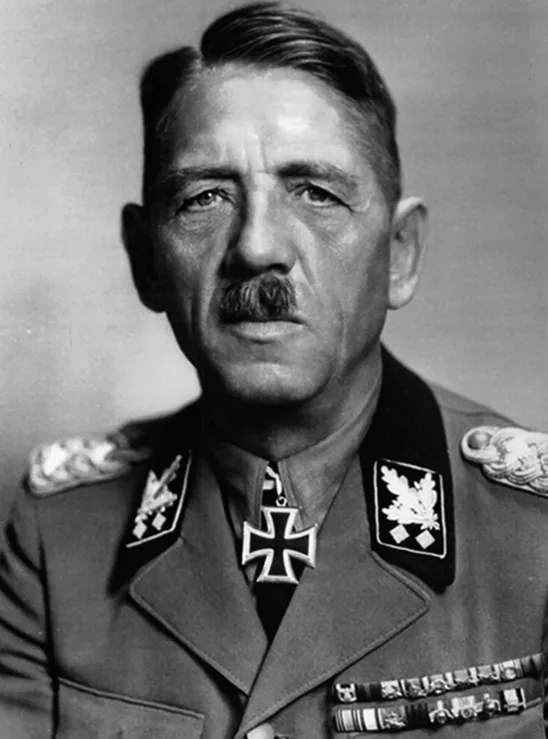
A portrait photograph of SS Obe...
Table of contents
- Cover
- Title
- Copyright
- Contents
- About the Author
- Introduction
- Chapter One: Formation
- Chapter Two: Anti-Partisan Operations
- Chapter Three: 1943 – Operation Weiss
- Chapter Four: Guerrilla Warfare
- Chapter Five: Last Months
- Appendix: Order of Battle & Commanders
Frequently asked questions
Yes, you can cancel anytime from the Subscription tab in your account settings on the Perlego website. Your subscription will stay active until the end of your current billing period. Learn how to cancel your subscription
No, books cannot be downloaded as external files, such as PDFs, for use outside of Perlego. However, you can download books within the Perlego app for offline reading on mobile or tablet. Learn how to download books offline
Perlego offers two plans: Essential and Complete
- Essential is ideal for learners and professionals who enjoy exploring a wide range of subjects. Access the Essential Library with 800,000+ trusted titles and best-sellers across business, personal growth, and the humanities. Includes unlimited reading time and Standard Read Aloud voice.
- Complete: Perfect for advanced learners and researchers needing full, unrestricted access. Unlock 1.4M+ books across hundreds of subjects, including academic and specialized titles. The Complete Plan also includes advanced features like Premium Read Aloud and Research Assistant.
We are an online textbook subscription service, where you can get access to an entire online library for less than the price of a single book per month. With over 1 million books across 990+ topics, we’ve got you covered! Learn about our mission
Look out for the read-aloud symbol on your next book to see if you can listen to it. The read-aloud tool reads text aloud for you, highlighting the text as it is being read. You can pause it, speed it up and slow it down. Learn more about Read Aloud
Yes! You can use the Perlego app on both iOS and Android devices to read anytime, anywhere — even offline. Perfect for commutes or when you’re on the go.
Please note we cannot support devices running on iOS 13 and Android 7 or earlier. Learn more about using the app
Please note we cannot support devices running on iOS 13 and Android 7 or earlier. Learn more about using the app
Yes, you can access 7th SS Mountain Division Prinz Eugen At War, 1941–1945 by Ian Baxter in PDF and/or ePUB format, as well as other popular books in History & German History. We have over one million books available in our catalogue for you to explore.