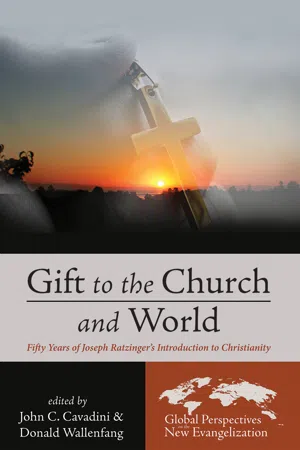
eBook - ePub
Gift to the Church and World
Fifty Years of Joseph Ratzinger’s Introduction to Christianity
- 364 pages
- English
- ePUB (mobile friendly)
- Available on iOS & Android
eBook - ePub
Gift to the Church and World
Fifty Years of Joseph Ratzinger’s Introduction to Christianity
About this book
Few books in theology have faced the twentieth century with all its horrors and yet convincingly revoiced the redemptive Christian antidote that compels us to reawaken to our true identity as beloved children of God. Joseph Ratzinger's 1968 masterpiece, Introduction to Christianity, is one of those rare books. On the fiftieth anniversary of this classic book's publication, English-speaking scholars from around the globe gathered at the University of Notre Dame to celebrate Ratzinger's lasting influence on the world of Christian theology. Bishops, priests, and lay men and women set their hands to "the trowel of tribute," honoring the theological legacy of Joseph Ratzinger and the pivotal role he has played in the recent history of the Catholic Church, from his early days as a parish priest and university professor, all the way to his election to the Chair of Saint Peter as Pope Benedict XVI. Readers of this collection, Gift to the Church and World, will enjoy the beautiful variety of essays penned by notable scholars that decorate the timeless insights of Ratzinger's theological genius. Thematic topics include an overview and context of Ratzinger's work, fundamental theology, philosophical theology, dogmatic theology, spiritual theology, and pedagogy. Altogether, readers will deepen their appreciation and understanding of the theological contributions of Joseph Ratzinger to the mission field of the New Evangelization today.
With contributions from:
Catherine R. Cavadini
Leonard J. DeLorenzo
Patrick X. Gardner
Robert P. Imbelli
Jennifer Newsome Martin
Aaron Pidel
Francesca Murphy
Anthony J. Pagliarini
Timothy P. O'Malley
Cyril O'Regan
Tracey Rowland
Richard Schenk (HC)
Anthony C. Sciglitano, Jr.
Clemens Sedmak
Rudolf Voderholzer
Trusted by 375,005 students
Access to over 1.5 million titles for a fair monthly price.
Study more efficiently using our study tools.
Information
Topic
Theology & ReligionSubtopic
Christian DenominationsIV. Dogmatic Theology
10
Joseph Ratzinger’s “Spiritual Christology”
Introduction
This article offers some considerations on the topic: “Joseph Ratzinger’s Spiritual Christology.” It does so mindful of the frequently alleged disconnect between doctrine and experience, manifest in such slogans as “I’m spiritual, but not religious.” This slogan has its ecclesiastical counterpart in the increasingly prevalent disjunction between what is “doctrinal” and what is “pastoral.” But I also address the topic in light of an ever-growing tendency towards academic specialization that often deems “spirituality” not ingredient to the theological curriculum, but “extra-curricular,” reserved to the chapel and not the classroom.
I will attempt to show, therefore, how theology and spirituality are intimately and exemplarily related in Ratzinger’s thought—just as they were for his theological ancestors and mentors: Augustine and Bonaventure, Guardini and de Lubac. For him, as for them, “Mystery” and “mysticism” (faith’s objective content and its subjective appropriation) are inseparable, and both have a distinctive “Christic form.”502 Ratzinger will come to call this persuasion and approach a “spiritual Christology.”
The article will proceed in five parts: (I) Looking Back . . . and Forward to Vatican II; (II) Ratzinger on Revelation: the Inextricable Nexus of Theology and Spirituality; (III) Introduction to Christianity: Laying the Foundations of a “Spiritual Christology”; (IV) Further Delineating “Spiritual Christology”; and (V) Towards a Eucharistic Mysticism and Spirituality.
But let me first dwell briefly upon the two images that accompany this reflection: the risen/ascended Christ bestowing the Holy Spirit upon the apostles (from the great entrance door of the twelfth century Basilica of Saint Mary Magdalene in Vézelay, France) and the painting of the Transfiguration (by the late thirteenth century Sienese painter, Duccio di Buoninsegna).

Panel Image from the 12th-century Basilica of Saint Mary Magdalene in Vézelay, France.

“Transfiguration” by the late 13th-century Sienese painter Duccio of Buoninsegna.
We know the crucial importance of images and of the aesthetic dimension of existence for Joseph Ratzinger/Pope Benedict. In his well-known 2002 address in Rimini, Ratzinger said: “Looking at icons, and in general at the great masterpieces of Christian art, leads us on an interior way, a way of transcendence, and thus brings us, in this purification of sight that is a purification of the heart, face to face with beauty, or at least with a ray of it.”503 A few years later, explaining why he insisted that images of Christian art be included in the Compendium to the Catechism of the Catholic Church, then Cardinal Ratzinger wrote: “In a culture of images, a sacred image can express much more than what can be said in words, and be an extremely effective and dynamic way of communicating the Gospel message.”504
In this spirit and with this same conviction, I offer these two images to recapitulate aesthetically and affectively all that I write here. They depict imaginatively and strikingly the absolute novum of the risen, ascending Jesus Christ and the transformative way of life to which he calls his disciples. Hopefully, these images will guide our meditations both “ante et post scriptum”! They certainly have continued to inspire my prayer and reflection since I first encountered them during a Junior Year Abroad sixty years ago.
I. Looking Back . . . and Forward to Vatican II
I begin by “Looking back and forward to Vatican II.” But, in doing so, I would like to begin with a note of personal witness.
By the providence of God and the generosity of the Archbishop and people of the Archdiocese of New York, I began my theological studies in Rome in the Fall of 1962—the time of the opening of the Second Vatican Council. Vatican II, of course, remains the indispensable point of reference for Catholic theology and spirituality even after more than fifty years. Indeed, one might legitimately wonder: have we yet received it fully, perhaps even “misremembered” it?505
I certainly had some excellent professors at the Gregorian University during the years of the Council—Bernard Lonergan, René Latourelle, Francis Sullivan (to name a few). But, to be honest, most of the real excitement took place in the evenings at lectures by Rahner and Congar, Chenu and Cullman. For a time Rome seemed once again the center of the world. And to experience the gradual opening of a formerly rather closed clerical Rome during that period was marvelous to behold.
November 20, 1962 was a particularly remarkable day. In my memory, I still vividly recall the astonishment we all experienced. On that day, the document “On the Sources of Revelation,” prepared by the Theological Commission (headed by Cardinal Ottaviani) was voted on by the Council fathers. There had been considerable discussion of the document in the days preceding the vote, and it had received much criticism for its style—overly scholastic and abstract, insufficiently biblical, historical, and ecumenical—a product of the reigning neo-scholasticism of the time.
When it came time to vote, more than 60 percent of the bishops chose not to accept the draft. But, according to the ground rules of the Council, it required a two-thirds negative vote to remand the document to Committee.
At that point, Pope John XXIII, with blessed common sense, intervened. He ordered that the document be re-composed...
Table of contents
- Title Page
- Contributors
- Acknowledgments
- Introduction
- I. Overview and Context
- II. Fundamental Theology
- III. Philosophical Theology
- IV. Dogmatic Theology
- V. Spiritual Theology
- Epilogue
Frequently asked questions
Yes, you can cancel anytime from the Subscription tab in your account settings on the Perlego website. Your subscription will stay active until the end of your current billing period. Learn how to cancel your subscription
No, books cannot be downloaded as external files, such as PDFs, for use outside of Perlego. However, you can download books within the Perlego app for offline reading on mobile or tablet. Learn how to download books offline
Perlego offers two plans: Essential and Complete
- Essential is ideal for learners and professionals who enjoy exploring a wide range of subjects. Access the Essential Library with 800,000+ trusted titles and best-sellers across business, personal growth, and the humanities. Includes unlimited reading time and Standard Read Aloud voice.
- Complete: Perfect for advanced learners and researchers needing full, unrestricted access. Unlock 1.5M+ books across hundreds of subjects, including academic and specialized titles. The Complete Plan also includes advanced features like Premium Read Aloud and Research Assistant.
We are an online textbook subscription service, where you can get access to an entire online library for less than the price of a single book per month. With over 1.5 million books across 990+ topics, we’ve got you covered! Learn about our mission
Look out for the read-aloud symbol on your next book to see if you can listen to it. The read-aloud tool reads text aloud for you, highlighting the text as it is being read. You can pause it, speed it up and slow it down. Learn more about Read Aloud
Yes! You can use the Perlego app on both iOS and Android devices to read anytime, anywhere — even offline. Perfect for commutes or when you’re on the go.
Please note we cannot support devices running on iOS 13 and Android 7 or earlier. Learn more about using the app
Please note we cannot support devices running on iOS 13 and Android 7 or earlier. Learn more about using the app
Yes, you can access Gift to the Church and World by John C. Cavadini, Donald Wallenfang, John C. Cavadini,Donald Wallenfang in PDF and/or ePUB format, as well as other popular books in Theology & Religion & Christian Denominations. We have over 1.5 million books available in our catalogue for you to explore.