A look at the events leading up to Japan's surrender in World War II, from the
New York Times–bestselling author of
Engineers of Victory.
By the spring of 1943, Japan had a tight grip on the countries and territories of East Asia and the Western Pacific. But the Allies had won decisive victories at Midway and Guadalcanal, and they were coming for the rest of Japan's conquests. Now the empire of Japan would be on the defensive.
Featuring a new introduction by the author, this book picks up where
Pacific Onslaught left off, providing a detailed, step-by-step account of the Allies' unstoppable rally across territories annexed by the Japanese in a brutal two-pronged attack across New Guinea and the Philippines, and the islands of the central Pacific. Here you'll find detailed contemporary accounts and strategy, from the epic battles of the Gilberts and Marshalls to the dropping of the atomic bombs on Hiroshima and Nagasaki and Japan's final surrender on the decks of the USS
Missouri.
- 158 pages
- English
- ePUB (mobile friendly)
- Available on iOS & Android
eBook - ePub
Pacific Victory
About this book
Trusted by 375,005 students
Access to over 1.5 million titles for a fair monthly price.
Study more efficiently using our study tools.
Information
Subtopic
Japanese HistoryIndex
HistoryDrive to Rabaul

An Australian mortar crew with armoured support engage the enemy during the Allied advance
The two-pronged Allied drive along the New Guinea coast and through the Solomons upon Rabaul was planned to commence on 30th June 1943. Halsey’s forces would land in the New Georgia group, the New Guinea Force under Lieutenant-General Herring would put ashore troops at Nassau Bay near Salamaua and Alamo Force under Lieutenant-General Krueger would seize Kiriwina and Woodlark Islands in the Trobriands. This latter operation, undertaken by two American divisions, went off without a hitch, there being no enemy opposition, and the construction of airstrips began immediately. Herring’s force, composed chiefly of Australians though with some American regiments, had a harder struggle but benefited from Japanese indecision. Two months earlier, the Australian garrison at Wau had been greatly expanded and its commander, then Lieutenant-General Savige (3rd Australian Division), had been ordered to advance upon Salamaua in support of the landing of 162nd US Regiment at Nassau Bay. Fearing this movement by Savige, the Japanese did not react in strength to the American landing, which was successfully accomplished despite early chaos on the beaches and the inexperience of the troops in the jungle. With the Americans advancing up the coast and the Australians from the interior, the 6,000 Japanese were gradually pushed back to the outskirts of Salamaua by mid-August. Savige was then ordered to keep the pressure upon the town in order to draw enemy troops from Lae, which was the chief objective, but not to take it until the main landings on the Huon Peninsula were under way.
By comparison, the New Georgia campaign was a far more difficult operation. This group, with its important airstrip at Munda, its garrison of some 10,000 Japanese troops and its terrain of wet, mountainous jungle, was likely to prove as hard to take as Guadalcanal—particularly as Imperial General Headquarters had insisted on its being held as long as possible. Moreover, the main island itself was not easy to invade, for it was surrounded by reefs on the north-east coast and by smaller islands on its western and southern flanks; an invasion would either have to take the islets first and thereby give the Japanese some warning, or risk leaving enemy forces untouched on the flank of the assault upon New Georgia itself.
The Americans’ plan was to divide their own forces into three landing groups, which it was hoped would confuse the defending garrison. The main body would land on the north side or Rendova Island, from where it would ‘hop’ across the strait to occupy Munda Point. As soon as this second stage was under way, another American force would land near Rice Anchorage and move quickly to Bairoko Harbour in the northern part of New Georgia, thus cutting off the enemy’s line of reinforcement and retreat. In addition there were to be three subsidiary landings in the southern part of the group, at Wickham Anchorage on Vangunu Island and at Segi Point and Viru Harbour on the south-east coast of New Georgia.
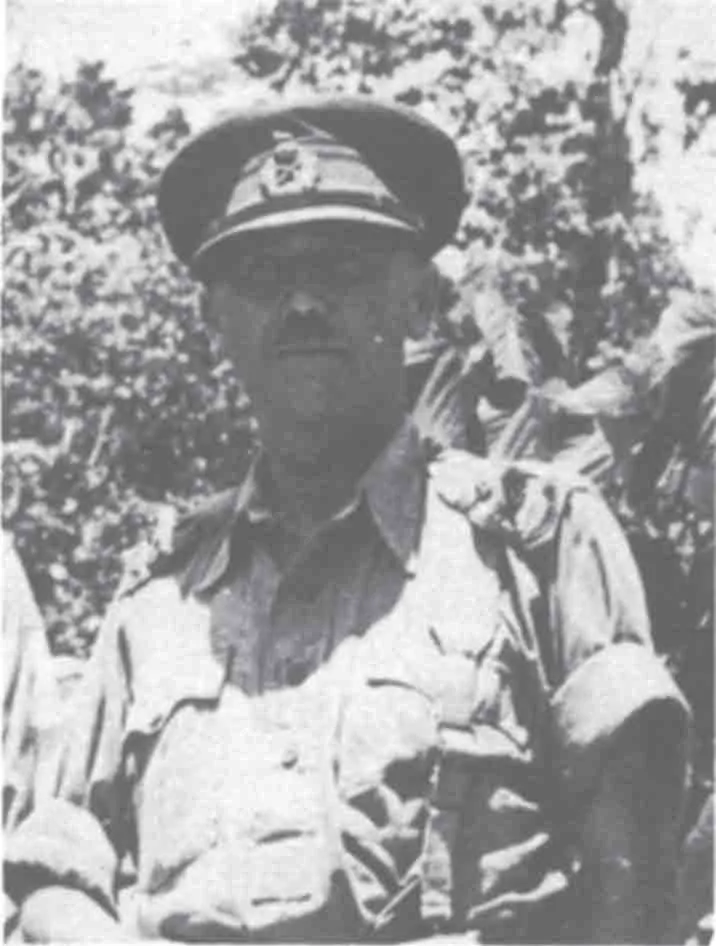
Lieutenant-General Herring, commander of Halsey’s New Guinea Force
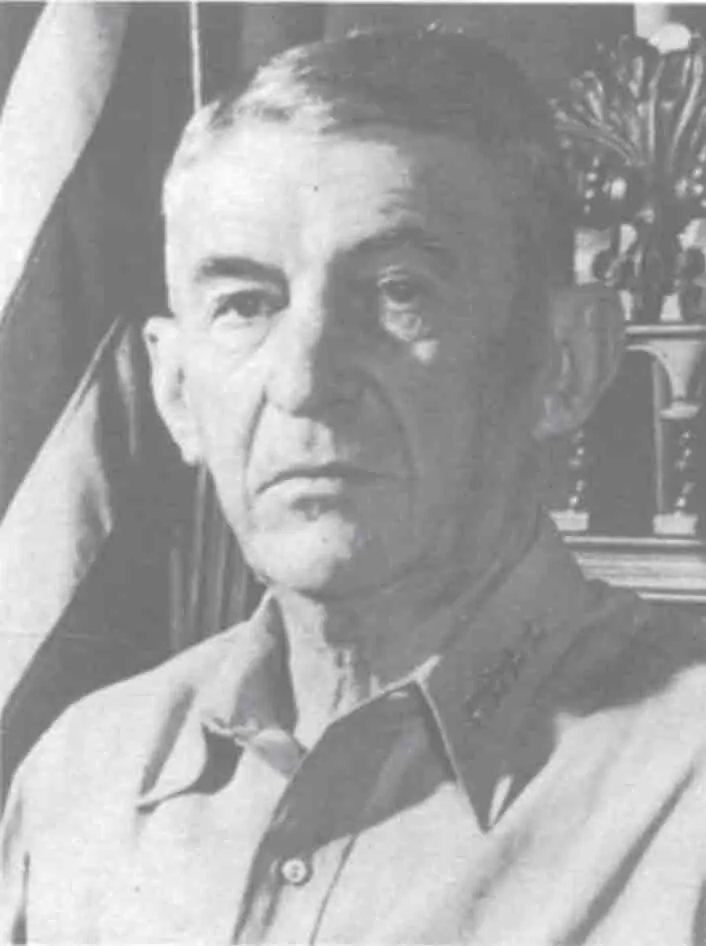
Lieutenant-General Krueger, Alamo Force commander

Lieutenant-General Savige watches the action against the Japanese near Salamaua

Australian troops move forward to engage the Japanese near Lae
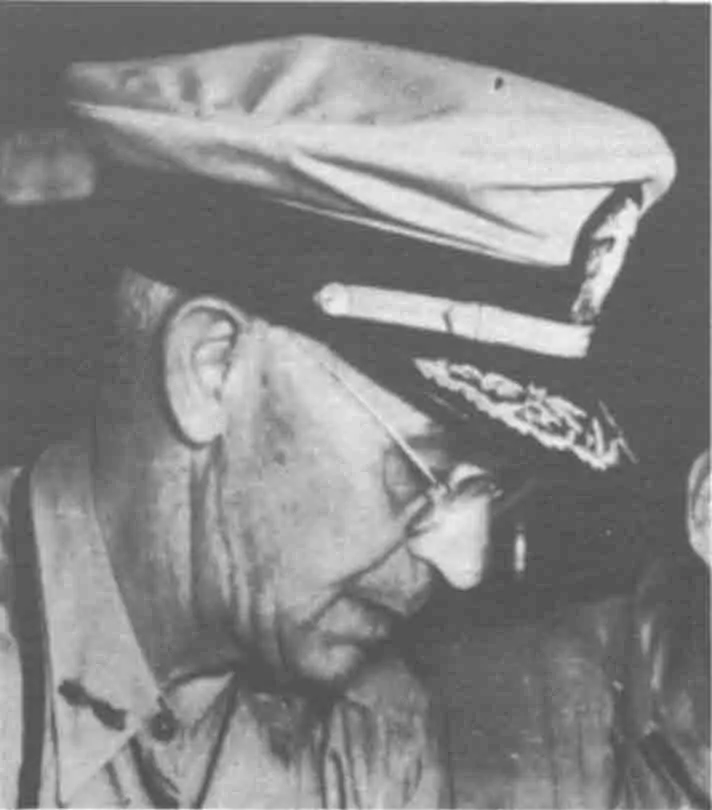
Rear Admiral Turner of TF 32
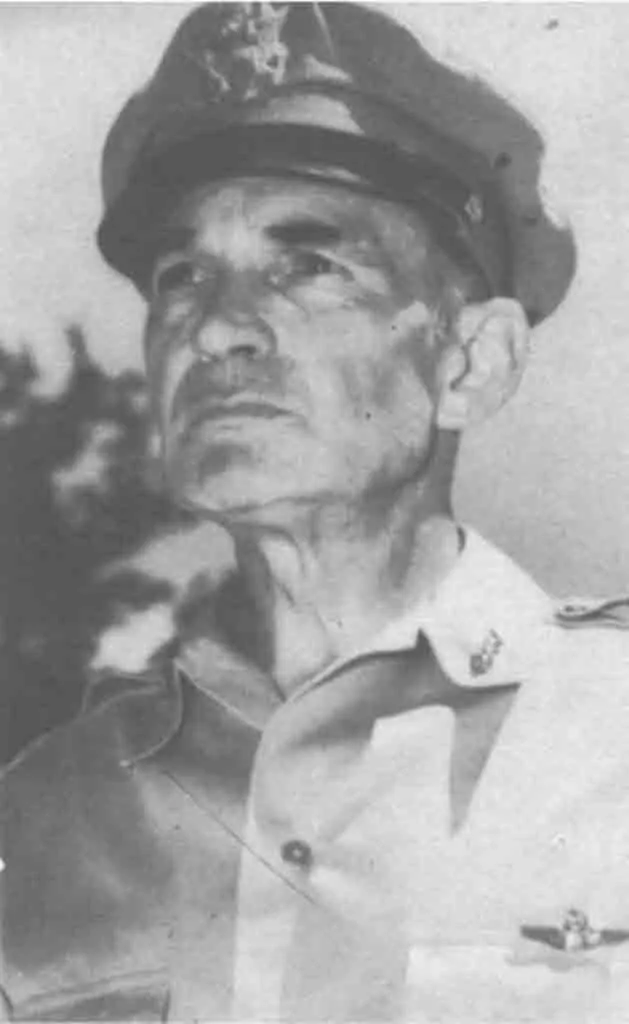
Lieutenant-General Harmon
Halsey himself kept direct control of the Special Service Squadron, which was to handle the complex logistics of the campaign, and of the distant naval covering force TF 36, which contained two fleet and three escort carriers, three battleships, nine cruisers and twenty-nine destroyers. Rear-Admiral Turner was in command of TF 32, the Amphibious Task Force. Land-based Allied air forces in the area (about 530 planes) were under Vice-Admiral Fitch, the US Marines under Major-General Vogel and the army under Lieutenant-General Harmon; the major portion of the ground forces was the 43rd Infantry Division, an inexperienced unit whose commander, Lieutenant-General Hester, had to control both the division and the entire landing force, a heavy strain on his staff.

Flame-thrower in action against Japanese emplacements during the first engagements on New Georgia
A coastwatcher’s report that the Japanese were moving into southern New Georgia prompted Halsey to order the landings at Segi Point for 21st June instead of the 30th. The move was carried out without enemy opposition and construction work on an airstrip there began immediately; but the overland thrust to cover the seaborne landing at Viru Harbour proved more difficult and Halsey decided to cancel the amphibious assault on the 30th and allow the stronghold to be taken later. At Wickham Anchorage the surf proved harder to master than the Japanese but by 3rd July Vangunu Island had been totally overrun.
The main assault by 6,000 troops on Rendova on 30th June was preceded by heavy bombing attacks upon the Japanese positions. The garrison of 200 was then swiftly disposed of. More serious threats to the invaders came from the fire of enemy batteries on Munda, across the strait, and from aerial raids from Rabaul. Yet by 2nd July the Americans felt strong enough to cross to New Georgia itself, landing at Zanana to the east of Munda Point and driving the Japanese back from the coast. Three days later came the landing at Rice Anchorage.
The Japanese response, as at Guadalcanal, was first made at sea. Four destroyers sailed from Bougainville with a batch of troops, landing them at Kolombangara Island on 4th July. The following evening, however, another attempt at reinforcement was intercepted by Rear-Admiral Ainsworth’s three cruisers and nine destroyers, which were covering the landings at Rice Anchorage. In this ‘Battle of Kula Gulf’ the ten Japanese destroyers, although at a great disadvantage in the darkness in not possessing radar, sank the cruiser Helena for the loss of one destroyer before disappearing into the night. Moreover, they managed to land 1,200 men on Kolombangara, losing a transport-destroyer which had beached itself to Allied aircraft on the next day. One week later, on the night of 12th July, another dogfight occurred when the cruiser Jintsu and nine destroyers, carrying more troops, were engaged by three Allied cruisers and nine destroyers, again under Ainsworth. During this ‘Battle of Kolombangara’, a radar-equipped Catalina flying-boat directed the Allied fire, which sank the Jintsu within minutes though the New Zealand cruiser Leander was damaged; but the Japanese destroyers, having disembarked a further 1,700 soldiers on Kolombangara, returned to the fray and sank an American destroyer and damaged the two other cruisers with their formidable ‘long lance’ torpedoes.
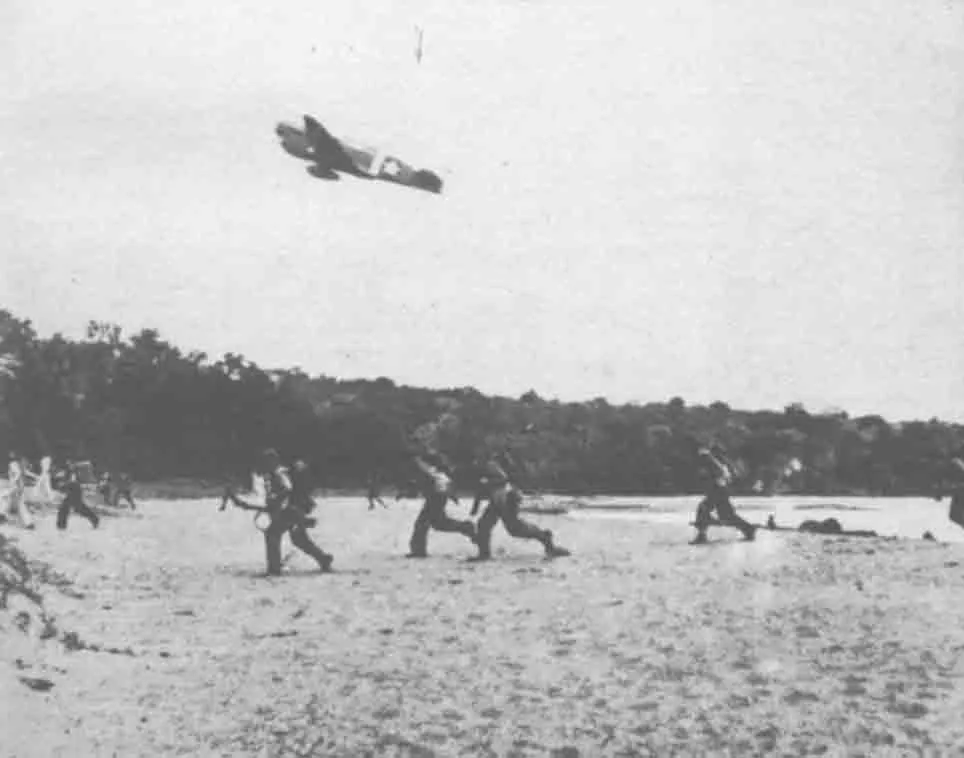
Supported by a USAF P-40, Allied troops storm the beach during the invasion of Rendova

Crewmen stack empty shell cases aboard USS Honolulu after the abortive engagement against ten Japanese destroyers in Kula Gulf

Wreck of the Japanese destroyer Nagatsuki on the beach at Kolombangara

Damage caused by Japanese ‘long lance’ torpedoes to the cruiser USS St Louis during the Battle of Kolombangara
On shore the inexperienced troops of the 43rd Division made little progress in the fierce terrain and climate against a tenacious Japanese defence, nor did the constant aerial, naval and artillery support seem to have much effect in the drive towards Munda. American morale was very poor—the majority of the casualties were given psychological treatment for ‘war neurosis’—and on 16th July Major-General Griswold was sent to take command. Despite the replacement of some officers and the use of tanks and flame-throwers, the American troops did not take Munda until 5th August, driving the Japanese away to the north of the island where Northern Force was also expanding. Avoiding this pincer movement, the majority of the defenders under Major-General Sasaki managed to withdraw to nearby Kolombangara since Bairoko Harbour was still in Japanese hands. On 24th August, it too fell into the possession of the Americans and the New Georgia campaign was complete.
Munda airstrip had been in use by the 14th but even before that Allied planes were dominating the skies, checking enemy bombing raids from Rabaul, giving ground support and attacking any Japanese attempts to reinforce the central Solomons. On 19th/20th July they sank one cruiser and two destroyers, on the 22nd one destroyer; when the Japanese sent supplies and troops by small barges instead, they were attacked by American PT boats. On the evening of 6th August larger targets presented themselves—four destroyers carrying 900 troops and provisions. Awaiting them in the Vella Gulf were six American destroyers under Commander Moosbrugger, positioned by radar for a perfect torpedo attack. Within half an hour three Japanese vessels were sunk and the survivor was streaking northwards to Rabaul.
The length of time it was taking to capture New Georgia dismayed Halsey and MacArthur, who were also aware that a step-by-step advance up the Solomons would give the enemy ample time to strengthen his next line of defence. Possessing the necessary aerial and naval superiority, the Allies therefore decided to move onto the lightly-defended Vella Lavella, sealing off Kolombangara with its 10,000 Japanese troops. Only by this deliberate leap-frogging strategy, first begun in the Aleutians, could South-West Pacific Command hope to keep up its planned progress and baffle the enemy’s defence system. One further advantage was that an airstrip built on Vella Lavella would only be 100 miles from Bougainville.
As a result, the island was invaded by 4,600 American troops on 15th August, even before the New Georgia campaign was completed. Reinforced by part of a New Zealand division, they quickly drove away the small garrison, which permitted the Seabees (the famous naval construction units) to commence work on an airstrip. To close the gap around Kolombangara, Arundel Island was invaded on 27th August, but it had been reinforced by Sasaki from the main island and its garrison was not wiped out until 21st September. The general’s hopes of crushing an Allied invasion of Kolombangara itself, where a garrison of 12,000 had constructed a very formidable defence system, were shattered by an order from Imperial General Headquarters, transmitted via Rabaul on 15th September which instructed him to withdraw his forces; in fact, his task had been purely a delaying one since the decision to abandon the central Solomons and concentrate upon Bougainville had been taken a month earlier.

A Curtis P-40 on Munda Field the day it became operational after its capture
Despite the Allied supremacy at sea and in the air, the Japanese once again managed to effect a skilful withdrawal. On 28th/29th September and the first two nights of October a host of small craft took off 9,500 men, including Sasaki himself. The only large-scale opposition offered by the US navy to this miniature Dunkirk came on the night of 6th October, when three destroyers under Captain Walker intercepted an enemy force of nine destroyers and some smaller craft which were evacuating the remaining soldiers from Vella Lavella. In the ensuing melee, the Japanese lost one destroyer but they successfully evacuated the troops and at the same time sank one and damaged two American destroyers. The central Solomons was now clear of ...
Table of contents
- Cover
- Title Page
- Copyright
- Contents
- Introduction
- Preparing for the comeback
- Drive to Rabaul
- The Gilberts and the Marshalls
- New Guinea and the Marianas
- Leyte Gulf and the Philippines
- Imphal
- Burma and China
- Iwo Jima and Okinawa
- The end in sight
- The fall of Japan
- Bibliography
Frequently asked questions
Yes, you can cancel anytime from the Subscription tab in your account settings on the Perlego website. Your subscription will stay active until the end of your current billing period. Learn how to cancel your subscription
No, books cannot be downloaded as external files, such as PDFs, for use outside of Perlego. However, you can download books within the Perlego app for offline reading on mobile or tablet. Learn how to download books offline
Perlego offers two plans: Essential and Complete
- Essential is ideal for learners and professionals who enjoy exploring a wide range of subjects. Access the Essential Library with 800,000+ trusted titles and best-sellers across business, personal growth, and the humanities. Includes unlimited reading time and Standard Read Aloud voice.
- Complete: Perfect for advanced learners and researchers needing full, unrestricted access. Unlock 1.5M+ books across hundreds of subjects, including academic and specialized titles. The Complete Plan also includes advanced features like Premium Read Aloud and Research Assistant.
We are an online textbook subscription service, where you can get access to an entire online library for less than the price of a single book per month. With over 1.5 million books across 990+ topics, we’ve got you covered! Learn about our mission
Look out for the read-aloud symbol on your next book to see if you can listen to it. The read-aloud tool reads text aloud for you, highlighting the text as it is being read. You can pause it, speed it up and slow it down. Learn more about Read Aloud
Yes! You can use the Perlego app on both iOS and Android devices to read anytime, anywhere — even offline. Perfect for commutes or when you’re on the go.
Please note we cannot support devices running on iOS 13 and Android 7 or earlier. Learn more about using the app
Please note we cannot support devices running on iOS 13 and Android 7 or earlier. Learn more about using the app
Yes, you can access Pacific Victory by Paul Kennedy in PDF and/or ePUB format, as well as other popular books in History & Japanese History. We have over 1.5 million books available in our catalogue for you to explore.