- 196 pages
- English
- ePUB (mobile friendly)
- Available on iOS & Android
eBook - ePub
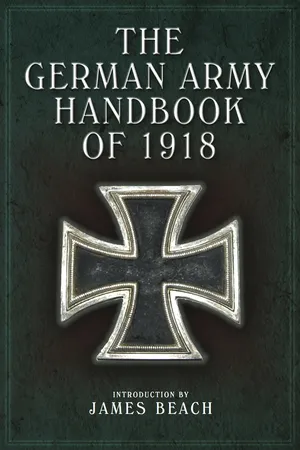
The German Army Handbook of 1918
About this book
An exact reproduction of the landmark British assessment of German military capability in the final months of World War I.
Compiled by British Intelligence, for restricted official issue by the General Staff, The German Army Handbook of April 1918 is a comprehensive assessment of the German Army during the latter stages of the First World War. Illustrated throughout with plates, diagrams, charts, tables, and maps, it provides a detailed breakdown of the army, covering all aspects from recruiting and training, mobilization, command and organization, weapons and signals to transportation, medical and veterinary services, and uniform. There are also two maps, showing Army Corps Districts, and Zones of Administration and Lines of Command in June 1917.
The German Army Handbook of 1918 was a remarkable achievement. It provides solutions to many questions that histories of the First World War and accounts of its battles are unable to answer. It shows how the static conventions of trench warfare usurped the traditional role of cavalry, and how the German Army was able to take advantage of the dominance of the machine gun on the Western Front in 1915.
Trusted by 375,005 students
Access to over 1.5 million titles for a fair monthly price.
Study more efficiently using our study tools.
Information
CHAPTER I.
RECRUITING AND RECRUIT TRAINING.
1. Liability to server.—In peace, every male German was liable to military service (wehrpflichtig) from his 17th to his 45th birthday.
Although not liable in peace to service in the standing army until his 20th year, every German, on reaching the age of 17, automatically became liable to serve in the Landsturm, i.e., the category intended primarily for home defence. Every man belonged to the Landsturm 1st Ban between the ages of 17 and 20.
2. Recruiting in peace.—In peace, liability to service in the standing army commenced when a man had reached the age of 20, and consisted of 2 years’ “aktiv” colour-service (3 years in the cavalry and horse artillery), followed by successive periods in the Reserve, (4 or 5 years), Landwehr (11 years), and Landsturm 2nd Ban (7 years). All men passed to the Landsturm 2nd Ban on the 1st of April in the year on which they reached the age of 39.
After completing his period of colour-service, a man was, in peace, liable to be called out for two annual trainings while in the Reserve, and after passing to the Landwehr 2nd Ban was free from further service.
3. Annual enrolment.—The annual recruit contingent, or “class” (Jahresklasse), comprises all men who attain their 20th birthday during the year in question. Thus, the men of the 1900 “Jahrgang” form the 1920 Class (Jahresklasse).
In peace the preliminary enrolment or mustering (Musterung) of the annual recruit contingent took place in the spring of each year. At this muster the following different categories came up for medical examination :—
- (a.) All men who would attain their 20th birthday in that particular year.
- (b.) “Restanten”1 from the two previous years.
- (c.) A few older men who for special reasons had been allowed to postpone their service.
- (d.) Younger men who had been allowed to come up before their normal time; i.e., chiefly men who wished to adopt the army as their profession.
The final classification and disposal of the above categories in the three years preceding the war were as under :—

Men on the Restanten-Liste, after having been put back at three successive musters, were finally released from their obligation to serve, and posted to the Untrained Landsturm. The actual calling of the annual class, i.e., its assembly in the depôts, took place on the 1st October in each year.
For the years 1914—1919 a gross total of 650,000 may be assumed for each annual class, before the elimination of the unfits. Actually, during the war, the net figures for the various classes have only averaged between 400,000 and 500,000 men each year. The reduction in the net figures has been due partly to the number of men who anticipated their calling up by volunteering, partly to the physical deficiency of men called up before their time, and partly to the necessity of retaining men in skilled occupations.
4. The Ersatz2 Reserve.—In peace, the annual contingent necessary to maintain the Army and Navy was about 240,000 men in 1912, but had risen to 305,000 in 1913, for the Army alone, owing to the passing of the Peace Strength Law of 1912.
As the annual class was greatly in excess of this figure, even after the weeding out of the unfits, a certain number of men (87,000 in 1912) were turned over each year to the Ersatz-Reserve (Supplementary Reserve).
The Ersatz Reserve was made up of—
- (a.) Men fit for active service, but excused for family or economic reasons, and
- (b.) Men with minor physical defects.
These men nominally remained in the Ersatz Reserve for 12 years, during which time they were liable to be called up for three annual trainings. Only a small proportion of the Ersatz Reserve underwent training.
After passing 12 years in the Ersatz Reserve, the trained men were transferred to the Landwehr 2nd Ban, while the untrained men were transferred to the Landsturm 1st Ban.
On mobilization, the Ersatz Reserve amounted to a total of about one million men, aged between 20 and 32.
As regards the employment of the Ersatz Reserve in war, it should be borne in mind that men of this category have not necessarily been incorporated in Ersatz formations; for instance, a very high percentage of Ersatz Reservists filled the ranks of the first series of new formation Reserve divisions in 1914. Conversely the brigade Ersatz battalions in the original Ersatz divisions contained a majority of reservists and Landwehr men.
5. One-year volunteers.—In peace, young men of good education who undertook to clothe, feed and equip themselves during their period of service, and who attained a satisfactory standard of proficiency in their duties, were permitted to transfer to the Reserve as “aspirant officers” at the end of one year’s service only. After undergoing two annual trainings with the Reserve, and passing a military examination, they were graded as Reserve Officers.
These men were known as “one-year volunteers” (Einjährig-freiwillige), and wore an edging of twisted cord of the State colours on their shoulder straps as a distinguishing mark.
6. Categories.—The following diagram shows the different classes forming the categories, trained and untrained, which were liable for service in July, 1914, and also the annual classes which have become liable for service since that time. Men of all the undermentioned classes and categories were serving in the German field army at the end of 1917 :—

7. Recruiting in war.—In war, the period of liability to be called up for military service is, as in peace time, between the ages of 17 and 45, with the following differences :—
- (a.) The annual classes can be called up and sent to the front before reaching the age of 20.
- (b.) All transfers from one category to another (i.e., from Active to Reserve, from Reserve to Landwehr, and from Landwehr to Landsturm) are suspended, except in a few cases of men who have been incapacitated by wounds or sickness, and are on that account definitely transferred to the Landsturm.
- (c.) Men are not released from service on reaching the age of 45.
- (d.) Men previously rejected as “permanently unfit” can be re-examined and called upon to serve. (Law of 9th September, 1915.)
In war, the enlistment of the recruits of a new class involves three distinct processes :—
- (a.) Inscription on the Landsturm Lists (Meldung zur Stammrolle), which takes place from time to time in each recruiting district (Aushebungsbezirk) for all youths who have reached the age of 17.
- (b.) Medical inspection (Musterung), when the men of the annual class in each district are assembled, medically examined and classified according to their fitness or otherwise for service.
- (c.) Calling up (Einziehung) for active service, when the reservists are actually incorporated in the standing army and join a depot.
At the medical inspection the recruits are classified as follows :—
- (a.) K.V.—Kriegsverwendungsfähige (= fit for active service).
- (b.) G.V.—Garnisonsverwendungsfähige (= fit for garrison duty in Germany, on the Lines of Communication, or in the field).
- (c.) A.V.—Arbeitsverwendungsfähige (= fit for labour employment).
- (d.) D.U.—Dauernd-untaugliche (= permanently unfit).
When a class is called up, the K.V. men are at once sent to the depots of field units; the G.V. and A.V. men are sent to Landsturm formations (see Chapter XVI.). The “Dauernd-untaugliche,” although temporarily exempted, are always liable to be re-examined; if then considered fit they are posted to a depôt.
After the medical inspection, and before being called up for service, a recruit engaged on an essential trade may be exempted on the application of his employer (“reklamiert”). These men have been combed out from time to time during the war.
8. War volunteers.—During the war a certain number of young men, between the ages of 17 and 20, have been allowed to volunteer for active service before the calling up of their class. These men are known as war volunteers (Kriegsfreiwillige).
In 1914, volunteers came forward in very large numbers and included a fair percentage of men, over 20 years of age, who had been posted to the untrained Landsturm, and were thus released from their obligation to serve in peace. In 1915 there was a marked falling off, and from that time onwards it may be estimated that about 5 per cent. of each class has anticipated its calling up by volunteering.
9. Stages of recruiting d...
Table of contents
- Title Page
- Copyright Page
- INTRODUCTION
- Table of Contents
- HANDBOOK OF THE GERMAN ARMY IN WAR. APRIL, 1918.
- CHAPTER I. - RECRUITING AND RECRUIT TRAINING.
- CHAPTER II. - OFFICERS AND NON-COMMISSIONED OFFICERS.
- CHAPTER III - THE MOBILIZATION AND EXPANSION OF THE GERMAN ARMY.
- CHAPTER IV. - COMMAND AND STAFFS.
- CHAPTER V. - INFANTRY.
- CHAPTER VI. - MACHINE GUNS.
- CHAPTER VII. - CAVALRY.
- CHAPTER VIII.. - ARTILLERY.
- CHAPTER IX. - ENGINEERS AND PIONEERS.
- CHAPTER X. - AIR SERVICE.
- CHAPTER XI. - SIGNAL SERVICE.
- CHAPTER XII. - SURVEY.
- CHAPTER XIII. - TRANSPORTATION.
- CHAPTER XIV. - INTENDANCE AND SUPPLY.
- CHAPTER XV. - MEDICAL AND VETERINARY SERVICES.
- CHAPTER XVI. - LANDSTURM UNITS.
- CHAPTER XVII. - UNIFORM.
- APPENDIX A. - THE NEW GERMAN FIELD SERVICE UNIFORM.
- APPENDIX B.
- INDEX.
Frequently asked questions
Yes, you can cancel anytime from the Subscription tab in your account settings on the Perlego website. Your subscription will stay active until the end of your current billing period. Learn how to cancel your subscription
No, books cannot be downloaded as external files, such as PDFs, for use outside of Perlego. However, you can download books within the Perlego app for offline reading on mobile or tablet. Learn how to download books offline
We are an online textbook subscription service, where you can get access to an entire online library for less than the price of a single book per month. With over 1.5 million books across 990+ topics, we’ve got you covered! Learn about our mission
Look out for the read-aloud symbol on your next book to see if you can listen to it. The read-aloud tool reads text aloud for you, highlighting the text as it is being read. You can pause it, speed it up and slow it down. Learn more about Read Aloud
Yes! You can use the Perlego app on both iOS and Android devices to read anytime, anywhere — even offline. Perfect for commutes or when you’re on the go.
Please note we cannot support devices running on iOS 13 and Android 7 or earlier. Learn more about using the app
Please note we cannot support devices running on iOS 13 and Android 7 or earlier. Learn more about using the app
Yes, you can access The German Army Handbook of 1918 by David Nash in PDF and/or ePUB format, as well as other popular books in History & Military & Maritime History. We have over 1.5 million books available in our catalogue for you to explore.