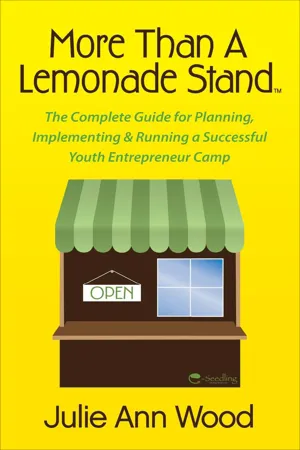
Help the leaders of tomorrow get their start with this step-by-step guide to creating your own youth entrepreneur camp.
Entrepreneurial skills are more in demand today than ever before. Often, the most successful entrepreneurs started honing their skills at a young age. Whether it was a lemonade stand or a newspaper route, they were learning fundamentals of business early in life. So what if we could guide more kids through these valuable lessons and put them on the path to success?
More Than a Lemonade Stand provides the resources and tools you need to run a youth entrepreneur camp—from guidance in building your curriculum to educational activities you can incorporate into your program. With this easy-to-follow guide, you will learn how to lead young men and women through the exciting process of brainstorming, conceptualizing, and building a business from scratch.
Trusted by 375,005 students
Access to over 1.5 million titles for a fair monthly price.
As mentioned above, Section 1 focuses on the steps you’ll need to take to prepare for your campers. Much of the success and missteps that occur during your time with campers can be traced back to your planning. If you take the time and effort on the details needed to build a successful camp, you’ll quickly find traction in the form of engaged and excited campers. It takes time and organization to develop a meaningful opportunity for these young entrepreneurs, but is well worth it when you see how completely dedicated and eager they are to get started.
Planning – The Earlier the Better!
Planning is the #1 most important thing you can do to create a successful camp experience for everyone involved including staff, parents, campers and presenters. For example, the earlier you start, the more supplies you can gather for free or buy at lower prices, the more donors you can contact, the more awareness you can create, and the more campers you will have in attendance. This section takes the guesswork out of putting together the camp. As an added bonus, you will find a planning and implementation checklist organized by time frame, so that you know what needs to be done when. The entire planning section is organized in the same manner by mirroring the checklist. If you follow the time frames and order of tasks as recommended in this section it will save you the time and energy you would spend figuring out what to do next, and it will allow you to achieve your goal of putting on a successful camp much faster. The checklist is like a map so that you can see how far you have progressed and how much further you have to go. It will also help you to see any potential problems that might arise along the way, and it will help you to quickly remedy them. It is much easier to make adjustments to your plan than to deal with a crisis during the camp.
Campfire Wisdom: Download a free planning & implementation checklist at http://eseedling.com/more-than-a-lemonade-stand-book/book-resources and use the password: MoreLemonade
The best way to consider your planning of the curriculum is from a time perspective and checklist perspective. Take a look at the following checklist for your More Than a Lemonade Stand™ camp:
More Than a Lemonade Stand™ Camp
Planning & Implementation Checklist
There are many steps to take before your camp actually begins. The devil is truly in the details, and you’ll find the more prepared you are to handle the small issues, the more successful you’ll find your camper’s experience. Thus, consider the following tasks and timeframes as you prepare for day one.
What Should You Do Before Camp Begins
Six Months Before
Name your camp and create a logo!
In order to successfully market your camp, you will need a name and design for all marketing materials including t-shirts. You might be asking yourself, do I really need a logo? The answer is 100% yes, and in order to further convince you, here are five reasons why a logo is necessary:
1)People judge a book by its cover – so create a good first impression.
2)It gives extra credibility that promotes your camp as being big and established.
3)It shows that you are reputable – parents really like to know their kids are going to a camp they can trust.
4)It builds your individual identity – the logo is just the beginning of your brand and all your materials should complement each other.
5)It shows commitment to what you are doing.
A logo should convey the vision you have for the camp. If you are an existing organization that is creating a camp you will need to take into consideration your company’s professional appearance. You will also want to think about colors, font choices, style, size, and placement when creating a logo. These all have a part in communicating your brand to your audience.
It is always good to have feedback from prospective customers and co-workers on your design and name. This will help you validate that your design conveys what you are trying to communicate, and ultimately it will make your design better. How early you start will determine how much feedback you have time to gather. At minimum, you should work on the logo one year to six months before the camp is scheduled so that you can create marketing materials (more on that in the marketing section) and effectively promote the camp.
You may also want to create a website (or page if you are adding the camp to part of an existing organization). You don’t have to be extremely creative; you just need to communicate what you are selling to your customers. The camp name can be as simple as your organization name’s Youth Entrepreneur Camp.
Campfire Wisdom: You have the option of purchasing the More than a Lemonade Stand™ t-shirts and gear; go to www.MoreThanALemonadeStand.com for more information.
Reserve a venue
You may already have space to hold the camp at your organization, but if you don’t then you need to reserve a room to be used as the base and main classroom for your camp. Popular venues fill up many months (if not years) in advance so it is important to find a place early in the planning process. Prices and amenities can vary significantly, so it is advised to check on at least three different venues that provide the following items needed for the camp:
1)Room set up for number of campers (24-25 is the ideal size) with 6 tables of 4 each with chairs that can be moved around for different activities. If you want a larger camp, you could have 5 chairs at each table. I would recommend 25 as the maximum number of kids allowed in the camp. I’ve dealt with up to 32 and have found 25 to be much more manageable. If you do want to allow for a larger group, you will need to think about having 3 teams for the Lemonade Stand Competition and adding more staff.
2)Parking for parents to drop off, pick up, and attend the poster session on the last day. Parking is also nice to have for the presenters and staff.
3)A place that the kids can hold their Lemonade Stand Competition (and where there are actually customers to sell to).
4)A computer lab (thi...
Table of contents
Cover
Half title
Title
Copyright
Table of Contents
Dear Reader
Acknowledgements
What’s to Come
Section I Countdown to Camp
Section II Camp Curriculum: And Now the Fun Begins
Section III Executing the Plan: Building Memories
Section IV Breathe: After the Camp is Over
About the Author
Frequently asked questions
Yes, you can cancel anytime from the Subscription tab in your account settings on the Perlego website. Your subscription will stay active until the end of your current billing period. Learn how to cancel your subscription
No, books cannot be downloaded as external files, such as PDFs, for use outside of Perlego. However, you can download books within the Perlego app for offline reading on mobile or tablet. Learn how to download books offline
Perlego offers two plans: Essential and Complete
Essential is ideal for learners and professionals who enjoy exploring a wide range of subjects. Access the Essential Library with 800,000+ trusted titles and best-sellers across business, personal growth, and the humanities. Includes unlimited reading time and Standard Read Aloud voice.
Complete: Perfect for advanced learners and researchers needing full, unrestricted access. Unlock 1.5M+ books across hundreds of subjects, including academic and specialized titles. The Complete Plan also includes advanced features like Premium Read Aloud and Research Assistant.
Both plans are available with monthly, semester, or annual billing cycles.
We are an online textbook subscription service, where you can get access to an entire online library for less than the price of a single book per month. With over 1.5 million books across 990+ topics, we’ve got you covered! Learn about our mission
Look out for the read-aloud symbol on your next book to see if you can listen to it. The read-aloud tool reads text aloud for you, highlighting the text as it is being read. You can pause it, speed it up and slow it down. Learn more about Read Aloud
Yes! You can use the Perlego app on both iOS and Android devices to read anytime, anywhere — even offline. Perfect for commutes or when you’re on the go. Please note we cannot support devices running on iOS 13 and Android 7 or earlier. Learn more about using the app
Yes, you can access More Than a Lemonade Stand by Julie Ann Wood in PDF and/or ePUB format, as well as other popular books in Education & Business Education. We have over 1.5 million books available in our catalogue for you to explore.