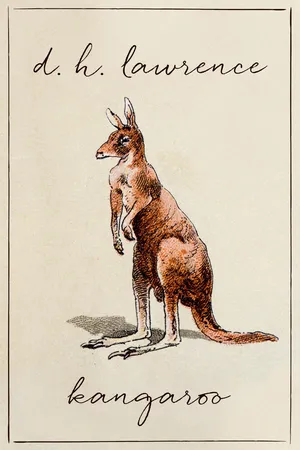
This novel of 1920s Australia by the author of
Lady Chatterley's Lover is "one of the sharpest fictional visions of the country and its people" (Gideon Haigh).
A few years after the close of World War I, English author Richard Lovat Somers and his German wife, Harriet, have fled the grim remains of Europe and ventured to Australia. But they soon discover the new world is an escape from neither the demands of politics nor the nightmarish memories of Richard's service on the front lines.
In Sydney, Richard meets Benjamin Cooley, a charismatic lawyer known to all as Kangaroo. But Kangaroo is also the leader of an underground fascist organization. While Richard finds himself drawn to the man's strength and certainty of purpose, he is simultaneously repelled by his embrace of dehumanizing violence.
In this semi-autobiographical novel, author D. H. Lawrence plumbs the depths of his own experience in the Great War while exploring in vivid detail the breathtaking landscape and social volatility of Australia.
eBook - ePub
Kangaroo
About this book
Trusted by 375,005 students
Access to over 1.5 million titles for a fair monthly price.
Study more efficiently using our study tools.
Information
Subtopic
ClassicsIndex
LiteratureChapter 1
Torestin
A bunch of workmen were lying on the grass of the park beside Macquarie Street, in the dinner hour. It was winter, the end of May, but the sun was warm, and they lay there in shirt-sleeves, talking. Some were eating food from paper packages. They were a mixed lot—taxi-drivers, a group of builders who were putting a new inside into one of the big houses opposite, and then two men in blue overalls, some sort of mechanics. Squatting and lying on the grassy bank beside the broad tarred road where taxis and hansom cabs passed continually, they had that air of owning the city which belongs to a good Australian.
Sometimes, from the distance behind them, came the faintest squeal of singing from out of the “fortified” Conservatorium of Music. Perhaps it was one of these faintly wafted squeals that made a blue-overalled fellow look round, lifting his thick eyebrows vacantly. His eyes immediately rested on two figures approaching from the direction of the conservatorium, across the grass-lawn. One was a mature, handsome, fresh-faced woman, who might have been Russian. Her companion was a smallish man, pale-faced, with a dark beard. Both were well-dressed, and quiet, with that quiet self-possession which is almost unnatural nowadays. They looked different from other people.
A smile flitted over the face of the man in the overalls—or rather a grin. Seeing the strange, foreign-looking little man with the beard and the absent air of self-possession walking unheeding over the grass, the workman instinctively grinned. A comical-looking bloke! Perhaps a Bolshy.
The foreign-looking little stranger turned his eyes and caught the workman grinning. Half-sheepishly, the mechanic had eased round to nudge his mate to look also at the comical-looking bloke. And the bloke caught them both. They wiped the grin off their faces. Because the little bloke looked at them quite straight, so observant, and so indifferent. He saw that the mechanic had a fine face, and pleasant eyes, and that the grin was hardly more than a city habit. The man in the blue overalls looked into the distance, recovering his dignity after the encounter.
So the pair of strangers passed on, across the wide asphalt road to one of the tall houses opposite. The workman looked at the house into which they had entered.
“What d’you make of them, Dug?” asked the one in the overalls.
“Dunnow! Fritzies, most likely.”
“They were talking English.”
“Would be, naturally—what yer expect?”
“I don’t think they were German.”
“Don’t yer, Jack? Mebbe they weren’t then.”
Dug was absolutely unconcerned. But Jack was piqued by the funny little bloke.
Unconsciously he watched the house across the road. It was a more-or-less expensive boarding-house. There appeared the foreign little bloke dumping down a gladstone bag at the top of the steps that led from the porch to the street, and the woman, the wife apparently, was coming out and dumping down a black hat-box. Then the man made another excursion into the house, and came out with another bag, which he likewise dumped down at the top of the steps. Then he had a few words with the wife, and scanned the street.
“Wants a taxi,” said Jack to himself.
There were two taxis standing by the kerb near the open grassy slope of the park, opposite the tall brown houses. The foreign-looking bloke came down the steps and across the wide asphalt road to them. He looked into one, and then into the other. Both were empty. The drivers were lying on the grass smoking an after-luncheon cigar.
“Bloke wants a taxi,” said Jack.
“Could ha’ told YOU that,” said the nearest driver. But nobody moved.
The stranger stood on the pavement beside the big, cream-coloured taxi, and looked across at the group of men on the grass. He did not want to address them.
“Want a taxi?” called Jack.
“Yes. Where are the drivers?” replied the stranger, in unmistakable English: English of the old country.
“Where d’you want to go?” called the driver of the cream-coloured taxi, without rising from the grass.
“Murdoch Street.”
“Murdoch Street? What number?”
“Fifty-one.”
“Neighbour of yours, Jack,” said Dug, turning to his mate.
“Taking it furnished, four guineas a week,” said Jack in a tone of information.
“All right,” said the driver of the cream-coloured taxi, rising at last from the grass. “I’ll take you.”
“Go across to 120 first,” said the little bloke, pointing to the house.
“There’s my wife and the bags. But look!” he added quickly. “You’re not going to charge me a shilling each for the bags.”
“What bags? Where are they?”
“There at the top of the steps.”
“All right, I’ll pull across and look at ’em.”
The bloke walked across, and the taxi at length curved round after him.
The stranger had carried his bags to the foot of the steps: two ordinary-sized gladstones, and one smallish square hat-box. There they stood against the wall. The taxi-driver poked out his head to look at them. He surveyed them steadily. The stranger stood at bay.
“Shilling apiece, them bags,” said the driver laconically.
“Oh no. The tariff is three-pence,” cried the stranger.
“Shilling apiece, them bags,” repeated the driver. He was one of the proletariat that has learnt the uselessness of argument.
“That’s not just, the tariff is threepence.”
“All right, if you don’t want to pay the fare, don’t engage the car, that’s all. Them bags is a shilling apiece.”
“Very well, I don’t want to pay so much.”
“Oh, all right. If you don’t, you won’t. But they’ll cost you a shilling apiece on a taxi, an’ there you are.”
“Then I don’t want a taxi.”
“Then why don’t you say so. There’s no harm done. I don’t want to charge you for pulling across here to look at the bags. If you don’t want a taxi, you don’t. I suppose you know your own mind.”
Thus saying he pushed off the brakes and the taxi slowly curved round on the road to resume its previous stand.
The strange little bloke and his wife stood at the foot of the steps beside the bags, looking angry. And then a hansom-cab came clock-clocking slowly along the road, also going to draw up for the dinner hour at the quiet place opposite. But the driver spied the angry couple.
“Want a cab, sir?”
“Yes, but I don’t think you can get the bags on.”
“How many bags?”
“Three. These three,” and he kicked them with his toe, angrily.
The hansom-driver looked down from his Olympus. He was very red-faced, and a little bit humble.
“Them three? Oh yes! Easy! Easy! Get ’em on easy. Get them on easy, no trouble at all.” And he clambered down from his perch, and resolved into a little red-faced man, rather beery and henpecked-looking. He stood gazing at the bags. On one was printed the name: “R.L. Somers.”
“R.L. SOMERS! All right, you get in, sir and madam. You get in. Where d’you want to go? Station?”
“No. Fifty-one Murdoch Street.”
“All right, all right, I’ll take you. Fairish long way, but we’ll be there under an hour.”
Mr. Somers and his wife got into the cab. The cabby left the doors flung wide open, and piled the three bags there like a tower in front of his two fares. The hat-box was on top, almost touching the brown hairs of the horse’s rail, and perching gingerly.
“If you’ll keep a hand on that, now, to steady it,” said the cabby.
“All right,” said Somers.
The man climbed to his perch, and the hansom and the extraneous tower began to joggle away into the town. The group of workmen were still lying on the grass. But Somers did not care about them. He was safely jogging with his detested baggage to his destination.
“Aren’t they VILE!” said Harriet, his wife.
“It’s God’s Own Country, as they always tell you,” said Somers. “The hansom-man was quite nice.”
“But the taxi-drivers! And the man charged you eight shillings on Saturday for what would be two shillings in London!”
“He rooked me. But there you are, in a free country, it’s the man who makes you pay who is free—free to charge you what he likes, and you’re forced to pay it. That’s what freedom amounts to. They’re free to charge, and you are forced to pay.”
In which state of mind they jogged through the city, catching a glimpse from the top of a hill of the famous harbour spreading out with its many arms and legs. Or at least they saw one bay with warships and steamers lying between the houses and the wooded, bank-like shores, and they saw the centre of the harbour, and the opposite squat cliffs—the whole low wooded table-land reddened with suburbs and interrupted by the pale spaces of the many-lobed harbour. The sky had gone grey, and the low table-land into which the harbour intrudes squatted dark-looking and monotonous and sad, as if lost on the face of the earth: the same Australian atmosphere, even here within the area of huge, restless, modern Sydney, whose million inhabitants seem to slip like fishes from one side of the harbour to another.
Murdoch Street was an old sort of suburb, little squat bungalows with corrugated iron roofs, painted red. Each little bungalow was set in its own hand-breadth of ground, surrounded by a little wooden palisade fence. And there went the long street, like a child’s drawing, the little square bungalows dot-dot-dot, close together and yet apart, like modern democracy, each one fenced round with a square rail fence. The street was wide, and strips of worn grass took the place of kerb-stones. The stretch of macadam in the middle seemed as forsaken as a desert, as the hansom clock-clocked along it.
Fifty-one had its name painted by the door. Somers had been watching these names. He had passed “Elite” and “Tres Bon” and “The Angels’ Roost’ and “The Better ‘Ole’”. He rather hoped for one of the Australian names, Wallamby or Wagga-Wagga. When he had looked at the house and agreed to take it for three months, it had been dusk, and he had not noticed the name. He hoped it would not be U-An-Me, or even Stella Maris.
“Forestin,” he said, reading the flourishing T as an F. “What language do you imagine that is?”
“It’s T, not F,” said Harriet.
“Torestin,” he said, pronouncing it like Russian. “Must be a native word.” “No,” said Harriet. “It means ‘To rest in’.” She didn’t even laugh at him.
He became painfully silent.
Harriet didn’t mind very much. They had been on the move for four months, and she felt if she could but come to anchor somewhere in a corner of her own, she wouldn’t much care where it was, or whether it was called Torestin or Angels Roost or even Tres Bon.
It was, thank heaven, quite a clean little bungalow, with just commonplace furniture, nothing very preposterous. Before Harriet had even taken her hat off she removed four pictures from the wall, and the red plush tablecloth from the table. Somers had disconsolately opened the bags, so she fished out an Indian sarong of purplish shot colour, to try how it would look across the table. But the walls were red, of an awful deep bluey red, that looks so fearful with dark-oak fittings and furniture: or dark-stained jarrah, which amounts to the same thing; and Somers snapped, looking at the purple sarong—a lovely thing in itself:
“Not with red walls.”
“No, I suppose not,” said Harriet, disappointed. “We can easily colour-wash them white—or cream.”
“What, start colour-washing walls?”
“It would only take half a day.”
“That’s what we come to a new land for—to God’s Own Country—to start colour-washing walls in a beastly little suburban bungalow? That we’ve hired for three months and mayn’t live in three weeks!”
“Why not? You must have walls.”
“I suppose you must,” he said, going away to inspect the two little bedrooms, and the kitchen, and the outside. There was a scrap of garden at the back, with a path down the middle, and a fine Australian tree at the end, a tree with pale bark and no leaves, but big tufts of red, spikey flowers. He looked at the flowers in wonder. They were apparently some sort of bean flower, in sharp tufts, like great red spikes of stiff wisteria, curving upwards, not dangling. They looked handsome against the blue sky: but again, extraneous. More like scarlet cockatoos perched in the bare tree, than natural growing flowers. Queer burning red, and hard red flowers! They call it coral tree.
There was a little round summer-house also, with a flat roof and steps going up. Somers mounted, and found that from the lead-covered roof of the little round place he could look down the middle harbour, and even see the low gateway, the low headlands with the lighthouse, opening to the full Pacific. There was the way out to the open Pacific, the white surf breaking. A tramp steamer was just coming in, under her shaft of black smoke.
But near at hand nothing but bungalows—street after street. This was one of the old-fashioned bits of Sydney. A little further off the streets of proper brick houses clustered. But here on this hill the original streets of bungalow places remained almost untouched, still hinting at the temporary shacks run up in the wilderness.
Somers felt a little uneasy because he could look down into the whole range of his neighbours’ gardens and back premises. He tried not to look at them. But Harriet had come climbing after him to survey the world, and she began:
“Isn’t it lovely up here! Do you see the harbour?—and the way we came in! Look, look, I remember looking out of the porthole and seeing that lighthouse, just as we came in—and those little brown cliffs. Oh, but it’s a wonderful harbour. What it must have been when it was first discovered. And now all these little dog-kennelly houses, and everything. But this next garden is lovely; have you seen the—what are they, the lovely flowers?” “Dahlias.”
“But did ever you see such dahlias! Are you sure they’re dahlias? They’re like pink chrysanthemums—and like roses—oh, lovely! But all these little dog-kennels—awful piggling suburban place—and sort of lousy. Is this all men can do with a new country? Look at those tin cans!”
“What do you expect them to do. Rome was not built in a day.”
“Oh, but they might make it nice. Look at all the little backs: like chicken houses with chicken runs. They call this making a new country, do they?” “Well, how would you start making a new country yourself?” asked Somers, a little impatiently.
“I wouldn’t have towns—and corrugated iron—and millions of little fences—and empty tins.”
“No, you’d have old chateaus and Tudor manors.”
They went down, hearing a banging at t...
Table of contents
- Cover
- Title
- Chapter 1: Torestin
- Chapter 2: Neighbours
- Chapter 3: Larboard Watch Ahoy!
- Chapter 4: Jack and Jaz
- Chapter 5: Coo-Ee
- Chapter 6: Kangaroo
- Chapter 7: The Battle of Tongues
- Chapter 8: Volcanic Evidence
- Chapter 9: Harriet and Lovat at Sea in Marriage
- Chapter 10: Diggers
- Chapter 11: Willie Struthers and Kangaroo
- Chapter 12: The Nightmare
- Chapter 13: “Revenge!” Timotheus Cries
- Chapter 14: Bits
- Chapter 15: Jack Slaps Back
- Chapter 16: A Row in Town
- Chapter 17: Kangaroo Is Killed
- Chapter 18: Adieu Australia
- About the Author
- Copyright
Frequently asked questions
Yes, you can cancel anytime from the Subscription tab in your account settings on the Perlego website. Your subscription will stay active until the end of your current billing period. Learn how to cancel your subscription
No, books cannot be downloaded as external files, such as PDFs, for use outside of Perlego. However, you can download books within the Perlego app for offline reading on mobile or tablet. Learn how to download books offline
Perlego offers two plans: Essential and Complete
- Essential is ideal for learners and professionals who enjoy exploring a wide range of subjects. Access the Essential Library with 800,000+ trusted titles and best-sellers across business, personal growth, and the humanities. Includes unlimited reading time and Standard Read Aloud voice.
- Complete: Perfect for advanced learners and researchers needing full, unrestricted access. Unlock 1.5M+ books across hundreds of subjects, including academic and specialized titles. The Complete Plan also includes advanced features like Premium Read Aloud and Research Assistant.
We are an online textbook subscription service, where you can get access to an entire online library for less than the price of a single book per month. With over 1.5 million books across 990+ topics, we’ve got you covered! Learn about our mission
Look out for the read-aloud symbol on your next book to see if you can listen to it. The read-aloud tool reads text aloud for you, highlighting the text as it is being read. You can pause it, speed it up and slow it down. Learn more about Read Aloud
Yes! You can use the Perlego app on both iOS and Android devices to read anytime, anywhere — even offline. Perfect for commutes or when you’re on the go.
Please note we cannot support devices running on iOS 13 and Android 7 or earlier. Learn more about using the app
Please note we cannot support devices running on iOS 13 and Android 7 or earlier. Learn more about using the app
Yes, you can access Kangaroo by D. H. Lawrence in PDF and/or ePUB format, as well as other popular books in Literature & Classics. We have over 1.5 million books available in our catalogue for you to explore.