- 128 pages
- English
- ePUB (mobile friendly)
- Available on iOS & Android
eBook - ePub
The 2nd SS Panzer Division Das Reich
About this book
"Certainly my first recourse from now on when looking at the SS panzer divisions. Give yourself a treat and buy a copy ASAP if tanks are your thing" (Army Rumour Service).
The Das Reich Division was the most infamous unit of the Waffen-SS. Originally a paramilitary formation raised to protect the members of the Nazi Party, it was founded in 1934 as the SS-Verfügungstruppe. During the invasion of Poland, the unit fought as a mobile infantry regiment. After the Battle of France, the SS-VT was officially renamed the Waffen-SS, and in 1941, the Verfügungs-Division was renamed Reich, later Das Reich.
By the time Das Reich took part in the battle of Moscow, it had lost sixty percent of its combat strength. It was pulled off the front in mid-1942 and sent to refit as a panzer-grenadier division. Returning to the Eastern Front, Das Reich took part in the fighting around Kharkov and Kursk. Late in the year, it was designated a panzer division.
In 1944, the unit was stationed in southern France when the Allies landed in Normandy. The following days saw the division commit atrocities, hanging one hundred local men in the town of Tulles in reprisal for German losses, and massacring 642 French civilians in Oradour-sur-Glane, allegedly in retaliation for partisan activity in the area. Later in the Normandy fighting, Das Reich was encircled in the Roncey pocket by US 2nd Armored Division, losing most of their armored equipment. Das Reich surrendered in May 1945.
"Another fascinating piece of military history from the opposite point of view . . . this doesn't purport to be an illustrated history of the Reich, but it damn well is!" — Books Monthly
The Das Reich Division was the most infamous unit of the Waffen-SS. Originally a paramilitary formation raised to protect the members of the Nazi Party, it was founded in 1934 as the SS-Verfügungstruppe. During the invasion of Poland, the unit fought as a mobile infantry regiment. After the Battle of France, the SS-VT was officially renamed the Waffen-SS, and in 1941, the Verfügungs-Division was renamed Reich, later Das Reich.
By the time Das Reich took part in the battle of Moscow, it had lost sixty percent of its combat strength. It was pulled off the front in mid-1942 and sent to refit as a panzer-grenadier division. Returning to the Eastern Front, Das Reich took part in the fighting around Kharkov and Kursk. Late in the year, it was designated a panzer division.
In 1944, the unit was stationed in southern France when the Allies landed in Normandy. The following days saw the division commit atrocities, hanging one hundred local men in the town of Tulles in reprisal for German losses, and massacring 642 French civilians in Oradour-sur-Glane, allegedly in retaliation for partisan activity in the area. Later in the Normandy fighting, Das Reich was encircled in the Roncey pocket by US 2nd Armored Division, losing most of their armored equipment. Das Reich surrendered in May 1945.
"Another fascinating piece of military history from the opposite point of view . . . this doesn't purport to be an illustrated history of the Reich, but it damn well is!" — Books Monthly
Tools to learn more effectively

Saving Books

Keyword Search

Annotating Text

Listen to it instead
Information

An SS Reich Division vehicle crosses the Desna on a bridge built by Pioneer Battalion 48. Note that the vehicle has a large G painted on it, which stands for Panzer Group Guderian. Also visible is the divisional insignia, and that of the reconnaissance battalion. (BA, Bild 101III-Zschaeckel-150-26)
Operation Barbarossa and its Aftermath
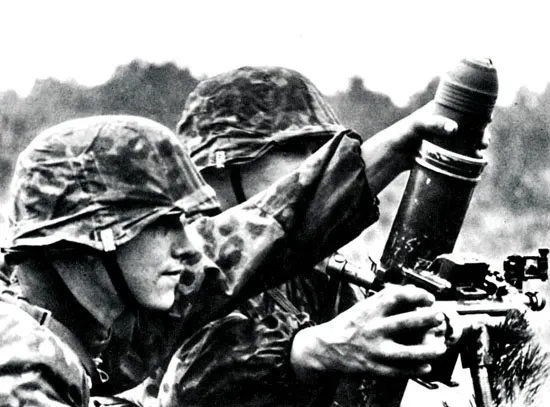
Stormtroopers of the Waffen-SS prepare to fire a mortar. Though it is not immediately evident from this photograph, these men belong to the SS Wiking Division. (Rights reserved)
SS-Wiking
Before and at the start of World War II, the German Army was wary of competition with the Waffen-SS, and compelled Hitler to restrict its recruitment. Thus the first SS divisions were drawn from Hitler’s own bodyguard (Leibstandarte), Nazi Party volunteers (Das Reich), the concentration camp system (Totenkopf), and the SS-controlled police (Polizei).
After the French campaign the SS discovered a new source of manpower in ethnic Germans abroad (not subject to Army recruitment) and foreigners who shared Nazi ideals. Thus the 5th SS Division, Wiking, was born constructed around Das Reich’s Germania Regiment and filled out with Dutch, Flemish, Danish, and Scandinavian volunteers. Wiking’s initial commander was Felix Steiner, former head of the V Division’s Deutschland Regiment.
The superb performance of SS-Wiking in Russia opened the floodgates to further units of this type, drawing on foreign nationals, until in Paul Hausser’s view, the Waffen-SS became Europe’s “first international army.”
When Operation Barbarossa—the Nazi invasion of the USSR—began on June 22nd, 1941, the Waffen-SS comprised three complete divisions, a little over 60,000 men. By 1945, when the Soviets overwhelmed the last German defenses in Berlin, the Waffen-SS had become a veritable army within an army, with 38 divisions and a million troops: it was on the Eastern Front that it saw this enormous growth. It was also here that the Reich Division was transformed into a powerful armored division, the 2nd SS Panzer Division, Das Reich.
In May 1941, the SS Reich Division found itself in Austria. No one really knew what the future held when superior officers were summoned to a conference at Gmunden am Traunsee in Upper Austria where they learned that Germany was going to attack Russia. One officer present at the meeting recalled the event: “There was no enthusiastic cry of ‘Sieg Heil’ when it was announced, because everyone felt so worried at the idea of invading a country of such size.”
The men and the subordinate officers were not told what was happening; when the division left for Poland, the rumor was that they were crossing the USSR to attack British India from the north.
The SS Reich Division was put under command of the XXIV Army Corps, part of General Heinz Guderian’s 2nd Panzer Group in Army Group Center, attacking across the front above the Pripet marshes in Belarus.
However, on June 22nd, 1941, the SS were not on the front line, nor were they even at the frontier. Rather, they were regulating road traffic between the Vistula and Bug rivers. At the time, the army still did not have confidence in the SS units, and was reluctant to give them a role in front-line action.
When, finally, the Reich Division was authorized to enter the Soviet Union, it found the roads reserved exclusively for the Wehrmacht, leaving the SS grenadiers to march on the verges.
The first objective was not given to the division until June 28th. The bulk of the division was ordered to cross a watercourse while a battle group—made up of the reconnaissance battalion, a motorcycle battalion and some Flak and engineering elements—took the main road to reach the region around Sloutsk, Belarus. Progress was fast, perhaps a little too fast, as the men of the motorcycle battalion soon found themselves surrounded and cut off from the rest of the division. The 3rd Battalion, Deutschland Regiment was called to their aid and intervened with self-propelled guns—75mm Ausf B StuG IIIs—named Yorck, Ziethen, Schill and Lützow. Their first engagement was, to the surprise of their critics, very favorable. Yorck put five Russian tanks out of action, and Schill four, not counting several antitank guns. The motorcycle battalion was relieved, but it had taken the 3rd Battalion to get them out of the mess they had got themselves into.
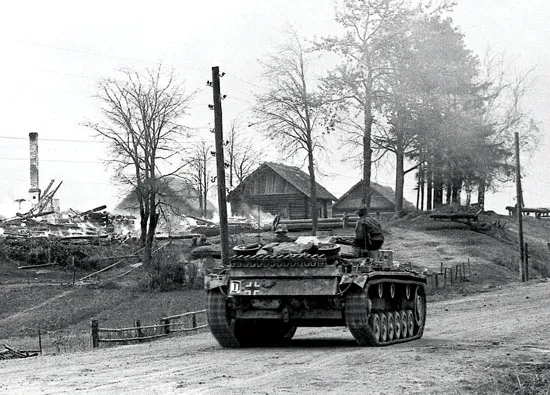
A Sturmgeschütz of the Reich Division on the outskirts of a Russian village in flames. For a long time, eight StuG III Ausf Bs were the only armored vehicles in the division that were capable of taking on Russian tanks. (BA, Bild 101I-596-0395-29, Ohlenbostel)
Heid Rühl, an artilleryman of the SS Reich Division, recalled how the subsequent advance unfolded. The troops reached the city of Minsk and then continued in the direction of Smolensk:
We passed Mogilev, rolling towards our next target, Smolensk. The number 8 battery was a point unit and, on the way, we crossed a German 15cm battery that had been attacked and destroyed, though there was no trace of the enemy. The moon shone and our infantry benefited from it, advancing so quickly that we were soon completely isolated. The first vehicles of the column—the commander’s car, the observation truck, and the vehicle carrying the general staff of the battery—had just passed a small hollow when a single shot fired from an antitank gun destroyed a prize of war that we were very interested in: a trailer containing 5,000 liters of fuel.
We heard terrifying cries of “Hurrah!” from all sides, which unleashed a tempest of small-arms fire … we didn’t need to be told what to do. Like a hedgehog spitting fire, we let off a barrage of shots and threw hand grenades like we were veterans of infantry combat.
They were soon relieved, as the rest of the artillery regiment had seen the gasoline tanker explode and marched immediately towards the fight.
Four Weeks at Yelnia
On July 22nd, the division advanced along the Minsk–Moscow road, but were forced to stop and reduce a Russian position established on a ridge east of Yelnia. This position was of key strategic importance, as the village was built at a crossroads just 300km from Moscow. Moreover, the high ground near Yelnia provided protection for the southeastern flank of Smolensk, so was a desirable asset for the invaders.
Despite a solid Russian defense and violent artillery fire, the Waffen-SS of the Deutschland Regiment reached the first crest of the first hill, the Der Führer Regiment following a little afterwards. However, this success did not come without loss. The next day, at 0600hrs, the Russians launched a counterattack. The fighting lasted the whole morning, but at 1200hrs, the Red Army was forced back to its start line. The Reich Division then received an order to go over to the defensive. Heid Rühl wrote:
The Russians around Yelnia attacked with tanks and penetrated as far as our artillery positions. One of our stretcher-bearers was awarded an Iron Cross for destroying a Russian tank by throwing a grenade through its hatch. Done! The gunners finished by repelling the first armored attack, but it was renewed with more force and our motorcycle battalion was soon in trouble. We were subjected to rolling fire from artillery like we had never known before. The courage of our soldiers and the way they fought was made clear by the actions of the
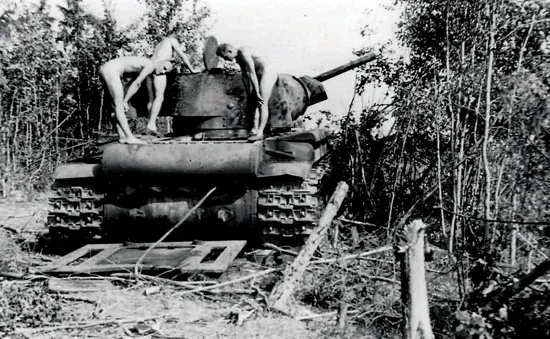
A very strange scene: three naked Waffen-SS stormtroopers inspecting a destroyed Russian KV-1. (Rights reserved)
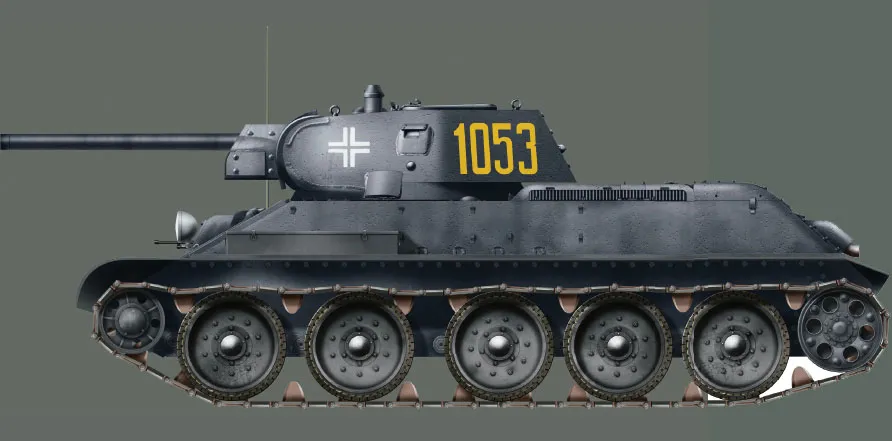
A Pz Kpfw T-34 747(r)-mod. 41 in SS Panzergrenadier Das Reich colours. The losses at Kharkov and Kursk were so heavy that numerous captured T-34s were put into service by the Germans.

A Pz Kpfw T-34 KN 747(r). In a need for haste, this 1943 T-34 was not repainted. The Balkenkreuz has been added by hand, as has the Das Reich divisional insignia.
In Profile:
Panzergrenadier Division Das Reich, Captured Vehicles
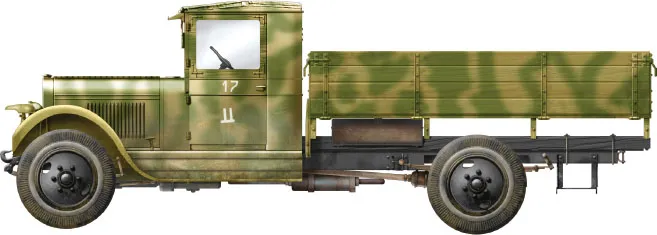
A Zis-5 Russian truck. These were built in Moscow from 1933, but their manufacture moved to the Ural Mountains due to the German advance on the capital. More than 83,000 trucks of this type were built during the war, out of a total of 325,000.
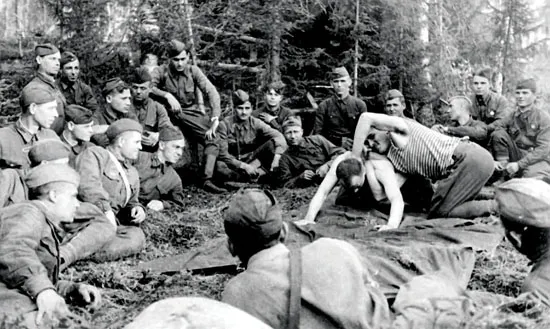
Russian soldiers let off steam with a wrestling match during a brief period of calm. (Rights reserved)
Kampfgruppe Förster, of the motorcycle battalion, who fought to the last man to stop the Soviets from getting through. With the help of the motorcyclists, we contained the enemy, but not for long as we started running out ...
Table of contents
- Cover
- Title
- Copyright
- Contents
- Timeline of Events
- The Creation of the Division and its Baptism by Fire
- The Campaigns in France and the Balkans
- Operation Barbarossa and its Aftermath
- The 1943 Russian Campaign: Kharkov, Kursk, Back to Kiev
- Normandy and the Ardennes, Endgame in Hungary
- Afterword
- Further Reading
Frequently asked questions
Yes, you can cancel anytime from the Subscription tab in your account settings on the Perlego website. Your subscription will stay active until the end of your current billing period. Learn how to cancel your subscription
No, books cannot be downloaded as external files, such as PDFs, for use outside of Perlego. However, you can download books within the Perlego app for offline reading on mobile or tablet. Learn how to download books offline
Perlego offers two plans: Essential and Complete
- Essential is ideal for learners and professionals who enjoy exploring a wide range of subjects. Access the Essential Library with 800,000+ trusted titles and best-sellers across business, personal growth, and the humanities. Includes unlimited reading time and Standard Read Aloud voice.
- Complete: Perfect for advanced learners and researchers needing full, unrestricted access. Unlock 1.4M+ books across hundreds of subjects, including academic and specialized titles. The Complete Plan also includes advanced features like Premium Read Aloud and Research Assistant.
We are an online textbook subscription service, where you can get access to an entire online library for less than the price of a single book per month. With over 1 million books across 990+ topics, we’ve got you covered! Learn about our mission
Look out for the read-aloud symbol on your next book to see if you can listen to it. The read-aloud tool reads text aloud for you, highlighting the text as it is being read. You can pause it, speed it up and slow it down. Learn more about Read Aloud
Yes! You can use the Perlego app on both iOS and Android devices to read anytime, anywhere — even offline. Perfect for commutes or when you’re on the go.
Please note we cannot support devices running on iOS 13 and Android 7 or earlier. Learn more about using the app
Please note we cannot support devices running on iOS 13 and Android 7 or earlier. Learn more about using the app
Yes, you can access The 2nd SS Panzer Division Das Reich by Yves Buffetaut in PDF and/or ePUB format, as well as other popular books in History & German History. We have over one million books available in our catalogue for you to explore.