- 288 pages
- English
- ePUB (mobile friendly)
- Available on iOS & Android
eBook - ePub
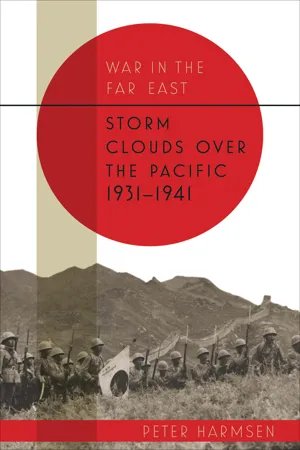
Storm Clouds over the Pacific, 1931–1941
About this book
"An excellent primer about World War II in Asia prior to the involvement of the United States"—part one of a fascinating history trilogy (
New York Journal of Books).
War in the Far East is a trilogy of books offering the most complete narrative yet written about the Pacific Theater of World War II, and the first truly international treatment of the epic conflict. Historian Peter Harmsen weaves together a complex and revealing narrative, including facets of the war that are often overlooked in historic narratives. He explores the war in subarctic conditions on the Aleutians; details the mass starvations in China, Indochina, and India; and offers a range of perspectives on the war experience, from the Oval Office to the blistering sands of Peleliu.
Storm Clouds Over the Pacific begins the story long before Pearl Harbor, showing how the war can only be understood if ancient hatreds and long-standing geopolitics are taken into account. Harmsen demonstrates how Japan and China's ancient enmity led to increased tensions in the 1930s, which, in turn, exploded into conflict in 1937.
The battles of Shanghai and Nanjing were followed by the Battle of Taierzhuang in 1938, China's only major victory. A war of attrition continued up to 1941, the year when Japan made the momentous decision to pursue all-out war. The infamous attack on Pearl Harbor catapulted the United States into the war, as the Japanese also overran British and Dutch territories throughout the western Pacific.
War in the Far East is a trilogy of books offering the most complete narrative yet written about the Pacific Theater of World War II, and the first truly international treatment of the epic conflict. Historian Peter Harmsen weaves together a complex and revealing narrative, including facets of the war that are often overlooked in historic narratives. He explores the war in subarctic conditions on the Aleutians; details the mass starvations in China, Indochina, and India; and offers a range of perspectives on the war experience, from the Oval Office to the blistering sands of Peleliu.
Storm Clouds Over the Pacific begins the story long before Pearl Harbor, showing how the war can only be understood if ancient hatreds and long-standing geopolitics are taken into account. Harmsen demonstrates how Japan and China's ancient enmity led to increased tensions in the 1930s, which, in turn, exploded into conflict in 1937.
The battles of Shanghai and Nanjing were followed by the Battle of Taierzhuang in 1938, China's only major victory. A war of attrition continued up to 1941, the year when Japan made the momentous decision to pursue all-out war. The infamous attack on Pearl Harbor catapulted the United States into the war, as the Japanese also overran British and Dutch territories throughout the western Pacific.
Trusted by 375,005 students
Access to over 1 million titles for a fair monthly price.
Study more efficiently using our study tools.
Information
CHAPTER ONE
Ancient Foes
China, Japan, and Asia until 1931
In August AD 663, two large navies clashed on the western side of the Korean Peninsula. The huge wooden ships, some several stories high and brimming with soldiers in heavy armor, met on the lower reaches of the Paekchon River,1 near the spot where it emptied into the Yellow Sea. One fleet had been sent by China’s powerful Tang emperor, while the other fleet was fighting for Japan’s Yamato dynasty. They were supporting rival kingdoms in Korea, and this was their final showdown. As the two floating armies approached each other, catapults sent heavy projectiles whistling through the air, while archers tried to take out individual soldiers on the decks of the opponent’s vessels.
When the distance was short enough, boarding parties climbed onto enemy ships, and the clang of iron against iron filled the air, as if the battle were taking place on land. Soon, the Chinese superiority in ships and men became evident, and the Japanese were surrounded on all sides. The Nihon Shoki, one of Japan’s classical works of history, described the scene: “In a brief space of time, the Japanese imperial force was defeated, and many fell into the water and drowned. The ships were unable to maneuver either astern or ahead. The Japanese general Echi no Takutsu faced heaven and swore in anger and despair. He gnashed his teeth, and in his rage he slew dozens of men. He died fighting.”2
It was a decisive Chinese victory and the earliest Sino-Japanese battle on record, but by the time their fleets fought to the death on that fateful summer day, the two ancient civilizations had already known about each other’s existence for nearly a millennium. There were vague reports, shrouded in mystery and myth, that China’s first emperor, Qin Shihuang, who lived around 200 BC and was thus the contemporary of the Carthaginian general Hannibal, had sent people to the Japanese isles in search of the elixir of youth, and in the year AD 57, the Chinese court had started exchanging emissaries with a kingdom located in what is now Japan.

Asia Pacific
Right from the earliest times, China jealously defended its position as the proud center of the known world, or as its people said, “all under heaven.” Japan sometimes seemed to forget this, signaling that it lacked an understanding of its own position in the hierarchy of states. In the early 7th century, a Japanese prince, acting on behalf of the imperial court, infuriated China by dispatching a message suggesting equivalence between the two civilizations: “The emperor of the land where the sun rises sends a letter to the emperor of the land where the sun sets.”3
The Chinese sense of superiority was not unfounded. All neighboring cultures, including that of Japan, were to a significant extent derivative of China’s. The mere fact that the region’s writing systems were mostly based on the Chinese script was sufficient indication of this massive one-way influence. China impacted its neighbors, not the other way around. In Japan, as elsewhere, China left an indelible mark in areas as diverse as philosophy, poetry, and architecture, as well as in the crucial area of religion. Buddhism, one of the most profound strands in Japanese thinking, was introduced mainly via China and the tireless efforts of missionaries such as the 8th-century Chinese-born monk Jianzhen.4
An era of growing suspicion and hostility between Japan and the Asian mainland began in the 13th century. In the 1280s, the rulers of China’s Yuan dynasty, the descendants of the Mongolian world conqueror Genghis Khan, attempted an invasion of the Japanese islands. This could have spelled the end of Japan as an independent civilization, if it were not for an unforeseen event. A large part of the Chinese-Mongolian fleet was destroyed by a kamikaze, a “divine wind” or, in modern parlance, a powerful typhoon. As a grateful Japanese official wrote a few years later, “a green dragon had raised its head from the waves” and as a result, on the Japanese island of Kyushu, “the coast was piled high with corpses.”5
The humiliating disaster did nothing to diminish China’s arrogance and its sense of entitlement manifested in a tributary system that required the Japanese to send envoys at regular intervals in order to demonstrate submission. In the cases where Japan’s rulers, once again, failed to demonstrate a sufficient degree of deference, the wrath from China’s court was predictable. A letter from the 15th-century emperor Zhu Yuanzhang suggests the general atmosphere of the relationship: “You stupid eastern barbarians! Your king and courtiers are not acting correctly; you have disturbed neighboring countries in all directions.”6
This set the tone for the uneasy relationship between China and Japan in late medieval times. Full-scale war broke out at the end of the 16th century. As had been the case nearly a millennium earlier, Korea formed the battleground. A samurai army landed on the peninsula and was harboring plans to enter China as well. China was huge, and the Japanese commanders asked, not for the last time in history, if they might have set their sights too high. “I wonder,” a Japanese officer wrote in a letter home to his family, “if we will be able to provide enough men to enter and rule that country.”7
Just as the political relationship changed throughout the centuries of conflict and cooperation, the Chinese views of Japan also underwent transformation. In Chinese texts from the first millennium AD, Japan was occasionally described as “a country of gentlemen” and a “society appreciating decorum.”8 An official dynastic history praised the Japanese, saying that “by nature, they are honest. They have a refined manner.”9 Over time, this was to change, and the positive depictions of the Japanese were, in the Chinese mind, to yield to more sinister images.
One much-feared figure did more than any other to transform Chinese perceptions: that of the Japanese pirate. For centuries, seaborne Japanese raiders were a threat to Chinese communities along the coastline, reputed to “arrive like a typhoon and leave like a flash of lightning.”10 The pirates lived by a strict law which required that “they all fought to the death,” a Chinese chronicler notes.11 Their code of conduct also allowed a staggering degree of cruelty. In a particularly notorious episode in the mid-15th century, a gang of Japanese pirates surrounded a village in east China’s Zhejiang province, killing most of the inhabitants and looting their homes before setting them ablaze. A contemporary account explains what happened to some of the survivors: “They guessed the gender of the fetuses of the pregnant women they had captured, then slashed the women’s bellies open to see who was right since they had made bets of wine on the outcome.”12
One source describes an assault by Japanese pirates on northeast China’s Liaodong peninsula in 1419 and their attempt to seize the riches of the city of Wanghaiguo: “The Commissioner-in-Chief, Liu Rong, taking charge in person, sped his crack troops to Wanghaiguo. The pirates, numbering several thousand men, came in twenty ships … and lay siege to city. “Liu sprang the trap, engaged them in battle and deployed troops to block their retreat route … Liu Rong threw in all the forces to attack them. Altogether 742 heads were taken and 857 men were captured.”13
The scourge of the pirates continued for centuries and at times forced the Chinese empire to expend enormous resources as it boosted coastal defenses. The pirates came to include a variety of nationalities and, according to some historians, they may at times have numbered more Chinese than Japanese.14 This did not change the fact that most people in China saw them as originating from the mysterious Japanese archipelago to the east and came to think of the strangers across the ocean as only partly human. “They are as wild as wolf cubs,” a 16th-century Chinese author wrote. “It is their basic nature to hurt others.”15

Technology progressed, cultural habits changed, and dynasties waxed and waned, but the basic pattern of Sino-Japanese interaction remained roughly the same for a millennium and a half. China formed the center of gravity of international politics in East Asia, and Japan mostly accepted this, although intermittently it showed itself in a defiant mode. This pattern might well have continued indefinitely were it not for the arrival of a completely new set of actors on the scene. They were Europeans, and they were the vanguard of a force that would change the world. That force was Western imperialism.
When the Portuguese explorer Francisco Zeimoto set foot on the Japanese island of Kanegashima in the 1540s, he brought with him an invention which captured the local imagination more than any other. It was a firearm capable of plucking birds from the sky with almost supernatural ease. The island’s ruler, who doubtless imagined other uses for this device, was said to show a particular interest and secured a weapon for himself. Soon, the technology was copied throughout the island and elsewhere in Japan and, little more than a decade later, when another Portuguese adventurer passed through the isolated country, he was told that there was now a total of 300,000 muskets in the Japanese islands. “From this alone,” he wrote, “it is easy to understand what kind of people they are and how naturally they take to military exercise, which they enjoy more than any other nation that is known to date.”16
Zeimoto and his shipmates were few in numbers, and with their light skin and their brown and red hair, they were little more than exotic curiosities to the people they encountered. Soon the sailors and merchants of the European powers would be arriving in East Asia in much greater numbers, bringing about the first era of true globalization, with the economies of all continents bound together in a tight network of maritime trade. Both China and Japan were affected, but their vastly different sizes determined the ways in which they reacted.
For a century after the arrival of Zeimoto and his contemporaries, Japan allowed trade not just with the Portuguese, but also with the Dutch and the British and, in addition, it allowed Catholic missionaries to seek converts among the Japanese. It was a spectacular success for Christianity, with half a million baptized souls speaking their own language about spiritual needs being met by the new religion. It was not to last. Fearing the fate of the Philippines, which had recently become a Spanish colony, the Japanese rulers decided to crack down on the foreign faith. In 1597, a total of 26 Roman Catholics, both European missionaries and local converts, were crucified. Over the coming decades, the persecution continued, with unabated ferocity, until Christianity was extinguished or forced entirely underground.
Japan’s political masters went even further in their zeal to protect their civilization and keep it undiluted by alien influences. By the middle of the 1600s, in a dramatic move that is almost unique in the history of mankind, they decided to turn their backs to the world and seal their country off entirely from Europe. For the next two centuries, Japan was inaccessible to virtually all Western powers, allowing only trade with the Dutch, who were permitted to maintain a regular presence on a man-made islet in Nagasaki harbor.
China also saw occasional and sometimes violent outbursts of xenophobia, but it never experienced a sweeping anti-Western revolution of anything resembling the consequence and completeness seen in Japan. China was too vast and too preoccupied with the challenges of governing a continent-sized empire to feel threatened at any existential level by the few European missionaries, advisors, and merchants making it to its shores. Rather, it signaled a sense of complacent indifference to anything the West might have to offer.
This was made abundantly clear in 1793 when Britain sent its first official mission to the imperial court in Beijing, headed by George Macartney, an experienced colonial administrator. Hoping to open China for trade, the British delegation had brought 600 boxes of presents, including elaborate clocks and globes. None of it made any impression on the Chinese emperor, Qianlong. “We have never valued ingenious articles, nor do we have the slightest need of your country’s manufacturers,” he said in a letter addressed to Britain’s King George III. “You, O King, should simply act in conformity with our wishes by strengthening your loyalty and swearing perpetual obedience.”17
Although the letter was sure to cause anger among the confident British, the Chinese emperor did have something of a point. China was at the time probably still the world’s largest economy,18 and while its technologies were beginning to lag seriously behind, the gap remained narrow. Even so, Qianlong’s empire was weaker than he was able to imagine. A disappointed Macartney dismissed China as “an old, crazy first-rate man-of-war,” which, when ruled by incompetent people would “drift for some time as a wreck, and will then be dashed to pieces on the shore.”19 His description was not far off. Qianlong and his officials failed to realize one crucial fact. The kind of Western imperialism they were encountering now was qualitatively different from the imperialism of preceding centuries. It was much more powerful, and much deadlier for those unable to co...
Table of contents
- Cover
- Title
- Copyright
- Contents
- Acknowledgements
- Preface
- 1 Ancient Foes: China, Japan, and Asia until 1931
- 2 The Road to War: Asia, 1931–37
- 3 Blitzkrieg: China, 1937
- 4 Defiance: China, 1938
- 5 Attrition: 1939
- 6 Stalemate: 1940
- 7 A Distant Thunder: Late 1940 until summer of 1941
- 8 Countdown: Summer and fall of 1941
- 9 Total War: December 7–8, 1941
- Endnotes
- Bibliography
- Plate section
Frequently asked questions
Yes, you can cancel anytime from the Subscription tab in your account settings on the Perlego website. Your subscription will stay active until the end of your current billing period. Learn how to cancel your subscription
No, books cannot be downloaded as external files, such as PDFs, for use outside of Perlego. However, you can download books within the Perlego app for offline reading on mobile or tablet. Learn how to download books offline
Perlego offers two plans: Essential and Complete
- Essential is ideal for learners and professionals who enjoy exploring a wide range of subjects. Access the Essential Library with 800,000+ trusted titles and best-sellers across business, personal growth, and the humanities. Includes unlimited reading time and Standard Read Aloud voice.
- Complete: Perfect for advanced learners and researchers needing full, unrestricted access. Unlock 1.4M+ books across hundreds of subjects, including academic and specialized titles. The Complete Plan also includes advanced features like Premium Read Aloud and Research Assistant.
We are an online textbook subscription service, where you can get access to an entire online library for less than the price of a single book per month. With over 1 million books across 990+ topics, we’ve got you covered! Learn about our mission
Look out for the read-aloud symbol on your next book to see if you can listen to it. The read-aloud tool reads text aloud for you, highlighting the text as it is being read. You can pause it, speed it up and slow it down. Learn more about Read Aloud
Yes! You can use the Perlego app on both iOS and Android devices to read anytime, anywhere — even offline. Perfect for commutes or when you’re on the go.
Please note we cannot support devices running on iOS 13 and Android 7 or earlier. Learn more about using the app
Please note we cannot support devices running on iOS 13 and Android 7 or earlier. Learn more about using the app
Yes, you can access Storm Clouds over the Pacific, 1931–1941 by Peter Harmsen in PDF and/or ePUB format, as well as other popular books in History & Asian History. We have over one million books available in our catalogue for you to explore.