- 328 pages
- English
- ePUB (mobile friendly)
- Available on iOS & Android
eBook - ePub
About this book
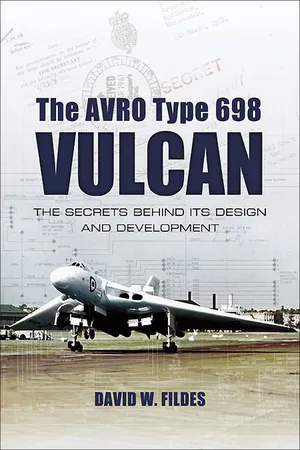
The Avro Vulcan was the last V Bomber to see active service in its primary role during the Falklands conflict. It is the most popular of the three and one aircraft has recently become airborne again after a long period of rejuvenation. It has always been a major attraction at air shows throughout the world, attracting crowds who delight in its unique delta-wing shape and amazing maneuverability.The book examines the origins of the design, the prototypes and experimental aircraft, and goes on to explain the modifications that were made to the last of the breed.A leading member of the Avro Historical Society, the author has discovered many photographs and experimental design plans in their archives which are here published for the first time.
Trusted by 375,005 students
Access to over 1.5 million titles for a fair monthly price.
Study more efficiently using our study tools.
Information
PART ONE
DESIGN AND DEVELOPMENT
About the Company
The Avro Company can trace back its origins to 1908 when Alliott Verdon Roe built his first biplane and later the more famous Triplane; he formed the company A.V. Roe & Co. based at Brownsfield Mill, in Manchester, along with his brother Humphrey. It was registered on New Year’s Day 1910 as an aeroplane manufacturer and became a Limited Company on 11th January 1913.
The Company was to become popularly known as AVRO and in the First World War it produced the Type 504, which was to become the first Avro aircraft to be used on a bombing raid, when three specially converted aircraft famously attacked the Zeppelin sheds at Friedrichshafen on 21st November 1914. Large orders were received for the 504 and this meant finding new premises. These were based at Clifton Street, Manchester and a site acquired from the nearby engineering firm Mather and Platt Limited. Later a design and experimental department was also established at Hamble, Southampton.
Avro also had a facility at Alexandra Park aerodrome in Manchester which they had to vacate. In 1925 the company moved these facilities to New Hall Farm at Woodford, Cheshire, and this meant dismantling one of the hangars at Alexandra Park for relocation to Woodford and which is still there today. These premises were further expanded in the 1930’s and in 1939 a new assembly facility and runway were built.
The new premises at Newton Heath was to remain the head office for more than twenty years, before a government aircraft expansion programme developed in the late 1930’s and the company was charged with setting up a new factory at Chadderton. These premises were to become the headquarters and manufacturing unit and during the Second World War were the heart of Avro’s wartime work.
Avro also operated a large underground factory at Yeadon, Yorkshire and for several years the company’s experimental flight was based at Ringway Airport, Manchester.
As the Avro Lancaster came into service a service repair depot was established at Bracebridge Heath, Lincoln. The repair organisation expanded rapidly and Langar, Nottinghamshire was opened in 1942 to cope with the re-building and assembly of damaged aircraft.
In 1954, a new Weapons Division was formed and based at Woodford, responsible for the design and development of a stand-off bomb, which was to be carried by the Vulcan bomber. The Weapons Division rate of expansion was considerable. During 1956 a new weapons branch was set up at Salisbury, South Australia and technicians from Woodford were transferred to Salisbury.
Later acquisitions included a design group at Harrow and a research and development group at Chertsey, Surrey.

Avro sites associated with the design and manufacture of the Avro Vulcan in the late 1950’s.

Woodford new assembly, pictured in 1945, the building was commissioned in 1939 along with the Chadderton factory as part of a Government aircraft expansion programme.
Avro pioneering achievements
Avro developed a considerable reputation in designing and manufacturing aircraft led by the two “Roy’s”. Roy Dobson joined Avro’s in August 1914 under Roy Chadwick and later became General Manager at Avro. Roy Chadwick who had joined the company in 1911, was to become Chief Designer. Of his notable achievements were the Avro Baby the world’s first true light aeroplane, the Bison, a fleet gunnery spotter; the Tutor, a replacement for the 504, the standard trainer for the Royal Air Force and the majority of the world’s airforces; the record breaking Avian and Cadet, popular light aircraft for club and private flying; and the versatile Anson, used initially for Coastal Reconnaissance, the Anson became the backbone of the Empire Air Training Plan. Later it continued in service in a variety of training roles, on communications and transport.
Roy Chadwick was to gain world wide recognition when he designed the Avro Lancaster Bomber which was a development of the Avro Manchester. The Manchester was Avro’s first all metal aircraft and marked a turning point in Avro design. It also led to a successful lineage of aircraft which was to end with the Avro Shackleton, a Maritime reconnaissance aircraft manufactured throughout the 1950’s. The knowledge gained on the Lancaster was also to find its way into the design of the Vulcan.
The Lancaster Bomber was nearly never built, Roy Dobson received a letter from Air Chief Marshall Sir Wilfrid Freeman dated 29th July 1940, which stated that Avro were to drop plans for the Manchester III (Lancaster) as they were to build the Handley Page Halifax, it was only with the intervention of Roy Dobson and Roy Chadwick, who less than a day later went to the Ministry of Aircraft Production and successfully put their case forward for production of the Manchester III, which eventually became the Lancaster. This rivalry was to continue between Handley Page and Avro, and even extended to Vulcan and Handley Page Victor aircraft.

Roy Chadwick (left) and Roy Dobson discuss the merits of the Avro York transport aircraft, a derivative of the Avro Lancaster design.

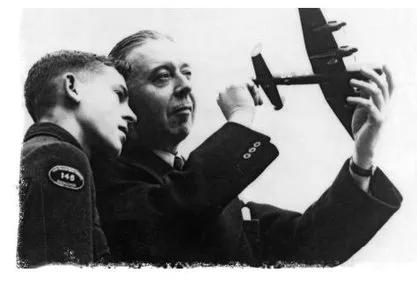
Roy Chadwick pictured with a model of his most famous design, the Avro Lancaster. Above is a picture of the Avro Lincoln prototype bomber at Ringway, Avro’s Experimental Department which was only a few miles from Woodford. The Lincoln’s Lancaster linage can clearly be seen in this photograph. The Lincoln was replaced by the “V” bombers when the latter entered service in the mid 1950’s.

Avro first venture into designing an all jet aircraft was the Tudor 8 pictured here on the 6th September, 1948.
Delta pioneers
Dr Alexander Lippisch
It is generally acknowledged that Dr Alexandra Lippisch made important contributions to the understanding of delta and flying wings. Lippisch’s most famous design being the Messerschmitt Me163 rocket-powered interceptor. His first tailless glider flew in 1927. Experience on a series of Storch tailless gliders led Lippisch to concentrate increasingly on delta-winged designs. This interest resulted in five aircraft, numbered Delta I - Delta V, which were built between 1931 and 1939. In 1933, the reorganised Deutsche Forschungsanstalt fur Segelflug (DFS - “German Institute for Sailplane Flight”) led to the Delta IV and Delta V being designated as the DFS 39 and DFS 40 respectively.
Wind tunnel research in 1939 had suggested that the delta wing was a good choice for supersonic flight, and Lippisch set to work designing a supersonic, ramjet-powered fighter, the Lippisch P.13a, however, the project had only advanced as far as a development glider, the DM-1 when World War Two ended. After the War Lippisch left Germany to continue his research in the U.S.A.
Early tailless design research
When the first tender brochure was produced by Avro for the Type 698 it was a delta aircraft of tailless design. Sir W. G. Armstrong Whitworth Aircraft Ltd which was part of the Hawker Siddeley Group of company’s was involved in laminar flow wing, boundary layer suction and general drag reduction research. This led to them designing a tailless flying wing aircraft as far back as early 1942. In March 1945, the AW 52g glider was flown in this configuration. A larger jet powered version of the flying wing shown below first flew on 13th November 1947, designed by John Lloyd, the AW 52 started life in 1944 under specification E.9/44, as a proposed flying wing bomber/airliner with a span of 120ft, and the aircraft was to prove u...
Table of contents
- David W. Fildes
- Title Page
- Copyright Page
- Foreword
- Acknowledgements
- Dedication
- Bibliography
- Table of Contents
- Introduction
- PART ONE - DESIGN AND DEVELOPMENT
- PART TWO - CONCEPT TO REALITY
- PART THREE - PROGRESS THROUGH DEVELOPMENT
- PART FOUR - INTO SERVICE B.Mk1/Mk.1A
- PART FIVE - B.Mk2 DEVELOPMENT
- PART SIX - CONCEPTUAL PROJECTS
- PART EIGHT - FINAL CHAPTER
- PART NINE - SPECIFICATIONS B.Mk2
- Abbreviations
Frequently asked questions
Yes, you can cancel anytime from the Subscription tab in your account settings on the Perlego website. Your subscription will stay active until the end of your current billing period. Learn how to cancel your subscription
No, books cannot be downloaded as external files, such as PDFs, for use outside of Perlego. However, you can download books within the Perlego app for offline reading on mobile or tablet. Learn how to download books offline
Perlego offers two plans: Essential and Complete
- Essential is ideal for learners and professionals who enjoy exploring a wide range of subjects. Access the Essential Library with 800,000+ trusted titles and best-sellers across business, personal growth, and the humanities. Includes unlimited reading time and Standard Read Aloud voice.
- Complete: Perfect for advanced learners and researchers needing full, unrestricted access. Unlock 1.5M+ books across hundreds of subjects, including academic and specialized titles. The Complete Plan also includes advanced features like Premium Read Aloud and Research Assistant.
We are an online textbook subscription service, where you can get access to an entire online library for less than the price of a single book per month. With over 1.5 million books across 990+ topics, we’ve got you covered! Learn about our mission
Look out for the read-aloud symbol on your next book to see if you can listen to it. The read-aloud tool reads text aloud for you, highlighting the text as it is being read. You can pause it, speed it up and slow it down. Learn more about Read Aloud
Yes! You can use the Perlego app on both iOS and Android devices to read anytime, anywhere — even offline. Perfect for commutes or when you’re on the go.
Please note we cannot support devices running on iOS 13 and Android 7 or earlier. Learn more about using the app
Please note we cannot support devices running on iOS 13 and Android 7 or earlier. Learn more about using the app
Yes, you can access The Avro Type 698 Vulcan by David W. Fildes in PDF and/or ePUB format, as well as other popular books in History & Military & Maritime History. We have over 1.5 million books available in our catalogue for you to explore.