The author of
Javelin from the Cockpit looks at some of the more notable British, German, and American fighters through performance and handling trials.
During the years preceding and during WW2, the RAF and the Royal Aircraft Establishment were responsible for the selection and procurement of British military aircraft and also to evaluate their capabilities against captured enemy models whenever possible. During the lend-lease agreement with the USA, the RAF and Fleet Air Arm operated several American designs, each of which was tested to evaluate its potential.
This book looks at the key area of fighter aircraft and includes the test results and pilot's own first-hand accounts of flying seventeen different models, designed in the UK, America and Germany. The reader will learn of the possibilities of air superiority offered by these types and also their weaknesses. Types included are The Hawker Hurricane, Supermarine Spitfire, Boulton Paul Defiant, Hawker Tempest and Typhoon, Bell Airacobra, Messerschmitt Bf 109, Focke-Wulf Fw 190, Brewster Buffalo, Curtiss Tomahawk, North American Mustang, Grumman Martlet, Republic Thunderbolt, and Vought Corsair. All aircraft that saw a great deal of action throughout the War and which are now part of legend.
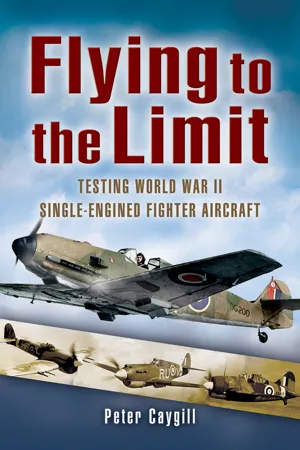
- 224 pages
- English
- ePUB (mobile friendly)
- Available on iOS & Android
eBook - ePub
About this book
Trusted by 375,005 students
Access to over 1.5 million titles for a fair monthly price.
Study more efficiently using our study tools.
Information
PART ONE
British Fighters
CHAPTER ONE
Hawker Hurricane
On 6 November 1935 the prototype Hawker F.36/34 (soon to be named Hurricane) was taken into the air for the first time by Group Captain P.W.S. ‘George’ Bulman, Hawker’s chief test pilot. The type was to form the backbone of Fighter Command during the Battle of Britain, a conflict in which it destroyed more enemy aircraft than all other forms of defence put together. It was to go on to serve with distinction in many other theatres of war and the last Hurricane (PZ865) was delivered in September 1944.
Unlike the more radical Spitfire, the design of the Hurricane was closely related to its immediate forebears and it was initially known as the ‘Fury Monoplane’. It was to have been powered by a steam-cooled Rolls-Royce Goshawk, the favoured engine at the time of its inception, but development problems led to the adoption of the new Rolls-Royce PV.12, which later became the Merlin. Initially a fixed, spatted undercarriage and four guns were included in the design, but these quickly gave way to a fully retractable undercarriage and eight guns. The Hurricane followed Hawker’s principles of construction, proved during manufacture of the RAF’s classic inter-war biplanes fighters, with a standard cross-braced tubular steel structure, which was fabric-covered aft of the cockpit. The cantilever wing was of two-spar construction and was also fabric-covered.
The Hawker F.36/34 (serial number K5083) was passed to the Aeroplane and Armament Experimental Establishment (A&AEE) at Martlesham Heath in early 1936 for brief preliminary handling trials. Among the pilots to fly the new fighter was Sergeant (later Group Captain) Sammy Wroath, who was to become a distinguished test pilot and was the first Commandant of the Empire Test Pilots’ School (ETPS). By the time that K5083 reached Martlesham Heath, it had been modified in several respects and no longer featured the tailplane struts as originally fitted. The sliding canopy had been reinforced with additional frames and the radiator bath had been enlarged to aid cooling. A radio mast had also been fitted and the tail surfaces now had trim tabs.
Initial impressions of the F.36/34 were favourable. Access was easy with the hood fully open and the cockpit was considered to be roomy, comfortable and sufficiently warm, even when flying at an Outside Air Temperature (OAT) of –50°C. It was not unduly noisy and the layout of the instruments and controls was good. The vision forwards and above was adequate, but there was a blind spot to the rear, which obscured the tail.
The view immediately downwards was largely blanked out by the wing, but no difficulty was experienced when taking off and landing. At speeds in excess of 150 mph indicated airspeed (IAS) it proved to be impossible to slide the hood to the open position and if already open, air pressure tended to suck it shut. This was obviously unacceptable, as the pilot would have been prevented from baling out.
The undercarriage could be retracted manually in about forty-five seconds without too much exertion and it could be lowered in slightly less than half this time. When in the down position, the wheels could be seen through small windows in the cockpit floor. The only airframe damage caused during the flight trials of K5083 was to the port undercarriage fairing, which struck the ground on landing, resulting also in a fractured pipeline to the brakes.
An assessment of the aircraft’s flying qualities showed the ailerons to be light at low speed, but tending to become heavier with increase in speed to the point where they were considered to be rather too heavy for a fighter. A small peculiarity of the lateral control was that at moderate speed when the starboard aileron was raised, the feel suddenly became slightly lighter and control was more effective. The aileron response was rapid under all normal manoeuvres, but tended to deteriorate at speeds close to the stall, with reduced effectiveness. The elevators were light and effective and gave quick response under all conditions of flight from the stall to diving speeds. The rudder loads were light in the glide but a lot heavier with the engine on at high speed, although the response was quick and the control remained effective at all speeds. The elevator trimming gear was easy to operate and had no tendency to slip. The range of control was not quite enough to trim the aircraft for every condition of flight. Also, the operating cables were inclined to stretch, allowing some free movement to the trimming tabs and some fore-and-aft instability.
Dive tests were carried out from trimmed level flight up to a limit of 3150 rpm or 300 mph IAS, whichever occurred first. The aircraft was steady in the dive and small movements of the controls led to the correct response, without any sign of control surface instability or vibration. Compared with the biplane fighters in service at the time, the F.36/34 was not easy to sideslip and could not be held in a sustained sideslip beyond 10 degrees. If the engine was opened up with the undercarriage down and with the tail trimming gear and flaps set for landing, the aircraft could easily be held by elevator control before re-trimming.
The flap control gear was conveniently placed and easy to use, and took about 10–15 seconds to move over the full range. There was a very noticeable nose-down change of trim when the flaps were lowered, but the elevator control was powerful enough to counteract this until the appropriate adjustment was made on the trimmer control. The flaps were very effective and tended to improve aileron control when down. In terms of stability, K5083 was laterally stable but tended to fly left wing low on the climb and right wing low at top speed. Directionally, the aircraft was neutrally stable with the engine on and stable with the engine off.
At an all-up weight of 5672 lb, K5083 achieved a top speed of 315 mph true airspeed (TAS) at its full throttle height of 16,500 ft using 6 lb/sq.in boost. The full test results as regards level speed performance were as follows:


The take-off distance into a 5 mph headwind was measured at 265 yards. The aircraft reached 15,000 ft in 5 minutes 40 seconds and took 8 minutes 24 seconds to reach 20,000 ft. The service ceiling was 34,000 ft. The rates of climb and times to height were recorded as follows:


During the period of the trial a number of problems with the engine had to be sorted out. At the time, the Merlin was still in the early stages of its development programme so it was no great surprise when some snags were encountered. K5083 arrived at Martlesham Heath powered by a 990-hp Merlin C (No. 15) driving a Watts two-blade, fixed-pitch propeller, but during early flight tests George Bulman had complained of high oil temperatures. At first the thermostatic bypass valve was suspected, but this was found to be satisfactory and it was then thought that the oil passing through the radiator might be freezing up. Following a further test flight, ground running indicated that a major failure had occurred, which proved to be bearing failure in the supercharger.
A new engine was fitted but then Bulman reported rough running, intermittent cutting of the engine and an oily exhaust – all the result of piston failure. Another Merlin C was fitted (No. 19) but high oil temperature was again experienced, caused by grit in the oil system. Subsequent flight tests were hampered by further rough running and at a 20-hour inspection a number of broken valve springs were discovered. In addition, there were two failures to the automatic boost control. During test flights by service pilots, the aircraft also suffered several engine cuts as a result of the port fuel tank having run dry. With both wing tanks ‘on’ there was nothing to ensure that they emptied simultaneously, and should either empty before the other, the system was such that the pump was certain to suck in air. It was also considered that the carburettor used on the engine was unsatisfactory for service use. It was far too sensitive to slight mixture adjustments.
After evaluation at A&AEE, K5083 was returned to Hawker and fitted with eight 0.303-in Browning machine-guns, making its first flight in this condition on 17 August 1936. Further handling and performance trials were carried out at Martlesham Heath before the aircraft was handed back to the manufacturer for spin trials.
The first production Hurricane I (L1547) was flown for the first time on 12 October 1937. It differed from the prototype in having a 1030-hp Merlin II (Merlin G) engine, ejector exhausts, a revised hood and redesigned undercarriage fairings. A further modification was carried out in early 1938 with the adoption of a slender ventral fin under the rear fuselage to aid spin recovery. A programme of spin trials was carried out on L1547 at Martlesham Heath, commencing in September 1939 at the following loadings:
| Load for | Weight – lb | CG – in aft of datum |
|---|---|---|
| Typical service load | 6040 | 57.3 |
| Forward CG limit | 5405 | 55.5 |
| Extended aft CG | 6058 | 58.7 |
All spins were entered from a straight stall with the flaps and undercarriage up. The aircraft proved to be easy to spin, especially at the extended aft centre of gravity (CG) loading. The first three turns were irregular but subsequent turns were generally smooth, except at extended aft CG, which was slightly less smooth and had a slightly variable rate of rotation. The first turn of the spin was quick with the nose well down, but after two more turns the aircraft assumed a more normal attitude. For a three-turn spin the height loss was around 1200 ft and took eleven seconds, an eight-turn spin requiring 3200 ft and twenty-three seconds. The recovery was similar in all cases and rotation ceased after one to two turns, provided the correct technique was used.
A further 2000 ft could be lost during the recovery and pull out to level flight and it was found that the amount of height loss was very dependent on the movement of the control column. Ideally, the stick had to be moved forwards slowly, after full opposite rudder had been applied, to a position just aft of central. If it was moved further forward, or was moved coarsely, height loss could increase considerably. On the other hand, if a pilot was tempted to ease out of the dive too soon, there was a possibility of a flick in the opposite direction, as the aircraft tended to emerge from the spin in a stalled state, which persisted for a considerable portion of the dive with backward pressure on the control column. Quick application of rudder in the dive recovery phase was required to keep the aircraft straight and correct the tendency to flick.
At typical service load, the flaps-down approach needed slight backward pressure on the control column when gliding at a speed of 85 mph IAS. A tail-down landing could be made with ease and full braking could be used on the landing run. There was no tendency to swing. At forward CG limit when gliding with the engine off, the aircraft could not be trimmed longitudinally with the flaps up at speeds lower than 90 mph IAS. With flaps down it could not be trimmed at any speed up to 120 mph IAS, the maximum permitted in this configuration. The normal approach speed with flaps down was between 80–85 mph IAS, with a little back stick to prevent the nose from dropping. After landing, the brakes could be used, but care had to be taken at forward CG as the tail tended to lift on rough surfaces.
Performance tests were carried out on L1547, which was fitted with a two-pitch metal de Havilland propeller. At an all-up weight of 6363 lb and take-off boost of +6¼ lb/sq.in, the take-off run was 280 yards with flaps up and 230 yards with flaps set to 30 degrees (adjusted for zero wind and International Standard Atmosphere (ISA) conditions). The lift-off speed was around 70–75 mph IAS. The maximum level speeds were as follows:


Diving trials were performed using L1696 at typical service and extended aft CG loadings. In the event, the CG position did not affect diving characteristics or the recovery, nor did it affect the force required to move the controls. The limiting speed in the dives was 380 mph IAS, although this was exceeded on several occasions, with a maximum of 395 mph IAS being recorded. The aircraft was steady in the dive and it was easy to keep it on a target. It had a tendency to swing to the right above 280 mph IAS, but this could be corrected by left rudder. There was a slight change in longitudinal trim when rudder was applied to induce a 10-degree sideslip. With right rudder the nose tended to go down and with left rudder it went up, but in both cases the change of trim could be easily held with the appropriate movement of the control column. A dive was also made with the radiator flap fully open. This produced increasing tail heaviness as speed was built up, requiring the pilot to push forward on the control column, but at no point did the force become excessive.
Of particular interest in the dives were attempts to open the hood, in view of the difficulty that had been experienced with the prototype. At speeds up to 380 mph IAS the hood could be opened to about halfway by the h...
Table of contents
- Title Page
- Copyright Page
- Table of Contents
- Introduction
- Acknowledgments
- PART ONE - British Fighters
- PART TWO - German Fighters
- PART THREE - American Fighters
- Glossary
- Boost Pressure Conversion Table
- Index
Frequently asked questions
Yes, you can cancel anytime from the Subscription tab in your account settings on the Perlego website. Your subscription will stay active until the end of your current billing period. Learn how to cancel your subscription
No, books cannot be downloaded as external files, such as PDFs, for use outside of Perlego. However, you can download books within the Perlego app for offline reading on mobile or tablet. Learn how to download books offline
Perlego offers two plans: Essential and Complete
- Essential is ideal for learners and professionals who enjoy exploring a wide range of subjects. Access the Essential Library with 800,000+ trusted titles and best-sellers across business, personal growth, and the humanities. Includes unlimited reading time and Standard Read Aloud voice.
- Complete: Perfect for advanced learners and researchers needing full, unrestricted access. Unlock 1.5M+ books across hundreds of subjects, including academic and specialized titles. The Complete Plan also includes advanced features like Premium Read Aloud and Research Assistant.
We are an online textbook subscription service, where you can get access to an entire online library for less than the price of a single book per month. With over 1.5 million books across 990+ topics, we’ve got you covered! Learn about our mission
Look out for the read-aloud symbol on your next book to see if you can listen to it. The read-aloud tool reads text aloud for you, highlighting the text as it is being read. You can pause it, speed it up and slow it down. Learn more about Read Aloud
Yes! You can use the Perlego app on both iOS and Android devices to read anytime, anywhere — even offline. Perfect for commutes or when you’re on the go.
Please note we cannot support devices running on iOS 13 and Android 7 or earlier. Learn more about using the app
Please note we cannot support devices running on iOS 13 and Android 7 or earlier. Learn more about using the app
Yes, you can access Flying to the Limit by Peter Caygill in PDF and/or ePUB format, as well as other popular books in History & Military & Maritime History. We have over 1.5 million books available in our catalogue for you to explore.