- 224 pages
- English
- ePUB (mobile friendly)
- Available on iOS & Android
eBook - ePub
History of British European Airways, 1946–1972
About this book
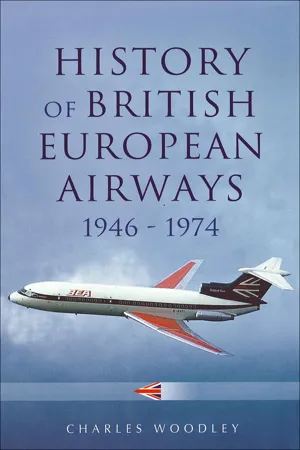
BEA was formed in 1946 and took over most UK domestic and European routes under the British government's nationalisation policy. It began operations with a fleet of outdated and hopelessly uneconomic passenger aircraft that were derivatives of wartime types such as the DC-3, Avro Viking and Rapide. By the end of 1955 the airline had re-equipped with more modern types such as the jet-prop Viscount and moved into a profit for the first time. From 1960 onwards the airline introduced larger jets such as the Comet, Trident and BAC 1-11. BEA merged with the British Overseas Airways Corporation in 1974 to form British Airways.This book looks at BEA's predecessors, its formation and early operation from Croydon and Northolt and the move to the newly-opened London Heathrow. The evolving structure is explained with chapters covering engineering bases, terminals, European and domestic services, cargo services and helicopter operations. The aircraft flown are all described in detail and the book includes anecdotes from former crew and ground-staff, a full fleet list and is highly illustrated throughout.
Trusted by 375,005 students
Access to over 1.5 million titles for a fair monthly price.
Study more efficiently using our study tools.
Information
CHAPTER ONE
BEA’s Predecessors
British European Airways was a post-war creation, but British air services to continental Europe had been operating since the end of the World War One. In the early 1920s the Hambling Committee was appointed by the British government to look into the state of the British air transport industry. This committee decided that a merger of the existing airline companies into a unified national airline was the only way to compete with the European competition. The British companies were offered an incentive of £1 million spread over a period of ten years, with the stipulation that the new airline must only operate aircraft of British design. Thus, on 31 March 1924, Imperial Airways was formed from the merger of Instone Air Line Ltd, Daimler Airways, the British Marine Air Navigation Company and Handley Page Air Transport. The new airline was based at Croydon Airport, and commenced operations on 26 April 1924 with a Croydon-Paris service using single-engined de Havilland DH 34 aircraft. The company inherited 1760 miles of cross-Channel routes, and during that year Imperial Airways operated services to Paris, Brussels, Cologne, Basle and Zurich, using Handley Page W.8b twin-engined machines. In 1926 the airline introduced the twenty-passenger, three-engined Armstrong Whitworth Argosy, and on 1 May 1927 this type was used to inaugurate the famous ‘Silver Wing’ lunchtime service to Paris.
Railway Air Services Dakota G-AGZB at Croydon. (Air-Britain)

In the summer of 1930 Imperial Airways experimented for four months with domestic services linking Croydon with Birmingham, Liverpool and Manchester. By 1931 the mainstay of the fleet was the Handley Page HP 42, which was built in two versions, for use on European and long-distance routes. The HP42W carried thirty-eight passengers on European routes. For a decade both HP 42 variants operated with a perfect safety record. However, they were slow, with a cruising speed of only 100 mph, and could not compete with the Douglas and Fokker types being introduced by their competitors. Other types were also in use, including the de Havilland DH 86, which was used to inaugurate a daily Croydon-Brussels-Cologne-Prague-Vienna-Budapest service in 1935.
In 1938 the Armstrong Whitworth Ensign monoplane was introduced on the Paris route, and the de Havilland Albatross also entered service. This all-wooden monoplane design was the first British 200 mph airliner, and cut the London-Paris flight time down to just one hour. By that time, however, Imperial Airways was finding that its competitive position on European routes was being increasingly hampered by its imposed policy of operating only British-built aircraft. A recommendation was put forward that the airline should continue to operate long-distance services, but hand over its European routes to British Airways, which was operating more competitive foreign types. Shortly after this, however, the decision was taken to merge Imperial Airways and British Airways into the British Overseas Airways Corporation, which was formed on 24 November 1939.
British Airways had been founded on 1 October 1935 as Allied British Airways out of a merger of Spartan Air Lines and United Airways, and competed with Imperial Airways on European routes. It was initially based at Heston, but transferred its operations to the new Gatwick Airport in 1936. At that time it was using a mixed fleet, which included DH 86s for passenger services and Junkers Ju 52/3ms for cargo flights and airmail services to Germany. In order to compete effectively with rivals such as KLM and Deutche Lufthansa, the airline used foreign types such as the Fokker F.8, and ordered four examples of the Fokker F12 for new services to Malmö, Amsterdam, Hamburg, Copenhagen, Stockholm, Cologne and Hanover. It later re-equipped with a modern all-American fleet of Lockheed L10 Electras and Lockheed L1 4s, later to become better known as Hudsons in their wartime maritime patrol role.
In early 1930 Imperial Airways had become perturbed by the parliamentary powers that had been granted to the railway companies to operate cross-Channel air services. Approaches were made to the London Midland and Scottish Railway and the London and North Eastern Railway, which led to the eventual registration on 21 March 1934 of Railway Air Services Ltd. One director was nominated by each of the constituent companies: the London Midland and Scottish Railway; the Great Western Railway; the London and North Eastern Railway; the Southern Railway; and Imperial Airways. The new company was based at the Imperial Airways terminus beside Victoria Station in London. Services commenced on 20 August 1934 over the route Glasgow (Renfrew)-Belfast (Aldergrove)-Manchester (Barton)-Birmingham (Castle Bromwich)-Croydon, using DH 86 biplanes. In the years leading up to World War Two, a varied fleet was operated, comprising DH 84 Dragon IIs, DH 86s, DH 89 Dragon Rapides, Avro XIXs and Douglas Dakotas. With the outbreak of war, all domestic air services were taken over for the duration by the Associated Airways Joint Committee (AAJC).
In October 1944 a plan was presented to the government by the Railway Company Association, under which Railway Air Services in a new form would operate post-war domestic and European air services, in partnership with other airlines and short-sea shipping interests to give complete interchangeability of tickets over their joint rail, sea and air networks. The proposed company would purchase new British aircraft as soon as they became available. It would operate all its routes without government subsidy, provided that agreement could be reached between governments that no subsidies would be granted to competing European airlines. An initial capital of £5 million was to be provided, and route development was to proceed in stages eventually to encompass twenty-seven domestic and twenty-five European routes. Purchase of the new Vickers Viking airliner was contemplated, and an artist’s impression of the type in Railway Air Services colours was published. However, the scheme was eventually rejected in favour of the formation of British European Airways.
CHAPTER TWO
The Beginnings of BEA
On 2 March 1945 Britain’s wartime coalition government published a White Paper entitled ‘British Air Transport’, in which it outlined its policy on civil air transport once the war was won. The White Paper proposed that British airline operations should be the prerogative of three public corporations. The British Overseas Airways Corporation (BOAC), which had been established in January 1939 and had operated priority government services throughout the war, would be responsible for all long-haul services except those to South America. These would be the responsibility of the British South American Airways Corporation (BSAAC). European and domestic services would be operated by the British European Airways Corporation, soon to become generally known as BEA. Following its victory in the 1945 General Election the new Labour government announced on 1 November 1945 that it would be implementing the proposals in the White Paper by introducing the 1946 Civil Aviation Bill.
A BEA Commer Commando coach outside Airways Terminal in the late 1940s. (BEA photo-copyright British Airways, via Brian A.L. Jones)


Ju 52/3m G-AHOH returning to its hangar at Croydon. (via Mrs Angela Poole)
On 1 January 1946 the wartime restrictions on civil flying in the UK were revoked, and on the same date the BEA Division of BOAC was formally constituted. Arrangements were put in hand for it to take over the services to continental Europe operated from Croydon by No. 110 Wing, 46 Group, RAF Transport Command. On 15 January 1946 BOAC board members Sir Harold Hartley and Gerard d’Erlanger began to formulate their plans for BEA. The takeover of the RAF services took effect on 4 February 1946. The London terminus was transferred from Croydon to RAF Northolt, and additional routes were added on that date. The list of destinations now comprised Amsterdam, Brussels, Helsinki, Lisbon, Madrid, Paris, Gothenburg and Stockholm. All these routes were served by Dakotas, which initially retained their RAF markings, and their crews their RAF uniforms. From 4 March 1946, however, BOAC colours and uniforms began to be seen on the Dakotas.
On 1 August 1946 the Civil Aviation Act 1946 received Royal Assent, and the British European Airways Corporation was established ‘with a view to providing civil air services in various parts of the world, and in particular in Europe (including the British Islands)’. The original Board comprised: Sir Harold Hartley (Chairman), W. Whitney Straight (Deputy Chairman), Gerard d’Erlanger (Managing Director), Wing Commander A.H. Measures, and I.J. Hayward. From that date, BEA operated its own services to mainland Europe, and the very first BEA service is believed to have been the 0840 hrs Northolt-Marseilles-Rome-Athens schedule. BEA was initially organised into two divisions, the Continental Division, based at Northolt, and the United Kingdom Division, based at Speke Airport, Liverpool. Under the Act, the independent airlines were banned from operating scheduled services, except under ‘associate agreements’ with BEA, and BEA was supposed to have taken over from them all the UK internal routes operated under the control of the wartime Associated Airways Joint Committee. However, BEA was by no means in a position to take these services on at that time, and for a further six months or so the independent airlines continued to operate their routes on BEA’s behalf.

Ju 52/3m G-AHOC. (via Mrs Angela Poole)
In December 1946 the BEA board appointed a Scottish Advisory Council and a Northern Ireland Advisory Council to assist BEA (and BOAC and BSAAC) in meeting the needs of these areas for air transportation. The two advisory councils had as their chairmen Sir Patrick Dolan and W. A. Edmenson respectively. On 31 March 1947 Sir Harold Hartley and Whitney Straight resigned from the BEA board to take up new appointments as Chairman and Chief Executive of BOAC. Gerard d’Erlanger and J. H. Keeling were appointed Chairman and Deputy Chairman of BEA, and J. V. Wood was appointed Managing Director.
Despite the move to Northolt, some new routes were still being inaugurated from Croydon. On 18 November 1946, Railway Air Services, operating on behalf of BEA, opened Croydon-Liverpool-Belfast (Sydenham) services, using former Luftwaffe Junkers Ju 52/3m aircraft. From 16 December the Belfast terminus was transferred to the new Nutts Corner airport. From 20 March 1947, by which time BEA was operating the service in its own right, the stop at Liverpool was withdrawn. In BEA service the Ju 52/3m was known as the ‘Jupiter’ Class, and featured Royal Blue furnishings. On 19 May 1947, however, the type was replaced by Dakotas operating out of Northolt. It was finally withdrawn from BEA service altogether on 31 August 1947. BEA’s last scheduled services out of Croydon with its own aircraft took place on 1 November 1947, when three Dakota scheduled flights to Guernsey were operated, the final one by G-AGIF. However, this was still not quite the end of the airline’s association with the airport, as during the summers of 1948 and 1949 Olley Air Services operated de Havilland Doves on seasonal services to Deauville on BEA’s behalf.

Ju 52/3m G-AHOF landing at Croydon in 1946/7. (via Mrs Angela Poole)
BEA’s initial fleet consisted of twenty-four Dakotas and eight Vickers Viking 1As inherited from the BEA Division of BOAC. The new airline suffered from a severe shortage of Dakota spares in the early days, resulting at one point in 25 per cent of the fleet being grounded. Dakotas had to be leased from BOAC for quite some time, and others were chartered from independent operators such as Skyways.
On 1 February 1947 BEA was ready to begin operating domestic schedules in its own right. It took over the services...
Table of contents
- Title Page
- Copyright Page
- Table of Contents
- Acknowledgements
- Introduction
- CHAPTER ONE - BEA’s Predecessors
- CHAPTER TWO - The Beginnings of BEA
- CHAPTER THREE - The Northolt Era
- CHAPTER FOUR - The Heathrow Years–Mainline Operations by Aircraft Type
- CHAPTER FIVE - German Internal Services
- CHAPTER SIX - The Scottish Network
- CHAPTER SEVEN - Scottish Air Ambulance Operations
- CHAPTER EIGHT - Channel Islands Operations
- CHAPTER NINE - Scilly Isles Operations
- CHAPTER TEN - Helicopter Operations
- CHAPTER ELEVEN - All-cargo Operations
- CHAPTER TWELVE - BEA Airtours
- CHAPTER THIRTEEN - BEA’s Structure
- CHAPTER FOURTEEN - BEA’s Financial and Operating Performance
- CHAPTER FIFTEEN - BEA’s Fleet Policy
- CHAPTER SIXTEEN - BEA Livery Changes
- CHAPTER SEVENTEEN - Training BEA’s Crews
- CHAPTER EIGHTEEN - BEA People
- CHAPTER NINETEEN - The British Airways Amalgamation
- CHAPTER TWENTY - BEA’s UK Bases
- APPENDICES
- Bibliography
- Index
Frequently asked questions
Yes, you can cancel anytime from the Subscription tab in your account settings on the Perlego website. Your subscription will stay active until the end of your current billing period. Learn how to cancel your subscription
No, books cannot be downloaded as external files, such as PDFs, for use outside of Perlego. However, you can download books within the Perlego app for offline reading on mobile or tablet. Learn how to download books offline
Perlego offers two plans: Essential and Complete
- Essential is ideal for learners and professionals who enjoy exploring a wide range of subjects. Access the Essential Library with 800,000+ trusted titles and best-sellers across business, personal growth, and the humanities. Includes unlimited reading time and Standard Read Aloud voice.
- Complete: Perfect for advanced learners and researchers needing full, unrestricted access. Unlock 1.5M+ books across hundreds of subjects, including academic and specialized titles. The Complete Plan also includes advanced features like Premium Read Aloud and Research Assistant.
We are an online textbook subscription service, where you can get access to an entire online library for less than the price of a single book per month. With over 1.5 million books across 990+ topics, we’ve got you covered! Learn about our mission
Look out for the read-aloud symbol on your next book to see if you can listen to it. The read-aloud tool reads text aloud for you, highlighting the text as it is being read. You can pause it, speed it up and slow it down. Learn more about Read Aloud
Yes! You can use the Perlego app on both iOS and Android devices to read anytime, anywhere — even offline. Perfect for commutes or when you’re on the go.
Please note we cannot support devices running on iOS 13 and Android 7 or earlier. Learn more about using the app
Please note we cannot support devices running on iOS 13 and Android 7 or earlier. Learn more about using the app
Yes, you can access History of British European Airways, 1946–1972 by Charles Woodley in PDF and/or ePUB format, as well as other popular books in History & Military & Maritime History. We have over 1.5 million books available in our catalogue for you to explore.