- 244 pages
- English
- ePUB (mobile friendly)
- Available on iOS & Android
eBook - ePub
About this book
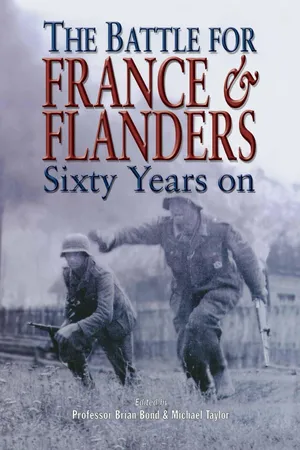
The Fall of France in 1940 has been well chronicled but numerous misconceptions remain.This fascinating and thought-provoking collection of essays on wide-ranging issues covering the politics and fighting on land, sea and in the air will be greatly welcomed by academics and military history enthusiasts.Topics covered include the preparations of the BEF, the failure of allied counter attacks, the air war, the Royal Navys's role in the campaign, the influence of the Battle on British military doctrine and the repercussions from the British, French and German angles.
Trusted by 375,005 students
Access to over 1.5 million titles for a fair monthly price.
Study more efficiently using our study tools.
Information
CONTENTS
Notes on Contributors
Foreword
Introduction: Preparing the Field Force, February 1939 – May 1940
Brian Bond
The German Breakthrough at Sedan, 12–15 May 1940
Peter Caddick-Adams
Anglo-French Co-operation during the Battle of France
Peter Caddick-Adams
The Manoeuvre that Saved the Field Force
M.R.H. Piercy
The Defence of the Dunkirk Perimeter
Jeremy A. Crang
The French View of Dunkirk
John C. Cairns
The Air War in France
John Buckley
The Royal Navy’s Role in the Campaign
Robin Brodhurst
British High Command and the Reporting of the Campaign
Stephen Badsey
The Influence of the Battle of France on British Miliary Doctrine
John Drewienkiewicz
Repercussions: The Battle of France in History and Historiography
The French View
Martin S. Alexander
The German View
Mungo Melvin
The British View
Brian Bond
Index
NOTES ON CONTRIBUTORS
| Brian Bond | is Professor of Military History at King’s College, London and President of BCMH. His Lees Knowles Lectures, Britain and the First World War: the Challenge to Historians, delivered in November 2000, will be published by Cambridge University Press in 2002. |
| Michael Taylor | is a member of the BCMH Committee with a special interest in the 1940 campaign. He is currently researching a book on the performance of the Field Force, |
| Peter Caddick-Adams | is a Lecturer in the Department of Defence Management and Security Analysis at Cranfield University. As a Territorial Army Officer he served in Bosnia with UNPROFOR. His publications include By God They Can Fight! A History of 143 Brigade (Shrewsbury, 1995). |
| Michael Piercy | is a retired head teacher who took an MA in War Studies at King’s College, London in 1993. He is a member of the BCMH team which is preparing a data base on British divisions in the First World War. |
| Jeremy Crang | is a Lecturer in the History Department and Assistant Director of the Centre for Second World War Studies at Edinburgh University. His publications include The British Army and the People’s War, 1939–1945 (Manchester University Press, 2000). |
| John Cairns | was formerly Professor of History at the University of Toronto. He has published numerous scholarly articles on France and Britain at war in 1939–1940 including ‘Some Recent Historians and the “Strange Defeat” of 1940’ in The Journal of Modern History (March, 1974). |
| John Buckley | is a Senior Lecturer in the Department of War Studies at the University of Wolverhampton. His most recent book is Air Power in the Age of Total War (U.C.L. Press, 1999). |
| Robin Brodhurst | is a former Greenjacket officer who is now Head of History at Pangbourne College. He has recently published Churchill’s Anchor. The Biography of Admiral of the Fleet Sir Dudley Pound (Pen & Sword, 2000). |
| Stephen Badsey | is a Senior Lecturer in the Department of War Studies at RMA Sandhurst. He has published on a great variety of subjects ranging from the South African War to the Falklands and Gulf Wars. His strong interest in the First World War is exemplified by his contribution to Brian Bond and Nigel Cave (eds) Haig: a Reappraisal Seventy Years On (Leo Cooper, 1999). |
| John Drewienkiewicz | is a Major-General whose most recent appointment was Senior Army Member, Royal College of Defence Studies. He has a wide and varied experience of service in the Balkans. |
| Martin Alexander | has recently moved from a chair at Salford University to become Professor of International Relations at the University of Wales, Aberystwyth. His numerous publications include The Republic in Danger. General Maurice Gamelin and the Politics of French Defence, 1933–1940 (Cambridge University Press, 1993). |
| Mungo Melvin | was formerly Colonel, Defence Studies at the Staff College Camberley and is currently, as a Brigadier, Chief Engineer of the Rapid Reaction Corps in Germany. He has published numerous articles in the Strategic and Combat Studies Institute Occasional Papers, and in other military journals. |
FOREWORD
In July 2000 the British Commission for Military History (BCMH) devoted its weekend conference at Bedford to a reappraisal of the Battle of France and Flanders sixty years after the dramatic events which left Germany in command of Western Europe, France defeated and in political turmoil and Britain with its Army in disarray and in expectation of imminent German invasion.
Most of the papers collected here in a revised form were delivered and discussed at the conference, and all but two of the contributors are BCMH members. We have consequently drawn on the special interests and expertise of our members and have not attempted either a complete narrative history or systematic coverage of all the controversies or of all national viewpoints: there is, for example, no essay focusing on the Belgian role in the operations or on the confused second phase of the German offensive in June which culminated in a second British evacuation from Cherbourg and other western ports. We have, however, aimed to produce a volume which has coherence and is much more than a miscellany. We re-examine the key phases of the campaign, including the astonishing German breakthrough at Sedan; the failure of the Anglo-French forces to organize and execute a significant counter-offensive; the brilliant manoeuvre which saved the Field Force when the Belgians suddenly accepted a ceasefire; the inspired improvisation of a defensible bridgehead at Dunkirk; and the air and naval aspects of the campaign. There is also an original and provocative account of British reporting of operations, and a brilliant analysis of French attitudes during the final days of the evacuation, based on a wide range of archival sources and interviews, which has been edited from a much longer essay. Finally, these profoundly influential operations have been placed in their historical context by surveys of the post mortems and controversies generated amongst participants and scholars in France, Germany and Britain and, in the British case, with an additional essay on the impact of the campaign on military doctrine which has hitherto been virtually unexplored.
Even after sixty years, the repercussions of the ‘sixty days that shook the West’ are far from over and the vast historiography steadily increases. We offer no apology for adding another stone to the edifice and hope that these essays will stimulate further research and writing, both on the topics covered and on others which we have had to leave aside.
Brian Bond, President BCMH.

INTRODUCTION:
PREPARING THE FIELD FORCE,
FEBRUARY 1939 – MAY 1940
BRIAN BOND
In retrospect it is hard to believe that the British Government did not commit even the small, regular contingent of its Army (the Field Force) to the Continent, in event of German aggression in the West, until February 1939. True, the Field Force was by now entirely dependent on motorized and mechanized transport, but it was smaller than the British Expeditionary Force of 1914, less well-trained and badly deficient in vital stores and equipment. “Better late than never,” noted Major-General Henry Pownall in his diary in April, “but late it is, for it will take at least eighteen months more … before this paper Army is an Army in the flesh.”1
In February 1939 this political decision fell far short of French expectations. Only the first four regular Divisions were definitely committed, with the first two due to reach their assembly area in France 30 days after mobilization. The French would have to carry a heavy burden alone in the first phase while the Field Force slowly assembled. Allied strategy would initially have to be defensive, irrespective of the reasons for going to war.
By the end of April the British government had further complicated the enormous problems of rapid rearmament by doubling the Territorial Army (to a paper target of 340,000); each existing T.A. unit was duplicated, thus creating twelve new infantry divisions, which stretched resources to the limit. A limited form of conscription was also introduced. As Pownall noted in his diary “it is a proper Granny’s knitting that has been handed out to us to unravel…. What an unholy mess our politicians have made of the rebirth of the Army through shortsightedness, unwillingness to face facts and preju...
Table of contents
- Cover
- Half Title
- Title Page
- Copyright
- CONTENTS
Frequently asked questions
Yes, you can cancel anytime from the Subscription tab in your account settings on the Perlego website. Your subscription will stay active until the end of your current billing period. Learn how to cancel your subscription
No, books cannot be downloaded as external files, such as PDFs, for use outside of Perlego. However, you can download books within the Perlego app for offline reading on mobile or tablet. Learn how to download books offline
We are an online textbook subscription service, where you can get access to an entire online library for less than the price of a single book per month. With over 1.5 million books across 990+ topics, we’ve got you covered! Learn about our mission
Look out for the read-aloud symbol on your next book to see if you can listen to it. The read-aloud tool reads text aloud for you, highlighting the text as it is being read. You can pause it, speed it up and slow it down. Learn more about Read Aloud
Yes! You can use the Perlego app on both iOS and Android devices to read anytime, anywhere — even offline. Perfect for commutes or when you’re on the go.
Please note we cannot support devices running on iOS 13 and Android 7 or earlier. Learn more about using the app
Please note we cannot support devices running on iOS 13 and Android 7 or earlier. Learn more about using the app
Yes, you can access The Battle for France & Flanders by Brian Bond,Michael Taylor in PDF and/or ePUB format, as well as other popular books in History & Military & Maritime History. We have over 1.5 million books available in our catalogue for you to explore.