eBook - ePub
Accrington Pals: The 11th (Service) Battalion (Accrington) East Lancashire Regiment
A History of the Battalion Raised from Accrington, Blackburn, Burnley and Chorley in World War One
- 256 pages
- English
- ePUB (mobile friendly)
- Available on iOS & Android
eBook - ePub
Accrington Pals: The 11th (Service) Battalion (Accrington) East Lancashire Regiment
A History of the Battalion Raised from Accrington, Blackburn, Burnley and Chorley in World War One
About this book
Follow the footsteps of the Pals in their journey from Lancashire to their training camps in England and Wales and to the villages and battlefields of France. A comprehensive account, with maps and pictures, of a Pals Battalion's service throughout the war.
Tools to learn more effectively

Saving Books

Keyword Search

Annotating Text

Listen to it instead
Information
Contents
Foreword
Introduction
1. Come back this afternoon
2. And we be brethren
3. Croeso i Gymru! Welcome to Wales!
4. Some Battalion! Some Colonel
5. An eastern interlude
6. We captured Serre three times a day
7. God help the sinner
8. The Aftermath
Epilogue
Appendix
1. Personae
2. Correspondent’s Reports
3. Report on Operations
4. Battle Report 12th Y.& L. July 1st
5. Peltzer letter
6. Appreciation messages
7. Casualty lists
8. Hometowns of July 1st casualties
9. Total Battalion casualties 1916–1918
Nominal roll
Decorations
Officers Monthly Army List
Name index
Photo postscript
Selected Bibliography
Acknowledgments
Foreword
Martin Middlebrook
I’ve been there, a most striking place, a sad place — Serre! The front line trench from which the 11th East Lancashires attacked on the first day of the battle of the Somme is still there, a grassy zig-zag, clearly a trench, just on the edge of a wood up a farm track. The 11th East Lancashires were, of course, the Accrington Pals. Unfortunately, the place where their old front line trench is to be found is now called the Sheffield Memorial Park. But the Sheffield unit did not attack from this stretch of front line. Their sector was a short distance to the north, but post 1918 Sheffield established their Memorial Park nearer the track up which the visitors would have to come. Accrington must have been asleep and made no protest.
In many ways the Accrington Pals were typical of Kitchener’s New Army of volunteers in 1914, but that local enthusiasm seems to have had a harder time in getting its Pals Battalion accepted by the War Office. Bill Turner’s book will describe the difficulties. In the post-war period, Accrington could not seem to stir itself to provide any memorial at the place where the Pals suffered so terribly on the Somme.
An Accrington man has produced a different type of memorial, a well researched history of the Pals which deserves wide circulation and support, not only in Accrington but further afield. I congratulate Bill Turner and most willingly commend his work.
Introduction
Accrington, East Lancashire, in the high hot summer of 1914 was a town of 45,525 people. A town famous for textile machinery, bricks and its football team. Howard and Bulloughs, makers of textile machinery, sold and installed thousands of machines, world-wide, every year. Seven collieries and thirty-two cotton mills completed the industrial basis of the town’s economy.
Accrington was a prosperous town. The Borough Treasurer presented ‘the most gratifying report on our financial position in thirty years an excellent state of affairs.’1 In contrast the Medical Officer of Health spoke of general mortality and infant mortality rates higher than the national average with ‘too many preventable deaths.’2 In a ‘prosperous’ town there were many poor, the margin separating working people from want and hunger desperately narrow. Accrington, as other industrial towns in Britain in 1914, had its bad housing and poverty but its parks and open spaces, along with easy access to open countryside, helped to make it a comparatively pleasant town. It had a considerable civic pride in its good reputation and achievements.
On June 27th, 1914, one of the cotton mills closed for six weeks because of lack of orders, putting five hundred men and women out of work. The closure came as no surprise. Orders for cotton cloth weaving had been falling for many months as part of a general decline in the British cotton industry. Other mills announced the extension to two weeks of the annual one weeks, unpaid holiday. The news added to the cotton workers’ growing fears about the future for themselves and the industry.
Engineering workers in the town were also restless for a different reason. In early June, 1914 simmering unrest by the skilled employees about low wages at Howard and Bulloughs culminated with a formal request for a ten per cent increase in wages.3 Saturday June 27th arrived with no reply from the employers. Feelings ran high, nothing it seemed could prevent a strike. The employees decided on a final dead-line of July 1st.
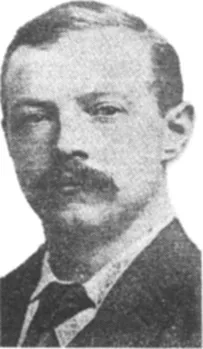
Mr Tom Bullough, Chairman of Directors of Howard & Bulloughs, a family firm founded in 1856. A.O.&T.

An artist’s view of Messrs. Howard and, Bulloughs Ltd, Globe Works, Accrington, as featured in a 1914 advertisement. Notwithstanding some artistic licence the works was large enough to employ over 4,000 men and boys. A.O.&T.
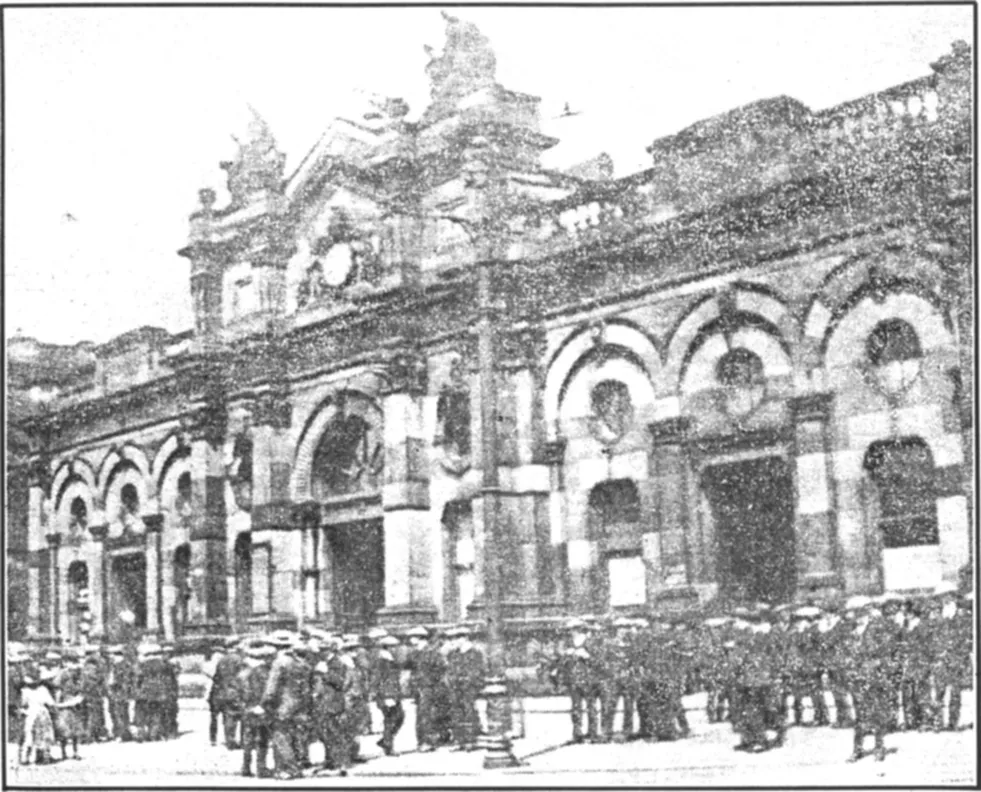
Groups of engineers from Howard and Bulloughs discuss the strike outside Accrington Market Hall. A.O.&T.
Meanwhile, on Sunday June 28th, whilst East Lancashire enjoyed the hottest day of the year, in Sarajevo, Bosnia, the heir to the throne of Austria-Hungary, Archduke Franz Ferdinand along with his wife died, the victims of an assassination plot. Balkan quarrels meant little to most in Accrington so the news received but passing interest the following day. At the Empire Picture Palace, the week’s film, ‘A King in Name Alone,’ coincidentally shared its opening night with the news, the film was proclaimed as a ‘strong drama set in South Eastern Europe showing the secret springs of intrigue and plot to overthrow a dynasty.’ The real-life attempt to overthrow a dynasty gave the film a measure of publicity.4 Concern, however, centered more on Wednesday July 1st.
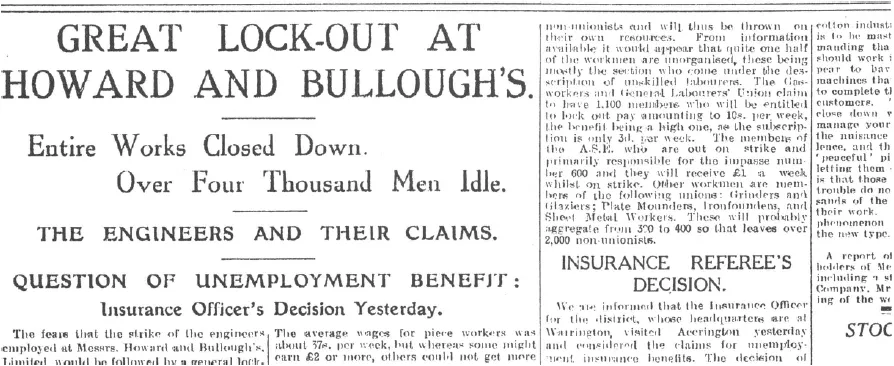
The day dawned bright and full of promise, yet in the early afternoon the hot weather broke with a tremendous thunderstorm. Floodwaters swirled into the Howard and Bulloughs machine-shop and stopped production. At 5.30 p.m. six hundred skilled engineers, their final dead-line ignored, walked out on strike. The strike had bitter beginnings. Everyday following when the works opened and closed, mounted police stood by as crowds of hostile strikers jeered and jostled non-strikers. One week later the works closed. Almost 4,000 semi-skilled and unskilled men and boys were prevented from working, ‘locked out’ by the closure. July had begun badly for Accrington and district.
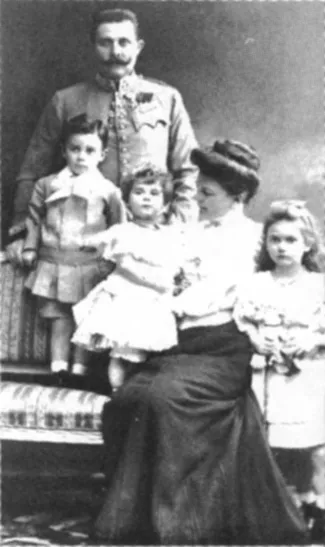
Franz Ferdinand, Archduke of Austria, heir to the Austrian throne from 1889, with his wife Sophia and children. B.C.P.L.
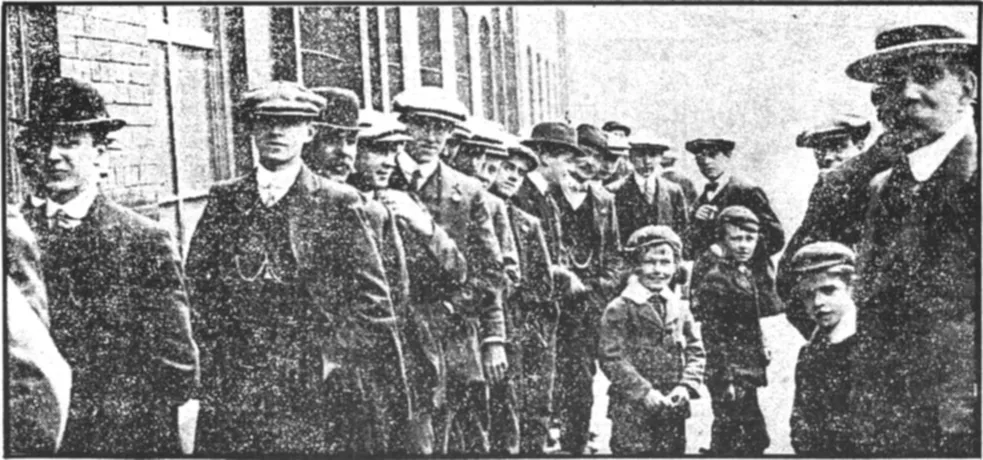
Men queue up outside the wages office at Howard and Bulloughs to draw their last wage. A.O.&T.
On July 18th, one week before the annual holiday, the six hundred skilled engineers collected their first strike pay of £1 each and 1,100 labourers ten shillings each from their respective Trade Unions. Three thousand not in a Trade U...
Table of contents
- Cover
- Title Page
- Copyright
- Contents
Frequently asked questions
Yes, you can cancel anytime from the Subscription tab in your account settings on the Perlego website. Your subscription will stay active until the end of your current billing period. Learn how to cancel your subscription
No, books cannot be downloaded as external files, such as PDFs, for use outside of Perlego. However, you can download books within the Perlego app for offline reading on mobile or tablet. Learn how to download books offline
Perlego offers two plans: Essential and Complete
- Essential is ideal for learners and professionals who enjoy exploring a wide range of subjects. Access the Essential Library with 800,000+ trusted titles and best-sellers across business, personal growth, and the humanities. Includes unlimited reading time and Standard Read Aloud voice.
- Complete: Perfect for advanced learners and researchers needing full, unrestricted access. Unlock 1.4M+ books across hundreds of subjects, including academic and specialized titles. The Complete Plan also includes advanced features like Premium Read Aloud and Research Assistant.
We are an online textbook subscription service, where you can get access to an entire online library for less than the price of a single book per month. With over 1 million books across 990+ topics, we’ve got you covered! Learn about our mission
Look out for the read-aloud symbol on your next book to see if you can listen to it. The read-aloud tool reads text aloud for you, highlighting the text as it is being read. You can pause it, speed it up and slow it down. Learn more about Read Aloud
Yes! You can use the Perlego app on both iOS and Android devices to read anytime, anywhere — even offline. Perfect for commutes or when you’re on the go.
Please note we cannot support devices running on iOS 13 and Android 7 or earlier. Learn more about using the app
Please note we cannot support devices running on iOS 13 and Android 7 or earlier. Learn more about using the app
Yes, you can access Accrington Pals: The 11th (Service) Battalion (Accrington) East Lancashire Regiment by William Bennett Turner in PDF and/or ePUB format, as well as other popular books in History & World War I. We have over one million books available in our catalogue for you to explore.