- 208 pages
- English
- ePUB (mobile friendly)
- Available on iOS & Android
eBook - ePub
About this book
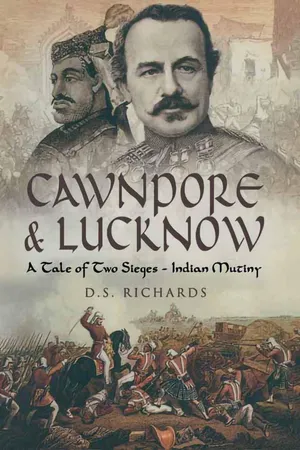
A history of two 1857 sieges in which Indians violently revolted against British colonials, featuring accounts from people who lived through them.
Following the May 1857 uprising by sepoys in Meerut and Delhi, the whole future of the British Raj was in the balance. Nowhere was this better demonstrated than at Lucknow and Cawnpore. At the latter, a garrison of 240 with 375 British women and children battled to survive a siege by 3,000 mutineers led by Nana Sahib. Unimaginable horrors of artillery and sniper fire coupled with the crippling heat of the Indian summer took their toll. An offer of safe passage was treacherously reneged on, and the massacres which followed drew a terrible retribution when relief finally arrived, in the shape of Generals Havelock and Neil. At Lucknow, the 1800 British men, women and children supported by more than 1,000 loyal sepoys resisted assaults by 20,000 mutineers, despite heavy casualties and sickness. Sir Colin Campbell's force got through to relieve the garrison and evacuate civilians in November 1857, but the city was not restored to British control until March 1858.
These dramatic events are brought to life in this first-rate history.
Trusted by 375,005 students
Access to over 1.5 million titles for a fair monthly price.
Study more efficiently using our study tools.
Information
Chapter 1
‘THE FAVOURITES OF HEAVEN’
For the many British families residing in Northern India whose duties bound them to the military cantonments of Oude, a province noted for its oppressive climate, there had been few outward signs in the months leading up to the fateful year of 1857 to suggest that they were poised on the brink of a catastrophe.
In October 1855, a new governor general had been appointed to succeed Lord Dalhousie in the task of governing the subcontinent, and it was Lord Charles John Canning’s hope that following Dalhousie’s controversial reforms, he would enjoy a period of peaceful calm. However, in a speech at a farewell dinner given for him by the Court of Directors before leaving for India, he admitted with commendable candour: ‘I wish for a peaceful term of office, but must not forget that in the sky of India, serene as it is, a small cloud may arise, at first no bigger than a man’s hand, but which growing larger and larger, may at last threaten to burst and overwhelm us with ruin.’
Although the era was long past when an enterprising individual could embark upon a career as a clerk with the East India Company and return with a considerable fortune, the officers and covenanted civil servants nevertheless pursued an existence as comfortable as the rigours of duty in a hostile environment would allow. Well paid by European standards and far from overworked, the Company’s employees, both civil and military, were able to enjoy a lifestyle not dissimilar to that of an English country gentleman, at a fraction of the cost, with the added advantage of a host of servants to provide a degree of personal comfort unimaginable outside of India.
Henry Addison, on his first night ashore in the house of a friend, was scarcely awake before the mosquito net around his bed was parted and he became aware of a native busily lathering his face preparatory to shaving him. ‘No wonder old Indians on their return to Europe fancy themselves sadly neglected by their domestics,’ commented an astonished Addison. ‘I shall however shut my door tomorrow morning, and insist on dressing myself.’ No doubt Henry Addison found the attentions of his friend’s servants tiresome, but in this he was not alone. British India’s First Lady, accustomed as she was to a large establishment of servants with the Queen at Windsor, found the constant presence of mute and deferential servants an aspect of Indian life difficult to live with. Lady Charlotte Stuart Canning confided to her diary:
I am not sure that I do not regret creaking footmen. These gliding people come and stand by one and will wait an hour with their eye fixed on one, and their hands joined as if to say their prayers, if you do not see them – and one is quite startled to find them patiently waiting when one looks round. I have such scruples to giving them so many journeys up and down, and it’s indeed far pleasanter to have creaking footmen in livery.
Lieutenant Vivian Majendie, himself a relative newcomer to India, found like those before him, attendance upon the individual to be a little overwhelming. He wrote:
There are few things more striking to a person just landed, than the native servants who, to use an un-classical expression, walk ‘quite promiscuous like’ in and out of one’s room all day, noiselessly, certainly, for there are no shoes on their dusky feet to creak and disturb you, but the very presence of these white clad figures flitting about one prevented me for some time from feeling that placid sensation of ‘at home’ and retirement which every man at times must long for.
At that time, servants in India were obligatory for even the most junior administrator, and although wages were low, since each servant was forbidden by his caste to do another’s work, the size of staff considered necessary for even a modest establishment surprised many a newcomer unfamiliar with the practice. Henry Addison’s friend advised:
A sirdar or principal servant to look after your clothes; a kit-mutgar to wait behind your chair; a hooker burder to take care of your hooker … eight bearers to carry you in your palanquin, a peon to convey your notes and messages, a dhobee, a durzee (tailor), a bheestee (water carrier), a bobachee (cook), three syces to take care of your three horses, a grass cutter to supply them with hay … and a moonshee (interpreter) as long as you are ignorant of the language.
Poor Addison, once he had recovered from his astonishment, could only gasp, ‘Then I’ll be shot if I shan’t be ruined.’
With the approach of the hot weather season most families made haste to exchange the sweltering heat of the central plains for the relatively cool and bracing climate of a hill station such as Simla, 7,000 feet above sea level, Mussoorie, or Darjeeling. There, in comfortable stone bungalows built in the ‘Swiss cottage’ style, the wives at least could profit from a welcome break until the monsoon brought a temporary halt to the rising temperature on the plains. For those obliged to remain in cantonments, there was little to do but seek refuge behind drawn blinds, gaze listlessly out over a compound swept by clouds of grit and dust, and idly watch the thermometer gradually climb to an energy sapping 120°F in the shade.
Writing from Cawnpore in April, Surgeon Francis Collins could complain with some justification that ‘The wind blows hotter every day, it is impossible to stir out with safety between 8.00 am and 6.00 pm. The very birds disappear at 9.00 am and we see nothing more of them till sunset … In the morning we see them with their beaks wide open panting for breath.’ In a climate such as this, the practice of over-indulgence at meals by some may well have eased the path to promotion for others in both military and civil circles, by lowering their resistance to the many virulent fevers common to India.
One such dinner, which even by Victorian standards seems to have been a massive affair, was attended by William Howard Russell, the correspondent of The Times, who found:
the incense of savoury meats hanging about like a fog. The soup is served, as it only can be in India – hot as the sun, thick with bones and meat – a veritable warm jelly. Then comes the fish – roach, or some cognate Cyprinus, hateful to me as Ganges fed; then joints of grain fed mutton, commissariat beef, curries of fish, fowl, and mutton, stews and ragouts, sweets of an intensely saccharine character, with sherry, beer, and soda water, and now and then a pop of Simpkin or champagne.
A chaplain in the service of the East India Company remembered both the delights and the discomforts of the occasion:
There was a blaze of uniforms, most of the ladies looked pale. A hot climate and late hours soon bleach the English complexion. At such a gathering in such weather as this, one is oppressed with the misery of woollen clothes. It would move your compassion to see men buttoned up to the chin in tight fitting scarlet or blue coats, and melting away like snowballs at a kitchen fire.
There was precious little relief to be had when having excused himself, the diner could retire to his bungalow for a fitful sleep – not without the risk of an encounter with a snake or a scorpion. ‘We gaze at the punkha,’ wrote Captain George Atkinson, ‘we simmer and accidentally fall asleep just as it is the hour to get up.’ Only in the relative cool of the evening, when he rose and dressed for the obligatory ride, was Atkinson released from what he described as ‘a captivity enforced by the bars and fetters of a scorching sun and the blasts of a fiery furnace’.
Whilst the menfolk had specific tasks to occupy their time, there was little to relieve their wives from the long hours of boredom. Letter writing, receiving calling cards, engaging in needlework or supervising the household servants might be undertaken, but until the heat of the day was over, few outdoor activities were possible. Many women preferred to remain indoors, a restriction which undoubtedly contributed to the loathing of India expressed by many memsahibs in their letters home. The wife of a future Chief Commissioner of Oude found the dull routine of a military station stifling, and the sheer tedium of cantonment life is convincingly brought to life by Honoria Lawrence in a letter written four years before the Mutiny:
the highlight of the day was reached when the married couples went out for the evening drive on the same dusty road where they had driven a thousand times, meeting the same faces they had met a hundred times. When they came in there is dinner, then coffee; then bed. So passes day after day till the corps or the civilian is removed, and then they settle down elsewhere to plod on the same eternal round.
The evening’s parade of carriages along the main street excited the interest of The Times correspondent, then in Cawnpore. ‘Whose buggy is that preceded by two native troopers and followed by five or six armed natives running on foot?’ asked William Howard Russell.
‘That is the magistrate and collector,’ came the reply.
‘What does he do?’
‘He is the burra Sahib or big man of the station.’
‘Who is that in the smart gharry with servants in livery?’
‘That is the chaplain of the station who marries and baptises and performs service for the Europeans.’
‘Does he go among the natives?’
‘Not he; he leaves that to the missionaries.’
‘Well, and who comes next along the drive, in the smart buggy with the bay mare?’
‘That is the doctor of the station. He attends the sick Europeans. He also gets, under certain circumstances, head-money for every native soldier in garrison.’
‘Does he attend them?’
‘I should think not. Why on earth should he attend a lot of niggers?’
‘But he is paid for them,’ suggested Russell naively.
‘Ah, that is another matter,’ came the reply. ‘You must understand our system a little better before you can comprehend things of this sort.’
‘Who, then, is this jolly looking fellow on the grey Arab?’
‘That is the judge of the station, a very good fellow. All judges are rather slow coaches, you know. They do the criminal business, and it is not much matter if they make mistakes, as they don’t meddle with Europeans. When they can do nothing else with a fellow in the Civil Service, they make him a judge.’
Russell had to be content with this potted history of the station’ s hierarchy, but the inherent prejudice against the native population was not lost upon the Irish journalist when he wrote: ‘The fact is, I fear, that the favourites of Heaven, the civilizers of the world, are naturally the most intolerant in the world.’
At Cawnpore, as with many other military stations, much of the evening’s social activity took place around the bandstand. There, officers in tight-fitting uniforms and civilians in alpaca jackets would gossip and exchange pleasantries with ladies in sprigged muslin dresses to the accompaniment of a sepoy band playing distorted versions of popular tunes of the day. Families would gather beneath the spreading branches of a peepul tree whilst their offspring were led around the bandstand by an ayah, which, as one fond parent remarked, ‘Would give the little things a decided taste or dislike for music in future years.’
Occasionally, an invitation to dine at a local rajah’s palace made a welcome diversion, which Captain George Atkinson recalled in what might seem less than flattering terms:
The guests arrive, and are installed in velvet-cushioned chairs, and attar of roses is handed round with dried fruits and sweetmeats. Then come the dancing girls, gyrating on their heels, ogling and leering, and shaking their uplifted palms, with their idiotic contortions, indicative, in the eastern eye, of grace and dignity of motion. Lobsters and tart fruits commingled, whilst truffles, sausages, and sugared almonds share mutually the same dish. Nor is it for want of crockery as dishes and plates, and vessels even of the most domestic character, grace the board, side by side with silver plate and glittering ormolu, to the unsmotherable amusement of the guests.
To a recent arrival from Britain, there was something inappropriate in the way a local nawab displayed his devotion to Western table manners. John Lang, a barrister, after a visit to the palace of Nana Gorind Dondhu Pant, the Rajah of Bithur, better known as the Nana Sahib – Nana being a term of endearment – recorded his impressions:
I sat down at a table twenty feet long … which was covered by a damask tablecloth of European manufacture. But instead of a dinner napkin there was a bathroom towel. The soup – for the steward had everything ready – was served up in a trifle dish which had formed part of a dessert service belonging to the 9th Lancers – at events the arms of that regiment were upon it; but the plate to which I ladled it with a broken teacup was of the old willow pattern. The pilau which followed the soup was served upon a huge plated dish, but the plate from which I ate it was of the very commonest description. The knife was a bone handled affair, the fork and spoon were of silver and of Calcutta make. The plated side dishes containing vegetables were odd ones, one was round and the other was oval. The pudding was brought in upon a soup plate of blue and gold pattern, and the cheese was placed before me on a glass dish belonging to the dessert service. The cool claret I drank out of a richly cut champagne glass, and the beer out of an American tumbler of the very worst quality.
Apart from the few Britons who took pains to learn something of the native’s culture, language and history there were many more who looked upon their service in India simply as an unavoidable step on the ladder towards self-aggrandizement. To many of those individuals the Indian was beneath ordinary notice. In reply to a question as to what she had seen of the country and its people since coming ashore, the wife of a newly appointed magistrate, replied: ‘Oh, nothing, thank goodness. I know nothing at all about them, nor do I wish to. Really, I think the less one knows of them the better.’ Comments such as these betrayed an unforgivable arrogance which was by no means confined to the newcomer, or griffin as he was known. Referring to the sepoys under his command, a major of a native regiment exclaimed to William Russell: ‘By Jove, Sir! By Jove! Those niggers are such a confounded sensual lazy set, cramming themselves with ghee and sweet meats, and smoking their cursed chillumjees all day and night, that you might as well think to train pigs.’
That infantry major’s attitude to his responsibilities would, however, have outraged many an earlier generation of Company officers. Writing some twenty-five years before the Mutiny, an enlightened Captain Albert Hervey advised the ‘griffin’ to divest himself of any notion that he was here to rule over an inferior race. He wrote:
People come out to India with but very different ideas regarding the native. They think that because a man is black he is to be despised. The grand mistake on the part of the officers is their ignorance of, and their indifference to, the feelings of their men. As long as they look upon them with prejudiced eyes … the poor soldier will be maltreated until his meek and humble spirit becomes roused, his pride hurt, and the consequence attended with fearful results.
Hervey of course, was referring to an earlier age when it was common for an officer to learn the language and customs of the people from his Indian mistress, and before the proselytizing by missionaries worked to the disadvantage of the East India Company. Sita Ram Pande, of the Bengal Native Infantry, recalled:
In those days the sahibs could speak our language much better than they do now and they mixed more with us. The sahibs often used to give nautches for the regiment, and they attended all the men’s games. Nowadays they seldom attend nautches because their padre sahibs have told them that it is wrong. The sahibs ...
Table of contents
- Cover
- Half Title
- Dedication
- Full Title
- Copyright Page
- Table of Content
- Personae
- Introduction
- Chapter 1 ‘The Favourites of Heaven’
- Chapter 2 The Gathering Storm
- Chapter 3 Misplaced Confidence
- Chapter 4 The Storm Breaks
- Chapter 5 Misplaced Hopes
- Chapter 6 ‘Kuda-Ki-Mirzee’
- Chapter 7 The Bibigarh Massacre
- Chapter 8 Retribution
- Chapter 9 The Gwalior Contingent
- Chapter 10 Battle for the Residency
- Chapter 11 The March of Henry Havelock
- Chapter 12 Enter Sir Colin Campbell
- Chapter 13 The Fall of Lucknow
- Chapter 14 The Demise of the Nana
- Select Bibliography
- Index
Frequently asked questions
Yes, you can cancel anytime from the Subscription tab in your account settings on the Perlego website. Your subscription will stay active until the end of your current billing period. Learn how to cancel your subscription
No, books cannot be downloaded as external files, such as PDFs, for use outside of Perlego. However, you can download books within the Perlego app for offline reading on mobile or tablet. Learn how to download books offline
Perlego offers two plans: Essential and Complete
- Essential is ideal for learners and professionals who enjoy exploring a wide range of subjects. Access the Essential Library with 800,000+ trusted titles and best-sellers across business, personal growth, and the humanities. Includes unlimited reading time and Standard Read Aloud voice.
- Complete: Perfect for advanced learners and researchers needing full, unrestricted access. Unlock 1.5M+ books across hundreds of subjects, including academic and specialized titles. The Complete Plan also includes advanced features like Premium Read Aloud and Research Assistant.
We are an online textbook subscription service, where you can get access to an entire online library for less than the price of a single book per month. With over 1.5 million books across 990+ topics, we’ve got you covered! Learn about our mission
Look out for the read-aloud symbol on your next book to see if you can listen to it. The read-aloud tool reads text aloud for you, highlighting the text as it is being read. You can pause it, speed it up and slow it down. Learn more about Read Aloud
Yes! You can use the Perlego app on both iOS and Android devices to read anytime, anywhere — even offline. Perfect for commutes or when you’re on the go.
Please note we cannot support devices running on iOS 13 and Android 7 or earlier. Learn more about using the app
Please note we cannot support devices running on iOS 13 and Android 7 or earlier. Learn more about using the app
Yes, you can access Cawnpore & Lucknow by D. S. Richards in PDF and/or ePUB format, as well as other popular books in History & Asian History. We have over 1.5 million books available in our catalogue for you to explore.